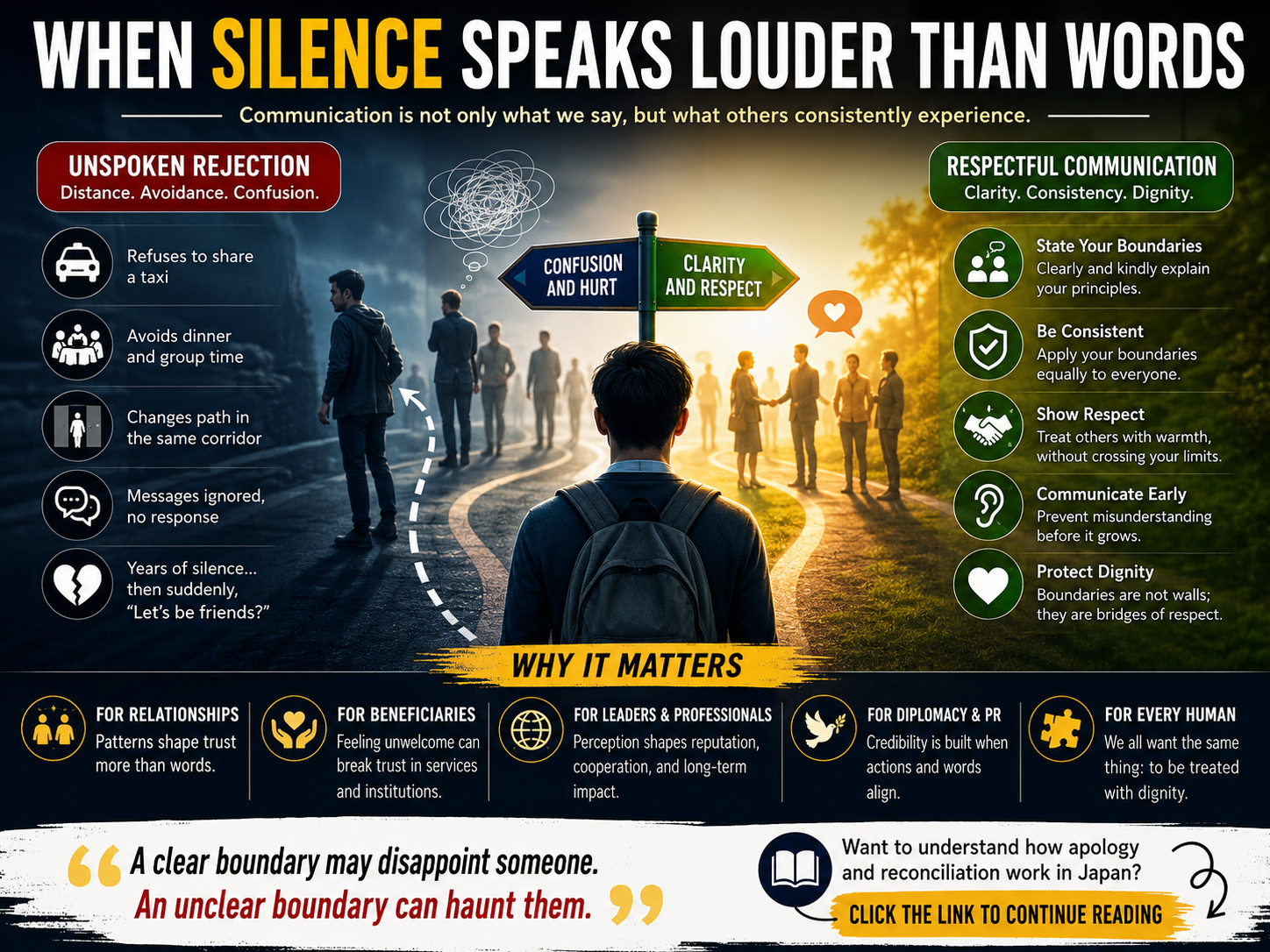
You've probably felt it before. Someone says "we're friends," yet every time you're in the room, they somehow find a reason to be somewhere else. No insults. No arguments. Just distance — quiet, repeated, and never explained. That gap between what someone says and what they consistently do isn't a small detail. It's the loudest message a person can send.
Most people believe communication is simply about choosing the right words. It isn't. One of the first lessons in public relations, diplomacy, negotiation, and stakeholder engagement is that people rarely judge us only by what we say. They judge us by what we consistently do. A spokesperson may deliver a flawless statement, yet a single facial expression can undermine an entire press conference. A humanitarian worker may repeatedly say, "Everyone is treated equally," but if beneficiaries consistently feel avoided, the spoken message loses its credibility.
Communication has never been limited to language. It includes body language, eye contact, physical distance, tone, timing, consistency — and even the absence of interaction. In communication science, these are not trivial details. They are often more persuasive than words themselves. Once behavior contradicts words, people naturally believe the behavior.
Whether or not that message was ever intended becomes almost irrelevant. In interpersonal communication, people respond not only to intention but also to perception — and that distinction may be one of the most overlooked principles in both personal relationships and professional communication.
Part 1 — When Actions Contradict Words: A Case Study in Silent Rejection and Selective Boundaries
Consider a simple situation. Two people know each other. One of them repeatedly says, "We're friends." Nothing sounds hostile — no insults, no arguments, no overt drama. Yet over time, a quiet, persistent pattern begins to emerge:
Whenever travel is involved, they refuse to ride in the same vehicle.
At dinners, they deliberately avoid sitting at the same table.
In a shared hallway, they always choose another route.
Conversations become one-sided; messages go largely unanswered.
There is no explicit confrontation — only distance. At first, the person being avoided tries to stay understanding. It's natural to search for reasonable explanations: Maybe they dislike crowded vehicles. Maybe they have social anxiety. Maybe their personal, cultural, or religious values call for stricter boundaries with the opposite sex. These explanations feel plausible and respectful — until new observations surface.
The Turning Point: The Selective Boundary
Over time, the same person is seen comfortably sharing transportation with others, laughing through group dinners at the same table, walking alongside other acquaintances without hesitation — freely doing the very things the "boundary" was supposed to restrict. Suddenly the explanation no longer looks universal. It looks selective. The question is no longer "Why do they have this boundary?" but quietly becomes "Why does this boundary seem to exist only when I am involved?"
People are remarkably accepting of consistent rules. Most of us readily accept a standard like "I don't travel alone with anyone" — consistency creates predictability, and predictability creates trust. But when a rule applies to one person while obvious exceptions are made for everyone else, the mind searches for a deeper explanation: Was it my personality? Did I offend them? Was I seen as unsafe or undesirable? Or was "the rule" never really the reason at all?
Now imagine, two years later, the same person reaches out: "I'd like us to remain friends, or even best friends." For someone who lived through years of selective avoidance, this doesn't bring warmth — it triggers a different question: "Weren't we supposed to be friends all along?" Friendship, after all, is rarely defined by labels or sudden declarations. It's defined by everyday behavior.
The Psychology Behind It — and Why It Actually Hurts
This scenario points to a core truth: intentions are invisible, but behavior is visible. People evaluate relationships through patterns, not isolated events. A few concepts explain why the pattern above lands as pain rather than mere inconvenience.
Five Concepts Behind the Sting of Silent Exclusion
- 1. Intent vs. perceived consistency — you may intend to signal a principle, but if observers see it applied selectively, they conclude they are the reason, not the principle.
- 2. Nonverbal communication — long before words register, we read distance, eye contact, and orientation, instinctively asking: Am I welcome here?
- 3. Ostracism and social exclusion — silent, repeated exclusion can activate neural pain circuitry similar to physical pain, which is why it leaves a deeper mark than direct disagreement.
- 4. Cognitive dissonance — when "You are my friend" and "I consistently avoid being near you" point in opposite directions, people trust the actions.
- 5. The need to belong — acceptance is communicated in small, consistent moments — and so is rejection.
Key Takeaway
Healthy boundaries and human dignity aren't opposing values — everyone has the right to set personal, cultural, religious, or professional limits. But boundaries earn credibility only when applied consistently. Applied selectively, a boundary meant as a principle is almost always felt as personal rejection. What hurts most is rarely hearing "I need space." It's silently wondering, "Was I ever welcome in the first place?"
Part 2 — Beyond Friendship: What If This Happened to a Beneficiary?
Now take friendship out of the equation and place the same dynamic inside a public institution — a humanitarian organization, a hospital, a government office. A beneficiary arrives seeking assistance. The staff member never insults them, never raises their voice, never explicitly refuses service. On paper, everything looks professional. Yet something feels different: staff quietly redirect them to a colleague whenever possible, avoid eye contact, keep conversations brief and mechanical — while other beneficiaries receive warmth and informal conversation. Nothing violates policy. Yet the beneficiary leaves with a feeling they can't quite name: "I don't think they wanted me there."
That single feeling can reshape how a person sees an entire organization — which is why communication professionals often say people remember how they felt long after they forget what was said. In stakeholder engagement, perception shapes trust, trust shapes cooperation, and cooperation determines whether programs succeed or fail. A beneficiary who feels psychologically unwelcome may stop asking questions, hesitate to seek future help, or quietly withdraw from services meant specifically for them — not because they were denied access, but because they no longer feel they belong.
The same logic scales down to a classroom, where a teacher may claim to treat every student fairly, but a consistently ignored student won't remember the written policy — they'll remember the experience. Communication is never judged solely by intention. It's judged by lived experience.
Former FBI agent Joe Navarro on how nonverbal signals reveal what words leave out (TEDxManchester)
Part 3 — When Good Intentions Communicate the Wrong Message
It would be easy to conclude that the person creating distance must be arrogant or intentionally hurtful. But communication is rarely that simple — many acts of silent rejection begin with entirely reasonable intentions: protecting personal boundaries, following religious convictions, fearing gossip, or simply being introverted. The problem begins when the boundary is communicated inconsistently.
Consistent Boundary
"I try not to spend time alone with anyone of the opposite sex — it's a principle I apply to everyone." Even if disappointed, most people can accept that. The rule is clear, consistent, predictable.
Selective Boundary
Same explanation given — but others notice comfortable rides, dinners, and casual familiarity with everyone except one person. The issue stops being the boundary and becomes credibility.
This is the fundamental split: intent belongs to the communicator; meaning belongs to the receiver. Neither side fully controls communication — both shape it together. Unclear communication invites people to write their own explanations, and the human brain tends to fill missing information with emotionally charged stories rather than neutral facts. A delayed reply becomes "Perhaps they dislike me." Repeated distance becomes "Perhaps I was never welcome." These stories may be inaccurate — but they feel real because they explain an observable pattern.
Purdue psychologist Kipling D. Williams, the researcher behind decades of ostracism studies, explains social rejection
Part 4 — How to Set Boundaries Without Making Someone Feel Unwelcome
Every relationship needs boundaries — to protect values, time, emotional well-being, and safety. No one should feel guilty for having them. The real question isn't whether to set boundaries, but how to communicate them. There's a real difference between saying "I have a boundary" and unintentionally saying "I don't want you around."
Silent Avoidance
Quietly avoid rides, leave whenever they approach, decline every chance to sit nearby. Months later, they only know: "Whenever I'm present, they create distance."
Explained Boundary
Explain the principle, keep greeting them warmly, stay in group settings without unnecessary avoidance. Same boundary — completely different message.
Boundaries don't weaken when explained — they become clearer. Respect doesn't shrink with distance — it becomes more intentional. Kindness isn't measured by how close we let people become, but by whether they leave our presence with their dignity intact.
Before the Epilogue — What If You Realize You've Been Sending the Wrong Message?
If you recognized yourself in some of these examples, the first response shouldn't be defensiveness. It should be reflection. The original injury was never just the distance — it was the uncertainty. Sometimes the most respectful approach is simply this: acknowledge what happened and take responsibility for your own behavior, without assuming the other person's feelings.
"I've been reflecting on how I interacted with you in the past. Looking back, I realize my behavior may have made you feel unwelcome or singled out. That was never my intention, but I understand how it could have been perceived that way. I'm genuinely sorry for the confusion and the hurt my actions may have caused."
An apology isn't a negotiation or a strategy for quick forgiveness — it's an act of accountability. If you're interested in how accountability, apology, and reconciliation are approached from a Japanese cultural perspective — and why indirect harmony can sometimes delay genuine healing — the discussion below explores it in depth.
Epilogue — The Silence We Leave Behind
This was never about forcing closeness or demanding friendship. People are different — different personalities, histories, beliefs, boundaries. Distance, by itself, isn't a crime. Boundaries, by themselves, aren't cruelty. What's difficult is something more subtle: ambiguity — the kind that makes someone spend months, even years, trying to understand a silence that was never explained.
Communication exists not merely to transfer information, but to reduce unnecessary misunderstanding. A boundary exists not merely to protect ourselves, but to do so without unnecessarily damaging another person's dignity. A single honest conversation may not repair every relationship — but it can offer something silence never can: clarity. And clarity is one of the greatest forms of respect.
Respect is not measured by proximity. It is measured by whether our presence leaves another person with their dignity intact.
Key Sources & Further Watching
Sommer, K. L., Williams, K. D., Ciarocco, N. J., & Baumeister, R. F. (2001). When silence speaks louder than words: Exploration into the intrapsychic and interpersonal consequences of social ostracism. Basic and Applied Social Psychology.
Eisenberger, N. I., Lieberman, M. D., & Williams, K. D. (2003). Does rejection hurt? An fMRI study of social exclusion. Science. Social exclusion recruits brain regions also active during physical pain. Link
Williams, K. D. (2007). Ostracism. Annual Review of Psychology, 58, 425-452. Link
Joe Navarro — The Power of Nonverbal Communication (TEDxManchester). YouTube
Kipling D. Williams — Social Rejection, Ostracism (Purdue University). YouTube
Weighing the Two-Edged Sword of Conflict Resolution: Japan's Accountability vs. the Dangers of Toxic Harmony. Link