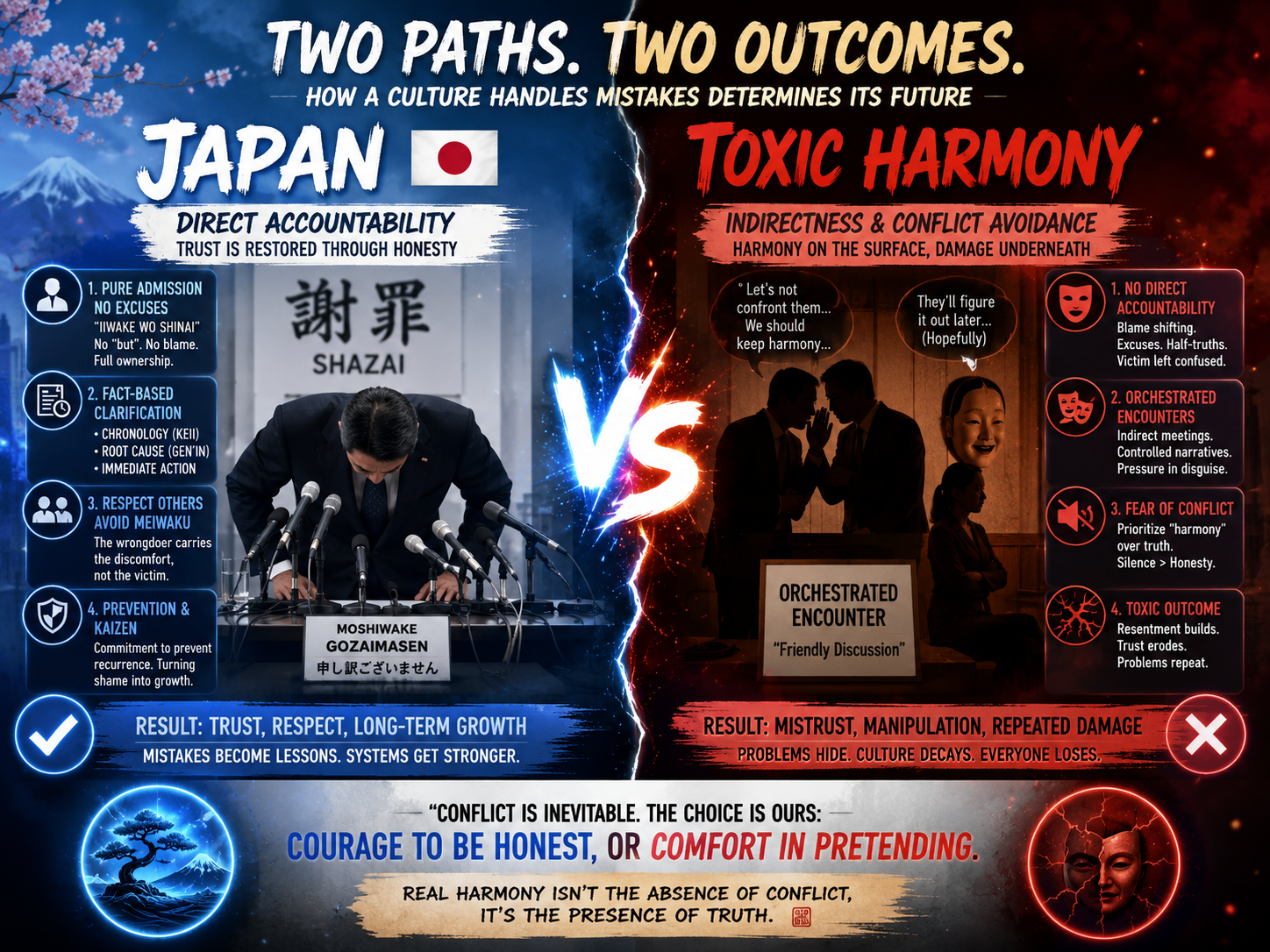
In every human interaction, conflict and mistakes are inevitable. What determines whether a mistake becomes a valuable lesson or a ticking time bomb is how a culture responds to it — through sincere, face-to-face accountability, or through indirection dressed up as politeness.
On one side stands Japan, a culture famous for flipping into explicit, direct, and uncompromising honesty the moment a crisis or error occurs. On the other side sit social environments that idolize "harmony" through roundabout, non-confrontational approaches — approaches that, taken past their healthy limit, quietly curdle into manipulation and toxic harmony.
This article expands the anatomy of the Japanese apology (shazai, 謝罪) as a living cultural practice, examines the psychology and quiet cowardice behind the "orchestrated encounter" tactic, and weighs both against the very real, well-documented dangers of taking conflict avoidance too far.
Part 1: The Anatomy of Direct Apology and Clarification in Japan
In daily life, Japanese social conduct is organized around maintaining harmony (wa, 和) and protecting the public face (tatemae, 建前). But the moment a mistake or failure harms another party, the norm flips almost 180 degrees into something highly direct, transparent, and fact-driven.
This directness isn't an attack — it's rooted in restoring trust (shinrai, 信頼) through demonstrated accountability. Cross-cultural linguistics research on Japanese apology backs this up structurally: Japanese even categorizes apology (shazai suru) and excuse (iiwake) into entirely separate semantic families, with excuse-making grouped alongside words for cajolery and duplicity — carrying sharply negative connotations that don't map cleanly onto the more justification-tolerant English word "apologize." In other words, the language itself encodes the taboo against self-defense during an apology.
A Living Cultural Practice, Passed Down Through Generations
This apology-and-clarification protocol isn't just modern corporate policy bolted on for PR purposes. It functions as a piece of Japan's living heritage — the kind of intergenerational, socially transmitted practice that UNESCO's 2003 Convention for the Safeguarding of Intangible Cultural Heritage uses as its working definition of "living heritage": practices, knowledge, and social rituals communities recognize as part of their identity and pass on generation to generation. Whether or not the apology ritual itself carries a formal inscription, it behaves exactly like living heritage in practice — a socio-cultural mechanism for cleansing friction and restoring the moral fabric of a group, valuing communal well-being over individual ego.
Visualizing the Anatomy of Shazai
Its main pillars:
1 Pure admission of fault — Iiwake wo shinai ("making no excuses")
The word "but" is considered corrosive to a Japanese apology. "I'm late, but the road was closed" or "the system crashed because of a vendor error" reads, to Japanese ears, as a cowardly shift of blame rather than an apology. A widely cited comparison from intercultural business consultants contrasts this with British-style apologies, which often say sorry but then wander into lengthy, face-saving explanations. That structure, however polite it sounds, is functionally iiwake — an excuse — not shazai.
The gold-standard formal phrase, moshiwake gozaimasen (申し訳ございません), literally means "there is no excuse that exists." It is a linguistic act of surrendering your own defense before anyone asks you to.
2 Fact-based clarification structure (keii, 経緯)
Clarification in Japan is not an arena for self-defense — it's a professional instrument for objectively dissecting what happened:
- Factual chronology (keii): a minute-by-minute account, without concealment or delay.
- Root cause (gen'in): naming the source of the problem bluntly.
- Immediate corrective action: concrete mitigation steps, executed in parallel with the disclosure, not after it.
3 Systemic responsibility and avoiding meiwaku
Meiwaku (迷惑) — the reluctance to burden or trouble others — is a foundational value in Japanese social life. Formally approaching the wronged party and openly admitting fault is considered the only respectful way to honor that person.
4 Closure through prevention (saihatsu bōshi, 再発防止)
A shazai that stops at verbal regret is considered defective. The cycle only closes with a specific, concrete commitment to prevent recurrence — converting the energy of shame into kaizen (continuous improvement).
Where This Plays Out in Public: Shazai Kaiken and Dogeza
This isn't only a private ritual — Japan has built entire public institutions around it. The apology press conference (shazai kaiken, 謝罪会見) is a recognizable media genre in its own right: executives sit behind a table with a white cloth and nameplates, read a statement of contrition, and bow deeply enough that photographers can capture the tops of their heads.
At the most extreme end of remorse sits dogeza (土下座) — kneeling and lowering the forehead to the floor. It's reserved for offenses so serious that words alone are considered insufficient, and its cultural weight is part of why footage of a spontaneous dogeza can go viral internationally.
Viral Sportsmanship: Yuji Nishida's Dogeza
Japanese volleyball star Yuji Nishida performs a traditional sliding dogeza to apologize for accidentally hitting a line judge.
Pop Culture: "The Japanese Tradition"
A classic comedic yet culturally insightful short film by NAMIKIBASHI explaining the levels of Japanese bowing and dogeza.
Interestingly, the demand for face-to-face contrition is now so embedded that a cottage industry has emerged around it: Tokyo's Shazai-daikou ("Apology Agency"), reported on by outlets like Tokyo Weekender, dispatches professional "apology agents" to perform sincere-looking apologies on a client's behalf when the client themselves cannot or will not show up. Whatever one thinks of the ethics of outsourcing contrition, its existence is itself evidence of how non-negotiable the expectation of a direct, face-to-face apology is in Japanese social life.
Part 2: The "Fake Coincidence" Tactic and the Psychology of Cowardice
The mirror opposite of this directness is manipulative behavior disguised as casual interaction — the wrongdoer who refuses to face the victim formally and instead engineers a situation that looks like an accidental encounter.
The Anatomy of the "Train/Vehicle Encounter" Scenario
Picture someone who has committed a serious error or deeply harmed another person. Rather than requesting time, visiting the victim, and offering a formal apology, they procrastinate and scheme. They arrange to board the same train or vehicle, sit beside the victim, and start a conversation as if it were pure coincidence — then slip in a half-apology, dressed as small talk, somewhere in the middle of that "chance" ride.
Beyond the Train: Other Engineered "Coincidences"
The train seat is just the most cinematic version of a much wider pattern. The same underlying cowardice shows up in several other disguises, all built around the same premise: make the meeting look like fate, not intention.
The "shared event" ambush
The wrongdoer learns the victim will attend a wedding, a reunion, a birthday, a conference, or a mutual friend's gathering — and shows up specifically because the victim will be there, then acts surprised to see them. The event becomes a stage prop: the apology gets folded into small talk between other guests, timed to look spontaneous rather than sought out.
The "mutual friend" setup
The wrongdoer asks a mutual friend to host a get-together, or accepts an invitation they'd normally skip, purely because it puts them in the same room as the victim without either of them having to formally initiate contact. The mutual friend becomes an unwitting alibi: "We just happened to both be at Dinda's place."
The "timed route" encounter
The wrongdoer learns the victim's regular commute, gym schedule, or coffee-shop routine, and positions themselves to "run into" them at that exact place and time. The apology is then delivered in passing, between the coffee counter and the door, with no room for the victim to properly respond.
The "public comment" drive-by
Online, the same tactic reappears as a stray comment, a like, or a message in a shared group chat — using an unrelated topic as cover to slip in a vague, half-apologetic remark the victim has to decode themselves, with witnesses present so the victim can't respond honestly without looking petty.
Why These Tactics Backfire
None of these variations actually produce reconciliation — most of the time, they make the victim more upset, not less. That's because the entire premise removes the one ingredient an apology depends on: sincerity. When an apology has to be engineered around a "coincidence," it stops reading as remorse and starts reading as a calculation the victim was never consulted on.
Genuine directness — asking for time, showing up on purpose, stating plainly why you're there — signals seriousness precisely because it required effort and risk. A staged "coincidence" signals the opposite: that the wrongdoer was never willing to take that risk in the first place.
Worse, it plants a specific, corrosive thought in the victim's mind: "If we hadn't happened to cross paths, this person probably never would have apologized at all." That thought doesn't produce closure — it produces resentment. It reframes the entire gesture backwards: from an act of remorse into an act of convenience, and from "you matter enough for me to make an effort" into "you only got an apology because circumstances forced it out of me." An apology that only exists because it was unavoidable isn't an apology — it's a footnote, and footnotes don't heal anything.
Why Humans Do This: Three Psychological Mechanisms
-
1
The ultimate face-saving mechanism.
A "coincidental" setting builds a built-in escape hatch for the ego. If the apology is rejected or received coldly, the perpetrator retains deniability: "I was just saying hi, we happened to be on the same train." It's a defense mechanism engineered specifically to eliminate the risk of outright rejection — the opposite of what a real apology requires, which is standing exposed to that risk.
-
2
Minimizing cognitive dissonance.
The perpetrator knows, at some level, that what they did was serious — but the brain resists accepting the "wrongdoer" identity. Raising a heavy, consequential issue in a deliberately casual, low-stakes setting subconsciously downgrades its severity. The implicit message sent to the victim is: this isn't a big deal, we can sort it out in passing. To the victim, that reads not as resolution but as a second injury.
-
3
Infiltrating personal space without consent.
Cornering someone you've hurt in a confined space — a train seat, a car, a corner of a wedding reception — is itself a form of psychological pressure. The victim has no time to prepare and no easy exit. True remorse requires ceding control of the time and place of the apology to the person who was wronged; the "fake coincidence" tactic does the reverse, seizing that control for the wrongdoer's comfort.
The Contrast with Japanese Sincerity
In Japanese custom, the more serious the offense, the more formal and direct the process has to become — a formal request for time, a visit to the victim's home or workplace, a deep bow (or dogeza for catastrophic failures), and yielding the floor entirely so the wronged party can speak first.
The willingness to stand transparently in front of the person you've harmed, without an engineered atmosphere or a manufactured "coincidence," is the clearest available signal of genuine sincerity.
Part 3: The Dark Side of Indirect Culture — When Harmony Becomes Tyranny
What happens when an environment rejects direct confrontation altogether and habitually defaults to indirection, procrastination, and staged interactions? Applied to serious offenses — intentional manipulation, slander, cruelty — "keeping the peace" stops being a virtue and becomes a fortress for perpetrators and a meat grinder for victims.
The Fatal Scenario: Slander, Depression, and Job Loss
Consider a pattern that recurs across toxic workplaces and communities. Employee A is slandered by a colleague amid internal political rivalry. The slander spreads through whispers — indirectly, deniably. Management, unwilling to trigger a tense confrontation in the name of a "calm atmosphere," refuses to hold a direct, evidence-based hearing.
A is gradually ostracized, labeled a troublemaker, and eventually loses their job — spiraling into severe depression. Colleagues who privately know A is innocent stay silent, afraid of being labeled "difficult" or becoming targets themselves. Once A's life has been dismantled, the original perpetrator, or management, might offer a passing, informal greeting on the street — as if nothing happened.
The Toxic Harmony Cycle
Why This Pattern Is Genuinely Dangerous, Not Just Unpleasant
This isn't just anecdotal. A growing body of organizational-psychology research documents exactly this mechanism:
- Ostracism breeds defensive silence, which breeds more ostracism. A 2025 study published in Behavioral Sciences found that workplace ostracism erodes organization-based self-esteem, which in turn drives defensive silence — employees actively withholding information to avoid further damage to already-fragile relationships.
- Silence has a documented health cost. Research reviewed on workplace mobbing has linked sustained ostracism to elevated depression risk among targets.
- Bystander silence is not neutral — it's a mechanism. Meta-analytic work on workplace ostracism shows that the behavior of onlookers — not just the original aggressor — measurably shapes whether mistreatment escalates or resolves. Silence functions as tacit permission, not as peacekeeping.
Why Does This Lead to Fatal Outcomes?
Slander thrives in the shadows. Lies and manipulation survive only in dark, unexamined spaces. Indirect culture facilitates this because nobody demands the direct proof that would kill a rumor on contact — dates, witnesses, documentation. The victim is condemned unilaterally, by hearsay, without ever being given a stage to answer.
Toxic harmony protects appearances over people. The environment prioritizes looking fine from the outside over being just on the inside. The silence of the majority is not peace — it functions as a tacit agreement to let the cruelty continue.
The asymmetry of impact is brutal. For the environment, silence is framed internally as heroic — "protecting the organization's image." For the victim, that same silence is a complete rejection of their reality. Slander, job loss, and the total absence of any avenue to clear one's name is one of the fastest documented routes to serious depression and despair.
Part 4: The Point of Communication Failure — and What to Do About It
There is a firm boundary here: once structured slander or intentional malice is in play, choosing indirection or procrastination is no longer a matter of cultural preference — it becomes a passive form of harm through omission.
The Japanese model — direct, chronological, ego-free — was built precisely to lance problems like this before they fester. But that system runs on one non-negotiable fuel: collective courage. A single individual practicing directness inside a culture of silence can still be crushed; the model only works when enough people are willing to demand facts over comfort.
What Has to Happen When an Environment Is Already Toxic
- Bring in a circuit breaker — an independent third party. A toxic conflict cannot be resolved by parties who are themselves hostage to fear or self-interest. A neutral outside party — legal counsel, an external auditor, an ombudsperson — can enforce the "Japanese tone": chronological facts, without being bogged down by emotional attachments or the fear of awkwardness.
-
Restore the victim's standing — not with pleasantries, but structurally. In cases where a victim has suffered real material and psychological loss, an "accidentally walking by and saying hi" gesture is not closure — it's an additional insult. Structural harm needs a structural remedy:
- Clarification and rehabilitation: openly clearing the victim's name in front of the same public or community that heard the slander.
- Accountability: real sanctions and a transparent admission of guilt from whoever is responsible.
- Compensation: material and moral restitution proportionate to the damage caused.
Conclusion
Directness in apology and clarification is not a sign of instability or aggression — it's the practical form that responsibility and respect for another human being take.
Procrastinating, fabricating alibis about "accidentally" running into someone, or pretending nothing happened in the name of "keeping the peace" are cowardice wearing the costume of harmony.
Honest, direct accountability may hurt in the moment, but it flushes the poison out of a relationship or an organization. Staying silent while watching slander spread — however comfortable that silence feels — is one of the fastest ways to destroy a person's life.
References and Further Reading
On the linguistics and structure of Japanese apology
- Kashima, E. — Apology Translation in Diplomacy
- Japan Intercultural Consulting — "Saying sorry sincerely in Japanese business"
- JapaPhrase — "Moshiwake Gozaimasen: Deepest Japanese Business Apology"
- Migaku — "Japanese Apology Phrases: Different Ways to Say Sorry"
On shazai kaiken and dogeza
- BBC / Yuzuha Oka — "The Culture of Apology"
- SoraNews24 — "Foreign comedian Atsugiri Jason's hot take on Japan's apology culture"
- Wikipedia — "Dogeza"
- Tokyo Weekender — "Never Have to Say You're Sorry: Meet Japan's Apology Artist"
On workplace ostracism, silence, and psychological harm
- Yang, Wang, Liao, Yang & Qian (2025) — "Silence as a Quiet Strategy: Understanding the Consequences of Workplace Ostracism"
- The Mobbing Portal — "Resources by Question: Targets of Silence"
- "Workplace ostracism in academia" (literature review, ERIC)
Video References (YouTube)
- "'Dogeza Bow' — The Ultimate Japanese Apology"
- "The Japanese Tradition – Dogeza"
- "Viral Japanese volleyball player's humble apology"
- "Japanese Streamer Apologizes After Viral Peru Incident"