Behaviour • Systems Thinking • Decision-Making
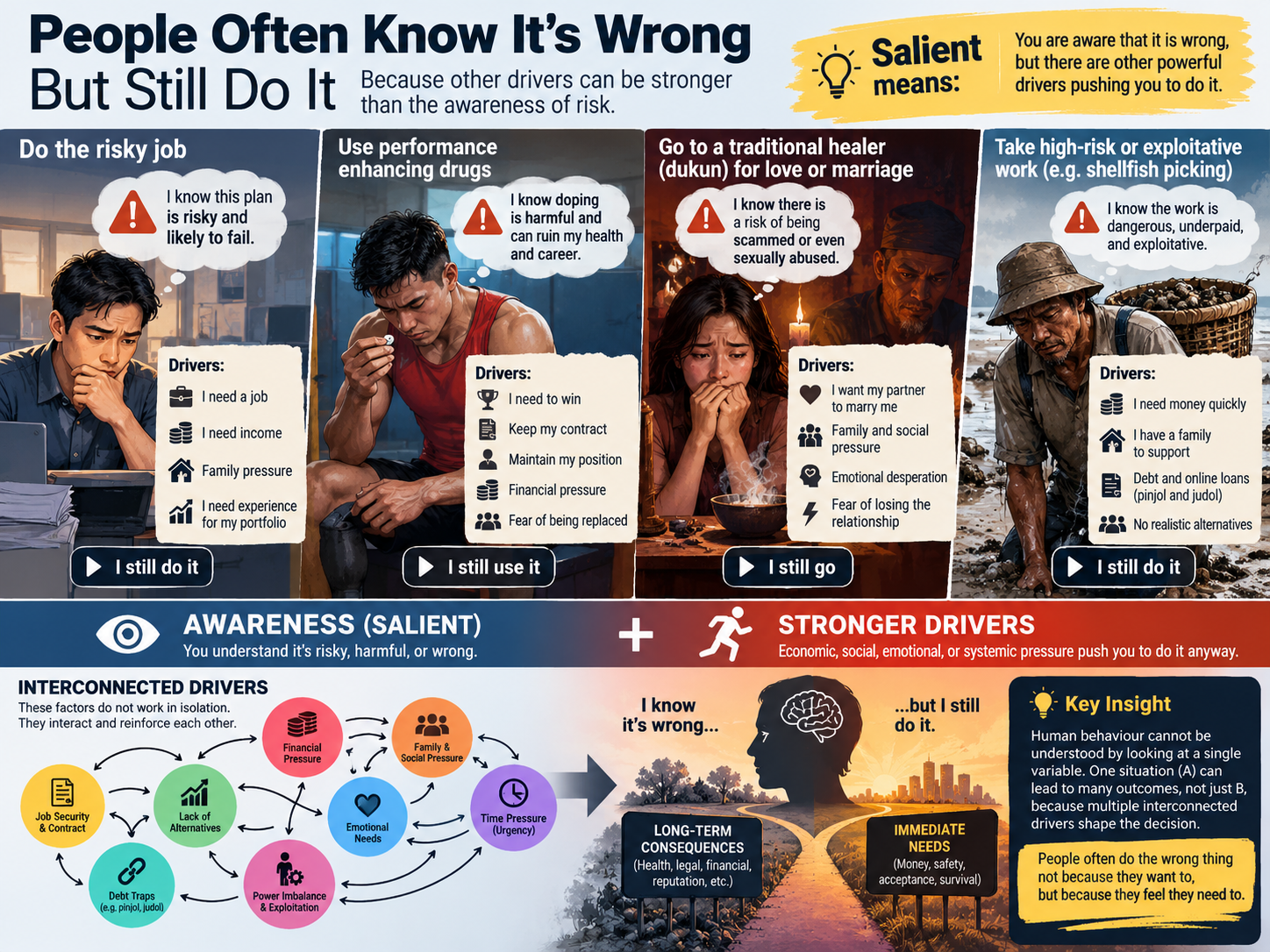
Sometimes, I already know a plan is bad. I can see the risks, anticipate the implementation problems, and explain why the approach may fail. Yet I still follow it because I need the job.
Perhaps the product is difficult to build. Perhaps the proposed approach does not address the real problem. Then someone says, “Our objective is simply to document the situation.” Fine. If the objective is documentation, I will go into the field, collect information, and document what I find.
But compliance should not be confused with agreement. I may carry out the instruction without believing that the broader plan is sound. I may understand the risk and still lack the freedom, resources, or authority to choose another route.
Knowing that a decision is risky does not automatically give someone the power to make a different decision.
I may need the income. I may need experience and a portfolio to attract future opportunities or donors. I may also be dealing with family responsibilities and economic pressure. Those needs become variables in my decision—not because I suddenly stop understanding the problem, but because I am making a choice inside a real-world constraint.
This is where awareness, salience of information, and systems thinking become important.
1. Awareness Is Not the Same as Behaviour Change
Consider an athlete who uses performance-enhancing drugs. We know doping can carry health risks, sanctions, reputational damage, and the possible loss of a sporting career. But the existence of that knowledge does not explain every decision to dope.
An athlete might understand the risks and still feel pressure to maintain performance, fulfil a contract, retain sponsorship, or remain eligible for selection. The risk is real, but so is the perceived threat of losing an income or an entire career.
This is the role of salience: the information that stands out, captures attention, or carries the greatest weight at a particular moment. The information that seems most important to an outside observer may not be the information that feels most urgent to the person making the decision.
This does not mean everyone who dopes is responding to economic pressure, and it does not excuse the behaviour. It means that a useful explanation must investigate more than awareness alone.
2. Smoking: Awareness Does Not Automatically Overcome Nicotine Dependence
Smoking is another clear example of the gap between knowing and doing. Many smokers understand that tobacco use can cause serious harm. Some genuinely want to stop. Yet they may continue smoking because nicotine dependence, daily routines, emotional triggers, and the expectation of immediate relief can make quitting difficult.
Nicotine reaches the brain quickly and reinforces repeated use. Over time, the brain and body adapt to regular nicotine exposure. When nicotine levels fall, a person may experience cravings, irritability, restlessness, anxiety, difficulty concentrating, or other withdrawal symptoms. A cigarette can then feel like a way to feel normal again—even though the temporary relief may partly be relief from withdrawal that the nicotine dependence itself helped create.
Smoking can also increase heart rate and blood pressure. Some people notice a racing or pounding heartbeat after nicotine exposure. That physical sensation is a potential effect, not the main explanation for why quitting is difficult. Dependence, withdrawal, learned routines, and environmental triggers are central parts of the cycle.
This is a reinforcing loop. The immediate effect is concrete and close in time; the health risks are often experienced as distant or abstract. Awareness of long-term harm remains, but it may not be the strongest influence at the moment a craving arrives.
This explanation is not a claim that every smoker experiences the same thing, nor does it remove personal agency. It shows why a warning about danger may be insufficient on its own. If the behaviour is reinforced repeatedly by dependence and routine, changing it may require more than repeating information the person already understands.
Further reading: CDC — Why Quitting Smoking Is Hard and NHS — Managing Nicotine Withdrawal Symptoms.
3. People Can Understand the Risk and Still Choose the Short-Term Option
Imagine a person who knows that taking another high-cost loan is financially dangerous. They understand interest, repayment obligations, and the possibility of falling into a debt cycle. But their family needs food or rent money today.
The long-term cost may be substantial, but the immediate need is visible and urgent. The person may borrow not because they have never heard a warning about debt, but because none of the available alternatives appears workable in the moment.
The same tension can appear in gambling-related harm. Someone may chase losses because they urgently want to recover money, even though they understand that gambling is not a reliable way to solve financial distress. The immediate possibility of relief can become more salient than the longer-term probability of further loss.
The central question should therefore be more useful than “Why don't they just stop?”
If they stop today, what realistic option do they have tomorrow?
Do they have savings, stable income, access to support, affordable services, or another source of work? Are the alternatives accessible in practice, not merely available in theory?
4. When Economic Pressure Becomes a Trap
Consider people who depend on collecting shellfish or harvesting other coastal resources for their livelihood. They have families and daily expenses, while their income may be small, seasonal, and unpredictable.
When an emergency occurs, they may need cash immediately. Some may turn to online lending. If repayments consume the income needed for daily life, they may borrow again. Others may become involved in online gambling because they hope to recover losses or find a faster way out of financial difficulty.
This is a reinforcing cycle. Each step may make the next risky decision more likely, even when the person would prefer a more stable life.
In some circumstances, debt dependence and exploitative labour arrangements can contribute to conditions resembling modern slavery. That conclusion must be based on the actual circumstances—such as coercion, exploitation, and restrictions on the freedom to leave—not on the mere existence of debt or precarious work.
Still, the broader lesson remains: telling people to stop borrowing or leave an exploitative situation is not enough if the conditions sustaining their dependence remain unchanged.
Explore the Causal Map: How Can A Push Someone Toward B?
A visible behaviour is an outcome, not a complete explanation. The map below shows how awareness can coexist with urgent needs, dependence, unequal power, and limited alternatives. These factors influence what feels most salient at a particular moment; that moment shapes a decision, while short-term outcomes can reinforce the same pattern. Select a node to jump to its explanation.
Interactive systems map: click or keyboard-select any node. The page will jump to an explanation below the diagram.
The arrows represent plausible pathways, not universal laws. A real behaviour may involve only some of these drivers, and the same driver can lead to different outcomes in different contexts.
1. Awareness: “I know this is risky.”
Risk knowledge can be genuine and accurate. It does not disappear simply because a person later smokes, complies, or takes a shortcut. The key question is what competes with that knowledge at the moment of action.
2. Urgency: “I need something now.”
Income, rent, deadlines, family responsibilities, or the fear of losing a contract can make the immediate consequence of saying no feel more concrete than a future risk. The urgent need can become more salient without making the risk unknown.
3. Dependence and habit: “I want to stop, but the urge returns.”
Nicotine dependence, withdrawal symptoms, routines, and cues can make smoking difficult to stop. Smoking may briefly relieve withdrawal discomfort, while nicotine also increases heart rate and blood pressure. That short-term effect can reinforce repetition even while the person knows the longer-term harms.
4. Power: “Why didn't I fight back?”
A person may anticipate retaliation, humiliation, job loss, or being labelled difficult. If another person controls their income, evaluation, resources, or future opportunities, resistance may feel costly or unsafe. Silence or compliance does not, by itself, prove agreement—and it must never be treated as consent to abuse or coercion.
5. Alternatives: “What else can I realistically do?”
Advice is less useful when safer options exist only in theory. People need accessible support, resources, information, time, and enough authority or freedom to act on what they know. An alternative must be viable in the conditions the person actually faces.
6. Salience: “What dominates my attention right now?”
Salience is not simply awareness. It concerns what stands out and carries weight in a particular context. A craving, immediate bill, job threat, or emotional emergency can dominate the decision even while the person remains aware of a serious risk.
7. Perceived choice: “What can I do right now?”
People do not always choose from every theoretically possible option. They act among the options they can see, afford, access, and believe they can survive. Perceived choice may be narrower than the choices an observer assumes are available.
8. Smoking again
A craving or familiar cue can lead to smoking; short-term reward or relief can then strengthen the association between the trigger and the behaviour. Support for quitting needs to address dependence, withdrawal, routines, and triggers—not only repeat the health warning.
9. Taking a shortcut
An athlete may feel pressure to dope; a person under financial stress may chase gambling losses or take a high-cost loan. These behaviours are not identical, but each can become more attractive when the hoped-for immediate gain overwhelms attention to delayed harm.
10. Complying with a flawed plan
A staff member may understand why a plan could fail yet carry it out because they need the income, lack decision authority, or believe dissent will put their job at risk. Compliance describes an action; it does not establish agreement with the decision.
11. Seeking help under emotional pressure
Someone facing an urgent relationship or family problem may approach an unsafe or exploitative source of help despite recognising the risk. Desperation and limited trusted alternatives can narrow attention. Responsibility for deception, abuse, or coercion remains with the person who commits it.
5. One Variable Can Lead to Different Outcomes
A central principle of systems thinking is that an outcome usually emerges from the interaction of multiple factors. A single variable rarely explains an entire pattern of behaviour.
The same pressure can produce different outcomes because other variables differ: available resources, social norms, authority, skills, fear, timing, support, and perceived alternatives.
This is why the relationship between variables matters. We must ask what connects a cause to an outcome, what strengthens or weakens that connection, and what feedback loops make the behaviour persist.
For monitoring, evaluation, and learning, this distinction is critical. Delivering training does not guarantee behaviour change. Collecting data does not guarantee better decisions. Launching a digital product does not guarantee that the product solves the problem it was meant to address.
Outputs tell us what was delivered. Outcomes tell us what changed. Systems thinking helps us investigate why.
6. Overconfidence Can Make a Weak Plan Harder to Challenge
Another problem emerges when people are highly confident that their interpretation is correct. Confidence and competence are not the same thing. A person can hold authority, speak persuasively, and still misunderstand important parts of a complex problem.
The Dunning–Kruger effect is often simplified into the claim that “the less someone knows, the more confident they are.” The actual concept is more nuanced: people can struggle to assess their own performance accurately, and limited knowledge can make it harder to recognise the limits of that knowledge. It is not a label to apply automatically to every confident person.
The organisational risk is that confidence can be mistaken for evidence. When a leader treats disagreement as disloyalty or incompetence, warnings get dismissed, assumptions go untested, and the organisation loses access to critical information.
Then a plan fails, and everyone appears surprised—even though the risks were visible before implementation.
7. When Staff Can See the Risk but Cannot Change the Decision
Imagine a staff member who recognises serious weaknesses in a project. They explain the risks, suggest alternatives, and try to communicate why the approach may not work. But the manager controls the budget, the project direction, the performance assessment, and perhaps the staff member's future employment.
The staff member faces a choice: raise the concern again and risk being labelled difficult, or follow the instruction and implement a plan they believe is flawed.
If the project fails, the implementer may be blamed for not delivering. But an honest assessment must distinguish between who made the decision, who implemented it, what information was available, and how much control each person actually had.
This does not remove responsibility from staff. It means responsibility should be assigned with evidence and in proportion to actual decision-making power, actions, and obligations.
8. A Personal Example: Technical Decisions and Blame
I have experienced a situation involving file management and OneDrive synchronisation. I deliberately used a file-naming approach involving repeated numbering because I was trying to reduce the risk of phantom deletion and synchronisation-related problems.
There was a technical rationale behind my decision. I was trying to protect data integrity and reduce the possibility of files disappearing unexpectedly. When problems occurred, however, I was accused of deleting data out of revenge because I was about to lose my job.
What frustrated me was not simply losing the job. It was feeling repeatedly blamed without a fair examination of the technical context and available evidence.
Technical decisions should be questioned. A solution may have weaknesses, and mistakes should be investigated. But a technical failure, an accidental action, a design limitation, and deliberate misconduct are different claims that require different evidence.
A fair investigation should examine system logs, synchronisation behaviour, access history, and the relevant decisions before attributing motive. A person's employment situation is not, on its own, evidence that they acted maliciously.
Investigate what happened before deciding why someone did it.
This experience reinforced a distinction I keep returning to: understanding a problem, having the authority to fix it, and having the power to defend your judgement are three different things.
9. The Same Pattern Can Damage Personal Relationships
These dynamics are not limited to projects and organisations. They also appear in families, friendships, and intimate relationships.
Someone withdraws, and we assume they do not care. Someone disagrees, and we assume they are being difficult. Someone makes a mistake, and we decide they are incompetent. Sometimes those interpretations may be right. Sometimes we are missing information.
There may be pressure, fear, conflicting priorities, or circumstances we do not know about. Understanding context does not mean excusing harmful behaviour or tolerating abuse. It means separating what we observed from what we inferred and what we can actually establish.
When assumptions become accusations, accusations damage trust. The original problem may be compounded by the conflict created through misinterpretation.
10. Why Awareness-Only Programmes Often Fall Short
Imagine a programme designed to improve financial literacy. The sessions are delivered successfully, participants learn the concepts, and the evaluation records improved knowledge. Months later, some participants still rely on high-cost borrowing.
That outcome does not automatically mean the training was useless. It may have improved knowledge while leaving the main constraints untouched: unstable income, emergencies, limited access to affordable credit, or a lack of alternative work.
The intervention addressed awareness, but the behaviour was also shaped by opportunity, resources, incentives, and structural constraints.
A programme can deliver all planned activities and still fail to change the conditions that matter. Evaluation therefore needs to investigate not only whether the intervention was delivered, but whether the mechanism linking the intervention to the intended outcome actually changed.
11. How Can We Respond More Effectively?
Instead of beginning with “Why won't people make better choices?”, start with questions that expose the system around the choice.
What outcome is the person trying to secure, and how urgent does it feel?
What financial, social, organisational, emotional, or practical pressures restrict the available options?
What information is most prominent at the moment of decision, and what important information is being discounted?
Does the person understand the risk, and do they have the authority and resources to act on that understanding?
Make safer, legitimate choices easier to access and sustainable in the real conditions people face.
Track whether incentives, access, constraints, and actual behaviour change—not only whether a workshop or policy was delivered.
Good design does not remove individual agency. It acknowledges that behaviour emerges from the interaction between people and their environment—and then uses that understanding to create better choices.
12. The Hardest Question: What If the Decision-Maker Refuses to Listen?
You can present evidence, explain risks, propose alternatives, and suggest a small pilot before an organisation commits all its resources. But you cannot always force another person to reconsider a belief, particularly when that person has authority over your work.
When disagreement feels unsafe, people learn to remain silent. Leaders then hear only what they want to hear, and the organisation loses the information it needs most. This is why psychological safety and a fair process for raising concerns are not simply matters of workplace comfort. They are part of sound decision-making and risk management.
A healthier organisation documents assumptions, tests plans, welcomes challenge, distinguishes dissent from disloyalty, and reviews failures without jumping straight to personal blame.
Sometimes a pilot, a written risk register, a decision log, or a clearly documented alternative can help make the concern more concrete. None of these guarantees that a leader will listen, but they can improve the quality of evidence available when decisions are reviewed.
13. A Practical Systems-Thinking Checklist
Conclusion: People Do Not Make Decisions in a Vacuum
Human behaviour cannot be understood by looking at isolated actions alone. We need to examine the interaction between awareness, salience, needs, incentives, resources, social pressure, power, and available alternatives.
People may understand a problem without having the power to change it. They may comply without agreeing. They may make a risky decision because the safer alternative is inaccessible. And they may be blamed for a failed outcome even when critical decisions were made elsewhere.
The answer is not to stop holding people accountable. It is to make accountability contextual, fair, and evidence-based.
Do not ask only, “Why did this person make that choice?” Ask, “What made that choice feel necessary, attractive, or unavoidable in this system?”
I am also learning to move on from situations I cannot change. I do not want to spend all my energy complaining about what happened. I want to keep building, learning, and creating things that solve real problems.
I can move on without pretending that every accusation was justified. I can learn from an experience without accepting every conclusion others have drawn from it. And I can choose to build something better rather than remain trapped in an argument that may never be resolved.
Perhaps the real “magic trick” is not convincing everyone that we were right. Perhaps it is building something useful enough to demonstrate a better way.
Related article
The Shortcut Problem: Why Doping, Gambling, Cheating and Corruption Follow the Same Behavioural Logic
This companion article explores the behavioural pattern behind shortcuts, immediate rewards, delayed costs, present bias, and the design of better alternatives.
Read Article 73Further Reading
- U.S. Centers for Disease Control and Prevention — Why Quitting Smoking Is Hard: nicotine dependence and routines that can make quitting difficult.
- NHS — Managing Nicotine Withdrawal Symptoms: cravings and common withdrawal symptoms after stopping smoking.
- UNDP — Systems & Portfolios: approaches to addressing interconnected development challenges.
- UNDP — System Change Guidebook: a practical guide to portfolio approaches and system change.
- Harvard Business Review — When a Team Member Speaks Up and It Doesn’t Go Well: communicating concerns in organisations.
- Harvard Business Review — Building a Culture Where Employees Feel Free to Speak Up: creating conditions in which staff can raise concerns.
- International Labour Organization — 10 Ways to Recognize Modern Slavery: indicators of exploitation and coercive labour conditions.
This article offers a systems-thinking perspective, not a diagnosis of any individual. Behaviour depends on context, and claims about responsibility or exploitation require case-specific evidence.