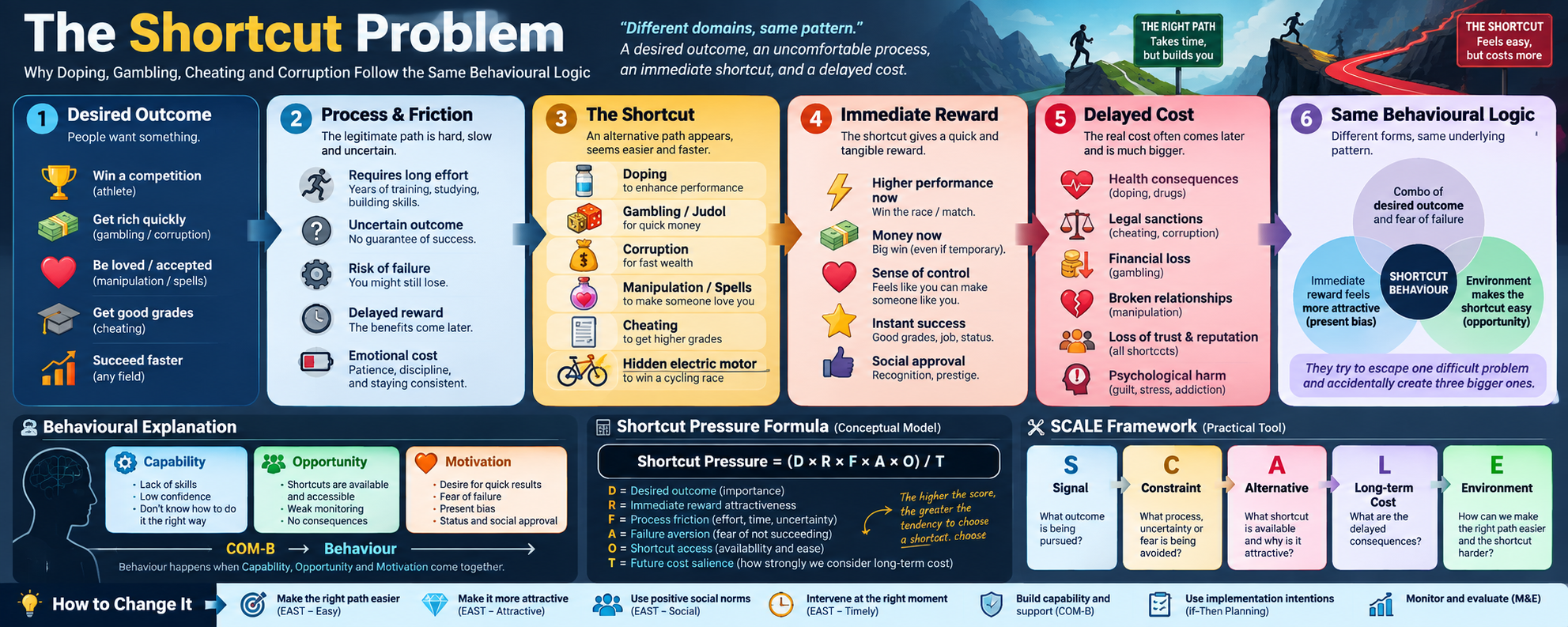
Doping is one of the clearest examples of a much bigger human problem. A person wants the trophy. The legitimate route is slow, uncertain and painful. Then a shortcut appears: a substance that promises better performance now.
But the pattern does not belong to sport.
Take away the stadium and the same behavioural skeleton can appear in gambling, corruption, cheating, manipulation, fraud, get-rich-quick schemes, and countless everyday decisions.
Different behaviours. Different consequences. The same behavioural logic.
This is the question that started bothering me:
Why do people repeatedly choose the shortcut when the shortcut itself can create a larger problem than the one they were trying to escape?
Part I — The Doping Hook
Imagine an athlete who has trained for years.
The temptation is not difficult to understand.
The legitimate process gives a delayed and uncertain reward. The shortcut offers an immediate and visible reward.
The athlete is not necessarily thinking, “I want to become a dishonest person.”
The internal dialogue may be much simpler:
“I have trained so hard. I just need an advantage. I cannot afford to lose again.”
That is why reducing the problem to “bad people do bad things” can be analytically weak. It tells us almost nothing about how the behaviour becomes attractive.
Part II — The Same Pattern Outside Sport
Even supernatural or pseudoscientific shortcuts can fit the same structure. Someone who desperately wants another person's affection may seek a supposed “special method” rather than face the possibility of rejection or incompatibility.
The mechanism is not “all these behaviours are morally equivalent.” They are not.
The point is more precise:
At the behavioural-mechanism level, many of them share the same sequence: desired outcome → friction or uncertainty → tempting shortcut → immediate reward → delayed cost.
Part III — What Is a Shortcut, Actually?
A shortcut is not automatically bad.
Technology, process redesign, automation and good management are full of legitimate shortcuts. If a better tool removes unnecessary work while preserving the objective, quality and integrity of the outcome, that is efficiency.
Shortcutting: remove necessary friction.
Training an athlete better is efficiency. Using doping to bypass training is shortcutting.
Automating a repetitive report is efficiency. Fabricating the underlying data to make the report look successful is shortcutting.
Finding a faster legal route to build wealth is efficiency. Fraud or corruption to bypass the economic process is shortcutting.
Part IV — The Core Behavioural Formula
I wanted a simple way to represent the pattern.
This is a conceptual working model, not a validated psychometric scale. I am using it as a systems-thinking tool: a way to make the mechanism visible and to ask where an intervention could change the system.
The sixth variable matters because humans do not always value immediate and delayed outcomes equally. Present bias and related time-dependent biases are well-established topics in behavioural economics and intertemporal decision-making.
Part V — Click the Model: Shortcut Pressure Calculator
Shortcut Pressure & Behavioural System Simulator
Use the sliders to diagnose why the shortcut is attractive. Then switch to the redesign panel and test how changing the system could alter the pressure.
Teaching prototype only. Equal weights are intentional for inspectability. The redesign simulator is an illustrative what-if model, not a validated predictive or diagnostic instrument.
Part VI — Why the Same Shortcut Appears in So Many Domains
Now we can see why the “this is all the same” intuition is useful.
The surface behaviour changes, but the underlying variables can remain remarkably similar.
The common factor is not the specific object of desire. It is the combination of time horizon + uncertainty + friction + perceived shortcut opportunity.
Part VII — COM-B Gives Us the Diagnostic Layer
This is where COM-B is particularly useful.
The Behaviour Change Wheel places Capability, Opportunity and Motivation at the centre of behavioural diagnosis. In a shortcut problem, I would invert the question and ask:
“Why is the legitimate pathway losing?”
Maybe the person lacks capability. Maybe the legitimate route is too difficult to access. Maybe the immediate reward is too weak. Maybe failure feels unbearable. Maybe the shortcut is sitting one click away.
Part VIII — Click the COM-B Bottleneck
Move the sliders and diagnose the system.
The three slider values are a teaching aid, not a formal COM-B score.
Part IX — COM-B Is the Diagnosis. It Is Not the Whole Intervention.
Diagnosis and intervention design are related but not identical. COM-B helps identify what needs to change; the wider Behaviour Change Wheel helps select intervention functions and policy categories.
For shortcut behaviour, that means we should not immediately jump to “education”.
If the problem is opportunity, education may do almost nothing. If the problem is motivation, changing the form may do almost nothing. If the problem is capability, punishment alone may not build the skill needed to choose the legitimate route.
Part X — EAST Explains How to Redesign the Environment
EAST turns behavioural insight into four practical questions: make the desired behaviour Easy, Attractive, Social and Timely.
If a person is tempted at 11:47 PM, giving them a two-hour seminar on financial literacy tomorrow afternoon may be too late. The intervention has to meet the temptation in time.
Part XI — The Intervention Is Not “Make People Stronger”
There is a common mistake in behaviour-change programmes:
“We need to teach people self-control.”
Sometimes yes. But a robust system does not rely only on heroic self-control.
Part XII — Present Bias: The Missing Time Variable
Imagine two options.
Option A: work for five years, uncertain result.
Option B: get a chance to win tonight.
Even when the long-term expected value of A is better, B can feel psychologically stronger because the reward is immediate.
Humans are not comparing abstract values in a vacuum. They are comparing time-stamped experiences.
Part XIII — If–Then Plans Protect the Moment of Choice
An implementation intention is an if–then plan that links a recognizable situation to a prepared response.
The point is not magical wording. The point is pre-commitment.
Part XIV — My Synthesis: SCALE
I would combine these ideas into a practical sequence I call SCALE.
SCALE is not a published behavioural-science framework. It is my working synthesis for making the shortcut mechanism operational.
Part XV — What Actually Changes the Behaviour?
If the aim is to reduce harmful shortcut behaviour, I would not begin with a poster saying:
“DON’T CHEAT.”
I would begin with a behavioural diagnosis.
Do not define success merely as “not cheating”. Define what people should do instead.
Find out whether the bottleneck is capability, opportunity or motivation.
Where is it available? What makes it salient? What reward does it give immediately?
Simplify the correct route before demanding more willpower.
Make risky shortcuts less accessible, less convenient or less rewarding where appropriate.
Give feedback, progress markers, recognition and small rewards before the distant outcome arrives.
Prepare for the exact moment when the shortcut becomes tempting.
Part XVI — Example: From Doping to a Better System
Suppose an organisation wants to reduce doping risk among athletes.
A weak intervention might be:
“Doping is bad. Here are the rules.”
A stronger system would ask:
Then EAST can reshape the environment.
Easy: make legitimate support easy to access.
Attractive: make clean performance visible and prestigious.
Social: strengthen team norms and modelling.
Timely: put decision support near the moments of greatest temptation.
That is a much richer intervention than “be a good person.”
Part XVII — Example: The Same Architecture for Gambling
The same architecture can be used for gambling-related shortcut behaviour.
The behavioural objective is not simply “understand gambling harms”. It could be:
“When I feel urgency to recover money quickly, I pause rather than attempt to chase the loss.”
The domain changed. The behavioural architecture did not.
Part XVIII — Measurement: How Do We Know It Worked?
Instead of measuring only the final outcome, measure the variables in the pathway.
Do not wait for the bad outcome to appear before asking whether the behavioural system has changed.
Part XIX — The Deeper Problem: We Often Reward the Shortcut
Sometimes the environment itself teaches people that shortcuts work.
If someone cheats and wins, the social signal may be: “Look how smart they are.”
If someone becomes rich through questionable means and receives admiration, the signal becomes: “They figured out the game.”
If someone constantly bypasses process and gets promoted for producing visible results, the organisation may unintentionally train everyone else to copy them.
Now the problem is no longer an individual weakness. It becomes a reinforcement system.
People repeat shortcuts when shortcuts repeatedly produce rewards.
Part XX — The Rule I Keep Coming Back To
Do not ask only, “Why did this person take the shortcut?”
Ask: “Why did the shortcut become the most attractive option in this system?”
That question changes the intervention. It moves us from blaming the individual to understanding the behaviour. And understanding the behaviour allows us to change the environment around it.
Part XXI — The Shortcut Problem Is Really an Uncertainty Problem
The deeper commonality may not be laziness. It can be discomfort with uncertainty.
The legitimate path says:
“Work hard. Wait. Learn. Fail. Adjust. Maybe succeed.”
The shortcut says:
“You can know the answer now.”
It promises not merely speed. It promises certainty.
That is why the intervention should not merely say “be patient”. It should help people become more capable of tolerating uncertainty while still moving forward.
Part XXII — The Practical Formula for Behaviour Change
Use Case: Social Program Design & Diagnosis
A digital canvas integrating Theory of Change (ToC) with the COM-B behavioral model. Enhanced by Google Gemini, it helps program designers stress-test logic, diagnose stalling results, and translate outputs into behavioral change.
Analisa lengkapnya bisa klik ini ↗Part XXIII — The Point Is Not “Never Take a Shortcut”
Some shortcuts are innovations. Some are accessibility improvements. Some are simply smarter process design.
The real question is:
What exactly is the shortcut removing?
If it removes waste, simplify it.
If it removes unnecessary bureaucracy, redesign the system.
If it removes learning, fairness, safety or responsibility, stop and investigate.
Conclusion — Diagnose the System, Then Change the System
What began with doping turned into a much broader question about human behaviour.
Athletes, gamblers, students, employees, entrepreneurs and decision-makers may face completely different situations. Yet many shortcut decisions can share the same structure:
COM-B helps us diagnose why the legitimate pathway is weak. Present-bias thinking helps us understand why “now” can beat “later”. EAST helps us redesign the environment. If–then plans protect the critical moment of choice. SCALE connects the pieces into a practical sequence.
And perhaps the most useful question is the simplest one:
Are we asking people to be more disciplined — or have we actually designed a system in which the right behaviour can win?
Because sometimes behaviour is not failing because people are weak.
The system may simply be rewarding the shortcut.
Working-model note
Shortcut Pressure and SCALE are conceptual synthesis tools created for this article. COM-B, EAST and implementation intentions are established behavioural-science frameworks/concepts; the interactive scores above are teaching aids and should not be treated as validated psychometric or clinical instruments.