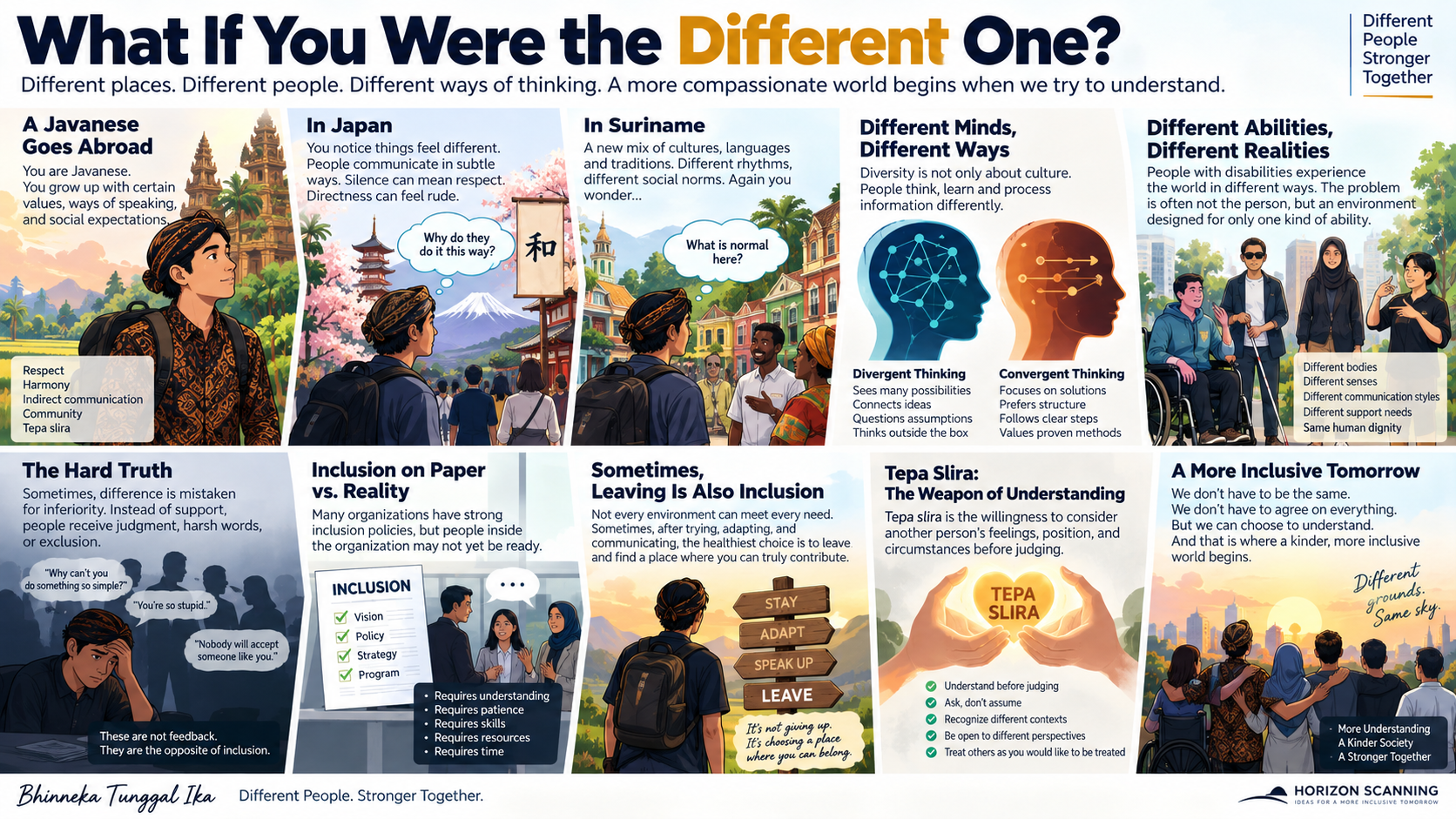
We often talk about diversity as something we observe in other people: different ethnicity, different language, different traditions, different beliefs, different ways of communicating. But there is a harder question: What happens when you are the one who is different?
The central question
What we call “common sense” may sometimes be nothing more than what our own environment taught us to expect.
Part I — When “Normal” Changes With Geography
Imagine that you are Javanese. You grow up with particular expectations about politeness, hierarchy, communication, social distance, hospitality, and how respect should be shown. None of this feels unusual because it is the environment in which you learned how to become a social human being.
Then you move to another country — perhaps Japan, perhaps Suriname, perhaps somewhere else whose history, language, social expectations, and everyday habits developed along a different path.
Suddenly, things that once seemed self-evident begin to look strange:
“Why do they do it that way?”
“Why is this considered polite here?”
“Why is that considered rude?”
And perhaps the most dangerous thought:
“Why can’t they just do things the normal way?”
The “normal way” is not always normal everywhere.
Indonesia has a familiar expression: “Di mana bumi dipijak, di sana langit dijunjung.” Wherever the earth is stepped on, there the sky is respected. It encourages us to understand the environment we enter. But it also teaches something else: when you enter a different world, many things you thought were common sense begin to look like cultural habits.
Part II — The Same Thing Happens Inside One Culture
The difference does not always exist between two countries. It can exist between two people sitting at the same desk.
Some people naturally process problems in a structured, sequential, convergent way. Others connect distant ideas, generate alternatives, see patterns, question assumptions, and explore possibilities.
Some learn through repetition. Others need experimentation. Some understand quickly when instructions are explicit. Others need to understand the underlying system before the instruction becomes meaningful.
These differences do not automatically tell us who is more capable. But put a person in an environment designed around only one cognitive style, and difference can quickly be interpreted as incompetence.
“Why can’t you just think like everyone else?”
And perhaps the person on the other side is asking exactly the same question:
“Why can’t everyone see what I see?”
Part III — When Difference Is Turned Into Insult
I personally tend to be more divergent in the way I think, although I also have convergent thinking within me. Sometimes I look at a problem and immediately see a connection that others do not seem to notice.
It is tempting to think, “Why don’t they see this?” But the reverse is also true. People who work differently from me may look at my approach and think, “Why are you making something so simple so complicated?”
In harsh workplaces, the difference can become ridicule. The message is no longer, “Here is another way to approach this.” It becomes, “You are stupid because you do not work like we do.”
The dangerous transition
Difference → misunderstanding → frustration → labeling → humiliation → exclusion.
I have experienced environments where the language became much harsher than ordinary criticism. Statements were made along the lines of:
“If you cannot even do that, you are stupid.”
And, in its cruelest form:
“You should just die. Nobody will accept someone like you.”
That is not constructive feedback. It is what happens when an environment stops trying to understand difference and starts treating difference as a defect in the person.
Part IV — Learning Differently Can Feel Like Not Belonging
This is where inclusion becomes personal.
I have also experienced being expected to learn in the same way that other people learned. But sometimes the method that works perfectly for one person does not work naturally for another.
Then you stop asking, “How can I learn?” and start asking, “Why can’t I be normal?” You begin to feel alienated. You begin to wonder whether you belong there at all.
Maybe I am not broken.
Maybe the environment was simply designed around a different way of processing information.
The same principle matters when we think about disability. A person with a disability may experience, navigate, communicate with, or interact with an environment differently. The difficulty is not automatically evidence that the person is less capable.
The useful question is therefore not only, “What is wrong with this person?” It can also be, “What assumptions did we build into this environment?”
Part V — Inclusion on Paper vs. Inclusion in Practice
An organization can have beautiful language about inclusion. It can have a strategy, a policy, a mandate, a program, a diversity statement. And still struggle to practice inclusion every day.
Inclusion requires people who understand difference. It requires skills, patience, time, and resources.
We should also be realistic. We cannot simply force every organization to accommodate every possible difference immediately. Organizations have operational constraints. Teams have limited capacity. Budgets are finite. People themselves have different levels of readiness.
Sometimes an organization genuinely cannot provide what a particular person needs. That does not automatically mean the organization is evil. And it does not automatically mean the person is incapable.
Sometimes it simply means the fit is not there.
Part VI — Sometimes, Leaving Is Also Inclusion
This is probably the most uncomfortable part of the argument.
We often imagine inclusion as, “Everyone must be able to stay here.” But there is another possibility:
Sometimes, the healthiest choice is to find another environment.
Not because every uncomfortable environment is oppressive. Not because organizations must always adapt to every individual. And not because people should leave at the first sign of difficulty.
But after communication, adaptation, accommodation, learning, and boundaries have been tried, there may come a point where a person realizes:
“This place may simply not be for me.”
A creative person may need an environment that gives room to experiment. A highly structured person may thrive where systems are explicit. A person with a disability may need a workplace where reasonable support is actually feasible. A student may need an educational environment that can respond to how they learn.
Sometimes leaving is not giving up.
Sometimes it is recognizing that two systems are not compatible.
Part VII — Tepa Slira: The Weapon of Understanding
This is where I keep returning to a Javanese idea: tepa slira.
Tepa slira can be understood as considering another person's position, feelings, circumstances, and perspective before judging or acting. It is a form of tenggang rasa: a reminder that the other person has a context we may not immediately see.
For me, tepa slira is powerful because it interrupts our reflex to judge.
Before saying, “Why can’t you do this?” ask, “What might make this difficult for you?”
Before saying, “Why are you so weird?” ask, “What experience might have shaped you like this?”
Before saying, “Why can’t you learn properly?” ask, “Maybe I need to find a different way to teach you.”
And perhaps the deepest question:
“What if I were the one standing in their position?”
Understanding another person does not mean agreeing with everything they do. It does not mean removing standards or abandoning boundaries. It means understanding the context before delivering the verdict.
Part VIII — Context Can Change the Meaning
A person who appears disrespectful may have learned a different communication norm.
A person who appears slow may process information differently.
A person who seems difficult may be overwhelmed by an environment designed for someone else.
A person who appears strange may simply have a different frame of reference.
Part IX — What Inclusion Really Asks From Us
Perhaps inclusion is not the promise that every person will fit every environment. Perhaps it is the commitment to stop assuming that our own way of seeing, learning, speaking, behaving, and working is the universal default.
Inclusion can mean adaptation. It can mean accommodation. It can mean teaching differently. It can mean designing environments differently. It can mean setting boundaries. And sometimes, it can mean helping someone find another environment where they can genuinely contribute.
What it should not mean is immediately turning difference into inferiority.
A simple sequence
Notice → Understand → Adapt → Accommodate → Set boundaries → If necessary, move on.
Part X — What If You Were the Different One?
The next time you meet someone and think, “Why are they like that?” pause.
Maybe they are wrong. Maybe you are wrong. Maybe neither of you is wrong.
Maybe you are simply standing on different ground.
The person from Java in Japan experiences this. The person from Java in Suriname experiences this. A person with a disability may experience this. A child who learns differently may experience this. A divergent thinker in a highly convergent environment may experience this. And perhaps many people who feel they “do not belong” experience some version of this every day.
The final thought
Before asking people to understand you,
learn to understand them.
That is where tepa slira becomes more than courtesy. It becomes a tool for inclusion.
Because perhaps the strongest form of inclusion is not saying, “Everyone must become the same.”
It is being able to say:
“I may not see the world the way you do. But I am willing to understand why you see it that way.”
Sometimes, that one sentence can be the difference between being judged and being understood.