CULTURE • INCLUSION • CONTEXT
Bhinneka Tunggal Ika: When Difference Becomes Inferiority
Unity in Diversity is not only about ethnicity. It is also about culture, cognition, experience, communication, ability, and the assumptions we make about what is “normal.”
When we talk about Unity in Diversity, we often begin with ethnicity: Javanese, Batak, Sundanese, Papuan, Balinese, Bugis, and many others.
Then we add language, religion, food, clothing, ceremonies, architecture, and other forms of cultural heritage.
But the deeper I look, the more I realize that diversity also lives in something less visible:
That means inclusion cannot be reduced to simply putting different people in the same room. We also need to understand that the people in that room may be operating from different contexts.
👁 Same Behaviour, Different Meaning
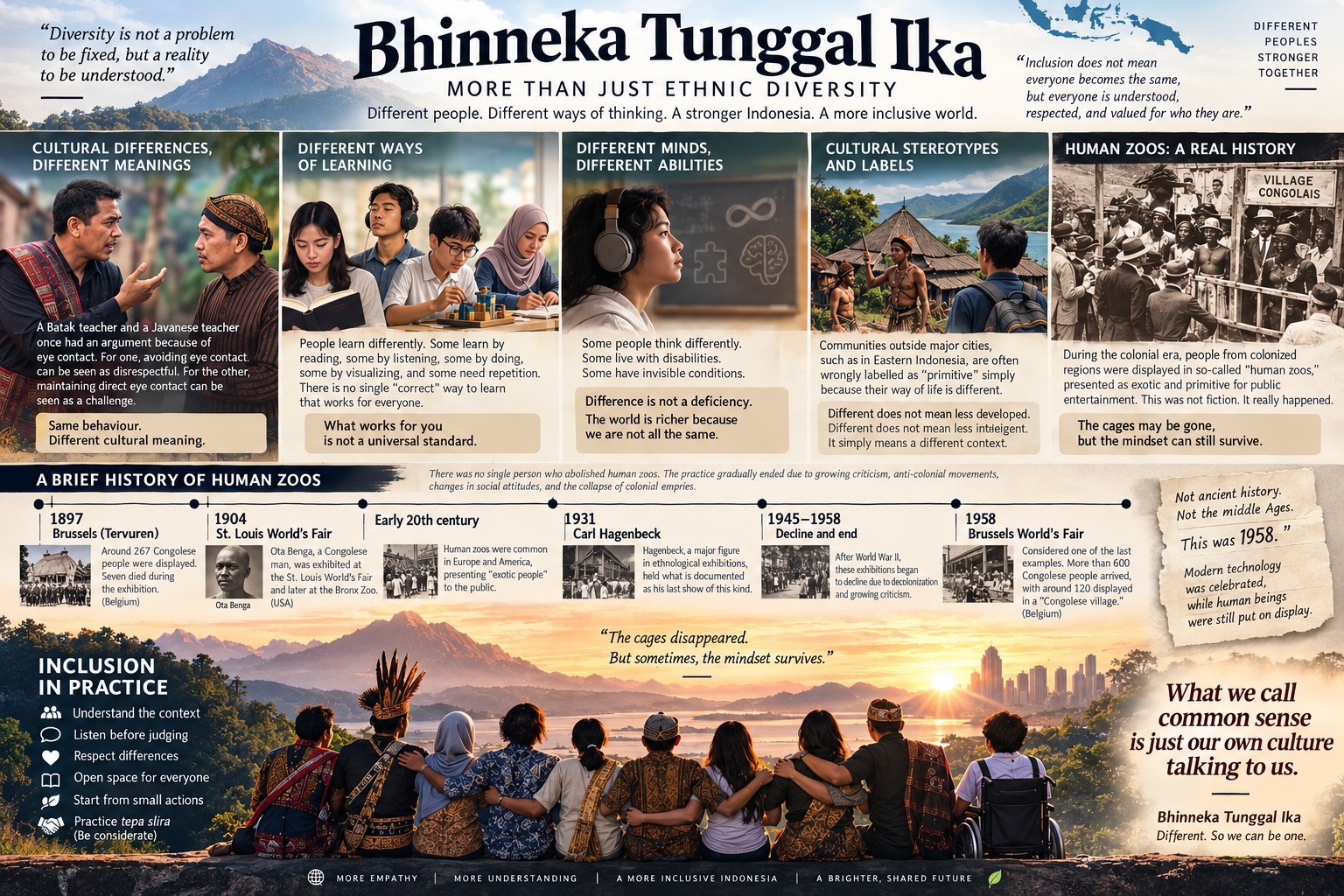
I once witnessed a misunderstanding between a Batak teacher and a Javanese teacher that revolved around something as simple as eye contact.
In that particular encounter, one person interpreted direct eye contact as confrontational, while the other interpreted avoiding eye contact as disrespectful. The same visible behavior was being translated through two different cultural expectations.
Person A
“Why are you looking at me like you are challenging me?”
Person B
“Why won't you look at me when I am talking to you?”
📚 Learning Is Not a Universal Template
The same problem can happen in education.
Someone may say: “Don't be stupid. That's not how you learn. The correct way is like this.”
But the obvious question is:
People differ in prior knowledge, attention, communication, sensory access, cognitive processing, experience, motivation, and the kinds of support or accommodations that help them participate.
So a useful method for one person is not automatically a universal standard for everyone else.
🧠 Different Minds, Different Abilities
There is another layer that is easier to overlook: cognitive and physical differences.
Some people live with disabilities. Some have invisible disabilities. Some are reluctant to acknowledge a disability because of stigma. Some simply process information and social interaction differently from the people around them.
None of that means that a person is less human, less intelligent, or less worthy of participation.
What inclusion asks
“What context, access, communication style, or support would allow this person to participate?”
What exclusion asks
“Why can't this person just behave like everyone else?”
🦁 Human Zoos: A Real History
The phrase “human zoo” refers to a historical practice in which people from colonized or racialized societies were put on public display as “living exhibits,” often within colonial or ethnological exhibitions.
This is not a metaphor invented for social media. These exhibitions really happened.
The purpose was not merely entertainment. The colonial section was explicitly connected to support for King Leopold II's project in Congo, while the display of people helped produce a visual hierarchy between the supposed “civilized” observer and the “primitive” Other.
Another well-known case is Ota Benga, a Congolese man who was exhibited at the 1904 World's Fair in St. Louis and later displayed at the Bronx Zoo in 1906. The Bronx Zoo itself now describes the episode as a “disgraceful incident,” and Smithsonian catalogues document the history of Benga's display and the racial prejudice surrounding it.
🕰 When Did Human Zoos End?
There was no single global law, single institution, or single person who “abolished human zoos.” The practice declined over time.
The AfricaMuseum describes 1945–1958 as the period in which these colonial exhibitions came to an end, as explicit racism and extreme colonialism lost legitimacy, anticolonial movements became more vocal, and European empires began to collapse.
1897
Brussels / Tervuren
267 Congolese were displayed in fenced villages; seven died during the exhibition.
1904–1906
St. Louis → New York
Ota Benga was exhibited at the 1904 World's Fair and later at the Bronx Zoo.
1945–1958
Decline
Colonial exhibitions faced growing anticolonial resistance and changing social attitudes after World War II.
1958
Brussels World's Fair
A Congolese village at Expo 58 is identified by the AfricaMuseum as the last example of this type of colonial exhibition.
Important: “1958” here means the last example of this type of colonial exhibition identified by the AfricaMuseum, not a universal legal abolition date.
🧩 The Difference Between History and Analogy
We should be careful here.
Modern stereotyping is not literally the same thing as a historical human zoo. The historical practice involved actual public exhibition of people within colonial systems.
What remains useful today is the underlying logic of the hierarchy:
That logic can survive in much quieter forms:
“Why don't they think normally?”
“Why don't they learn properly?”
“Why is their culture so strange?”
“Why are they so primitive?”
When observation becomes judgment, and judgment becomes a hierarchy of human worth, difference has been turned into inferiority.
🌏 From “Different” to “Primitive”
I have seen people from communities in Eastern Indonesia described as “primitive” simply because their cultural practices and living environments are very different from what people in Jakarta are accustomed to.
That raises an uncomfortable question:
A community can have a different relationship with land, time, ritual, authority, family, technology, or social life without that difference automatically proving inferiority.
The same principle applies at the individual level. A person's different communication style or cognitive pattern should not automatically be interpreted as stupidity, laziness, arrogance, or bad character.
Difference is not proof of inferiority.
🤝 Inclusion Begins With Context
This is why I increasingly understand inclusion as more than “everyone is welcome.”
Understand the context
What cultural, social, cognitive, historical, or physical context might shape this person's behavior?
Pause before judging
Could the same behavior have a different meaning in another context?
Make space for difference
Can the environment adapt without forcing everyone into one model of “normal”?
Practice tepa slira
Consider the other person's position before assuming that your own perspective is universal.
And you do not necessarily have to become an anthropologist to begin doing this.
Sometimes you need something much simpler:
Pause. Understand the context. Ask why. Then respond.
📖 Cultural Intelligence Is Not Only Academic
Sometimes someone from a small village may have a very sophisticated understanding of social difference even without formal academic training in anthropology.
Why?
Because cultural intelligence can be learned through everyday life: knowing when to speak, when to listen, how to approach an elder, how to behave in another community, how to interpret a gesture, and when not to assume that one's own rules apply everywhere.
Academic knowledge is valuable. So is lived experience.
Reading about culture and living with difference are not the same skill.
🪞 What We Call “Common Sense”
This may be the deepest lesson for me.
We often use the phrase “common sense” as if it were a universal operating system shared by every human being.
But much of what feels obvious to us has been shaped by family, language, culture, education, community, history, and personal experience.
That does not mean every belief is equally valid. It means we should distinguish between “this is familiar to me” and “this is universally true.”
🇮🇩 A Deeper Reading of Bhinneka Tunggal Ika
Perhaps Bhinneka Tunggal Ika is not only a statement that Indonesians come from many ethnic groups.
Perhaps it is also a challenge to our instinct to make our own perspective the default.
We may differ in culture.
We may differ in experience.
We may differ in cognition.
We may differ in ability.
We may even disagree about what “respect,” “normal,” or “common sense” looks like.
That is not a failure of diversity.
That is the reality diversity asks us to navigate.
From Mental Cages to Shared Space
The cages disappeared decades ago.
Our task now is to make sure we do not keep building new ones inside our heads.
🌏 More context. 🤝 More empathy. 🧠 More understanding.
Bhinneka Tunggal Ika.
Sources & Further Reading
The historical claims in this article are grounded primarily in institutional sources. The Batak–Javanese eye-contact example is presented as a personal observation, not as a universal rule about either ethnic group.
https://www.africamuseum.be/en/discover/history_articles/the_human_zoo_of_tervuren_1897
https://expohumanzoo.africamuseum.be/en/node/82
https://expohumanzoo.africamuseum.be/
https://bronxzoo.com/125-birthday/timeline
https://www.si.edu/object/spectacle-astonishing-life-ota-benga-pamela-newkirk:siris_sil_1047645
https://www.africamuseum.be/en/discover/history