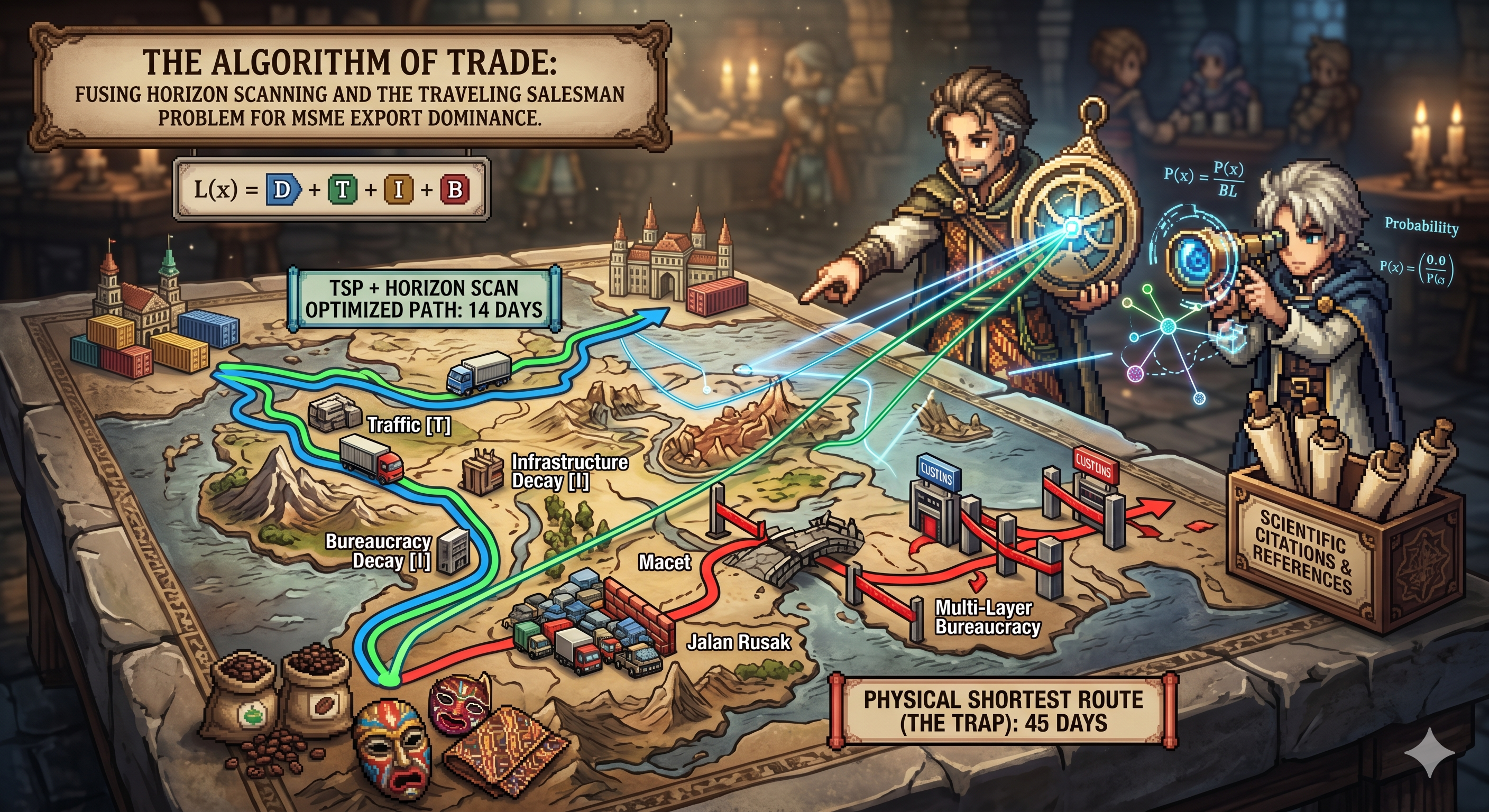
Imagine an Indonesian MSME producing world-class specialty coffee or artisanal batik. A buyer in Berlin wants to import five tons. Logically, this is a massive win. Operationally, it is a labyrinth. Moving a product from a rural village in Java to a European port is not just a matter of physical distance — it is a battle against invisible friction. Indonesia's logistics and supply chain market is valued at USD 131.2 billion in 2025, yet Indonesia ranks only 61st on the World Bank's Logistics Performance Index, lagging behind every major ASEAN peer. The gap between the size of the opportunity and the efficiency of the pipeline is the story of every MSME that has tried — and failed — to scale internationally.
In supply chain mathematics, determining the most efficient route is known as the Traveling Salesman Problem (TSP). The TSP asks: given a list of cities and the distances between each pair, what is the shortest possible route that visits every city exactly once and returns to the starting point? It sounds elegant. It is, in fact, classified as an NP-hard problem — meaning that as the number of nodes (cities, ports, checkpoints) grows, the computational complexity explodes exponentially. For a route through just 10 stops, there are over 3.6 million possible orderings. For 20 stops, there are more combinations than atoms in the observable universe.
But the classical TSP has a fatal flaw when applied to emerging markets: it assumes that the cost of traveling between two points is fixed, predictable, and purely geographic. In Indonesia's archipelago of 17,000 islands, that assumption is not just wrong — it is dangerous. To solve the MSME export crisis, we must abandon the traditional map and integrate the mathematical routing of TSP with the predictive intelligence of Horizon Scanning.
First: What Exactly Is the Traveling Salesman Problem? (A Real-World Analogy)
Before we upgrade the model, let's make sure we understand the original. Picture a street food vendor in Yogyakarta who supplies sambal to ten different warungs (small food stalls) spread across the city. Every morning, they load their truck and need to deliver to all ten locations before the morning rush. The question is: in what order should they visit each warung to minimize total driving time and fuel cost?
If they visit them in a random order, they might crisscross the city inefficiently. If they plan the route by trial and error, it takes too long. The TSP gives us the mathematical framework to find the optimal sequence — the route that minimizes the total cost of the journey. Now scale this up to an export operation: instead of ten warungs, the MSME is navigating warehouses, toll roads, inland transport depots, customs inspection points, and ports. Instead of fuel cost, the "cost" includes time, money, cargo integrity, and international credibility. The stakes are infinitely higher — and the variables are far less predictable.
The Equation of Frictional Latency
In a classical TSP, we minimize kilometers. In a real-world emerging market TSP, we minimize Latency Variables. The true cost of any route is not distance — it is total frictional delay. We define it as:
-
[D] Distance — The Baseline CostThe physical Euclidean distance between nodes. In a perfect world, this is the only variable that matters. In Indonesia's archipelago, it is the least predictive of the four.
-
[T] Traffic and Congestion — The Time ThiefTemporal bottlenecks that destroy delivery windows and inflate fuel costs unpredictably. Land transportation accounts for approximately 50% of domestic logistics costs in Indonesia, and urban congestion in Jakarta alone costs the economy an estimated USD 6.5 billion annually in lost productivity.
-
[I] Infrastructure Decay — The Silent Cargo KillerBroken roads, inadequate bridge load limits, and underdeveloped hinterland connectivity force trucks to slow dramatically, increase vehicle maintenance costs, and risk damaging fragile cargo. The World Economic Forum ranked Indonesia 57th out of 139 countries in logistics infrastructure quality in 2023.
-
[B] Multi-Layer Bureaucracy — The Invisible WallAdministrative delays, unpredictable customs clearances, and redundant inter-agency checks that artificially inflate dwell time at ports. Research at Belawan Port in North Sumatra found that fragmented processes between Pelindo, Customs, and Quarantine caused vessel clearance times to rise from 7 hours in 2023 to 8–10 hours in 2024, despite rising throughput volumes. At Tanjung Priok — Indonesia's largest port — container dwell time once reached 8 days, triple the rate of Southeast Asia's most efficient ports.
1. The MSME Export Reality: Why the Standard Model Fails
Indonesia's MSME export contribution stands at roughly 15.6% of total national exports — dramatically lagging behind peer manufacturing nations like Malaysia (46%) and China (60%). The root cause is rarely product quality. The primary barrier is the overwhelming weight of the [B] (Bureaucracy) and [I] (Infrastructure) variables crushing operations before they even reach the international shipping lane.
Consider a concrete scenario: An MSME coffee exporter in Aceh needs to move five tons of specialty Gayo coffee to a buyer in Hamburg. The nearest major port is Belawan in Medan. A standard logistics planner calculates: distance is manageable, route is known, truck dispatched. What the algorithm does not see is that a new inter-ministerial audit has been announced at Belawan, triggering an additional documentation review layer. The provincial road from the plantation to the city is partially flooded from seasonal rainfall. A local ceremony has created unusual traffic. What should be a 3-day domestic leg becomes 20 days. The Hamburg buyer cancels the order. The MSME loses both the contract and its international credibility.
This is not a hypothetical. The World Bank's analysis of Tanjung Priok port explicitly found that the main cause of increased dwell time is not hard infrastructure — it is the port's soft infrastructure: manual validation requirements, back-and-forth documentation, and uncoordinated multi-agency inspection workflows. The physical port was never the bottleneck. The bureaucratic process was. And no standard routing algorithm can see that.
The Frictional Latency Breakdown
Why Route A (shortest distance) becomes a catastrophic trap while Route B (optimized for friction) delivers on time. Each block represents relative time consumed by each latency variable.
2. Upgrading the Model: The Stochastic Time-Dependent TSP
Classical TSP assumes a static world — fixed distances, fixed costs, no surprises. Real supply chains are the opposite: dynamic, probabilistic, and constantly disrupted. The academic upgrade to this problem is called the Stochastic Time-Dependent TSP (STD-TSP), formalized by Malandraki and Daskin (1992) and extended by Lienkamp, Hewitt, and Schiffer (2024) into a full branch-and-price algorithm that explicitly models uncertainty.
Here is the key conceptual shift: in the STD-TSP, the "cost" of traveling from Node A to Node B is not a fixed number. It is a probability distribution. The algorithm does not ask "how far is Port Belawan?" — it asks "given all available intelligence about today's conditions, what is the probability that a container passing through Belawan tomorrow will experience a clearance delay exceeding 48 hours?" If that probability is high, the algorithm applies a statistical time penalty — and routes around it.
Think of it like a weather forecast for your supply chain. A meteorologist does not tell you it will rain at exactly 3:47 PM. They tell you there is a 78% chance of rain between 2 PM and 5 PM. You bring an umbrella and leave earlier. The STD-TSP does exactly the same for every node in the supply chain: it converts raw risk signals into mathematical time-penalty weights, then finds the sequence of stops that minimizes the expected total latency — not the shortest distance.
How AI Solves the TSP: Three Competing Approaches
Modern ML-based TSP solvers can generate near-optimal solutions in milliseconds — enabling real-time rerouting as conditions change.
Ant Colony Optimization (ACO)
Inspired by how real ants find the shortest path to food by depositing pheromones. Virtual "ants" explore thousands of routes simultaneously, reinforcing efficient paths and evaporating poor ones. Ideal for dynamic rerouting as conditions change in real-time.
Genetic Algorithms (GA)
Simulates biological evolution: starts with many random route sequences, selects the best-performing ones, "breeds" them to create improved offspring, and discards weak solutions. Excellent at exploring enormous solution spaces without computing every possibility.
Graph Neural Networks (GNN)
The cutting-edge approach. GNNs represent every supply chain node and its connections as a graph, then learn patterns from historical routing data to predict optimal paths. Liu et al. (2025) demonstrated GNNs solving instances with over 71,000 nodes — far beyond human computation.
3. Horizon Scanning: The Predictive Radar That Makes TSP Intelligent
How does the TSP algorithm know that the bureaucracy at Port Belawan will spike tomorrow because of an inter-ministerial audit? How does it know that the Trans-Java toll road has a 40% higher accident probability this week due to a tropical depression? It doesn't — unless it has an intelligence feed. Algorithms are mathematically powerful but informationally blind. They can only optimize what they can measure. This is the strategic role of Horizon Scanning: it converts the invisible, qualitative, "soft" signals of the real world into quantifiable latency weights that the STD-TSP algorithm can act on.
Horizon Scanning is a structured foresight methodology used by intelligence agencies, military logistics planners, and strategic policy organizations to detect "weak signals" — early indicators of events that have not yet happened but are beginning to emerge in available data. Applied to supply chain operations, it functions as a continuous environmental intelligence system. Here is how it maps onto each of our four latency variables:
- Scanning for [B] Bureaucratic Latency: Indonesia's DGCE Regulation No. 22/2024, effective March 2025, introduced a fully new digital customs submission system (SKP). Any MSME not tracking this regulatory shift faced an unexpected compliance barrier during the 90-day transition window. Horizon Scanning automatically monitors regulatory announcement databases, ministry press releases, and customs agency bulletins — flagging new compliance requirements before they become operational surprises. Each new requirement gets translated into a probabilistic time-penalty applied to affected ports.
- Scanning for [I] Infrastructure Latency: Indonesia's government allocated USD 6.5 billion in the 2024 budget specifically for road, port, and airport infrastructure — signaling ongoing construction disruptions across multiple highway corridors. Horizon Scanning cross-references infrastructure project databases with meteorological rainfall data and local news sources to flag which routes are currently impaired. Heavy rainfall in West Java during December–February annually degrades provincial road load-bearing capacity, creating predictable seasonal latency spikes that should be pre-weighted in the routing model.
- Scanning for [T] Traffic and Congestion Latency: Industrial zone congestion is often triggered by non-logistical events: regional elections, major festivals, large-scale protests, or stadium events. Horizon Scanning monitors local government event calendars, social media OSINT (Open Source Intelligence), and satellite traffic data feeds to assign temporal congestion penalties to specific road segments on specific dates.
The Predictive Routing Engine: End-to-End Flow
How weak signals from the real world become mathematically-optimized routing decisions.
1. Signal Detection
Horizon Scan ingests regulatory feeds, weather APIs, social media OSINT, and port authority bulletins. Weak signals are flagged before they become disruptions.
2. Bayesian Weighting
Each signal is converted into a probabilistic time-penalty using Bayesian inference. A port audit announcement = +12 day penalty weight applied to that node.
3. Dynamic STD-TSP
The routing algorithm recalculates the entire supply chain graph using updated penalty weights, optimizing strictly for the lowest expected total frictional latency — not shortest distance.
4. Strategic Bypass
The system proposes a secondary route — longer geographically, but with a mathematically lower expected total latency. The MSME cargo reroutes to a smaller port with 48-hour customs pre-clearance.
5. On-Time Export
The shipment arrives at the international gateway on schedule. The buyer in Berlin receives confirmation. The MSME earns credibility, secures repeat orders, and builds a global supply chain reputation.
4. The Ant Colony Analogy: Nature Already Solved This
The most intuitive way to understand how the optimized algorithm works is through the ant colony. Marco Dorigo's Ant Colony System (ACS), introduced in 1993, remains one of the most elegant solutions to the TSP — and it draws directly from biology. Real ants, when foraging, initially explore multiple random paths to a food source. Each ant deposits chemical pheromones along its path. Shorter, faster paths are traversed more frequently, so they accumulate pheromone faster. Over time, the entire colony converges on the optimal path — not because any single ant computed the best route, but because the collective system evolved toward it through distributed intelligence.
Now apply this to an MSME export network. Each "ant" is a simulated routing agent exploring a different sequence of logistics nodes. Each successful, on-time delivery deposits a "pheromone signal" on the route that was used. Routes that consistently encounter bureaucratic delays, flooded roads, or congested ports receive negative pheromone — they become progressively less attractive to future routing decisions. Over time, the system organically discovers which ports, which roads, which timing windows, and which sequences produce the lowest frictional latency — without any single planner having to manually compute every possibility.
The Chess Clock Analogy for Bayesian Weighting
Imagine each logistics node (port, customs checkpoint, toll gate) has a chess clock attached to it. When the clock is running slowly — conditions are smooth, bureaucracy is minimal — the node is cheap to traverse. When an event occurs that accelerates the clock (an audit, a flood, a protest), the node becomes progressively more expensive. The Horizon Scanning layer is the intelligence system watching all the clocks simultaneously. The STD-TSP algorithm is the chess grandmaster deciding, given the current state of all clocks, which sequence of nodes produces the minimum total time pressure. The MSME's job is simply to follow the grandmaster's recommended move.
5. Indonesia's Real Digital Logistics Horizon: The NLE Window
There is one significant tailwind that makes this model increasingly viable in Indonesia right now: the National Logistics Ecosystem (NLE). As of October 2024, the NLE has been implemented across 46 seaports and 6 airports, covering 97% of sea cargo traffic and 98% of air cargo traffic. The NLE digitizes pre-clearance documentation, integrates customs with quarantine agencies, and has introduced autogate systems at Tanjung Priok that allow trucks to clear entry gates with QR codes — eliminating the manual gate verification that was a persistent bottleneck.
This matters for the TSP-Horizon Scanning framework because the NLE creates a machine-readable logistics environment. Each digitized touchpoint becomes a data source that Horizon Scanning can monitor. When an NLE-connected port reports a spike in average processing time, the system detects it in near real-time. When a new documentary requirement is added to the digital platform, the system flags it before it impacts in-transit shipments. The government's infrastructure investment — USD 6.5 billion allocated in the 2024 budget — is gradually converting Indonesia's analog logistics friction points into digital signals. And digital signals are exactly what the STD-TSP algorithm needs to optimize against.
Tanjung Priok's container throughput reached 4.07 million TEUs in the first three quarters of 2025, up 5.7% year-on-year. Tanjung Perak in Surabaya processed over 1.1 million TEUs in the same period. As volume grows and digitization deepens, the latency data density increases — making the predictive routing model progressively more accurate. The window to build this intelligence capability is open, and it is widening. The MSME that builds its supply chain routing on friction-optimized logic today will be compounding a structural competitive advantage as every competitor continues to use static, distance-only planning tools.
The Competitive Advantage Ledger
Standard TSP (Distance Only)
- Plans for kilometers, not friction
- Assumes static, predictable conditions
- Cannot anticipate bureaucratic surges
- No recalculation when conditions change mid-transit
- Average outcome: 45-day domestic-to-port leg in disrupted scenarios
STD-TSP + Horizon Scanning
- Optimizes for frictional latency, not raw distance
- Models uncertainty probabilistically (Bayesian weights)
- Detects regulatory changes before they become delays
- Dynamically reroutes mid-transit using live signal feeds
- Average outcome: 12-day leg on the same corridor
Interactive TSP Simulator
Don't just read the theory; test firsthand how latency variables change your logistics routes. Use our interactive calculator to simulate the Time-Dependent Stochastic TSP in real-world scenarios, including a case study on avoiding geopolitical friction inStrait of Hormuz.
Conclusion: Hacking the Labyrinth
In emerging markets, standard logistics software fails because it commits one foundational error: it assumes that the rules of the environment are stable, that distance equals time, and that every node in the supply chain behaves predictably. Indonesian MSMEs who rely on this illusion are routinely crushed by the invisible architecture of bureaucratic delay, infrastructure decay, and temporal congestion — forces that are entirely invisible to a distance-only routing algorithm.
The framework presented here is not science fiction. Every component already exists: Stochastic Time-Dependent TSP has been formalized in peer-reviewed operations research. Ant Colony Optimization and Graph Neural Networks are solving real logistics problems at scale. The National Logistics Ecosystem is digitizing Indonesian port infrastructure in real-time. Horizon Scanning methodologies are deployed by governments, militaries, and multinationals to detect weak signals of systemic change.
The synthesis — an MSME export intelligence system that fuses STD-TSP with real-time Horizon Scanning — is the operational upgrade that transforms small Indonesian producers from fragile, friction-exposed vendors into resilient, globally competitive supply chain participants. By mapping where the friction will be tomorrow and routing around it today, we stop fighting the labyrinth. We simply refuse to enter it.
For Indonesian MSMEs, this is not just an operational upgrade. It is the ultimate algorithm to take a world-class product from a village in Aceh to a shelf in Berlin — on time, every time.
The optimal route is never the shortest line. It is the path of least friction.
#SupplyChain #HorizonScanning #TSP #MSME #Indonesia #LogisticsOptimization #OperationsResearch #ForesightStrategy #ExportIntelligence
Scientific Citations & References
Asian Development Bank (2020). Asia Small and Medium-Sized Enterprise Monitor 2020: Volume I — Country and Regional Reviews. ADB Institute. (Documents Indonesian MSME export contribution at 15.6%, contrasted against Malaysia at 46% and China at 60%.)
Malandraki, C., & Daskin, M. S. (1992). Time dependent vehicle routing problems: Formulations, properties and heuristic algorithms. Transportation Science, 26(3), 185–200. (Foundational formalization of time-dependent routing costs, directly underlying the STD-TSP model applied here.)
Lienkamp, B., Hewitt, M., & Schiffer, M. (2024). Branch and Price for the Stochastic Traveling Salesman Problem with Generalized Latency. Transportation Science, 59(2), 229–249. (Most recent extension of stochastic TSP with explicit latency uncertainty modeling — directly underpins the probabilistic penalty-weighting framework described in this article.)
World Bank (2024). Business Ready (B-READY) Report 2024: Assessing the regulatory framework and public services for private sector development. World Bank Group. (Contextualizes Indonesia's logistics regulatory environment within global benchmarks.)
Christopher, M. (2016). Logistics & Supply Chain Management (5th Edition). Pearson UK. (Core theoretical framework on supply chain performance dependency on speed, reliability, and agility.)
Dorigo, M. (1993). Ant Colony System for the Traveling Salesman Problem. As reviewed in Wikipedia (2025) and applied to dynamic logistics environments. The ACS framework establishes the pheromone-reinforcement analogy applied to supply chain route learning in this article.
Liu et al. (2025). UNiCS: A Neural-Guided Hybrid TSP Solver. Artificial Intelligence Review, Springer Nature. (Demonstrates GNN-based TSP solvers handling 71,000+ node instances in real-time — establishing the computational feasibility of the real-world scale routing engine described in this article.)
World Customs Organization / Indonesia NLE Report (2024). National Logistics Ecosystem: Indonesia's Holistic Approach to Trade Facilitation. WCO News, Issue 3, 2024. (Documents NLE deployment across 46 seaports and 6 airports as of October 2024, covering 97% of sea cargo — establishing the digital infrastructure underpinning real-time signal collection.)
Awaloedin et al. (2025). Indonesia Logistics Sector Review: Performance, Challenges, and Future Growth. Zenodo. (Comprehensive sector review documenting Indonesia's LPI rank of 61st, logistics market value of USD 131.2 billion in 2025, and the triad of reform policies shaping the sector through 2030.)