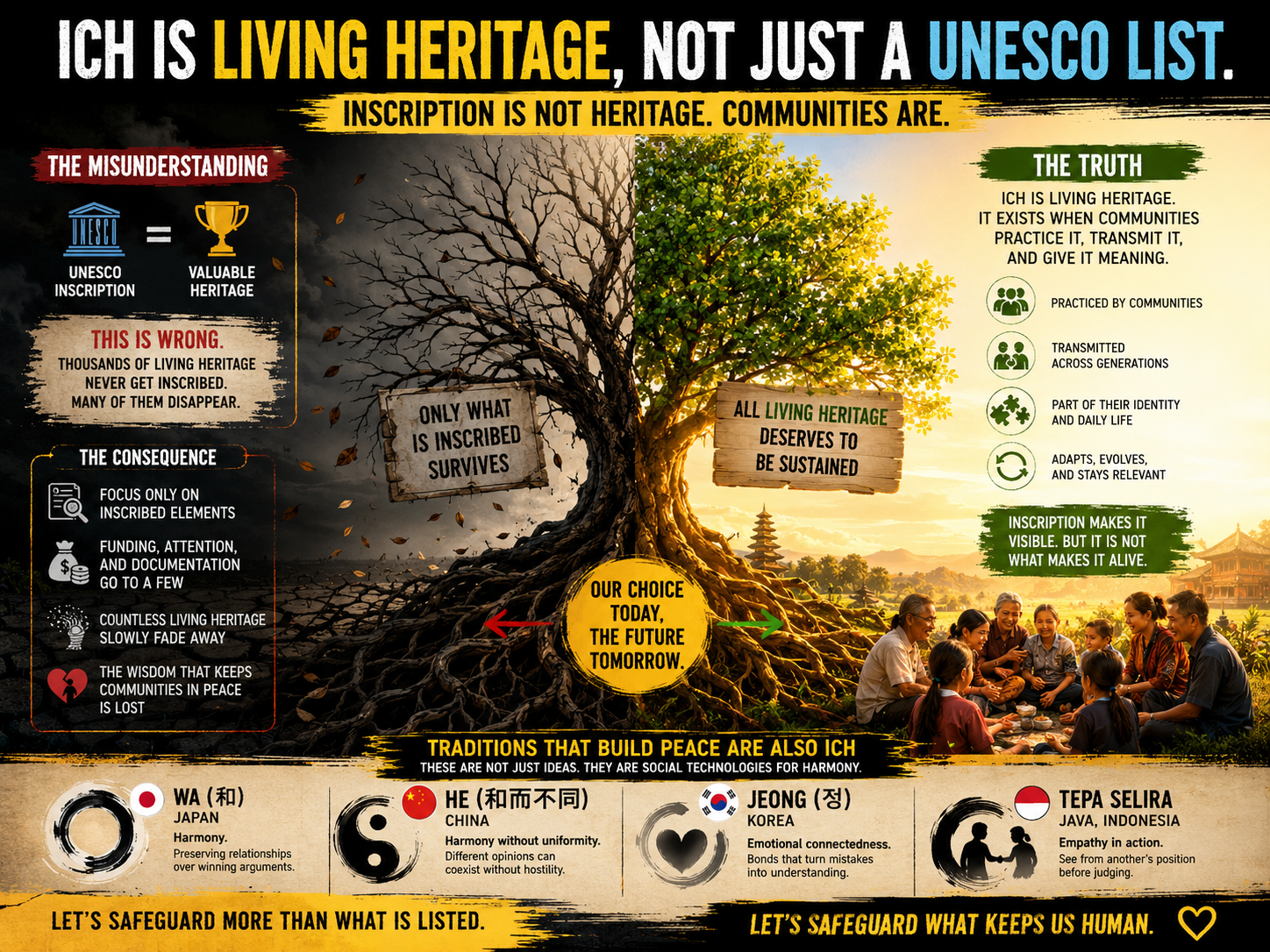
UNESCO has spent decades cataloging the traditions that teach communities how to create — dances, textiles, festivals, craftsmanship. Far less attention goes to the traditions that teach communities how to coexist. This is a tour through four of them, a look at what happens when harmony itself needs a safety valve, and an honest look at a misconception that quietly decides which of these traditions survive.
The Four Parts
- The Blind Spot in Cultural Preservation
- Four Traditions, One Mechanism
- When Harmony Itself Needs a Safety Valve (Japan)
- The Inscription Myth — A Disclaimer
Part I — The Blind Spot in Cultural Preservation
"It's just a small mistake." "Why are we making this so complicated?" A delayed reply becomes evidence. A misunderstanding becomes a courtroom drama. The original problem is almost always small — the explosion happens later, once someone refuses to admit fault, feels attacked, or reads an apology as defeat. Psychologists have names for this: escalation of commitment, self-serving bias, the fundamental attribution error. Different labels, the same pattern — people defend their self-image more aggressively than they solve the actual problem.
UNESCO's Constitution opens with one of the more quoted sentences in modern diplomacy:
"Since wars begin in the minds of men, it is in the minds of men that the defences of peace must be constructed."
If that's true, culture isn't only about preserving the past — it's about preserving the knowledge that lets human beings coexist. And that raises an uncomfortable question: what if the most endangered heritage in the world isn't a dance, a festival, or a craft, but the wisdom that once taught people how to forgive?
Part II — Four Traditions, One Mechanism
Long before "conflict resolution" became a management-training buzzword, several societies had already engineered their own social technologies for it — practical tools, not abstract philosophy.
The Scenario: The Slide Deck Joke
To make the four traditions concrete, run the exact same small workplace incident through each one. During a project review, Rian cracks a joke about a colleague, Dinda's, slide design — "did you make this in MS Paint, 2004 edition?" — timed right as she's presenting to the wider team. The room laughs. Dinda forces a smile, finishes her slot, and says nothing. By afternoon she's visibly quiet, and a few teammates start wondering whether something's actually wrong, or whether they're overreacting by even noticing.
Japan — Wa (和)
In 604 CE, Prince Shōtoku's Seventeen-Article Constitution opened not with power or law, but with: "Harmony should be valued, and quarrels should be avoided." Its central question was never "who is right," but "how do we preserve the relationship" — the same logic later formalized in business as nemawashi, quietly building consensus before a decision is ever made public.
In Practice
Nobody addresses it in the meeting itself — calling Rian out publicly would just stack a second embarrassment on top of the first. Instead, a team lead quietly pulls Rian aside afterward, nemawashi-style: not an accusation, just a plain "hey, I don't think you meant it this way, but Dinda looked pretty rattled after that comment." Rian gets the chance to apologize privately, before the moment has time to calcify into a resentment nobody names out loud.
China — He (和)
Confucius, Analects 13.23: 君子和而不同 (Junzi he er bu tong) — "the virtuous person seeks harmony, not sameness." Agreement was never the requirement; the goal was learning to live with difference without letting it curdle into hostility.
In Practice
He isn't "everyone pretend it was fine so the team stays comfortable" — that would be tong, forced sameness, not harmony. Dinda is allowed to say plainly that the joke landed badly, without the whole team needing to agree it was objectively out of line. Rian doesn't have to agree he meant harm either. The disagreement itself is allowed to exist — what changes is that both of them keep working together afterward, instead of one of them quietly checking out of the team.
Korea — Jeong (정)
Jeong is the emotional bond that accumulates quietly between people over shared time — not friendship, not love, not family, but something that runs through all three. The stronger the jeong, the more a mistake gets read as circumstance instead of character.
In Practice
How Dinda reads the joke depends heavily on how much jeong already exists between her and Rian. If they've grabbed lunch together for two years and covered each other's deadlines more than once, the same line probably reads as clumsy banter, not cruelty — the accumulated goodwill buys Rian the benefit of the doubt. If they barely know each other, the identical sentence reads as a public dig. Jeong doesn't excuse the joke; it explains why the exact same words get forgiven instantly in one relationship and remembered for months in another.
Java — Tepa Selira
Placing oneself in another person's position before judging — a direct, centuries-old interruption of what modern psychology later named the fundamental attribution error: judging others by character while judging ourselves by circumstance.
In Practice
Before anyone decides Rian is just careless, tepa selira asks what's actually going on with him: he's shipped three deadlines that week on almost no sleep, and the joke was less cruelty than an unfiltered reflex. And before anyone tells Dinda she's "too sensitive," it asks the same question of her: this was her first time presenting to leadership, and she'd been quietly anxious about it for days, so the room's laugh landed on a nerve that had nothing to do with Rian personally. Neither context erases what happened — it just means the next conversation starts from curiosity instead of a verdict.
Part III — When Harmony Itself Needs a Safety Valve
It would be incomplete to treat "harmony" as a single, uncomplicated good. Japan — the same culture that gave the world Wa — also built an entirely separate, highly explicit system for the moment harmony breaks: the anatomy of shazai (謝罪), the formal apology, and a sharp cultural line against toxic harmony — the version of "keeping the peace" that protects wrongdoers instead of victims.
A companion piece on this same site goes deep on that mechanism: the four pillars of a real Japanese apology, the psychology of the "fake coincidence" tactic people use to dodge real accountability, and what happens to a workplace or a community when indirect culture is pushed past its healthy limit.
The Other Half of Japan's Harmony
Direct, ego-free accountability on one side. "Toxic harmony" — slander protected by silence, apologies staged as fake coincidences — on the other. Same culture, two edges of the same sword.
Read: Japan's Accountability vs. Toxic HarmonyPart IV — The Inscription Myth
A Disclaimer, Before Going Further
Everything above — Wa, He, Jeong, Tepa Selira, shazai — is Intangible Cultural Heritage (ICH) and living heritage in the fullest technical sense of both terms, whether or not any government has ever filed paperwork about them. A common assumption says otherwise: that ICH only "counts," or only gets safeguarded, once UNESCO formally inscribes it on one of its lists. That assumption is wrong. And it isn't a harmless misunderstanding — in practice, safeguarding effort, funding, and institutional attention concentrate almost entirely on the handful of elements that make it onto a list, while everything else — the vast majority of living heritage on earth — quietly fades with no formal mechanism protecting it at all.
Interactive — Toggle the Assumption
See how the same tradition is treated depending on which assumption a reader carries.
The Takeaway
None of the traditions in this piece need an inscription certificate to be doing their job. Wa, He, Jeong, and Tepa Selira are already living heritage — practiced daily, transmitted quietly, holding relationships together long after a formal apology or a courtroom ever could. The real safeguarding question isn't "is it on a list," it's whether the next generation still gets taught it at all.
Key Sources
1 UNESCO Constitution, Preamble (1945/1946) — https://www.unesco.org/en/legal-affairs/constitution
2 "Seventeen Article Constitution," Encyclopaedia Britannica — https://www.britannica.com/event/Seventeen-Article-Constitution
3 "China's Traditional Cultural Values and National Identity," Carnegie Endowment for International Peace — https://carnegieendowment.org/research/2013/11/chinas-traditional-cultural-values-and-national-identity
4 "Jeong: a concept to be experienced, not defined," Korea.net (Republic of Korea) — https://www.korea.net/NewsFocus/HonoraryReporters/view?articleId=198727
5 "Intangible Heritage Domains in the 2003 Convention," UNESCO ICH — https://ich.unesco.org/en/intangible-heritage-domains-00052
6 "Weighing the Two-Edged Sword of Conflict Resolution: Japan's Accountability vs. The Dangers of Toxic Harmony," Angga Conni Saputra — https://horizon-scanning.org/blog/article/weighing-the-two-edged-sword-of-conflict-resolution-japans-accountability-vs-the-dangers-of-toxic-harmony.html