Living Heritage · Cognitive Development · Lifelong Learning
How to Become a Modern-Day Great Sage
What if the Great Sage was not simply someone who emptied the mind and waited for enlightenment? What if the ancient image of the hermit, the cultivator, and the scholar described a disciplined process of developing the mind—reducing distractions, studying deeply, training deliberately, and learning to act with wisdom?

Ancient metaphors. Modern lessons. A wiser way to learn.
1. The Hypothesis: Perhaps the Sage Was Cultivating More Than Stillness
In stories about ancient sages, we often encounter a familiar scene: a person retreats to a mountain, leaves behind ordinary distractions, meditates, reads scrolls, practices for years, and eventually acquires extraordinary knowledge or insight.
One interpretation focuses on emptiness: the sage clears the mind, abandons worldly desires, and waits for enlightenment or guidance to arrive. That may capture part of the meaning in some spiritual traditions, but it does not tell the whole story of the metaphor.
Here is an alternative hypothesis—not a claim that every ancient tradition meant exactly this, but a modern interpretation worth exploring:
Perhaps the Great Sage is not someone who empties the mind of knowledge, but someone who clears away what prevents the mind from learning.
Under this interpretation, retreat is not the final destination. It is a method for reclaiming attention. Emotional discipline is not the rejection of human feeling. It is the ability to feel without being controlled by every impulse. Reading scrolls is not decorative storytelling. It represents the deliberate acquisition of knowledge. Cultivation is the repeated practice that turns knowledge into capability.
The metaphor becomes surprisingly contemporary when we consider our current environment: endless notifications, fragmented attention, algorithmic feeds, emotionally provocative content, and a constant supply of information that is easy to consume but not always easy to understand or remember.
We might call some of this brainrot or information overload. These terms should not be treated as clinical diagnoses, and digital media is not inherently harmful. The central concern is whether our habits leave enough time and attention for reflection, sustained learning, and meaningful practice.
This is a working framework inspired by ancient metaphors and informed by modern learning research. It is not a historical claim about the original meaning of every sage, hermit, or cultivator in every culture.
2. Four Metaphors, One Developmental Path
The four stages are a practical interpretation of the metaphors—not a universal historical doctrine.
1. The Hermit: protect attention
Reduce avoidable distractions and create periods for focused thought. The aim is not social isolation; it is intentional control over where attention goes.
2. The Cultivator: practice
Choose abilities worth developing, work on specific weaknesses, seek feedback, and repeat the practice. Exposure alone is not mastery.
3. The Scholar: understand
Read, compare sources, ask why, identify uncertainty, retrieve ideas from memory, and explain concepts in your own words.
4. The Great Sage: integrate
Use knowledge with judgment. Consider context, trade-offs, ethics, uncertainty, and consequences before deciding what to do.
3. First Principle: Clear the Noise, Not the Mind
The phrase “empty your mind” can be misunderstood as a call to stop thinking. For this framework, a more useful interpretation is to reduce the dominance of mental habits that repeatedly hijack attention.
Jealousy, envy, anger, resentment, anxiety, and desire are normal human experiences. The goal is not to erase emotions or pretend that nothing matters. Emotions can provide important signals. The task is to notice them, understand what they are telling us, and avoid letting a passing impulse make every decision.
Try a simple three-question pause when a strong emotion appears:
- What am I feeling? Name the emotion without immediately judging yourself.
- What triggered it? Separate observable facts from assumptions and interpretations.
- What response serves my values and goals? Choose a response rather than automatically obeying the first impulse.
Attention also needs protection from the environment. Put the phone out of reach during a focused learning session, turn off non-essential notifications, and decide in advance what you intend to learn before opening a feed or browser.
This is not a claim that all entertainment or social media degrades cognition. Digital tools can teach, connect, and inspire. The key is whether use is deliberate and balanced, or whether it repeatedly displaces the activities you value.
4. Second Principle: Train Both Divergent and Convergent Thinking
A modern Great Sage needs more than a large collection of facts. Complex problems often require two complementary modes of thinking.
Divergent thinking generates a range of possible ideas, interpretations, or solutions. It asks: What else could be true? What alternatives have I overlooked? How might this problem be approached differently?
Convergent thinking evaluates and narrows those possibilities. It asks: Which options fit the evidence? What constraints matter? What are the costs, risks, and trade-offs? Which choice is most defensible?
These modes are not enemies, and they are not necessarily separate stages that occur only once. Creative work often alternates between generating ideas, evaluating them, discovering gaps, and returning to exploration. Research reviews also suggest that divergent thinking draws on multiple executive processes, including flexible attention and working memory; the exact relationships are complex and not fully settled.
Further reading: Divergent thinking and the core executive functions: a state-of-the-art review (2022); Metacontrol of human creativity: the neurocognitive mechanisms of convergent and divergent thinking (2020); and the OECD discussion of divergent and convergent thinking.
Try Invergent: a deliberate thinking workout
If you want to practice switching between divergent and convergent thinking, try Invergent, an experimental, browser-based thinking toolkit designed to help users deliberately move between exploring possibilities and making decisions.
It combines divergent thinking to expand the possibility space, convergent thinking to evaluate options using constraints and trade-offs, and switching exercises to practice moving between exploration and selection. Its lightweight, data-driven design uses an editable JSON question bank, heuristic profiles, and timed learning sessions to support reflection and practice.
Use case: Divergent & Convergent Thinking Practice — a small mental workout for generating alternatives, evaluating them, and switching modes intentionally.
5. Third Principle: Do Not Confuse Information with Learning
Modern life makes it easy to collect links, save videos, highlight passages, and accumulate notes. These activities can be useful, but they do not prove that learning has occurred.
Learning is more convincing when you can retrieve an idea without looking, explain it in your own words, apply it to a new problem, or notice when it does not fit the evidence.
A major review by Dunlosky and colleagues evaluated ten common learning techniques. It found strong support for practice testing and distributed practice, while techniques such as rereading and highlighting alone often had lower utility when used as primary strategies. A later review in Nature Reviews Psychology also emphasizes the benefits of spacing learning over time and retrieving information from memory.
Sources: Dunlosky et al. (2013), Improving Students’ Learning With Effective Learning Techniques; Carpenter, Pan & Butler (2022), The science of effective learning with spacing and retrieval practice.
Retrieve
Close the source and write down what you remember. Then compare your recall with the original and correct the gaps.
Space
Return to important material over multiple sessions rather than trying to absorb everything in one marathon session.
Explain
Ask “why?” and “how?” Connect a new idea to examples, mechanisms, counterexamples, and concepts you already understand.
Apply
Use the concept in a real task, a worked example, a small experiment, or a problem that differs from the original example.
For example, after reading about cognitive flexibility, do not stop at underlining the definition. Put the source away and explain what it means. Then identify an occasion when you changed your mind because of new evidence, and another occasion when you should have considered more alternatives.
That process turns reading into retrieval, explanation, and application. It also exposes the difference between familiarity—“I have seen this before”—and actual recall.
6. Fourth Principle: Practice Deliberately, Not Merely Frequently
The cultivator metaphor is especially useful here. Repeating an activity can improve performance, but repetition alone is not a magic formula. Practice becomes more informative when it targets a specific skill, includes feedback, and gives you a chance to correct errors.
Research on expert performance has examined the role of deliberate practice: structured activities designed to improve performance, often involving effortful work on weaknesses and informative feedback. The details vary by domain, and practice is not the only factor behind expertise. Access to instruction, prior knowledge, motivation, opportunity, health, and other circumstances also matter.
Further reading: Ericsson et al. (1993), The Role of Deliberate Practice in the Acquisition of Expert Performance; Ericsson & Harwell (2019), Deliberate Practice and Proposed Limits on the Effects of Practice.
Instead of saying, “I will become better at thinking,” choose a specific practice target:
- Critical reading: distinguish a source’s evidence from its interpretation and conclusion.
- Systems thinking: map the actors, incentives, dependencies, feedback loops, and unintended consequences in a problem.
- Programming: build a small feature, test it, inspect failure cases, and document what the debugging process taught you.
- Writing: explain a complex concept to a beginner, revise the explanation, and remove claims that are unclear or unsupported.
- Decision-making: record your assumptions, expected outcomes, uncertainties, and the evidence that would change your mind.
Use a feedback loop: choose one target, practice it, review the result, identify the most important error, and practice again. Keep the challenge demanding enough to reveal weaknesses but manageable enough that you can learn from them.
7. Fifth Principle: Develop Metacognition—Learn How You Learn
A modern sage needs to think about thinking. Metacognition includes awareness of your own knowledge and the ability to regulate your learning: planning, monitoring understanding, and evaluating what worked.
It is easy to mistake confidence for competence. A passage may feel obvious while you read it, yet become difficult to explain once the page is closed. A useful safeguard is to compare your confidence with observable performance.
Before learning: What do I already know, and what question am I trying to answer?
During learning: Can I explain the mechanism, or am I only recognizing the words?
After learning: Can I retrieve the main idea, apply it, and name what remains uncertain?
Later: What do I still remember, and what needs another practice session?
Keep a small learning log. It does not need to be elaborate. Record the question, the source, the main idea in your own words, one practical application, one unresolved question, and what you will revisit later.
This habit also helps protect against overconfidence. A thoughtful learner is not someone who doubts everything; it is someone who can distinguish what is known, what is inferred, what is uncertain, and what evidence could change the conclusion.
8. Sixth Principle: Use Writing to Organize and Retain Ideas
Writing is not merely a way to display knowledge. It can be a tool for discovering whether an idea is coherent. When you explain a concept to another person, you must choose a structure, make hidden assumptions visible, connect evidence to claims, and identify gaps in your own understanding.
Try the “one idea, three layers” method:
- Simple explanation: describe the idea in plain language.
- Mechanism: explain why or how it works, with evidence where available.
- Application and limitation: give an example, a counterexample, and a condition under which the idea might not apply.
Stories can also help organize concepts into meaningful sequences, but a memorable story is not automatically accurate. Keep the narrative connected to evidence and distinguish a helpful analogy from a proven mechanism.
Want to learn more effectively? Read this companion article about storytelling, memory, and long-term retention.
9. Seventh Principle: Build a Personal Knowledge System
Ancient scrolls, libraries, notebooks, scientific journals, code repositories, and digital databases can all serve a similar purpose: preserving knowledge so it can be revisited, compared, tested, and applied.
A personal knowledge system does not need to become a complicated productivity project. Start with a simple structure:
Questions
Keep a list of questions worth investigating. Good questions help you avoid collecting information without a purpose.
Sources
Save the original source, author, date, and relevant context. Prefer primary evidence and reputable reviews where appropriate.
Insights
Write your interpretation separately from the source’s claim. Note supporting evidence, limitations, and competing explanations.
Experiments
Record what you tried, what happened, what failed, and what you would change next time.
Use technology to reduce friction, not to create the illusion of productivity. A beautifully organized archive is not useful if you never retrieve or apply its contents.
Review your notes periodically. Ask whether each item still matters, whether your understanding has changed, and whether two ideas can be connected. Knowledge becomes more useful when it can be retrieved and adapted to a new context.
10. Eighth Principle: Protect Depth Without Rejecting the World
The hermit is a metaphor for deliberate distance, not necessarily permanent withdrawal from society. Other people can challenge assumptions, offer feedback, reveal blind spots, and expose us to experiences that solitary study cannot provide.
A balanced modern practice combines focused solitude with deliberate engagement:
- Spend some time learning without notifications or unnecessary interruptions.
- Discuss important ideas with people who can challenge them respectfully.
- Seek criticism that helps improve the work, not only praise that confirms your beliefs.
- Take breaks and protect sleep; attention and learning are not improved simply by pushing harder without limit.
- Return to real-world problems to test whether your understanding actually helps.
Emotional discipline should not become emotional suppression, and solitude should not become avoidance. If a difficult feeling or situation needs conversation, support, or practical action, retreating indefinitely may not solve it.
The point is not to escape the world forever. It is to engage with the world more intentionally, with a mind that is less easily pulled in every direction.
11. A Practical 30-Day Modern Sage Experiment
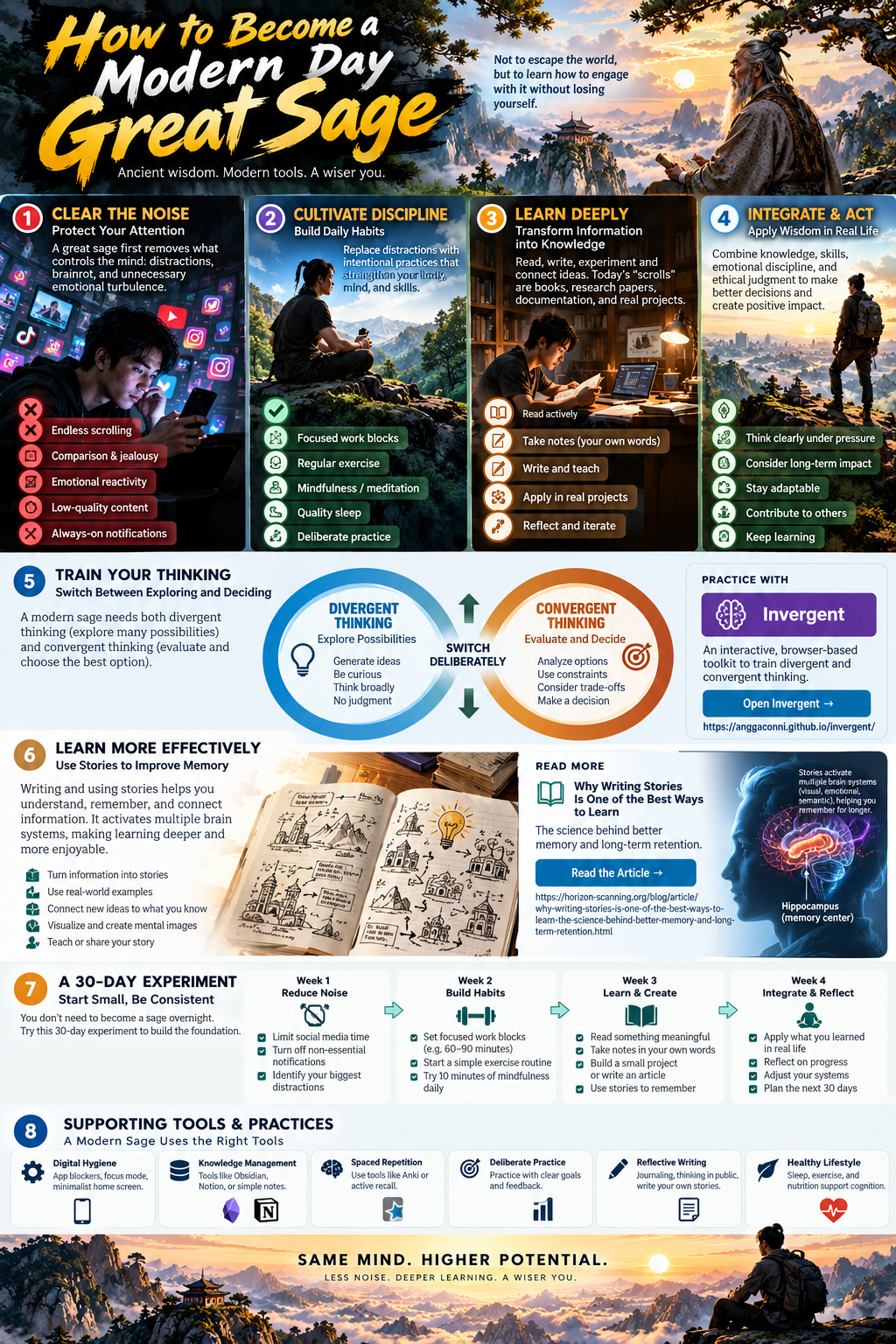
A practical roadmap: turn the metaphor into repeatable habits.
You do not need to wait for perfect conditions. Treat the next 30 days as an experiment in attention, learning, and practice—not a guaranteed brain transformation or a test of personal worth.
Days 1–7: Observe and clear
Notice your biggest sources of distraction. Choose one daily focus block. Write down one question you genuinely want to understand.
Days 8–14: Learn actively
Study one topic using reliable sources. After each session, retrieve the main points from memory and explain them in your own words.
Days 15–21: Generate and evaluate
Use divergent thinking to create several approaches to one problem. Then use convergent thinking to compare evidence, constraints, and trade-offs.
Days 22–30: Practice and integrate
Build a small output: an essay, prototype, map, analysis, lesson, or solution. Seek feedback, revise it, and record what the process taught you.
At the end of each week, ask yourself:
- What can I now explain or do that I could not do before?
- What did I retrieve from memory without looking at my notes?
- Which assumption changed because of new evidence?
- What mistake taught me the most?
- What is the next specific skill I should practice?
Keep the routine realistic. A shorter session that you can sustain may be more useful than an ambitious schedule that collapses after three days. Adjust the experiment to your responsibilities, energy, and circumstances.
12. What a Modern-Day Great Sage Is—and Is Not
A modern sage is...
- Curious but willing to question assumptions.
- Disciplined but capable of changing methods.
- Ambitious without being ruled by comparison.
- Knowledgeable while honest about uncertainty.
- Willing to practice, fail, receive feedback, and revise.
A modern sage is not...
- A person who knows everything.
- Someone who avoids all emotion or relationships.
- A person who consumes endless information without applying it.
- Someone who mistakes confidence for evidence.
- A person who believes one routine works for everyone.
Wisdom includes knowing when to act, when to wait, when to ask for help, when to change your mind, and when the available evidence is not enough to justify certainty.
Expertise is usually domain-specific: being excellent at one task does not automatically make someone wise in every other area. The aim is not to become a superhuman who can solve everything, but to build transferable habits of attention, learning, reasoning, and self-correction.
13. The Deeper Meaning of Cultivation
Return to the ancient images: the hermit on a mountain, the cultivator training alone, the scholar studying scrolls, and the sage who eventually acts with extraordinary clarity.
We can read these images as a sequence of questions for modern life:
- The Hermit asks: What deserves my attention—and what is merely consuming it?
- The Cultivator asks: Which ability am I building through deliberate practice?
- The Scholar asks: What do I actually know, and how do I know it?
- The Great Sage asks: Given what I know, what is the wisest action in this context?
In this interpretation, the scroll may be a scientific paper, a technical manual, a history book, or a carefully documented experiment. The mountain may be a quiet room, a library, a workshop, or an uninterrupted hour away from a feed. Cultivation may be writing, coding, researching, teaching, repairing, designing, or practicing a difficult skill.
The external symbols change. The deeper discipline remains: create space to think, learn what matters, practice what you learn, test it against reality, and revise your understanding when reality disagrees.
The modern Great Sage hypothesis:
A Great Sage is not merely someone who empties the mind, but someone who deliberately withdraws from unnecessary distractions and worldly attachments to cultivate knowledge, discipline, skills, and wisdom.
Do not simply consume more information. Learn to ask better questions, generate more possibilities, evaluate them carefully, practice deliberately, and use what you learn with humility.
Perhaps the real cultivation is this: stop letting every signal command your attention, and start deciding what kind of mind you want to build.
References and Further Reading
- Dunlosky, J., Rawson, K. A., Marsh, E. J., Nathan, M. J., & Willingham, D. T. (2013). Improving Students’ Learning With Effective Learning Techniques: Promising Directions From Cognitive and Educational Psychology. Psychological Science in the Public Interest, 14(1), 4–58.
- Carpenter, S. K., Pan, S. C., & Butler, A. C. (2022). The science of effective learning with spacing and retrieval practice. Nature Reviews Psychology, 1, 496–511.
- Weinstein, Y., Madan, C. R., & Sumeracki, M. A. (2018). Teaching the science of learning. Cognitive Research: Principles and Implications, 3, 2.
- Olivetti Belardinelli, M. et al. (2022). Divergent thinking and the core executive functions: a state-of-the-art review.
- Zhang, W., Sjoerds, Z., & Hommel, B. (2020). Metacontrol of human creativity: The neurocognitive mechanisms of convergent and divergent thinking. NeuroImage, 210, 116572.
- OECD. Divergent and convergent thinking: which tasks led to more creative ideas on the PISA test?
- Ericsson, K. A., Krampe, R. T., & Tesch-Römer, C. (1993). The Role of Deliberate Practice in the Acquisition of Expert Performance. Psychological Review, 100(3), 363–406.
- Ericsson, K. A., & Harwell, K. W. (2019). Deliberate Practice and Proposed Limits on the Effects of Practice on the Acquisition of Expert Performance. Frontiers in Psychology, 10, 2396.
- Saputra, A. C. Why Writing Stories Is One of the Best Ways to Learn: The Science Behind Better Memory and Long-Term Retention. Horizon Scanning.
