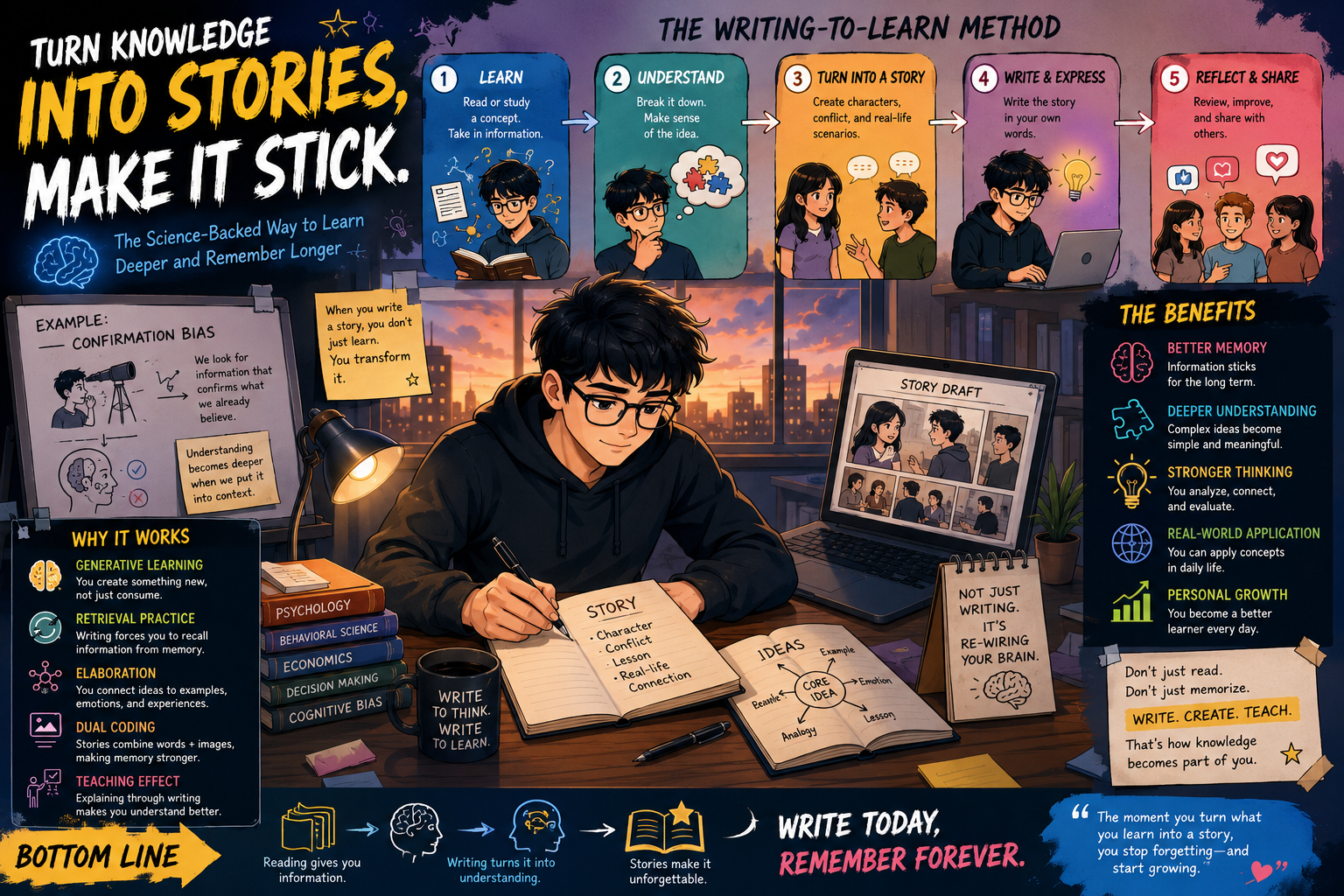
“I used to think I wrote because I enjoyed it. Later, I realized something surprising—I actually remember what I learn because I write.”
For years, I believed writing was simply a hobby.
Whenever I discovered an interesting concept—whether it was psychology, behavioral science, economics, or decision-making—I would read about it, then write an article or even turn it into a short story.
At first, I thought I was only creating content. Then I noticed something unusual. Months later, I could still explain concepts I had written about without reopening the original journal. Meanwhile, topics that I had only read quietly faded from memory.
That made me wonder: does writing actually improve learning?
According to cognitive science, the answer is yes. In fact, writing may combine several of the most effective learning strategies ever discovered.
Most People Read More, But Remember Less
Many learners believe that the secret to mastering a subject is simply reading more books. Read another article. Watch another lecture. Highlight another page.
Unfortunately, research in cognitive psychology suggests that passive exposure rarely creates durable memory. Reading is important. But reading alone often creates what psychologists call the illusion of competence.
The Illusion of Competence
Because the material feels familiar, we mistakenly believe we understand it deeply—until someone asks us to explain it. Suddenly, we realize we can't. Familiarity is fluent; fluency is not the same as understanding. The brain confuses recognizing an idea with being able to reconstruct it, which is why highlighted textbooks so often give a false sense of mastery.
Writing Forces Your Brain to Build Knowledge
Writing changes everything. Instead of consuming information, you must reconstruct it.
Imagine reading about the Barnum Effect. Reading alone might help you recognize the definition. Writing forces a completely different question: “How would this look in real life?” Now your brain begins creating examples, characters, dialogues, situations. Instead of memorizing a definition, you are constructing understanding.
Generative Learning
Educational psychologists call this Generative Learning. Learning becomes stronger when learners actively generate explanations, examples, or summaries rather than simply receiving information. The act of generating — not just absorbing — is what makes the knowledge yours.
Stories Give Knowledge a Home
Facts without context are surprisingly easy to forget. Stories give them somewhere to live.
Suppose someone asks me today, “What is the Barnum Effect?” I probably won't remember the exact sentence from a psychology textbook. Instead, I'll remember a fictional character named Ray reading a horoscope to Arjuna. The theory immediately comes back. The story becomes an anchor for memory.
Narrative Memory & Dual Coding
This is closely related to what psychologists describe as narrative memory and dual coding. Our brains tend to remember information more effectively when ideas become connected to mental images, characters, and emotional situations. Stories transform abstract theories into experiences — and experiences, unlike definitions, come with a beginning, a middle, and an end that the brain can walk back through.
Every Story Is Also Retrieval Practice
There is another reason writing works. When writing, you usually aren't copying a textbook word for word. You pause, think, then ask yourself: “What exactly was Confirmation Bias again?”
At that moment, your brain is retrieving information from memory.
Retrieval Practice
This process is called retrieval practice, one of the most well-supported learning strategies in cognitive psychology. Ironically, trying to remember information often strengthens memory more than reading it again. The effort itself — the small struggle of pulling a fact out of memory instead of having it handed back to you — is part of the learning process, not a sign that learning failed.
Explaining Is Learning
There is another fascinating phenomenon known as the Protégé Effect. Research has shown that people often learn more deeply when they expect to teach others.
Writing articles works similarly. Even if no one reads your work, your brain behaves as if it is preparing to explain the concept to another person. That expectation encourages deeper understanding. It is no longer enough to recognize a definition — you must understand it well enough to explain it clearly.
Connecting Ideas Creates Stronger Memory
One of the biggest differences between reading and writing is the number of connections your brain creates. When reading, you may simply encounter a concept. When writing, you naturally begin asking questions:
- How does this theory relate to real life?
- Have I ever experienced this?
- Could this explain something I once observed?
- How would I teach this to someone else?
Elaborative Encoding
Psychologists call this elaborative encoding. The more meaningful connections your brain creates, the easier it becomes to retrieve that information later. Knowledge stops being isolated. Instead, it becomes part of a network — and a network of ideas is far harder to forget than a single, unconnected fact.
Why I Turn Scientific Papers into Stories
Some people summarize journals. I prefer turning them into fiction.
A short story forces me to answer questions that textbooks rarely ask. How would this bias appear in a workplace? How would two people misunderstand each other because of it? How would someone emotionally react?
As I build the story, the theory slowly becomes intuitive. Eventually, I no longer remember the paper. I remember the characters. Ironically, the characters help me remember the science.
One Theory... Many Memory Paths
When I learn a new behavioral science concept, I rarely stop after reading. Instead, I often follow this process:
- 1Read a journal
- 2Understand the concept
- 3Rewrite it using simple language
- 4Create a fictional story
- 5Design an illustration
- 6Write a social media post
- 7Discuss it with readers
Notice what happened. The same idea has now been revisited from multiple perspectives. Each step becomes another opportunity to strengthen memory.
Multiple Retrieval Paths
Learning scientists sometimes describe this as creating multiple retrieval paths and multiple representations. The more ways your brain can access the same knowledge, the less likely it is to disappear. A fact stored in only one form has only one door back to it; a fact stored as a story, an image, and a conversation has many.
Perhaps We Have Been Studying Backwards
Schools often encourage students to read more, memorize more, highlight more. But perhaps one of the best questions isn't, “How much did you read?”
Instead, it might be: “What did you create from what you learned?”
Because the moment knowledge becomes something you can explain, something you can visualize, or even something you can turn into a story, it begins to belong to you.
My Favorite Way to Learn Behavioral Science
People sometimes ask me why I write so many articles. The answer is surprisingly simple: I don't write because I already know. I write because writing is how I learn.
Every article is another review session. Every story is another memory exercise. Every character is another psychological experiment.
Perhaps that is why I no longer see writing as content creation. I see it as cognitive training.
“Because sometimes, the best notebook isn't the one where information is stored. It's the one where information is transformed. And perhaps the best way to remember something isn't to read it one more time. It's to tell its story.”