Cognitive Psychology • Stress • Working Memory • Systems Thinking
Your brain is not literally a CPU, and IQ is not a battery percentage. But the computer analogy can help explain a useful idea: when attention and working memory are occupied by competing demands, fewer resources may remain available for the task in front of you.
Imagine you are trying to finish a difficult project. You must analyse information, remember instructions, solve errors, make decisions, and meet a deadline. Now add stress: you worry about failure, anticipate criticism, and replay every possible consequence. Then add concealment: you must remember what you told different people, which details you left out, and how to keep explanations consistent.
The original task has not become easier. You have simply added more processes for your mind to manage.
1. One interactive brain: from a problem to cognitive overload
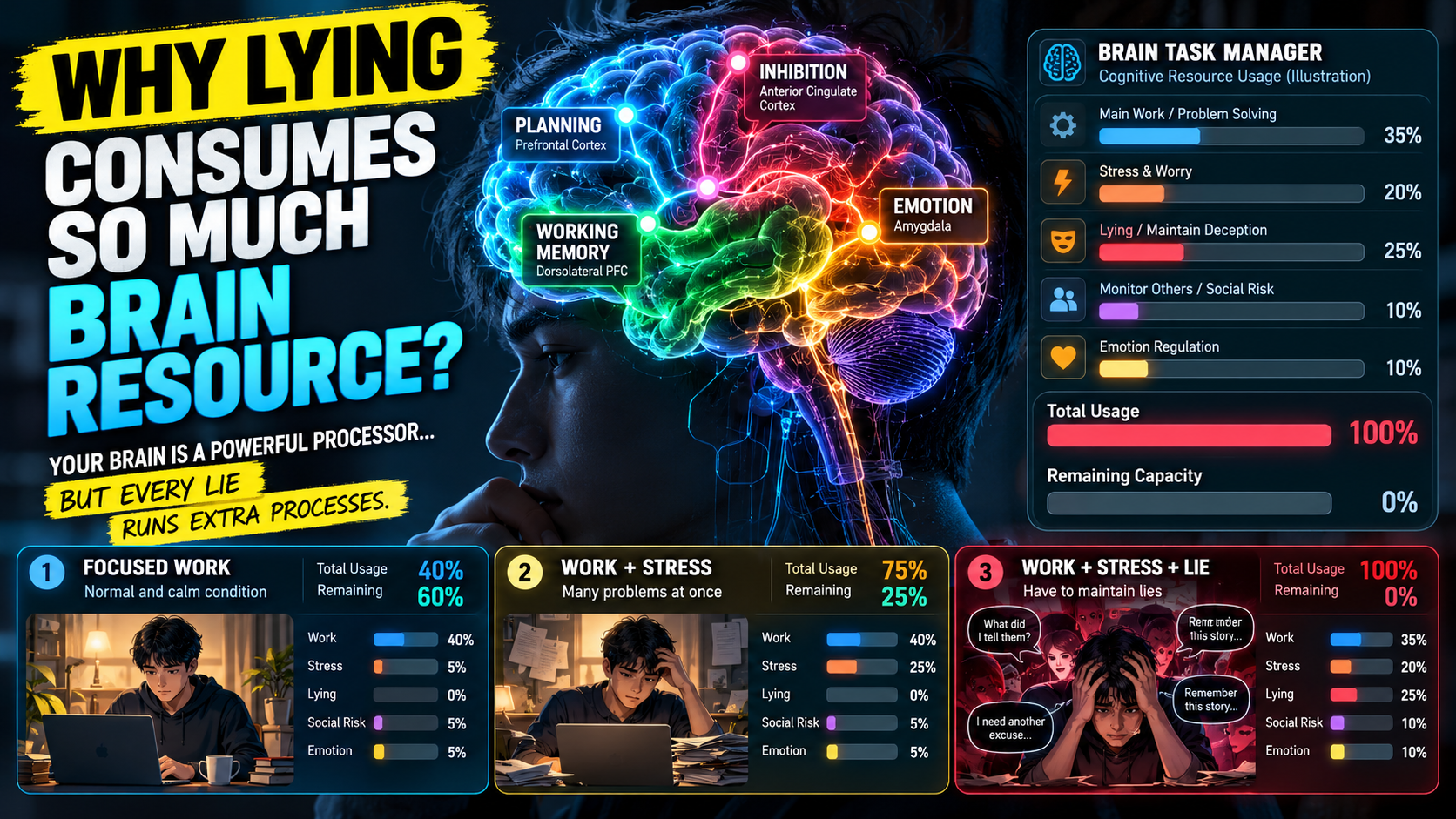
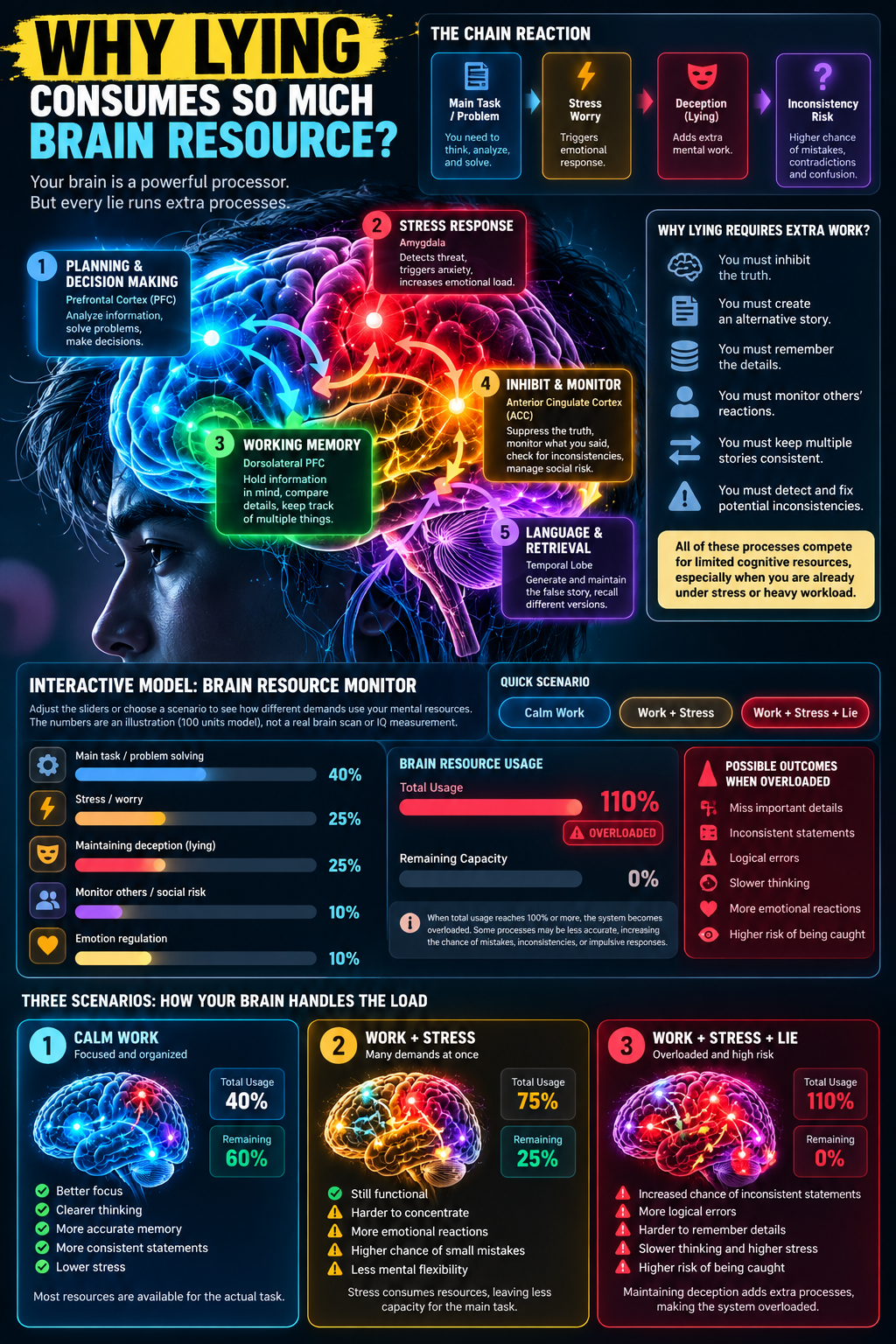
Use this single visual to follow the chain: a problem demands attention; stress adds worry and threat-monitoring; hiding the problem can add another task—maintaining a story. When the illustrative demand reaches the model's 100-unit reference, there may be no “headroom” left for unexpected details. Real people may then overlook information, contradict earlier statements, or make faulty connections—not because a lie always causes this, but because competing demands can strain attention and working memory.
Adjust the same live model
Total illustrative demand: 100 / 100 units · Remaining headroom: 0
At the reference limit: no headroom remains in this toy model.
The “100 units” are a teaching metaphor, not a measurement of IQ, brain energy, or an individual's mental capacity. When the model reaches the limit, it illustrates competition between demands—not a biological brain hitting a literal 100% cap.
3. Why stress can make thinking harder
Stress can redirect attention toward threats, consequences, and uncertainty. Some of that monitoring may be useful: noticing a real deadline or safety risk can help you respond. But persistent worry can also compete with the task you are trying to complete.
Think of a developer debugging an application. The developer needs to inspect logs, test hypotheses, and keep several technical details in working memory. If they are also worrying constantly about being blamed, they may find it harder to stay focused on the evidence. That does not prove their intelligence has fallen. It means the situation is demanding more from their attention and control.
Stress affects people differently. Its effects depend on intensity, duration, context, experience, and the task. The CPU analogy is useful for explaining competition between demands, but the brain does not literally allocate a neat percentage to “stress.”
4. Why maintaining a lie can add more processes
A simple false statement may be brief. A sustained deception can be more complicated, especially when a person has to keep multiple details consistent or conceal information from different people. Possible extra demands include:
- Constructing a version: deciding what to say instead of reporting what happened.
- Monitoring consistency: remembering what was said previously and to whom.
- Inhibiting the truth: stopping a well-practised or spontaneous truthful response from coming out.
- Tracking the listener: watching questions and reactions to decide whether the story needs further explanation.
- Managing consequences: anticipating discovery, judgement, or punishment.
- Justifying the choice: creating reasons that make the behaviour feel acceptable to oneself.
These processes are not equally present in every lie, and lying is not always more demanding than truth-telling in every context. Familiar, rehearsed, or low-stakes lies may be produced with little apparent effort. The strongest claim is narrower: complicated deception can impose extra cognitive demands, and competing tasks can interfere with some forms of dishonest responding.
5. What does the research say?
A study by van ’t Veer, Stel, and van Beest, published in Judgment and Decision Making, tested whether cognitive load affected dishonest reporting. In an experiment with 173 participants, people memorised either a short or a longer string of letters while reporting die-roll outcomes, one of which affected payment. In the high-load condition, the researchers did not detect the same pattern of dishonest reporting for the paid roll that appeared in the low-load condition.
The authors interpreted the result as evidence that limited cognitive capacity can interfere with certain forms of dishonesty. The study does not establish a universal law that every lie consumes a fixed amount of mental capacity, nor does it show that a person's resource use can be calculated as a percentage. Its findings are specific to the experimental setup and should be read alongside the broader, mixed research on deception and cognitive load.
Research on deception has also examined response time, pupil dilation, working memory, and brain activation. These measures can indicate differences in cognitive processing at group level, but no single cue reliably proves that a particular person is lying. A person who pauses, looks nervous, or struggles to explain something may be stressed, confused, tired, or afraid—not necessarily dishonest.
6. IQ is not a CPU percentage
The “100% resource” idea is a metaphor, not an IQ equation. IQ scores are standardised scores from specific tests; they are not a live gauge showing how much of someone's intelligence is available at a given moment. There is no scientifically valid conversion such as “50% resource remaining = 50% IQ.”
A more accurate way to express the idea is: your underlying ability may remain the same, while your performance on a particular task can be affected by distraction, stress, fatigue, competing memory demands, or uncertainty. Even that varies from person to person and task to task.
7. How to stop running unnecessary background processes
1. Pause before reacting
When pressure rises, take a short pause if the situation allows. A slower response can give you time to separate facts from fears and choose the next action deliberately.
2. Put the facts outside your head
Write down the actual problem, what is known, what remains uncertain, and the next step. Notes and checklists reduce the need to keep every detail active in working memory.
3. Replace a complicated cover story with a clear update
If you made a mistake, say what happened, what the impact is, what you have done so far, and what you will do next. You do not have to explain endlessly, and honesty does not require sharing irrelevant private details.
4. Ask for time or support when needed
If you are too overwhelmed to answer accurately, say that you need a little time to check the facts. If distress is severe or persistent, consider reaching out to someone you trust or a qualified professional.
5. Fix the original issue
Correct the error, communicate the risk, or ask for help with the task. Concealment may feel protective in the moment, but it can make the practical problem harder to diagnose and repair.
Conclusion: stop hiding, start solving
The processor analogy helps us picture how several demands can compete for limited attention and working memory. A difficult task already requires effort. Stress can add worry and threat-monitoring. A sustained lie can add the need to construct, remember, and maintain a consistent account.
That extra cognitive work may leave fewer resources for the original task—not because the person's IQ has literally dropped, but because their attention is divided. The interactive monitor above is only an illustration of this principle, not a diagnostic tool or a measurement of any individual's brain.
Do not spend the attention you need to solve a problem on maintaining a second problem created by hiding the first one. Be clear about what happened, focus on what can be corrected, and take one step at a time.
Sources and further reading
- van ’t Veer, A. E., Stel, M., & van Beest, I. — “Limited capacity to lie: Cognitive load interferes with being dishonest.” Judgment and Decision Making, 9(3), 199–206 (2014). The main experimental source on cognitive load and dishonest reporting.
- University of Amsterdam research repository record. A related academic source supplied for further reading.
- Frontiers in Psychology — article on deception and cognitive processing. Further context on the cognitive processes involved in deception.
Evidence note: the numerical resource bars are invented for educational illustration. The cited research supports a relationship between cognitive load and some dishonest behaviour under specific experimental conditions; it does not validate the percentages used in this simulation or establish a universal brain-resource formula.
