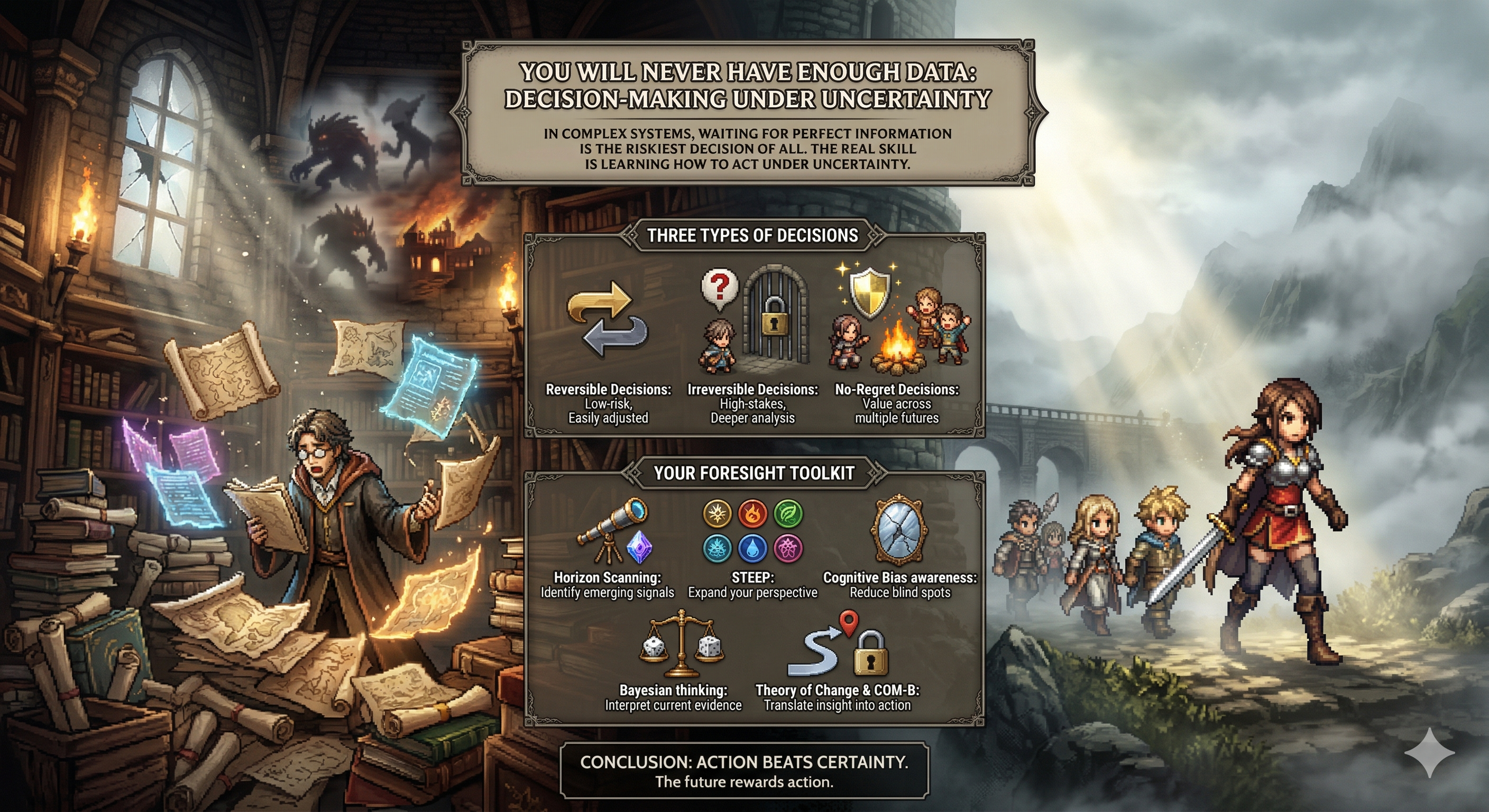
In an ideal world, decisions would be made with complete information, clear probabilities, and predictable outcomes. But in reality, especially in complex systems, this rarely happens.
Leaders, analysts, and policymakers are constantly forced to make decisions with incomplete data, conflicting signals, and high uncertainty.
The uncomfortable truth is this: you will never have enough data.
And waiting until you do may be the most dangerous decision of all.
The Illusion of Certainty
Many organizations fall into the trap of seeking perfect information before acting. They delay decisions, commission more studies, and wait for clearer signals.
But in fast-moving environments, certainty often comes too late. By the time a risk is fully understood, it has already materialized.
This creates a paradox: the desire for certainty increases the likelihood of failure.
Uncertainty is Not the Enemy
Uncertainty is often perceived as a problem to eliminate. In reality, it is a condition to navigate.
Foresight does not remove uncertainty—it helps us understand its structure. It allows us to distinguish between what is known, what is unknown, and what is unknowable.
The goal is not to predict the future perfectly, but to make better decisions despite uncertainty.
Three Types of Decisions
Not all decisions require the same level of certainty. Understanding this distinction is critical.
Reversible Decisions: Low-risk decisions that can be easily adjusted. These should be made quickly, even with limited data.
Irreversible Decisions: High-stakes decisions that are difficult to undo. These require deeper analysis, scenario planning, and stress-testing.
No-Regret Decisions: Actions that provide value across multiple possible futures. These are the most powerful tools in uncertain environments.
From Analysis to Action
The challenge is not just understanding uncertainty, but acting within it.
This is where your foresight toolkit comes together:
Horizon Scanning helps identify emerging signals.
STEEP expands your perspective.
Cognitive Bias awareness reduces blind spots.
Bayesian thinking helps interpret current evidence.
Theory of Change and COM-B translate insight into action.
Together, they create a system that allows you to move forward—even without perfect information.
The Courage to Decide
Ultimately, decision-making under uncertainty is not just a technical skill—it is a leadership trait.
It requires the courage to act without guarantees, to make informed bets, and to adapt as new information emerges.
The goal is not to be right all the time. The goal is to be less wrong, faster—and to recover quickly when needed.
Conclusion: Action Beats Certainty
In complex systems, inaction is not neutral—it is a decision with consequences.
Waiting for perfect data often means missing the window to act.
The organizations that thrive are not those that eliminate uncertainty, but those that learn to operate within it.
Because in the end, the future does not reward certainty—it rewards action.