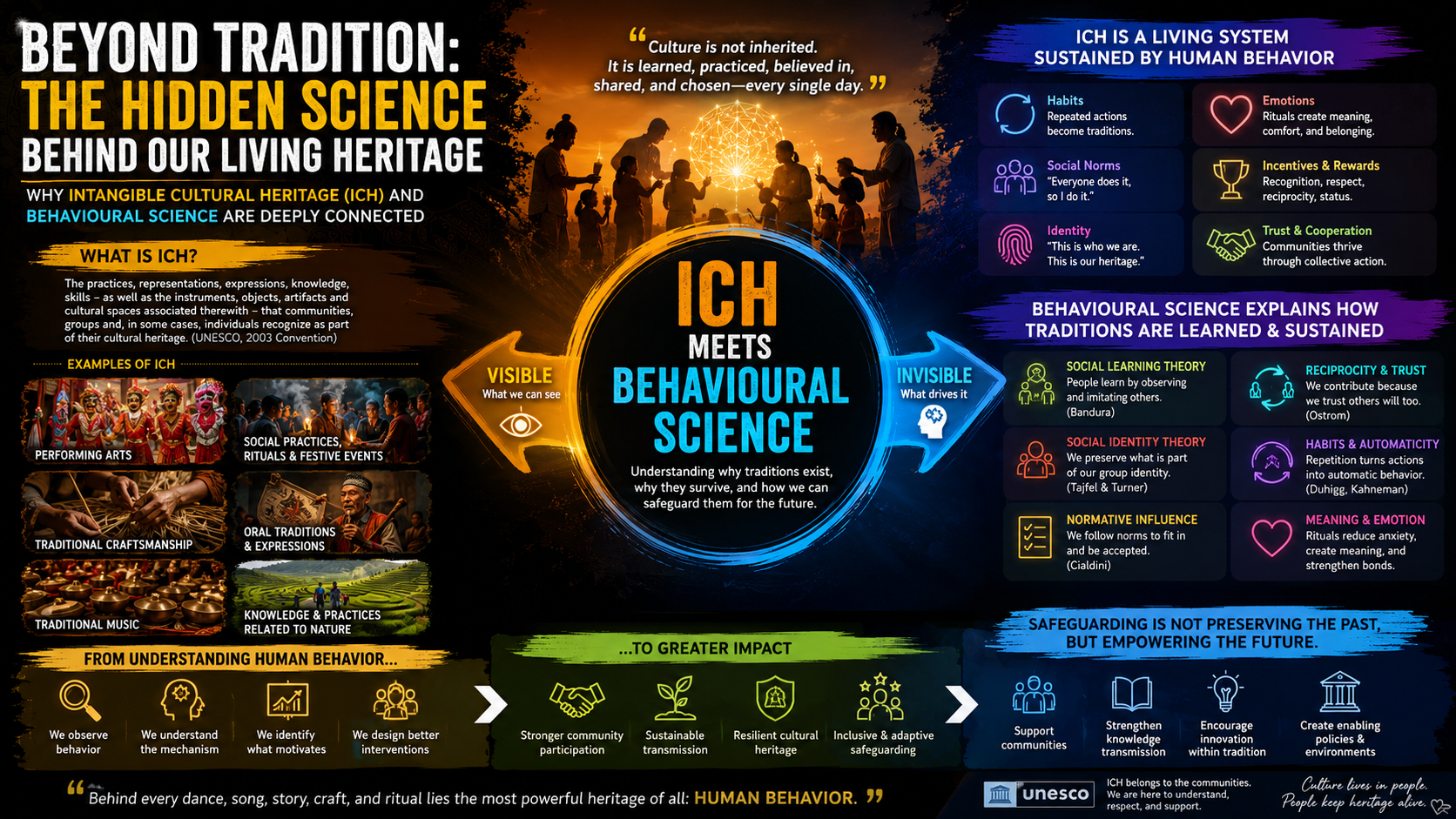
“Many people think Intangible Cultural Heritage is about traditional dances, music, rituals, festivals, oral traditions, or craftsmanship. Of course, it is. But to me, those are only the visible outcomes. What truly fascinates me is the invisible system behind them: human behavior.”
One of the reasons I have always been fascinated by Intangible Cultural Heritage (ICH) is probably different from what most people expect.
When someone says “heritage,” the mind reaches for objects and performances — a mask, a costume, a gamelan orchestra, a woven bag, a chant recorded on tape and archived in a national library. These are the things we photograph, inscribe, fund, and put on tourism brochures. They are real, and they matter. But they are also the output of something far less visible, and in my view far more interesting: thousands of small human decisions, repeated across generations, by people who could have chosen otherwise and didn't.
A dance does not survive because it is beautiful. It survives because, this year, enough people decided to rehearse it. A weaving technique does not survive because it is efficient. It survives because a grandmother had the patience to teach it and a teenager had a reason to sit still and learn. Strip away those decisions and the heritage evaporates — the costume becomes a display case exhibit, the chant becomes an audio file nobody plays.
That is why, for me, ICH has never really been a subject in the humanities. It is a behavioral question wearing a cultural costume.
A Lesson From My Father
Growing up, my father rarely taught me to memorize facts. Instead, he encouraged me to observe people.
One of the last lessons he gave me, a few months before he passed away in early 2009, was unexpectedly specific. He told me to study the story of a once-wealthy man who had nine wives — someone who, despite immense wealth, ended up with a tragic life marked by deception, loss, and an inability to sustain what he had built. The person I needed to study happened to be his neighbour — who, fortunately, was also the neighbour of my crush at the time.
The man was the son of a general, born into serious money. And by the time my father pointed him out to me, I could see exactly what he meant. The house was enormous — the kind of house that used to signal a family had made it — but it was falling apart. Paint peeling, gates rusted, the whole compound looking like nobody had the will to maintain it anymore. And there he was: a general's son, selling bread by the roadside from a beat-up bicycle, with three of his nine wives still beside him. The rest had already left.
My father never spelled out the moral. He just made me watch it — the size of the house against the state of the house, the wealth of the family name against the man pedaling bread down the street, the number of wives who stayed against the number who walked away. His message was never really about judgment. It was about awareness: that even those who appear powerful can be vulnerable, that abundance without discipline erodes itself, and that sensitivity must be balanced with inner strength.
From him, I learned to ask deeper questions:
- Why does someone behave this way?
- Why do people make irrational decisions?
- Why do communities cooperate?
- Why do traditions survive for centuries while others disappear within a generation?
Those questions stayed with me long before I formally studied public policy or worked with UNESCO. Looking back, I realize they were all behavioral questions.
What I've only understood as an adult is how deliberately my father taught — or rather, how deliberately he didn't. He almost never handed me a concept. He handed me a scene, a person, a contradiction, and then left. No explanation, no follow-up lecture. I was the one who had to sit with it, turn it over, and figure out what it meant. He gave me the raw material and made me build the theory myself, which, honestly, used to annoy me to no end — I'll admit that meeting him sometimes felt like a chore, because I knew I wasn't walking away with an answer, I was walking away with homework. It's a bit funny in hindsight: I was reluctant to see my own father because he kept forcing me to think instead of just telling me things.
It's only now, writing this, that I recognize what that method actually was. He wasn't teaching me facts about a neighbour. He was training me in exactly the kind of reasoning behavioral science formalizes decades later — observe the behavior first, resist the urge to explain it away, and only then go looking for the mechanism underneath. He never used words like “cognitive dissonance” or “status erosion.” He just made sure I'd never forget what an unmaintained mansion and a bicycle full of bread looked like standing next to each other.
Observational Learning, Before I Had a Name For It
There is a quiet irony here. My father was teaching me through modeling and observation — the exact mechanism Albert Bandura described in Social Learning Theory (1977) — while teaching me to study observation itself. He never assigned a reading. He assigned a person to watch. The method and the subject were the same thing. Decades later, when I encountered Bandura formally, it didn't feel like learning something new; it felt like finally reading the manual for a machine I'd already been operating.
What Behavioral Science Actually Asks
Behavioral science asks a deceptively simple question: why do humans do what they do? It combines insights from psychology, sociology, economics, neuroscience, anthropology, and decision science to understand how people make decisions, develop habits, cooperate with others, and adapt to change.
The field's central insight is that behavior is rarely the product of pure reasoning. It is the product of context — of what is easy, what is expected, what is visible, what feels like “who we are,” and what other people around us appear to be doing. Change the context and the behavior changes, often without anyone's stated values changing at all.
Interestingly, those are also some of the same questions we encounter when studying Intangible Cultural Heritage. A tradition is, functionally, a behavior that has been successfully reproduced for a very long time. Which means every surviving tradition is also a case study in sustained behavior change — arguably the hardest problem in the entire behavioral field, solved repeatedly by communities that never read a single paper about it.
A short public introduction to living heritage
The Same Ritual, Different Questions
Take a traditional ceremony, for example. Put six specialists in the same room, show them the same three hours of ritual, and you will get six different research agendas.
- An anthropologist may ask: “What does this ritual symbolize?”
- A historian may ask: “How did this tradition emerge?”
- A linguist may ask: “How has the language evolved?”
- A policy maker may ask: “What instrument protects this, and what does it cost?”
- The community itself may ask something the others rarely think to: “Who will still be doing this in twenty years?”
A behavioral scientist, however, might ask something different again:
- Why do people continue participating?
- Why do younger generations choose to preserve it?
- What motivates knowledge transmission?
- Which social norms encourage participation?
- How does identity influence commitment?
- Why do some traditions become stronger while others gradually disappear?
The questions are different. Yet they complement one another. The anthropologist explains the meaning, the historian the origin, the linguist the medium, the policy maker the protection — and the behavioral scientist explains the engine. Without the engine, everything else is documentation of something already stopping.
Culture Survives Because People Choose to Keep Practicing It
This is one reason I believe behavioral science offers a valuable lens for understanding ICH.
Traditions are not merely inherited. They are continuously recreated through countless human decisions. Every generation decides — consciously or unconsciously — whether to preserve, modify, or abandon a cultural practice. And crucially, most of those decisions are never framed as decisions at all. Nobody sits down and formally resolves to let a tradition die. It dies the way most things die: through a hundred small, individually reasonable choices to do something else this weekend.
In other words, culture survives because people choose to keep practicing it. And that reframing has consequences. If heritage is a stock of objects, safeguarding is a storage problem — build better archives, better museums, better inventories. But if heritage is a flow of decisions, safeguarding becomes a behavioral problem: what makes the next decision, by the next person, more likely to be “yes”?
Stock vs. Flow: Why the Distinction Matters
Tangible heritage is largely a stock — a temple exists whether or not anyone visits it this year. Intangible heritage is a flow — it exists only while it is being performed, taught, and re-performed. Stocks decay slowly and visibly. Flows can stop almost instantly and invisibly: a practice can have zero living transmitters while still appearing on every official inventory list. This is why inventory alone is never safeguarding.
The Theories Behind the Choice
Behavioral science provides several theories that help explain this phenomenon. I originally leaned on three of them. Rereading my own reasoning, I realized the picture was incomplete without three more — one about how culture is inherited across generations, one about why people keep participating even when no one is watching, and one about how a community governs a shared resource without anyone owning it outright. Then, writing this expanded version, I found three more still that I had been using implicitly without ever naming.
What follows is not a literature review for its own sake. Each theory answers a specific question that the others cannot.
1. Social Learning Theory — Albert Bandura (1977)
Bandura's theory explains that people learn largely by observing others, not by being formally instructed. Children rarely learn traditions from textbooks. They watch. They imitate. They practice. Eventually, traditions become habits — reinforced not by punishment or reward, but by the simple fact that they were modeled by someone the child trusts.
The practical implication for heritage is blunt: if there is no visible practitioner, there is no transmission. Documentation cannot model behavior. A video archive of a master weaver is not a substitute for a master weaver sitting in a room with a child, because Bandura's mechanism requires attention, retention, reproduction, and motivation — and motivation, in his model, comes largely from watching someone you identify with succeed at it.
Answers: How is the practice acquired in the first place?
A short, clear explanation of Bandura’s Social Learning Theory
2. Social Identity Theory — Henri Tajfel & John Turner (1979)
Tajfel and Turner argued that people derive part of their self-concept from the groups they belong to. Being Javanese. Being Balinese. Being Māori. Being Sami. Being part of a community creates a psychological motivation to preserve what defines that community. Traditions become part of who people believe they are — so abandoning a tradition can feel like abandoning a piece of the self.
This explains something otherwise puzzling: why heritage revival movements often surge precisely when a community feels threatened, marginalized, or displaced. Identity salience rises under threat, and practices that mark identity become more valuable, not less. It also explains the inverse — why traditions can fade fastest not under repression but under comfortable assimilation, when the group boundary stops feeling relevant to anyone's sense of self.
Answers: Why would anyone bear the cost of continuing?
3. Normative Social Influence — Deutsch & Gerard (1955); Cialdini & Trost (1998)
This explains why communities maintain customs even without formal enforcement. People often follow traditions because everyone else does, and because deviating carries a quiet social cost. Social expectations can be more powerful than written regulations — a village doesn't need a law requiring people to attend a harvest ritual; it needs enough people who would notice if you didn't.
Cialdini's later refinement matters here: there is a difference between a descriptive norm (what people actually do) and an injunctive norm (what people believe ought to be done). Heritage practices in decline often retain a strong injunctive norm long after the descriptive norm has collapsed — everyone agrees the ritual is important, and almost nobody attends. When those two diverge, the injunctive norm alone rarely holds the practice up for long.
Answers: Why does it persist without enforcement?
4. Cultural Evolution / Dual Inheritance Theory — Boyd & Richerson (1985); Cavalli-Sforza & Feldman (1981)
This is the theory I was missing. Boyd, Richerson, and colleagues proposed that culture behaves like a second inheritance system running alongside genes — practices are copied, sometimes with small errors or deliberate modifications, and the variants that spread are the ones people find easiest to learn, most prestigious to imitate, or most useful to keep. This is why a ceremony performed today rarely looks identical to the one performed a century ago, yet is still recognizably “the same” tradition. Living heritage isn't a copy-paste process; it's a selection process, generation after generation.
Two of their transmission biases are especially relevant to safeguarding. Prestige-biased transmission means people copy whoever appears successful or high-status — which is why a tradition tied to respected figures spreads, and a tradition associated with poverty or backwardness contracts, regardless of intrinsic merit. Conformist transmission means people copy the majority — which creates threshold effects: above a certain participation level a practice is self-sustaining, below it collapse accelerates.
Answers: Why does it change while staying the same thing?
5. Self-Determination Theory — Edward Deci & Richard Ryan (1985)
Deci and Ryan's theory holds that human motivation is strongest when three needs are met: autonomy, competence, and relatedness. This explains a pattern I have seen repeatedly in heritage work: younger generations rarely disengage from a tradition because they dislike it — they disengage when participation feels imposed, when they never get good enough at it to feel competent, or when it no longer connects them to people they care about.
Safeguarding heritage, in this light, is partly a design problem: how do you let a teenager feel ownership, mastery, and belonging inside a practice their grandparents started? Note the sequencing trap here — many programs deliver relatedness (community events) and demand participation (obligation), while completely neglecting competence. A child who is repeatedly the worst performer in a ritual is receiving a steady signal that this is not for them, no matter how warmly they are welcomed.
Answers: Why do individuals sustain effort over years?
6. Collective Action and Common-Pool Resources — Elinor Ostrom (1990)
Ostrom studied how communities successfully manage shared resources — fisheries, forests, irrigation systems — without either privatizing them or destroying them through overuse. Intangible heritage behaves similarly. No single person owns a ritual, a dance, or an oral tradition, yet its survival depends on enough people continuing to invest effort in it. Ostrom's work on self-organized rules, mutual monitoring, and graduated social sanctions offers a surprisingly literal template for how ICH communities keep a shared practice alive without top-down control.
Her design principles map onto heritage almost line by line: clearly defined boundaries (who is a legitimate transmitter?), rules matched to local conditions (who may perform which part, and when?), collective-choice arrangements (do practitioners get to modify the practice?), monitoring, graduated sanctions, cheap conflict resolution, and — critically — recognition of the community's right to organize itself. That last principle is where external safeguarding interventions most often go wrong: a well-funded program that takes decision rights away from practitioners can degrade the commons it was designed to protect.
Answers: Who coordinates the upkeep of something nobody owns?
A concise introduction to Elinor Ostrom’s work on governing the commons
7. Costly Signaling and Ritual — Irons (2001); Sosis & Bressler (2003)
Here is a theory I had been using without naming it. Why are so many heritage practices expensive — long rehearsals, painful initiations, elaborate offerings, months of preparation for a single day? From a pure efficiency standpoint, this looks irrational. From a signaling standpoint, the cost is the function.
Sosis and Bressler's cross-cultural study of 19th-century American communes found that those imposing more costly requirements survived significantly longer. The reasoning: only genuinely committed members will pay a high entry cost, so costly ritual filters free-riders and produces reliable, trustworthy cooperation. This has a sharp and uncomfortable implication for safeguarding — “simplifying” a tradition to make it more accessible can remove the very mechanism that made it bind people together. Convenience and commitment are frequently in tension.
Answers: Why is the practice so demanding, and why does that help it survive?
8. Collective Memory and Transactive Systems — Halbwachs (1925); Wegner (1987)
Maurice Halbwachs argued that memory is not stored individually but reconstructed socially — we remember through the frameworks, occasions, and groups that prompt us. Daniel Wegner's later concept of transactive memory formalized a related idea: groups distribute knowledge across members, so that no single person holds the whole, but the group collectively does, provided everyone knows who knows what.
This explains one of the most under-appreciated fragilities in ICH. A tradition can be functionally lost even while most of it survives, because the index is gone — the person who knew which elder held which portion of the chant, which family had rights to which section of the ceremony. Losing three specialists in a village of two hundred can be more destructive than losing thirty non-specialists. Safeguarding must therefore map not just the knowledge, but the distribution of it.
Answers: Where does the knowledge actually live, and how does it get lost?
9. Habit, Context, and Choice Architecture — Wood & Neal (2007); Thaler & Sunstein (2008)
Finally, the least romantic and possibly most decisive mechanism: habit. Wendy Wood and David Neal's research shows that a large share of daily behavior is cued automatically by stable context rather than chosen deliberately. Traditions that are tied to fixed cues — a harvest date, a lunar calendar, a Friday evening, a specific building — get re-triggered without anyone deciding to trigger them. Traditions that lose their cue must be actively remembered, and actively remembered behavior is fragile behavior.
This is why urbanization and migration are so corrosive to ICH even when values are fully intact. Nobody in the family changed their mind about the ritual; they simply moved somewhere the cue no longer fires. And it is why the most effective interventions I've seen were not persuasive campaigns but context repairs: restoring the calendar slot, rebuilding the shared space, embedding the practice in the school year — Thaler and Sunstein's choice architecture applied to heritage rather than to pensions.
Answers: Why do practices vanish even when people still believe in them?
Nine Theories, Four Levels of Analysis
These theories are not rivals. They sit at different levels. Individual mind: Bandura (acquisition), Deci & Ryan (motivation), Wood & Neal (habit). Group: Tajfel & Turner (identity), Deutsch & Gerard / Cialdini (norms), Halbwachs & Wegner (distributed memory). Institution: Ostrom (governance), Irons & Sosis (signaling and commitment). Population over time: Boyd & Richerson (selection and variation). A safeguarding plan that only operates at one level will be defeated by the levels it ignored.
How These Theories Actually Correlate
Listing nine theories side by side makes them look like nine separate explanations competing for the same phenomenon. They aren't. Each theory operates on a different unit of analysis — the individual mind, the group, the population, the resource system — and they hand off to one another in a fairly precise sequence. Mapping that sequence is where the real explanatory power sits.
Here is the core loop, stated as a chain of handoffs:
- Bandura → Tajfel & Turner. Observational learning doesn't happen at random. Children preferentially imitate people who belong to their own group — parents, elders, respected community members. So Social Learning Theory doesn't just produce a skill; it produces a skill tagged with group membership. That tagging is what Social Identity Theory picks up: the practice becomes evidence of “who we are,” not just “what we know how to do.”
- Tajfel & Turner → Deutsch & Gerard / Cialdini. Once a practice is fused with identity, deviating from it stops being a neutral choice and starts carrying social cost. This is precisely the mechanism behind normative social influence: people conform not because they're persuaded the norm is correct, but because breaking it threatens their standing inside a group they already care about belonging to.
- Normative influence → Cultural Evolution Theory. Norm strength acts as a selection pressure. Boyd and Richerson's model of cultural transmission needs some mechanism to decide which variants of a practice get copied and which die out — normative pressure is one of the strongest such filters, alongside prestige-biased and conformist transmission. A ritual detail that violates a strong norm gets edited out within a generation; one that reinforces group belonging gets amplified.
- Cultural Evolution Theory → Deci & Ryan. A variant can only be copied if someone is motivated enough to learn it well and pass it on. This is where Self-Determination Theory enters: cultural evolution needs willing carriers, and willingness depends on whether the practice still delivers autonomy, competence, and relatedness to the people learning it. A technically “fit” tradition can still go extinct if it stops meeting those three needs.
- Deci & Ryan → Ostrom. Individual motivation is necessary but not sufficient — someone still has to coordinate rehearsal schedules, teaching turns, material costs, and access to sacred or restricted knowledge. Ostrom's commons framework explains how a community converts many individually motivated people into a functioning, self-governed system of upkeep, without a central authority issuing orders.
- Ostrom → Bandura. A well-governed commons keeps producing visible, successful practitioners — elders who are still weaving, still dancing, still leading the ritual correctly. Those practitioners are exactly the role models Social Learning Theory requires. This closes the loop: governance sustains the models, and the models restart observational learning in the next generation.
The three theories I added later do not sit on the ring. They act on it — as modifiers that can strengthen or break the loop from the outside:
- Costly signaling (Irons, Sosis) amplifies the identity→norm segment. The more a practice costs, the stronger the signal of commitment, and the more credible the group boundary becomes. Remove the cost to boost accessibility, and you weaken the very link that made participation meaningful.
- Transactive memory (Halbwachs, Wegner) sits underneath the Ostrom→Bandura segment. Governance can only reproduce role models if the knowledge distribution map is intact. Lose the index of who knows what, and the commons still functions socially while the content quietly hollows out.
- Habit and context (Wood & Neal, Thaler & Sunstein) gate the entire loop's frequency. Cues determine how often the loop runs at all. A loop that would be perfectly healthy at twelve iterations a year can die at one, simply because the calendar slot disappeared. This is the modifier most often missing from safeguarding plans, because it is the least visible and the least romantic.
And two connections cut across the ring rather than running along it. These matter because they explain tension, not just reinforcement:
- Social Identity ↔ Ostrom (reinforcing). Group identity is often the reason Ostrom's “self-organized rules” work without formal enforcement in the first place — people monitor each other and accept graduated sanctions precisely because breaking a shared-resource rule feels like betraying the in-group, not just breaking a policy.
- Normative Influence ↔ Self-Determination (a genuine friction point). This is the one place the theories pull against each other. Deci, Koestner, and Ryan's well-known meta-analysis on the “over-justification” and “crowding-out” effect shows that when external pressure to conform becomes too strong or too controlling, it can quietly erode the intrinsic motivation SDT says is needed for long-term engagement. In practice, this is why heritage programs that rely purely on obligation — “you must participate because it's expected of you” — often produce compliant children who stop practicing the moment the obligation is lifted, while programs that also protect a sense of choice tend to produce adults who keep practicing on their own.
From Correlation to Loop
Once you see the theories as a correlated system rather than a shelf of separate explanations, the six-step behavioral cycle below stops looking like a metaphor and starts looking like a mechanism — each step is simply the correlation above, restated as a stage a real person moves through.
Read it as a lifecycle. A child observes. The child imitates until the movement becomes automatic. Somewhere in the repetition, the practice stops being a skill and starts being a marker of self. Once it marks the self, the group begins to expect it. Expectation filters which versions survive. Survival requires people willing to coordinate the upkeep. And upkeep produces the visible masters that the next child observes.
The important property of a loop is that it can be broken at any single point. You do not need a war or a ban to end a tradition. You only need one link to fail for one generation — no visible practitioners, or no felt identity, or no shared expectation, or no motivated learners, or nobody willing to organize the rehearsal. That is the entire safeguarding challenge, stated structurally.
What Behavioral Economics Adds
Behavioral economics contributes another perspective. Humans are not perfectly rational decision-makers. Our decisions are shaped by habits, emotions, trust, reciprocity, identity, and social expectations. Many cultural practices endure not because people calculate their economic value, but because they strengthen relationships, reinforce belonging, and create meaning — the same non-market motivations that Richard Thaler and Daniel Kahneman spent their careers documenting in ordinary economic life.
Three specific findings from that literature translate almost directly into heritage work.
Loss aversion. Kahneman and Tversky showed that losses loom roughly twice as large as equivalent gains. This explains why framing matters enormously in safeguarding communication: “we are about to lose the last three people who know this chant” mobilizes a community in a way that “learning this chant would enrich you” almost never does. It also explains a less flattering pattern — heritage attention tends to arrive late, because urgency is generated by imminent loss rather than by slow decline.
Present bias and hyperbolic discounting. Transmission is a classic intertemporal problem: the cost is paid now (hours of teaching, hours of practice) while the benefit accrues decades later, often to someone else. Rational actors would still invest; real actors systematically under-invest. This is not a values failure. It is a discounting failure, and it responds to design — shortening the feedback loop, creating visible near-term milestones, giving learners something to perform within months rather than years.
Crowding-out of intrinsic motivation. Perhaps the most important warning for anyone designing heritage incentives. When payment or external reward is introduced for something previously done for meaning, the meaning-based motivation can be displaced rather than supplemented. Well-funded programs sometimes leave communities less able to sustain a practice once funding stops than they were before it started — because the practice was quietly reclassified in participants' minds from “something we do” to “a job we were paid for.”
The Incentive Paradox in Safeguarding
Money and formal recognition can rescue a dying practice — or hollow it out. The determining variable is usually whether the intervention enables the community's own motivation (paying for materials, protecting time, restoring the venue) or replaces it (paying per performance, making participation contingent on external reward). The first strengthens Ostrom's commons. The second converts practitioners into contractors, and contracts end.
Living Heritage, Not a Museum Artifact
This perspective also changes how we think about safeguarding heritage. UNESCO's 2003 Convention does not aim to freeze traditions in time. It defines intangible cultural heritage as practices, representations, expressions, knowledge, and skills that communities recognize as part of their own heritage — heritage that is transmitted from generation to generation and continuously recreated in response to the community's environment and history[1].
Communities innovate. Communities adapt. Communities reinterpret. Safeguarding therefore is not about preserving a museum artifact. It is about supporting the people who continue practicing, transmitting, and reinventing their heritage — the “people, resilience, and knowledge passed on from generation to generation” that the Convention itself centers[2].
Notice how well this aligns with cultural evolution theory. The Convention's insistence on “continuously recreated” is, in behavioral terms, an acknowledgment that variation is not a defect to be corrected but the mechanism by which a practice remains learnable and relevant. A tradition frozen at one historical moment is a tradition denied the ability to adapt — which, evolutionarily, is a tradition scheduled for extinction the moment its environment changes.
This is where behavioral science becomes particularly relevant. If we understand why communities participate, why younger generations disengage, why certain incentives encourage transmission, or why trust influences collective action, then safeguarding strategies become far more effective. We move beyond documenting traditions. We begin understanding the human behaviors that keep traditions alive.
It also gives us a sharper diagnostic vocabulary. Instead of the blunt verdict “this tradition is endangered,” we can ask which link is failing: Is it an observation problem (no masters left visible)? A competence problem (learners never get good enough to enjoy it)? A cue problem (the occasion that used to trigger it no longer exists)? A governance problem (nobody has authority to schedule and resolve disputes)? A norm problem (attendance has quietly become optional)? Each diagnosis implies a completely different intervention — and the wrong intervention on the right problem is simply money spent to feel active.
A Small Example From Everyday Life
I saw a version of this loop firsthand in something far more ordinary than any formal program: the way my extended family still makes and shares a particular weekend dish that my grandmother used to prepare every Sunday.
Nobody ever sat down and declared “we must preserve this recipe.” It simply kept happening. The children watched. They helped stir. Later they cooked it themselves when they had their own kitchens. The dish became a quiet marker of belonging — “this is how we eat on Sundays.” When someone moved to another city, they still cooked it on the same day, sometimes alone, sometimes inviting new friends. The social norm was never written down; absence was simply noticed. The competence grew slowly, through repetition, until the younger ones could do it without asking. And the cue was ironclad: Sunday afternoon, the same kitchen smells, the same shared table.
Two details stayed with me, because both were behavioral rather than culinary.
First, the cue mattered more than the recipe book. When the family stopped gathering on Sundays for a few years (work, distance, life), the practice nearly vanished even though everyone still loved the food. Re-establishing a fixed recurring slot did more for continuity than any amount of nostalgic talk. Wood and Neal would have predicted this: a behavior tied to a stable context repeats itself; a behavior dependent on remembering to feel inspired does not.
Second, visible mastery had to be local. A child watching a celebrity chef on television does not receive the same signal as a child watching an aunt or uncle finish the dish in the same kitchen. Bandura’s model is explicit that identification with the model drives motivation. Prestige-biased transmission adds the other half: if the only people who ever demonstrate the skill are distant experts or influencers, the implicit message is that this belongs to someone else, not to the child’s own household.
Neither insight required inventing anything new. Both required noticing which link in the loop was actually loose — the exact discipline my father had drilled into me by making me stare at a peeling mansion and a bicycle full of bread until I worked out what connected them.
Another quiet example came from something I chose to do regularly in daily life at the workplace. I had heard, more than once, that wearing traditional regional clothing to the office was somehow embarrassing — something better reserved for ceremonies or designated cultural days. I disagreed. So I wore it. Not as a one-time statement, but repeatedly, walking the corridors and meeting rooms of the building without apology or special explanation.
The point was never to lecture anyone. It was simply to make the alternative visible. According to Bandura, people learn not only from formal instruction but from models they can identify with. By treating traditional dress as ordinary professional clothing, the perceived social cost of the behavior began to drop for anyone watching. Social Identity Theory explains why the act carried weight: the clothes were not decoration; they were a public claim of belonging. And the quiet resistance to the “shame” norm illustrated how descriptive norms (what people actually do) can slowly shift when one person consistently models a different choice without demanding that others follow.
No campaign was needed. The modeling itself was the intervention. In the language of the theories above, it was a small, repeated act of identity expression that also served as costly signaling — the willingness to absorb a potential social cost in order to keep a cultural practice ordinary rather than exceptional.
Modeling Without a Speech
When a behavior is widely believed to be “embarrassing,” the fastest way to weaken that belief is not to argue against it. It is to perform the behavior calmly, repeatedly, and in plain sight. The observer updates two things at once: the descriptive norm (“people like me actually do this”) and the social cost estimate (“the sky did not fall”). That dual update is pure Bandura plus Social Identity Theory in action.
Different Disciplines, the Same Human Story
The more I studied public policy, psychology, behavioral science, and cultural heritage, the more I noticed something interesting. At first glance, these disciplines seem unrelated. But they all revolve around one fundamental subject: people.
Public policy attempts to influence behavior. Behavioral science explains behavior. Culture shapes behavior. Heritage preserves behaviors across generations. Different disciplines. The same human story.
Which is also why the boundaries between them are, in practice, artificial. A safeguarding plan is a policy instrument. A policy instrument is a behavioral hypothesis. A behavioral hypothesis about a community is, inevitably, a cultural claim. Anyone who works seriously on one end of that chain ends up working on all of it, whether or not they have the vocabulary for it.
Closing
Perhaps that is why ICH has always fascinated me. Not because traditions are old. But because every tradition is evidence of thousands of human decisions accumulated over generations.
Behind every dance, every song, every ritual, every craft, lies an invisible network of psychology, social norms, trust, cooperation, identity, memory, and collective behavior.
And there is something quietly humbling in that. Communities with no access to Bandura, Ostrom, or Deci and Ryan have been solving the hardest problems in behavioral science for centuries — sustaining cooperation without enforcement, transmitting complex skills without formal schooling, governing shared resources without ownership, and maintaining motivation across generations without incentives. The theories did not create these solutions. They arrived late, and are still catching up to describe what practitioners already knew how to do.
To me, Intangible Cultural Heritage is not only about preserving culture. It is also one of the most fascinating ways to understand humanity itself.
The Reflection in One Sentence
A tradition is not an object we inherit; it is a decision we keep making — and safeguarding it means understanding, honestly and mechanically, why the next person would choose to make that decision again.
“My father never used the words ‘social learning’ or ‘collective action.’ He just made me watch people until I understood that behavior always has a mechanism underneath it. Everything I do with heritage is still that same assignment.”
#UNESCO #IntangibleCulturalHeritage #ICH #BehavioralScience #Psychology #PublicPolicy #SocialScience #CulturalHeritage #HumanBehavior #Culture #Anthropology #SocialNorms #KnowledgeTransmission #CollectiveBehavior #LivingHeritage #BehavioralEconomics #Ostrom #Bandura
References
- UNESCO. Text of the Convention for the Safeguarding of the Intangible Cultural Heritage (2003), Article 2.
- UNESCO. 2003 Convention for the Safeguarding of the Intangible Cultural Heritage — overview, International Scientific Committee on Cultural Landscapes.
- Bandura, A. (1977). Social Learning Theory. Prentice Hall.
- Tajfel, H., & Turner, J. C. (1979). An integrative theory of intergroup conflict. In The Social Psychology of Intergroup Relations.
- Deutsch, M., & Gerard, H. B. (1955). A study of normative and informational social influences upon individual judgment. Journal of Abnormal and Social Psychology.
- Cialdini, R. B., & Trost, M. R. (1998). Social influence: Social norms, conformity, and compliance. In The Handbook of Social Psychology.
- Boyd, R., & Richerson, P. J. (1985). Culture and the Evolutionary Process. University of Chicago Press.
- Cavalli-Sforza, L. L., & Feldman, M. W. (1981). Cultural Transmission and Evolution: A Quantitative Approach. Princeton University Press.
- Henrich, J., & Gil-White, F. J. (2001). The evolution of prestige. Evolution and Human Behavior.
- Deci, E. L., & Ryan, R. M. (1985). Intrinsic Motivation and Self-Determination in Human Behavior. Plenum.
- Deci, E. L., Koestner, R., & Ryan, R. M. (1999). A meta-analytic review of experiments examining the effects of extrinsic rewards on intrinsic motivation. Psychological Bulletin.
- Ostrom, E. (1990). Governing the Commons: The Evolution of Institutions for Collective Action. Cambridge University Press.
- Irons, W. (2001). Religion as a hard-to-fake sign of commitment. In Evolution and the Capacity for Commitment. Russell Sage Foundation.
- Sosis, R., & Bressler, E. R. (2003). Cooperation and commune longevity: A test of the costly signaling theory of religion. Cross-Cultural Research.
- Halbwachs, M. (1925/1992). On Collective Memory. University of Chicago Press.
- Wegner, D. M. (1987). Transactive memory: A contemporary analysis of the group mind. In Theories of Group Behavior.
- Wood, W., & Neal, D. T. (2007). A new look at habits and the habit–goal interface. Psychological Review.
- Kahneman, D., & Tversky, A. (1979). Prospect theory: An analysis of decision under risk. Econometrica.
- Thaler, R. H., & Sunstein, C. R. (2008). Nudge: Improving Decisions About Health, Wealth, and Happiness. Yale University Press.
- Thaler, R. H. (2015). Misbehaving: The Making of Behavioral Economics. W. W. Norton.