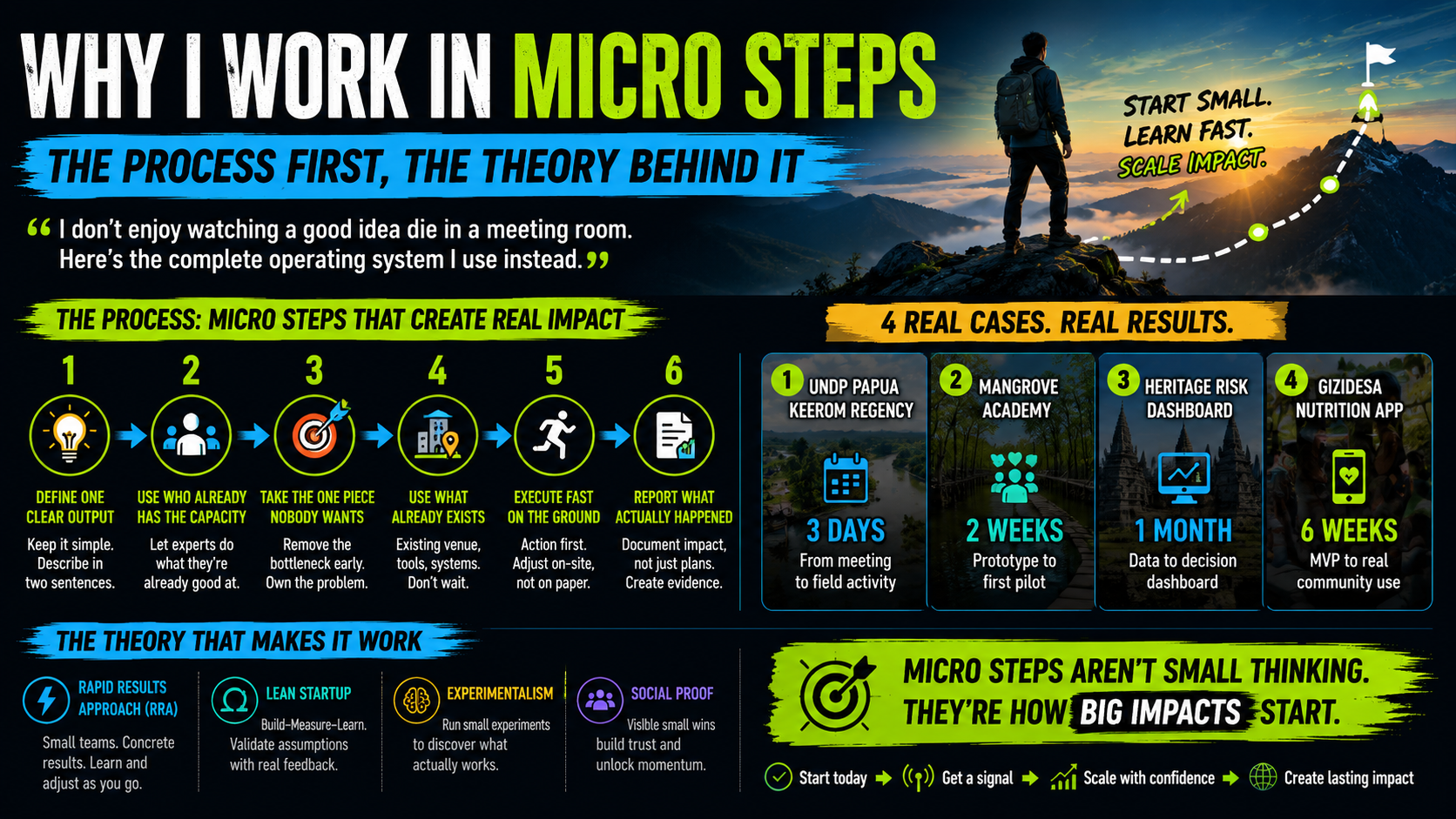
I don’t enjoy watching a good idea die in a meeting room. If a process turns into endless discussion, or I start sensing that people are deliberately stalling, I usually walk away — not because I refuse to collaborate, but because I already know how it ends: time burned, energy drained, zero impact. I’d rather do something useful. Below is exactly how that plays out in practice — the actual steps, in order — followed by the theory that explains why each one works. I’m laying out the process first because a reader can copy a process. A theory alone is just a label.
This is not impatience. It is a deliberate operating system: start small enough that motion is possible today, learn from what actually happens, then expand only when there is a real signal. The alternative — designing the full system first, securing the full budget first, aligning every stakeholder first — has a predictable outcome in complex environments. It stalls.
Case 1: UNDP Papua, Keerom Regency — From Meeting to Field Activity in 3 Days
What I did, step by step:
- One meeting to define the single deliverable. Not a full workplan — just: what training, for whom, by when. Kept the scope small enough to describe in two sentences.
- Split the work by who already had the capacity to do it. UNICEF and WHO already had the technical material and facilitators — so they ran delivery. I didn’t try to own every part of the activity myself.
- I took the one piece nobody else wanted: digital logistic reporting. This is often the bottleneck that kills momentum in development projects, so claiming it upfront removed the biggest source of delay.
- Booked the venue that already existed — the district office aula — instead of waiting for a purpose-built location or budget line for one. Choosing the kabupaten level rather than the province was deliberate: the distance was shorter, logistics were simpler, and the people who needed the training were already closer to the venue.
- Ran the training within a day of the meeting. No second or third alignment meeting. If something needed adjusting, it got adjusted on-site, not in advance on paper.
- Filed the report immediately after, using what actually happened — not what the original plan said should happen. The report captured both the training delivery and the exposure the participants received, turning the activity into documented evidence rather than an undocumented event.
Why this worked — the theory
Rapid Results Approach (RRA). Developed by Robert Schaffer and Ron Ashkenas, RRA organizes work around small teams committing to a concrete result in 100 days or less, learning and adjusting as they go instead of finalizing a plan before starting. The World Bank has used this exact approach with government reform teams specifically because breaking large goals into short, achievable cycles reduces implementation risk compared to attempting everything at once. The Rapid Results Institute has run this with UN agencies and national governments across health, governance, and housing programs — it’s not an outside management fad, it’s a method the development sector already validated. Keerom is RRA compressed from 100 days to 3: define one result, assign by existing capacity, execute, report.
What this avoided: the common pattern where a promising activity spends weeks in coordination meetings while the original energy drains away. By locking the deliverable early and assigning by existing capacity, the only remaining variable was execution, not negotiation.
Case 2: UNESCO Museum Partnership — Getting Resources Without Waiting for Budget
What I did, step by step:
- Identified the actual need — a museum visit component for the program — without first asking “what’s the budget for this.”
- Went directly to the museum and asked what they had. Not a funding proposal. A direct conversation about what could be arranged.
- Offered something the museum could say yes to immediately — visibility, partnership, participants — instead of asking them to wait on a formal MOU or budget cycle.
- Negotiated in-kind, not cash. Free guide, free meals — resources the museum already controlled and could allocate without going through a procurement process.
- Closed the negotiation within a week, because nothing in the ask required external approval on either side.
Why this worked — the theory
Effectuation — the Bird-in-Hand Principle. Saras Sarasvathy’s research on expert entrepreneurs found that under uncertainty, the effective move isn’t to define a goal and then plan out every resource needed to reach it (“causal” logic). It’s to start with the means already at hand — who you are, what you know, who you know — and build forward from there. A related principle, “affordable loss,” says commit only what you can afford to lose rather than optimizing for a hypothetical best case.
The Effectual Entrepreneur — Bird-in-Hand Principle
What this avoided: the long cycle of writing a funding request, waiting for approval, and discovering that the museum could have simply said yes months earlier. The constraint of “no budget” became irrelevant once the conversation shifted from money to mutual value.
Case 3: High School Environmental App — MVP in a Day
What I did, step by step:
- Scoped the smallest version that could actually be used, not the full system I had in mind. One core function: let a student log an observation about their environment.
- Built the MVP in a single day. No feature list, no stakeholder sign-off round — just enough for a student to open it and use it in the field.
- Took students to the field the very next day. No separate “training phase” before real use — the first use was the training. The classroom and the mangrove (or local ecosystem) were connected immediately.
- Had them file a real report from a real location, using the app as it was, imperfections included.
- Accepted that the first data would be rough. Didn’t block the exercise on data quality — treated inaccurate first reports as the expected output of round one, not a failure. The roughness itself became useful information: it showed exactly where the students’ understanding was incomplete.
- Used the report itself as the assessment. Instead of a separate test on “do you understand your environment,” the report is the evidence of understanding — or the gap that shows what to teach next. In other words, the act of reporting was both the learning activity and the measurement tool.
- Queued improvements for round two — better prompts in the app, a short calibration session, maybe pairing with an adult ranger for spot-checks — instead of adding those before round one even started.
Why this worked — the theory
Lean Startup — Build, Measure, Learn. Eric Ries’s methodology centers on getting through this loop as fast as possible with minimum wasted effort. The MVP isn’t a cheap toy version of the final product — it’s the fastest route to real learning. Under this lens, “inaccurate” student data isn’t a flaw in the plan — it’s the Measure step. Each report teaches the student something about their environment and teaches the program something about what to fix in round two. Waiting to build a polished, validated data system before starting would have delayed real learning by months for no real gain.
What this avoided: the classic trap of waiting for a “proper” monitoring system, a trained expert team, and clean data before allowing any student to observe. By treating the first imperfect cycle as legitimate data, the program gained both early awareness among the students and an immediate baseline of where their environmental understanding actually stood.
The Meeting Walk-Away
What I do, step by step:
- Watch for a specific signal: a second or third meeting on the same topic with no new decision made.
- Ask once, directly, for the next concrete action and date.
- If the answer is another meeting instead of an action — leave. Not dramatically, just disengage from that thread.
- Redirect the energy to something with a decision-maker who can act now.
Why this works — the theory
Bias for Action. Amazon’s leadership principle states plainly that speed matters, and that most decisions and actions are reversible, so they don’t need extensive study — the cost of delay usually outweighs the cost of a decision that turns out to need adjusting later. A meeting that produces no decision is, by definition, not moving toward a reversible action — it’s stalling on a decision that was already reversible in the first place. Leaving isn’t impatience; it’s correctly identifying that no action is actually being risked by staying, so nothing is gained by staying either.
This is the practical filter I use across every environment. When the pattern of delay becomes deliberate rather than structural, continuing to attend becomes a choice to spend time on something that has already demonstrated it will not produce a result.
Why “BIG BIG BIG” Usually Stalls
Across all four cases, the same shape repeats: small scope, existing resources, immediate execution, adjust after. The opposite pattern — design the full system first, secure the full budget first, align every stakeholder first — tends to stall, and there’s a name for why.
The Cynefin framework (Dave Snowden) sorts problems into domains, each needing a different response. Most social and development programs fall into the “complex” domain, where cause and effect can only be understood in hindsight — not predicted through upfront planning. Snowden’s recommended approach for complex problems is probe → sense → respond: take a small, reversible action, see what actually happens, then adjust. Treating a complex program like a predictable engineering problem — plan everything, then execute — is a category mistake, and it’s also why big plans generate more surface area for delay: more people who can say “not yet,” more approvals that can stall, more reasons to wait for certainty that never fully arrives.
The Cynefin Framework by David Snowden, explained
In practice this means that the bigger the initial ambition, the more points of friction appear before any real movement occurs. A micro step collapses those friction points by design.
A Reusable Playbook: How to Run a Micro Step (Expanded Tutorial)
Distilled from the cases above, into a process anyone can repeat. This is the full operating manual.
Name one deliverable, in one sentence
Not a program. Not a vision. One thing that either happens or doesn’t. Example: “High-school students log one environmental observation using a working app and file a report within 48 hours.” If you cannot say it in one clean sentence, the scope is still too large. Shrink it.
List what already exists before asking what’s missing
People, venues, relationships, half-built tools, existing materials, partners who already have capacity. Write the list first. Only after that list is complete do you look at the gaps. Most projects invert this order and stall on the missing pieces.
Assign by existing capacity, not ideal roles
Give each part of the work to whoever can already do it today. Do not invent new roles or wait for the “perfect” person. If UNICEF already has facilitators, they facilitate. If the museum already has guides, they guide. Ideal roles create delay; existing capacity creates motion.
Set an execution date within days, not months
If the answer is “next quarter,” the scope is still too big — shrink it further until the date can be measured in days. A micro step that cannot start within a week is not yet a micro step.
Ship the imperfect version
A rough MVP, a bare-bones training, a partial dataset — anything that produces a real result beats a polished plan that produces none. Imperfection is not failure; it is the price of learning in real conditions.
Treat the first result as data, not a verdict
Rough output tells you what to fix in round two. It is not proof the idea failed. Write down what the first cycle revealed — both about the students (or participants) and about the tool or process itself. That list becomes the agenda for the next cycle.
Only scale after round one produces a real signal
Expansion, funding requests, and formal systems come after there’s evidence worth scaling — not before. A signal can be: students kept using the app, reports contained usable observations, partners asked for a second round, or the data revealed a clear gap worth teaching. No signal = no scale.
Walk away from any thread that keeps producing meetings instead of decisions
Redirect that time to a thread that’s already moving. This is not drama. It is resource allocation. Time spent in non-decision meetings is time stolen from the next micro step that could have produced a real result.
This playbook is deliberately sequential. Skipping steps — especially jumping to scale before a signal exists — recreates the exact stalling pattern the method is designed to avoid.
How This Style Could Make Me More Effective Specifically at UNDP
UNDP’s own institutional direction has been moving toward this exact logic, which means the fit isn’t hypothetical — it’s already sanctioned by the organization’s own strategy documents.
- • UNDP Accelerator Labs and “agile, anticipatory” ways of working. UNDP’s strategic plan explicitly states the intent to embed agile ways of working, testing, and prototyping — modeled on its Accelerator Labs network — across the whole organization, because partners have found this valuable. That’s a formal, board-approved mandate for exactly the pilot-first behavior described above. Framing a proposal internally as “an Accelerator Lab–style rapid prototype” rather than “a shortcut around process” aligns it with language UNDP leadership already uses and funds.
- • Frugal innovation as a named UNDP practice, not an improvisation. UNDP’s Accelerator Lab network documents and celebrates “frugal innovation” — using existing, repurposed resources to solve a problem cheaply and fast, rather than waiting for a fully resourced solution. Their own example is a WiFi vending machine built from repurposed electronics by a community in the Philippines. This is effectively the museum negotiation story, but UNDP has a name and a publication series for it. Explicitly citing “frugal innovation” when proposing an unconventional, low-cost route can turn what might read as impatience into a recognized methodology.
- • Results-Based Management (RBM) as the actual UNDP operating philosophy. UNDP’s RBM framework is built around defining clear, measurable results and working backward from them — compatible with, not opposed to, fast execution. The tension in most UNDP experiences isn’t RBM itself; it’s when process (meetings, sign-offs, coordination layers) gets treated as the deliverable instead of a means to the result. Naming the actual deliverable and timeline early, in RBM language (“output,” “indicator,” “target date”), gives a fast approach the same vocabulary the institution already uses to evaluate success.
The practical move: rather than treating UNDP’s process requirements as the obstacle to speed, translate rapid pilots into the institution’s own frameworks — Accelerator Lab language, frugal innovation, RBM indicators — so the fast approach reads as institutionally fluent, not as working around the system.
Why Training High School Students to Monitor Mangroves Without Funding Also Works
This isn’t just a scrappy workaround — it lines up with a well-documented pattern in environmental monitoring: citizen science.
Citizen science is a recognized, effective monitoring methodology, not an inferior substitute for professional monitoring. Research on community-based environmental monitoring shows that structured citizen science programs — with a clear method, training, and a feedback loop — can generate genuinely useful environmental data while simultaneously building local capacity and awareness. The “low accuracy” concern is a known and manageable trade-off, not a disqualifying flaw, provided the training and method are clear.
Community-based mangrove management (CBMM) research from Central Java is directly relevant. A study comparing four Indonesian coastal villages found that community-based, participatory approaches produced measurably better mangrove biodiversity and coastal protection outcomes than top-down efforts, with the best-performing village succeeding through consistent, long-term, integrated community engagement rather than the largest budget. This suggests the mechanism that matters is sustained local involvement and observation, not funding level.
Youth engagement compounds the effect over time. In Kenya’s mangrove restoration programs, capacity-building work that trains local people directly in monitoring methods — rather than outsourcing monitoring to external experts — is treated as central to program sustainability, not a fallback. Training students to observe and report isn’t a cheaper version of “real” monitoring; over multiple report cycles, it becomes a genuine, standing local data source that no external, funded team would maintain as consistently, because the students are already there.
Why this specifically fits the micro-step logic: an MVP app plus a field visit plus a report is a probe, in the Cynefin sense — small, reversible, cheap. If it doesn’t produce useful engagement, nothing was lost. If it does, later cycles can add rigor (better indicators, calibration against expert surveys, tool improvements) without having delayed the first year of data and awareness-building while waiting for a grant.
The dual value is important. The same activity that generates environmental observations also generates evidence of how well the students understand their environment. That dual output is only possible if the first cycle is allowed to happen imperfectly and quickly.
The Climax — What This Actually Means
The pattern across every case is the same: name one concrete result, use what already exists, move within days, treat the first output as data, then decide whether to expand. This is not a rejection of long-term vision. It is a refusal to let long-term vision become an excuse for indefinite delay.
When a process produces only meetings, or when delay becomes intentional rather than structural, I disengage. Not out of frustration, but because the alternative — staying and hoping the next meeting will finally produce a decision — has already been tested and failed. Energy is finite. I prefer to spend it where motion is still possible.
You already know the cost of the other way. You have watched good ideas die in rooms that never decided anything. The only remaining question is whether you will keep attending those rooms, or whether you will start building the next micro step instead. The playbook is above. The theories are validated. The cases already happened. The only variable left is whether you run the system on purpose.
Micro steps first. Signal second. Scale only after. Everything else is noise.
Key Sources & Further Watching
Rapid Results Approach — Wikipedia, Schaffer Consulting, and World Bank applications. Link · Schaffer
Eric Ries — What Is an MVP? Link
Amazon Leadership Principles. Link
UNDP Strategic Plan 2022–2025, Accelerator Labs & Frugal Innovation, RBM. Strategic Plan · Frugal Innovation
Community-based mangrove management & youth monitoring studies. ScienceDirect · Kenya CBEMR