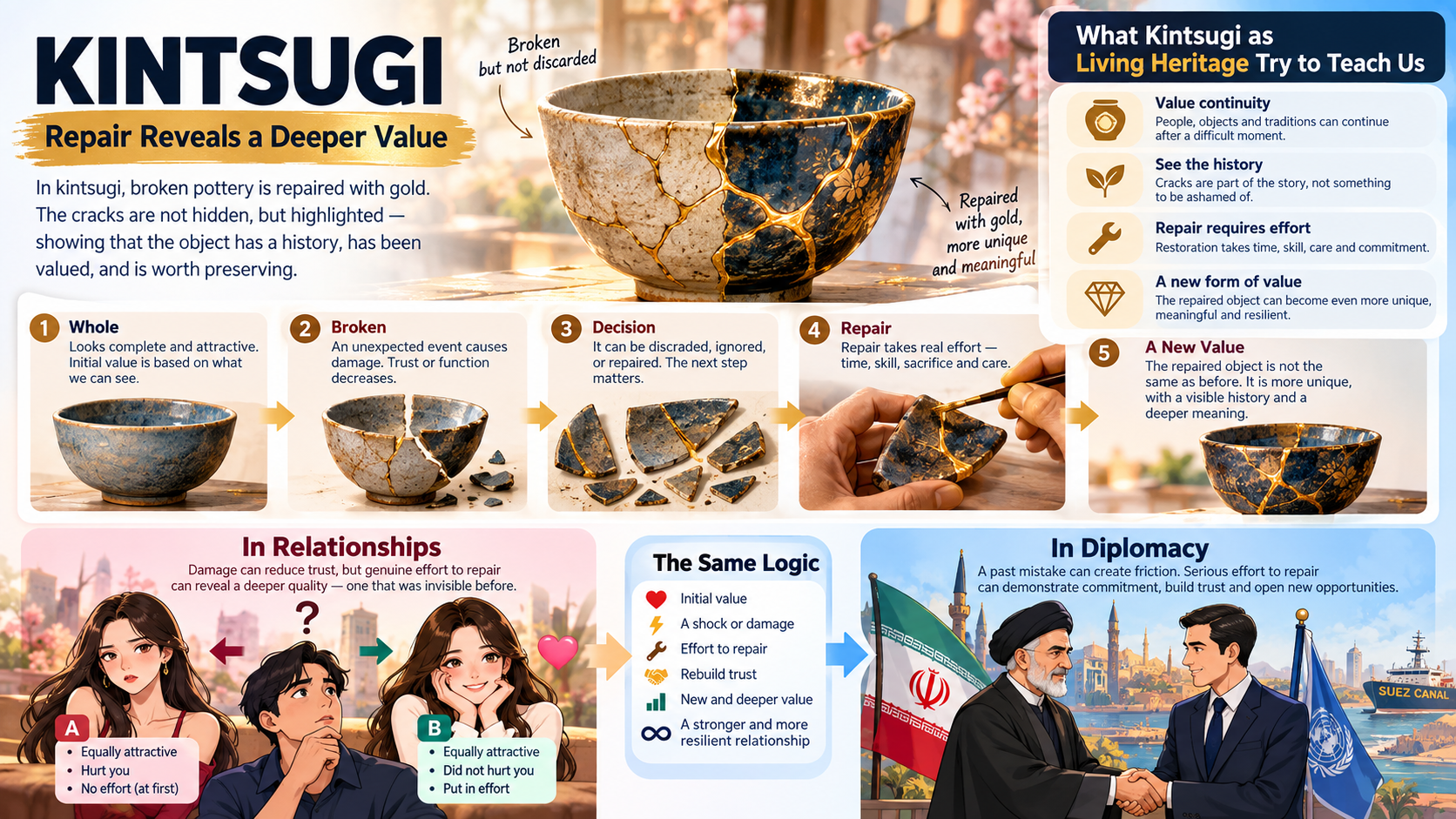
Consider this simple situation. You have two options, A and B. They are equally attractive. Then A hurts you, while B does not. Later, both approach you. All else being equal, why would you necessarily choose A?
Many people intuitively understand the answer: you probably would not. You would likely pay attention to the fact that A created a negative experience while B did not.
But now change one variable.
A starts making a serious effort.
A shows up.
A changes behaviour.
A sacrifices time.
A accepts a commitment that was previously resisted.
A repeatedly demonstrates that the relationship matters.
The interesting part is that A did not necessarily become a different person.
A's original attractiveness may be unchanged. A's baseline characteristics may be exactly what they were before.
What changed was the relationship history.
At the beginning, A and B may have looked similar.
After several interactions, they no longer represent the same proposition to the decision-maker.
One now carries evidence of hurt, repair, consistency and commitment.
The other carries a different history.
That is the central idea behind this article:
People do not choose options based only on what those options are. They also choose based on what interacting with those options has become.
Although the example starts with relationships, the same conceptual structure can be used to think about suppliers, partnerships, negotiations, institutions and diplomacy.
1. Story first: why two “equal” options can stop being equal
Let's start with a deliberately simplified model.
Suppose A and B both have a baseline value of 8.
At this stage, they are equivalent within the model.
Then A hurts you.
Nothing about B had to improve for B to become more attractive relative to A.
This is an important point.
Sometimes an option does not “win” because it became better.
Sometimes the alternative simply acquired a relative advantage because the first option created a cost.
Now suppose A makes an effort to repair the relationship.
In this toy model, A becomes competitive again.
This does not mean that every form of damage is reversible.
It does not mean that enough effort gives anyone a right to another person's forgiveness.
It does not mean that a relationship should continue after every kind of harm.
It simply illustrates a more general mechanism:
When the inputs to a decision change, the relative position of the alternatives can change.
2. First distinction: baseline value is not final value
People often use a single adjective to describe an option:
“beautiful,” “smart,” “powerful,” “qualified,” “valuable,” “important,” “strategic.”
But those labels describe only part of the decision.
A decision-maker may care about:
What the option brings initially.
How predictable and dependable the interaction feels.
What the option is willing to invest.
What negative experience or friction has been created.
What maintaining the relationship requires.
What happens when something goes wrong.
This gives us a more complete conceptual equation:
Again, this is not a scientific law.
It is a thinking instrument.
The purpose is to force us to stop collapsing a multidimensional relationship into one adjective.
3. Why choice is comparative, not absolute
Suppose A is still objectively “good”.
That does not mean A must be chosen.
Why?
Because most decisions are comparative.
The relevant question is not:
“Is A good enough?”
It may be:
“Given my available alternatives, which option produces the better overall position?”
This is why:
can still produce:
or:
depending on the accumulated history.
A can remain attractive while becoming less attractive relative to B.
4. “A + effort” is not the same as “A says sorry”
This is where the word effort needs more precision.
| Level | Example | What it may signal |
|---|---|---|
| Presence | showing up, replying, accompanying | attention |
| Time | rearranging a schedule | opportunity cost |
| Practical sacrifice | doing something inconvenient | investment |
| Behaviour change | ending a repeated harmful behaviour | learning |
| Major commitment | changing a significant plan | long-term investment |
| Sustained consistency | repeating the new behaviour over time | credibility |
These are not interchangeable.
A ten-minute message can be meaningful.
But changing a major life plan can carry a very different opportunity cost.
The point is not that “bigger sacrifice = better person.”
The point is that a costly action can provide different information about priorities than a nearly costless statement.
5. Opportunity cost makes effort visible
One reason effort becomes meaningful is opportunity cost.
Imagine someone says:
“I care about you.”
That sentence may be sincere.
Now imagine the person also changes their schedule every week to make room for the relationship.
Now they are giving up something.
That does not automatically prove deeper love or better character. But it does provide additional behavioural evidence.
The same concept applies to organizations.
If a country wants another country to believe a commitment is serious, a statement may be less informative than an action that imposes a real cost on the state making the commitment.
That is why costly actions can matter in negotiation: they can reveal priorities more clearly than cheap words.
6. The commitment example
Consider a person who originally does not want marriage, while their partner does.
Later, the first person decides that the relationship matters enough to change that position.
The interesting variable in this framework is not whether marriage is inherently the correct outcome.
The interesting variable is the magnitude of the change.
Changing a previously stated long-term intention is different from sending an apology message.
It has greater opportunity cost.
It therefore represents a different level of investment.
7. Damage changes the next round
Another important concept is path dependency.
Before A hurts you, you do not have direct evidence of that particular behaviour from A.
After the incident, you do.
Even if you forgive A, the information environment has changed.
The next interaction therefore begins from a different starting point.
This is why trust is cumulative.
It can be built through repeated positive interactions.
It can be damaged by negative interactions.
It can sometimes be repaired.
And it can sometimes be permanently altered.
8. Repair is not the same as erasure
This distinction is crucial.
Repair does not necessarily mean:
“Pretend it never happened.”
Repair can instead mean:
“The event happened, we understood it, and the system changed so that the next interaction is different.”
That is why a useful repair sequence is:
An apology may be part of the first stage.
Behaviour change belongs to the second and third.
Trust is rebuilt through repeated evidence.
9. The surprising case: B is less attractive, but B invests
Now consider a different scenario.
A is very attractive.
B is ordinary.
But B invests heavily.
Under this simplified model, the two options become comparable.
The conclusion is not that “effort always beats beauty.”
The conclusion is that decisions can depend on multiple dimensions simultaneously.
That same principle appears everywhere.
A product can have a lower technical specification but lower maintenance cost.
A supplier can be smaller but more reliable.
A partner can have fewer resources but stronger cooperation.
A diplomatic relationship can involve fewer strategic assets but lower friction.
10. Reverse the scenario
Now B has the lower baseline and also creates damage.
The lower-baseline option is now substantially less competitive.
This illustrates something people sometimes overlook:
Effort is not a magic multiplier. It is one variable in a system of variables.
If the negative history is large enough, a small amount of effort may not compensate for it.
If the baseline difference is large enough, the lower baseline may still remain lower.
If the damage is severe enough, repair may not restore the prior position.
11. One-time gesture versus repeated behaviour
Suppose A makes one spectacular gesture.
Then A returns to the same behaviour that caused the original problem.
Contrast that with B, who makes small but consistent positive contributions.
The two forms of effort provide different information.
A dramatic gesture has high intensity.
B's behaviour has high persistence.
Persistence may be more informative when the decision-maker is trying to predict what happens next.
This is one reason repeated behaviour matters.
A single gesture tells you what happened once. A pattern gives you more evidence about what may happen again.
12. SVG visualization: accumulated relationship value
13. The deeper model: accumulated relationship capital
We can now stop thinking about effort as a one-time bonus.
Instead, imagine that relationships generate a kind of relational capital.
Repeated positive interactions can increase it.
Repeated negative interactions can decrease it.
Repair can recover part of it.
Major breaches can impose unusually large losses.
This produces a dynamic system:
The last step matters.
The system does not reset after every decision.
The outcome of today's interaction can become tomorrow's baseline.
14. Transition to diplomacy
Now we can translate the same structure to diplomacy.
States are obviously not people.
States contain governments, institutions, bureaucracies, militaries, economic actors and domestic political interests.
Diplomatic choices are constrained by laws, treaties, security considerations, formal procedures and strategic calculations.
So the relationship analogy should be treated as a conceptual lens, not a literal equation of state behaviour.
What transfers well is the idea that relationships accumulate history.
15. Diplomatic scenario 1: the accidental damaging statement
Whatever the intent, State B may now reassess the interaction.
The immediate damage could involve:
- loss of confidence;
- additional verification;
- greater diplomatic friction;
- requests for clarification;
- greater caution in future negotiations.
The important point is not that every mistake causes a diplomatic crisis.
The point is that a mistake can become part of the relationship context surrounding subsequent decisions.
Repair then becomes relevant.
The repairing state may need:
- clarification;
- correction;
- reassurance;
- additional communication;
- confidence-building actions.
The exact response depends on the context.
16. Diplomatic scenario 2: two partners request the same cooperation
A has recently created friction.
B has not.
It would be reasonable to model the difference as a potential difference in transactional friction, not as an automatic “winner” or “loser”.
The third party may need to consider:
- formal eligibility;
- legal obligations;
- security;
- operational feasibility;
- strategic value;
- political consequences;
- existing relationship history.
This is an important refinement.
Relationship quality can influence the cost of cooperation, but it does not necessarily override formal rules.
17. Diplomatic scenario 3: “I can help bring you closer”
Now introduce a broker.
The broker tells two actors:
“I can help connect you. I can make cooperation easier.”
This creates value because the broker is reducing search costs, uncertainty and communication friction.
Then the broker makes a major communication error.
The damage does not simply affect the broker's reputation.
It can also affect the two actors the broker was trying to connect.
Now the broker has a new task:
repair the bridge.
18. Diplomatic scenario 4: repair requires more than words
Suppose a diplomatic partner says:
“That was not what we intended.”
That may be useful.
But the other side may still ask:
“What changed?”
This is the diplomatic equivalent of asking whether repair is observable.
Depending on circumstances, credible repair can involve:
- formal clarification;
- corrective communication;
- new safeguards;
- confidence-building measures;
- greater transparency;
- behavioural consistency over time.
Again, this is not a universal diplomatic recipe.
The broader idea is simply that repair becomes more credible when the future behaviour changes, not only the explanation of the past.
19. The Suez Canal thought experiment
Consider a hypothetical example involving Suez.
Suppose State A and State B both seek a comparable form of canal transit or cooperation.
State A has recently created diplomatic friction with another actor.
State B has not.
The intuitive relational question is:
Could the difference in diplomatic history create different levels of friction around later requests?
That is a reasonable question as a relationship analogy.
However, Suez cannot simply be treated as a personal relationship.
The canal operates under formal navigation rules and international legal arrangements. The Suez Canal Authority publishes Rules of Navigation, while the Constantinople Convention establishes a legal framework for the canal.
Therefore:
Relationship dynamics may influence political context, but they do not replace formal legal and institutional rules.
This distinction is one of the most important safeguards in the analogy.
20. Diplomatic scenario 5: strategic value can still outweigh friction
Another subtlety is that damage does not necessarily dominate every decision.
A state may have a very high strategic value.
Even if cooperation is difficult, the expected benefit may still be large enough to justify the friction.
In our toy framework:
A may still be the more valuable relationship.
This is important because the model is not a moral score.
A difficult relationship can still be strategically important.
That is another reason why diplomatic decision-making is more complex than interpersonal preference.
21. SVG visualization: from relationship repair to diplomatic repair
22. Interactive simulation: what changes the choice?
The simulator is deliberately transparent.
It does not tell you which person to choose.
It does not predict which country will “win” a negotiation.
Instead, it asks a more useful analytical question:
Which assumptions are driving the relative position of A and B?
Option A
Option B
B starts from the same baseline but has more positive relational inputs and less damage.
How to use the simulation
Change one slider at a time.
For example:
- increase A's effort and see how much damage it offsets;
- increase B's trust and observe how much lower baseline B can compensate for;
- increase A's friction and see when a high baseline stops being sufficient;
- switch to diplomacy mode and reinterpret the same dimensions as strategic value, trust, confidence-building, diplomatic friction and risk.
The formula remains:
The important word is assumptions.
If you change the assumptions, you change the outcome.
That means the simulation is better understood as a simple sensitivity analysis than as a prediction machine.
23. Scenario matrix
| Scenario | A | B | What changes? |
|---|---|---|---|
| Equal baseline | 8 | 8 | Starting point is equivalent. |
| A creates damage | 8 − 3 | 8 | B gains relative advantage. |
| A repairs | 8 − 3 + 4 | 8 | A can recover in the toy model. |
| B has lower baseline + effort | 9 | 6 + 3 | The gap can narrow or disappear. |
| B has lower baseline + damage | 9 | 6 − 3 | The gap widens. |
| A has higher baseline + high friction | 10 − 5 | 8 + 1 | B can become competitive. |
| Both invest | 8 + 3 | 8 + 2 | A remains slightly ahead. |
24. What the model does explain
Different attributes can offset one another under some assumptions.
Two similar options can become different after different interactions.
Post-damage behaviour can change the next decision position.
Effort is more informative when we understand what it costs.
An option can remain good while another becomes relatively better.
Small changes in assumptions can change the relative position of A and B.
25. What the model does not explain
It does not explain everything.
Humans are not spreadsheets.
People have values, boundaries, emotions, memories, identities and changing preferences.
Relationships also contain variables that cannot easily be quantified.
Diplomacy is even more complex because formal rules and institutions impose constraints that a relational score cannot override.
Therefore, the framework should be used to ask better questions, not to pretend that human or diplomatic behaviour can be reduced to a single formula.
26. The deeper analogy: relative value under relationship history
At this point, the beauty analogy becomes almost unnecessary.
The more general structure is:
That can describe:
- a romantic relationship;
- a friendship;
- a supplier relationship;
- a business partnership;
- an institutional collaboration;
- a negotiation;
- a diplomatic relationship.
The common mechanism is not romance.
It is accumulated interaction history.
27. “Better on paper” versus “better in reality”
This framework also explains a familiar paradox.
Sometimes A looks much better on paper.
A has more resources.
A has more credentials.
A has more money.
A has more strategic importance.
A has more impressive baseline characteristics.
Yet B is easier to work with.
B is reliable.
B communicates.
B does not create unnecessary friction.
B repairs mistakes.
B invests consistently.
The decision-maker may rationally prefer B even though B was not the stronger option on the first page of the spreadsheet.
This is not necessarily irrational.
The spreadsheet may have measured baseline value.
The decision-maker may also need to consider relationship value.
28. Closing: value is not static
So perhaps the real lesson is this:
When two options begin with comparable value, the way they interact with you can become part of the value calculation.
Effort can add value.
Trust can add value.
Damage can subtract value.
Repair can restore part of what was lost.
Consistency can make repair credible.
Opportunity cost can make effort more informative.
And a major commitment can matter because it demonstrates that the relationship is being treated as valuable enough to justify a real cost.
That is why “A was better on paper” and “B was chosen” are not necessarily contradictory statements.
One describes the starting position.
The other describes the position after interaction.
And that is the bridge to diplomacy.
A country can remain strategically important while becoming more difficult to work with.
A partner can create friction and then repair the relationship.
An intermediary can create access and then damage the trust that made the access valuable.
Formal rules can constrain what is possible, while relationship history can still influence the political and practical cost of cooperation.
The useful question is therefore not simply “Who is better?” It is: “Given the history, the costs, the effort, the trust and the constraints, how has the relative value of these options changed?”
This article is a conceptual framework and interactive simulation. The numerical values are illustrative, not empirically calibrated measures of attraction, trust, or state behaviour. They are intended to make the reasoning visible and testable rather than to produce objective verdicts.