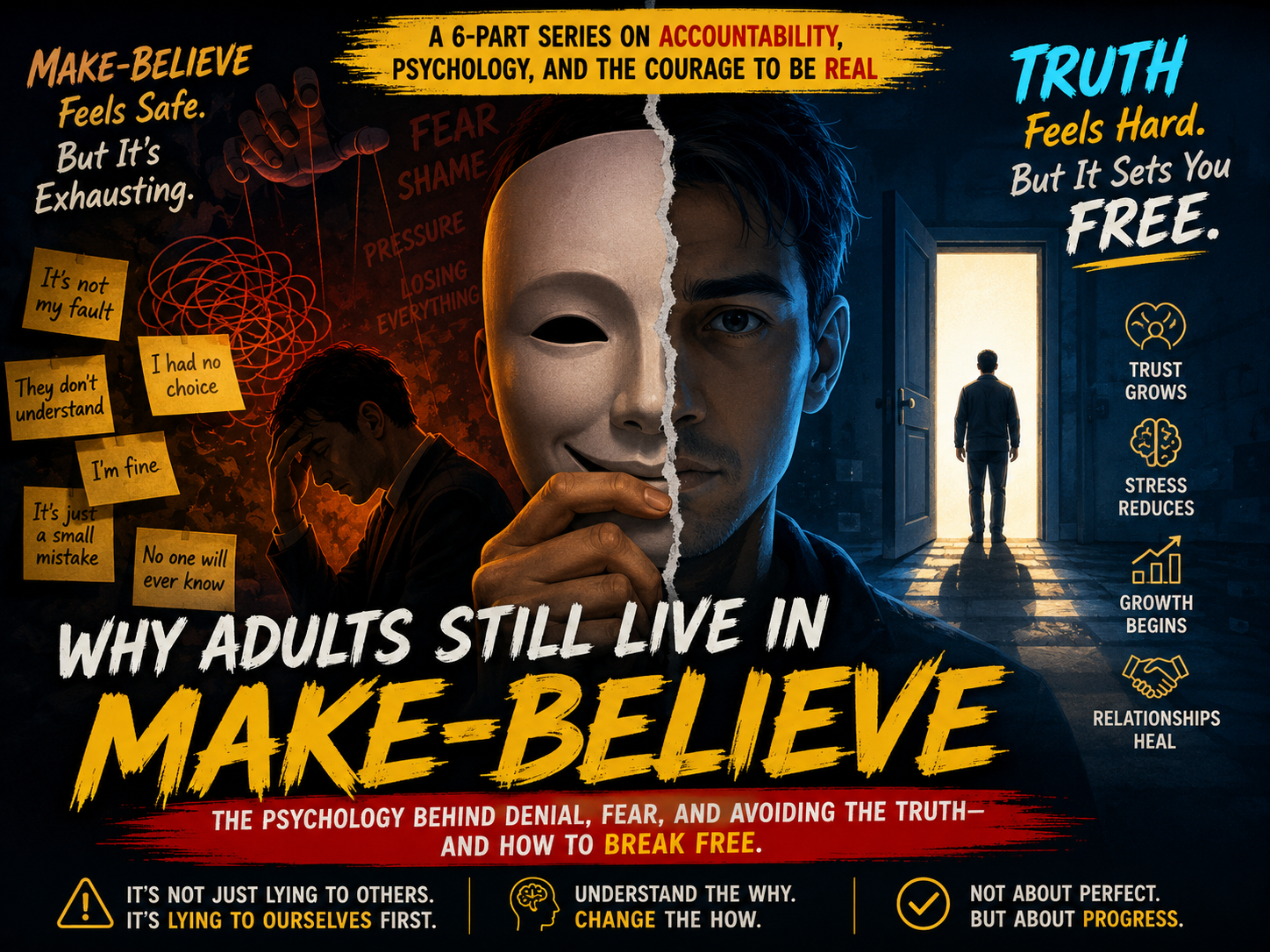
A little girl hosts a tea party with invisible guests. A little boy declares himself a superhero. No one finds it strange — imagination is a healthy part of childhood. But somewhere on the way to adulthood, the costumes disappear and the toys get put away, while make-believe itself quietly stays. It just changes shape: "The requirements weren't clear." "You made me do it." "Everything is under control." Different people, different situations, the same psychological pattern — and sometimes, before anyone else is deceived, the person is first lying to themselves.
It's tempting to believe people avoid apologizing simply because they lack humility. But the more people, organizations, and conflicts you encounter, the less that explanation holds up. What if many people aren't trying to deceive anyone? What if they're trying to protect something far more fragile — their identity, their reputation, their livelihood, or simply the image they hold of themselves? Before a person lies to someone else, their mind often builds a version of reality that feels emotionally safer. Not because reality changed, but because accepting it would be painful. That is where adult make-believe begins.
This isn't about mocking people who won't admit mistakes, or excusing dishonesty. It's about one uncomfortable truth: human beings are remarkably good at protecting themselves from psychological pain — sometimes with silence, sometimes with denial, sometimes with stories they gradually start to believe themselves. Understanding why people hide doesn't remove accountability. It just puts us in a better position to build environments where honesty feels safer than pretending.
Part 1 — Why We Lie to Ourselves Before We Lie to Others
Imagine you see yourself as honest, responsible, and competent. Then one day you make a serious mistake, and two beliefs collide: "I am a good and capable person" versus "I just made a mistake." Psychologists call this cognitive dissonance — the mind's dislike of holding two conflicting beliefs at once. The discomfort demands relief, and there are two paths: the hard one ("I was wrong") and the emotionally easier one ("It wasn't really my fault," "Anyone would have done the same," "People are exaggerating"). Reality hasn't changed. But the story has.
This is where an ego defense mechanism quietly steps in — think of it as the mind's emotional airbag, built not to discover the truth but to reduce psychological pain. A few patterns show up constantly:
"That never happened" — even when the evidence says otherwise.
"I had no choice" — even though other options existed.
"They're the dishonest ones" — while avoiding our own behavior.
"It's not a big deal" — even when trust has clearly been damaged.
These reactions usually happen automatically; most people aren't consciously choosing them. Every fact passes through identity, pride, fear, shame, and years of past experience before it becomes a story — which may explain why arguments so rarely change people's minds. If accepting the truth feels like destroying who I believe I am, my mind will often defend the identity before it examines the evidence. That's why more facts alone are rarely enough. The safer people feel, the less psychological armor they need — and the easier it becomes to say four simple words: "I was wrong."
Part 2 — When Survival Becomes More Important Than the Truth
Imagine a father who is the only source of income for his family. He makes one mistake at work — nothing catastrophic — but he knows his company has little tolerance for failure. One mistake affects a review. Another costs a promotion. A third could cost the job. So what's really happening in his mind: "How can I deceive everyone?" or "What happens to my family if I lose this job?" Those are two very different psychological realities.
This is where behavioral economics offers a sharp insight. The Nobel Prize-winning work of Daniel Kahneman and Amos Tversky showed that people generally feel the pain of losing more intensely than the pleasure of an equivalent gain — a principle called loss aversion. Losing feels bigger than winning. Much bigger. So when we ask "why didn't they just tell the truth," their brain may be answering a different question entirely: "Can I afford the consequences of telling the truth?" If honesty appears to threaten livelihood, status, or the ability to provide for people they love, the brain starts searching for another path — silence, denial, or make-believe. Not because the person forgot reality, but because reality started to feel unsafe.
Nobel laureate Daniel Kahneman explains why losses feel heavier than equivalent gains
This doesn't make dishonesty acceptable — a doctor can study disease without approving of it. But it explains why deception can become so tempting, and why judging someone as simply "dishonest" often misses that they may also be frightened: of unemployment, humiliation, or disappointing the people they love. Fear doesn't justify deception. It explains it.
Part 3 — When Systems Teach People to Hide
Picture two workplaces. In the first, an employee makes a costly mistake and is publicly criticized; their review suffers, promotion opportunities vanish. Everyone in the office silently learns the same lesson: never admit mistakes — not because honesty is wrong, but because honesty became dangerous. In the second, the same mistake happens, but the manager asks "What happened?" instead of "Who should we blame?" The mistake is investigated, the process improves, and the employee is still accountable — but accountability is separated from humiliation.
Harvard professor Amy Edmondson calls this second condition psychological safety: not lowered standards or removed accountability, but an environment where people feel safe enough to speak honestly without unnecessary fear of humiliation. It's why commercial aviation investigates accidents in extraordinary detail, why modern healthcare increasingly examines errors through system analysis, and why tech companies run blameless postmortems — because hidden mistakes cannot be fixed. Only visible ones can. Ironically, the harsher the punishment for every failure, the more valuable secrecy becomes; small issues stay hidden until they compound into a crisis leadership never saw coming.
Harvard's Amy Edmondson on why teams need safety to speak up — and how that safety pairs with accountability
The Pattern Often Starts Earlier Than Work
Some children grow up hearing "don't embarrass the family," "good children don't make mistakes," or "if you fail, you'll disappoint everyone." Often well-intentioned — but when every mistake threatens love, respect, or belonging, children learn not how to become better, but how to become harder to catch. Years later, those children become adults who instinctively hide mistakes — not because deception is part of their character, but because concealment became part of their survival strategy.
Part 4 — The Hidden Cost of Living in Make-Believe
At first, make-believe feels like protection — it softens embarrassment and postpones consequences. But avoiding pain is very different from healing it. Imagine carrying a backpack with one small stone in it: barely noticeable. Then another. And another — each one a detail that must stay consistent, an excuse that must be defended, a version of events that must be maintained. Reality doesn't need rehearsal; it simply happened. A fabricated story must be reconstructed, protected, and adjusted every time a new fact appears — an ever-increasing cognitive load that leaves less energy for solving the real problem.
Trust follows the same arithmetic in relationships. It's rarely destroyed by one large mistake — more often it erodes through many small moments where reality and explanation no longer match, until people start asking, "If I cannot trust your words today, how can I trust them tomorrow?" The same pattern plays out in organizations: a hidden problem compounds for weeks until leadership finally asks, "Why didn't anyone tell us earlier?" The honest answer is usually that somewhere along the way, people learned speaking up carried more risk than staying silent. Ironically, the concealment often becomes more damaging than the original event — many public scandals follow exactly that shape.
Some people use mistakes as mirrors; others use excuses as curtains. A mirror can be painful, but it helps us adjust. A curtain feels comforting, but eventually we stop seeing what's really there.
Part 5 — The Bravest Words an Adult Can Say
If make-believe is this deeply rooted — if fear can silence honesty, if systems can teach people to hide, if our own minds can rewrite reality — what does emotional maturity actually look like? Perhaps it begins with four simple words: "I was wrong." Simple to say. Extraordinarily difficult to mean.
The strongest people aren't the ones who never fail — they're the ones who can face failure without running from it. Real accountability isn't humiliation or self-punishment; it's the willingness to let reality be reality: no embellishment, no convenient edits, just enough honesty to say "This happened. I contributed to it. Now let me help make it right."
Key Takeaway
Compassion and accountability aren't enemies. We can understand someone's fear while still expecting honesty; we can acknowledge the pressures they face while still encouraging responsibility. Empathy without accountability becomes permissiveness. Accountability without empathy becomes cruelty. Maturity requires both.
Final Reflection
The opposite of make-believe is not perfection. It is honesty — not flawless judgment, but the courage to say "I was wrong," "I'm sorry," "Let's make it right." Children need make-believe because imagination helps them grow. Adults sometimes cling to it because fear helps them survive. But every meaningful relationship, every healthy organization, and every resilient individual eventually reaches the same crossroads — the day pretending is no longer enough, and reality quietly asks: "Will you face me now?"
Emotional maturity isn't measured by how rarely we make mistakes. It's measured by how quickly we stop hiding from them — and how sincerely we try to repair what's been broken.
Key Sources & Further Watching
Festinger, L. (1957). A Theory of Cognitive Dissonance. Stanford University Press — the foundational account of why conflicting beliefs create psychological discomfort the mind is motivated to resolve.
Kahneman, D., & Tversky, A. (1979). Prospect Theory: An Analysis of Decision under Risk. Econometrica. The origin of loss aversion — losses are typically felt about twice as intensely as equivalent gains.
Edmondson, A. C. (1999). Psychological Safety and Learning Behavior in Work Teams. Administrative Science Quarterly. Link
Daniel Kahneman — Uncertainty & Loss Aversion. YouTube
Amy Edmondson — Building a Psychologically Safe Workplace, TEDxHGSE. YouTube