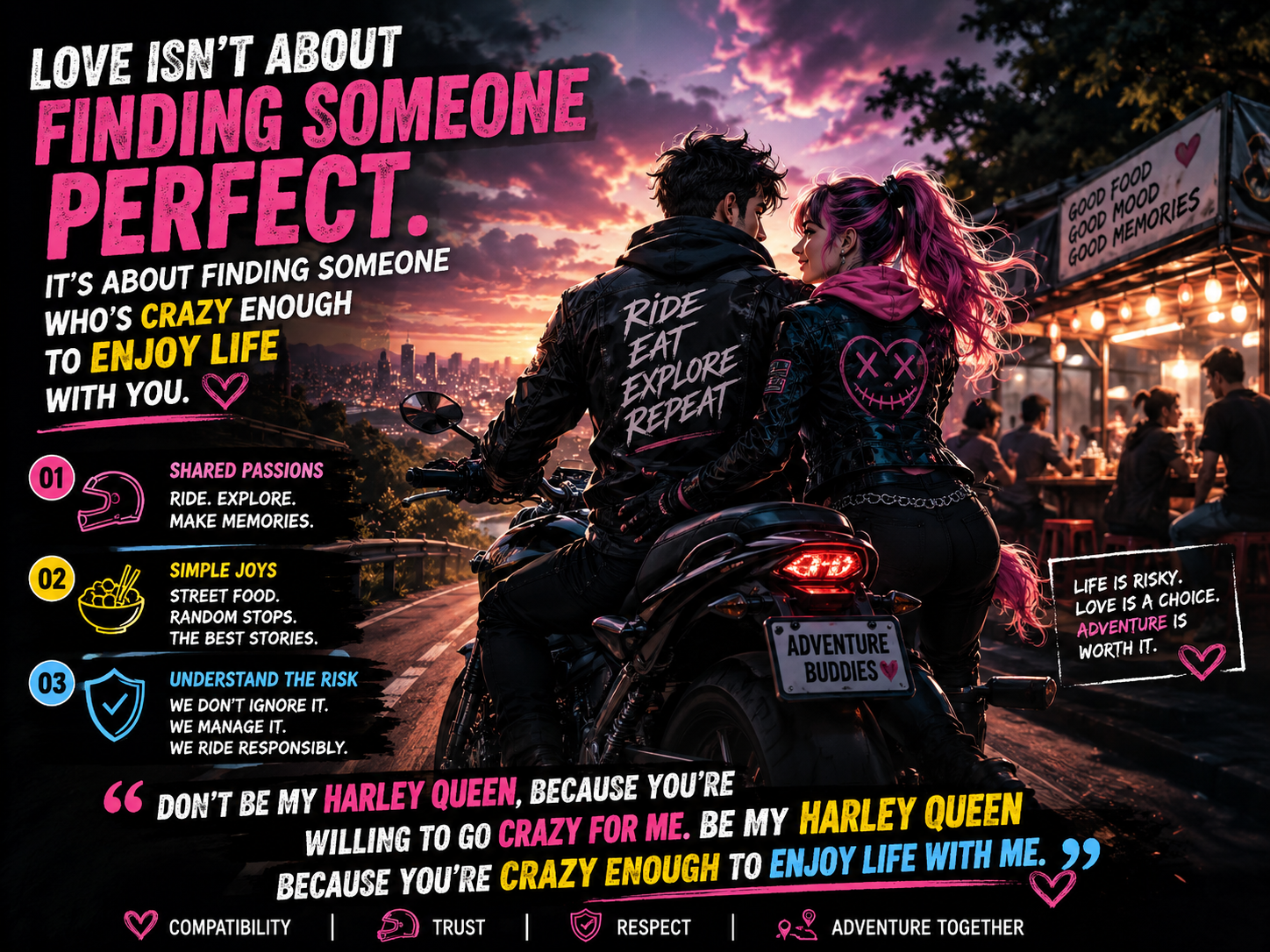
I used to think love was the whole test. If you love someone enough, everything else finds a way to fit. Then I loved two people who didn't want what I wanted — one who wouldn't get on the back of a motorcycle, another who couldn't enjoy a plate of food from a roadside stall — and I learned love was never the whole test. It was just the entry fee.
This is a story in three parts, and one long argument I've been having with myself for years: about what compatibility actually means, why I still ride a motorcycle knowing exactly what it can do to a body, and why I stopped wanting a partner who would destroy herself for me.
Part I — Compatibility Isn't Finding a Copy of Yourself
I once dated someone who didn't want to ride a motorcycle with me. I was genuinely sad about it — not because she was wrong. Motorcycles are risky, and she had every right to say no. But riding was never just transportation to me. I love going nowhere in particular, discovering places along the way, having someone behind me to share the road, the weather, the random stops, and the stories that come out of them.
I had a similar moment with someone I was interested in who couldn't really enjoy street food. Again — nothing wrong with that. But I love culinary adventures. I want to spot a crowded little stall on the side of the road and say, "That looks suspiciously good. Let's try it." 😂 I want to travel, wander, discover strange little places, eat things I've never tried, and occasionally have no idea where I'm going. And someday, I want to share that with the person I love.
Eventually I understood something simple that took me a long time to accept: compatibility isn't about finding someone who likes everything you like. It's about finding someone whose way of enjoying life can coexist with yours.
Why Overlap Matters More Than Sameness
Decades of relationship research back this up, even if it isn't usually framed in terms of motorcycles and street food. Donald Byrne's similarity-attraction research found that people are consistently drawn to — and stay satisfied with — partners whose attitudes, values, and lifestyles overlap with their own.1 Attraction isn't random; it tracks shared ground.
But overlap on its own isn't the whole story. Arthur and Elaine Aron's self-expansion theory adds something I find more interesting: people are drawn to relationships that let them grow — take on new perspectives, skills, and experiences they wouldn't have access to alone.2 In their studies, couples who did novel, mildly arousing activities together — genuinely new things, not just pleasant, familiar ones — reported higher relationship satisfaction than couples who spent the same amount of time doing something comfortable and routine. It isn't the food or the motorcycle that matters. It's the appetite for novelty, and whether two people can feed it together.
Not a Villain Story
Neither of us was wrong. Love can be completely real while two lifestyles are simply incompatible. Sometimes you walk away not because you don't love someone, but because you already know you'll be walking through life in different directions. I don't need someone to change herself to fit into my life. I'd rather meet someone who sees the things that make me excited about being alive and says, "That actually sounds fun."
Compatibility isn't finding someone who sacrifices the life she loves to join mine. It's finding someone whose idea of living makes us both want to walk the same road.
Part II — Put On Your Helmet. Let's Go. 🏍️
I know motorcycles are dangerous. That's exactly why I check my brakes. Before I ride, I check the brakes, the tires, the lights, anything that feels off. And when someone I love is sitting behind me, I become even more careful, because I'm no longer responsible for just one life. I'm responsible for two.
People sometimes ask, "If you know motorcycles are dangerous, why do you still ride?" It's a fair question. I've met doctors who are bikers — people who know better than almost anyone what accidents can do to the human body. Yet some of them still ride. Understanding risk doesn't automatically mean avoiding everything that carries risk. Sometimes it means learning how to manage it. Safety isn't the absence of risk. Safety is the management of risk.
Chosen Risk Feels Different — And It Is Different
There's a reason preparation changes how dangerous something feels, and it isn't just in my head. Chauncey Starr's classic study of risk acceptance found that people tolerate roughly a thousand times more danger from activities they choose voluntarily — driving, sport, recreation — than from risks imposed on them without consent, like pollution or unsafe infrastructure they had no say in.3 Voluntariness itself changes how tolerable danger feels.
Paul Slovic's later work on risk perception adds the missing piece: our felt sense of danger isn't driven by statistics, it's driven by dread and by a sense of control.4 A risk feels safer when it's familiar, understood, and something you can actively manage — which is exactly what checking the brakes does, psychologically as much as mechanically. And Julian Rotter's research on locus of control found that people who believe outcomes depend on their own preparation and skill, rather than luck, are more likely to engage in what researchers call controlled risk-taking — instead of either recklessness or total avoidance.5 Checking the brakes isn't just maintenance. It's what turns fear into agency.
That's also why I don't want a partner who rides with me simply out of obligation. I don't want, "I'm scared, but if you love me, I'll do it." That's not romantic to me. I want someone who understands what she's getting into — someone who sees me checking the brakes, checking the tires, prepping the bike, putting on my gear, and understands why I do it. Being adventurous doesn't have to mean being careless.
What "Let's Go" Actually Means
Maybe one day she'll look at me, put on her helmet, and simply say, "Let's go." That's romantic to me — not because she's willing to risk her life for me, but because she trusts me enough to share a piece of her life with me. And I respect that trust enough to take her safety seriously. Not reckless together. Responsibly crazy together.
Part III — Don't Be My Harley Quinn
I've joked before that someday I want to find my own Harley Quinn. Yes, I know how ridiculous that sounds. 😂 Harley Quinn was Dr. Harleen Quinzel — a psychiatrist. Of all people, she should have understood exactly how deeply troubled and dangerous the Joker was. She was supposed to study the madness. Instead, she joined it. Somewhere in that absurdity is a metaphor I always found strangely romantic: "You already know I'm crazy, and somehow, you still want to be crazy with me."
But as I've gotten older, I've realized something. I don't actually want a Harley Quinn who destroys herself for me. I don't want blind loyalty, or someone who abandons her boundaries, her identity, or her common sense just because she loves me. That's not the kind of love I'm looking for.
The Clinical Shadow Behind the Joke
The Harley-and-Joker dynamic isn't just a comic book trope — it maps almost exactly onto a documented clinical pattern called folie à deux, or shared psychotic disorder, first described by Charles Lasègue and Jean-Pierre Falret in 1877: one person's distorted beliefs absorbed by a partner in an isolated, dependent relationship, until neither one can see clearly anymore.6 It's the clinical shadow of what pop culture romanticizes as devotion.
The healthier alternative shows up in John Bowlby's attachment theory. Bowlby described securely attached partners as functioning like a "secure base" for each other — a stable foundation that makes it safer, not more dangerous, to explore, take risks, and try new things, rather than merging identities the way anxious or disorganized attachment tends to.7 Murray Bowen's concept of differentiation of self makes a related point from family-systems theory: the healthiest closeness comes from two people who stay distinct individuals with intact judgment and boundaries, not from fusing into one shared identity.8
What I actually want is the spirit behind the metaphor, not the self-destruction underneath it. Someone who won't be surprised when I say "Let's go somewhere" and can't yet tell her where. Someone who won't blink when I suddenly stop the bike because I spotted a tiny street-food stall that looks interesting. Someone who can laugh when the plan changes — who looks at my ridiculous ideas and says, "This is stupid," and five seconds later, "Okay, how are we doing this safely?" 😂
Because maybe the best partner isn't someone who follows you blindly. It's someone who can be crazy and sensible with you. Someone who says "Slow down," "Check the brakes first," "Bring a raincoat," "Wear your helmet" — and then, "Okay. Let's go."
The Correction
So maybe I've been saying it wrong all along. Don't be my Harley Quinn because you're willing to go crazy for me. Be my Harley Quinn because you're crazy enough to enjoy life with me. Not reckless together. Not destructive together. Just responsibly crazy together. 🏍️❤️
Closing — The Road We're Actually Building
Put the three parts next to each other and they stop sounding like separate stories. Compatibility is about finding the overlap. Risk management is about protecting that overlap once you've found it. And refusing the Harley-Quinn fantasy is about making sure neither person disappears in the process. All three are really one idea, said three different ways: love needs somewhere to live, and that somewhere is the shared, ordinary, occasionally reckless-looking texture of a life two people actually build together.
When I imagine growing old with someone, I don't only imagine a house, a marriage, a set of responsibilities. I imagine experiences: two helmets, random road trips, street food at night, getting lost, laughing about it, finding our way home — and doing it all over again. Aron's self-expansion research suggests that's not just sentimentality; couples who keep feeding each other new, shared experiences report more satisfaction over time than couples who simply keep each other comfortable.2 Comfort is not nothing. But comfort alone doesn't expand you, and expansion, it turns out, is a large part of what keeps love from going stale.
I don't need someone who would die with me. I need someone who knows how to live with me — two whole people, two helmets, one road, figuring it out one wrong turn at a time.
Key Sources
1 Byrne, D. (1971). The Attraction Paradigm. Academic Press — similarity-attraction theory: shared attitudes and lifestyles predict both attraction and satisfaction.
2 Aron, A., & Aron, E. N. (1986). Love and the Expansion of Self. Hemisphere; Aron, A., Norman, C. C., Aron, E. N., McKenna, C., & Heyman, R. E. (2000). Couples' Shared Participation in Novel and Arousing Activities and Experienced Relationship Quality. Journal of Personality and Social Psychology, 78(2), 273–284 — self-expansion theory.
3 Starr, C. (1969). Social Benefit versus Technological Risk. Science, 165(3899), 1232–1238 — voluntary risk is tolerated at far higher levels than involuntary risk.
4 Slovic, P. (1987). Perception of Risk. Science, 236(4799), 280–285 — the psychometric paradigm: dread and control shape felt risk more than statistics do.
5 Rotter, J. B. (1966). Generalized Expectancies for Internal Versus External Control of Reinforcement. Psychological Monographs, 80(1), 1–28 — locus of control.
6 Lasègue, C., & Falret, J. (1877). La folie à deux (ou folie communiquée). Annales Médico-Psychologiques.
7 Bowlby, J. (1969/1982). Attachment and Loss, Vol. 1: Attachment. Basic Books — the "secure base" concept; see also Ainsworth, M. D. S., Blehar, M. C., Waters, E., & Wall, S. (1978). Patterns of Attachment. Erlbaum.
8 Bowen, M. (1978). Family Therapy in Clinical Practice. Jason Aronson — differentiation of self.