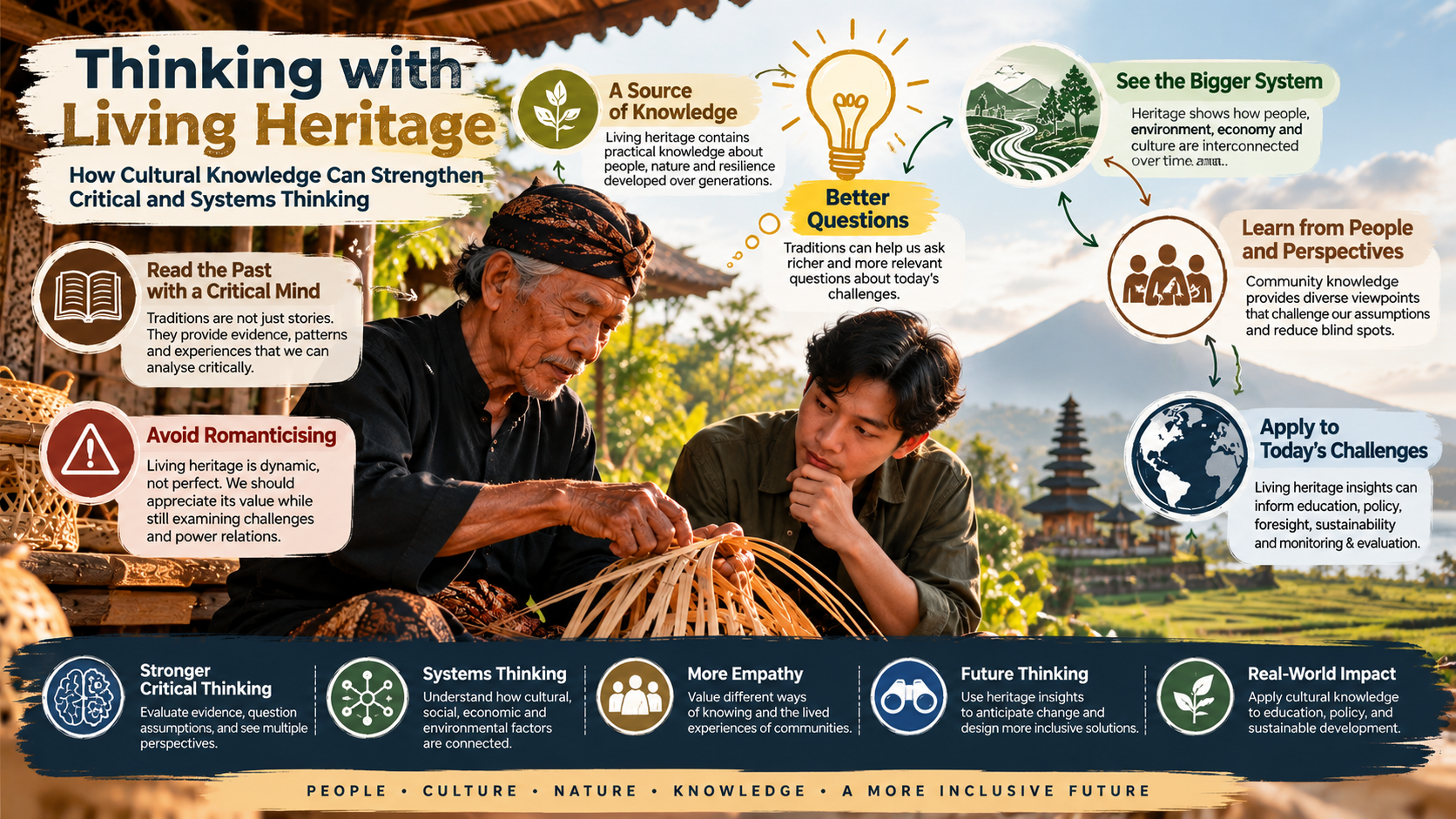
Living Heritage • Critical Thinking • Systems Thinking
Living heritage is not only something communities inherit and preserve. It is also a living process of observing, remembering, interpreting, testing, and adapting knowledge across generations.
When people hear the word heritage, they may picture monuments, costumes, dances, ceremonies, or objects kept in a museum. Yet much of cultural heritage lives through practice: the way knowledge is taught, a craft is learned, a story is retold, a community organises collective work, or people interpret changes in their environment.
UNESCO uses the term living heritage for intangible cultural heritage that is transmitted between generations and continually recreated in response to communities’ environments, history, and interactions with nature. Its value lies not only in a visible cultural expression, but also in the knowledge, skills, meanings, and relationships carried through it.
That perspective offers an interesting lesson for anyone who wants to think more carefully. Living heritage can help us ask: How do people learn from repeated experience? How do they recognise patterns? How does knowledge change when circumstances change? And how can different kinds of knowledge work together when a community faces a new problem?
Living heritage can be understood not merely as something to know about, but as a way to investigate how knowledge is created, shared, challenged, and adapted.
1. Think in Context, Not in Isolated Facts
A fact rarely explains an entire situation. A practice that makes sense in one place may work differently somewhere else because ecology, livelihoods, history, social relationships, and available resources differ.
For example, imagine a coastal community whose members pay close attention to seasonal winds, tides, cloud formations, or changes in marine life. These observations may have developed through repeated interaction with a particular environment. Their meaning cannot be separated from where they were observed, by whom, and under what circumstances.
A systems thinker asks how those observations connect with fishing practices, household income, local rules, weather patterns, technology, and exposure to risk. Rather than treating a traditional practice as an isolated item, the thinker investigates the relationships that make it meaningful.
This way of thinking is useful beyond heritage. Policies, technologies, and management methods also succeed or fail within specific contexts. A solution cannot be evaluated well if we ignore the conditions that shape its results.
2. Look for Patterns Across Time
Living heritage is transmitted through generations, but transmission is not simply the copying of an unchanged instruction. People teach, practise, remember, reinterpret, and adapt. Each generation may preserve some elements while adjusting others in response to new circumstances.
This invites a form of temporal thinking. Instead of asking only what is happening today, we can ask what has changed, what persists, what conditions accompanied earlier changes, and which explanations remain plausible.
In an illustrative coastal example, fishers’ observations might provide clues about how local conditions have varied over time. Those observations should not automatically be treated as a complete forecast. They can instead help generate questions: Have seasonal patterns shifted? Are the observations comparable across years? Have equipment, fishing locations, or reporting practices changed too?
Comparing lived experience with environmental measurements, historical records, or other forms of evidence can produce a richer account than relying on only one source. It also helps prevent us from confusing a pattern that people remember with a pattern that has been independently established.
3. Recognise That Knowledge Is Distributed
No single person necessarily holds all the knowledge needed to understand a complex issue. A craftsperson may understand materials through years of practice. An elder may remember earlier community responses to a crisis. Young people may recognise changing communication habits. Farmers, fishers, performers, healers, educators, and researchers may each contribute different observations, methods, and questions.
These forms of knowledge are not interchangeable, and none should be romanticised. The point is that complex problems often require contributions from people who see different parts of the situation.
Living heritage reminds us to ask not only, “What information do we have?” but also, “Who knows something relevant, how did they learn it, and whose experience is missing from this conversation?”
Good analysis does not ask one form of knowledge to perform every task. It creates a process for comparing contributions, exploring disagreements, and clarifying what each source can and cannot establish.
4. Use Stories and Practices to Generate Better Questions
Stories, sayings, demonstrations, and rituals can carry accumulated interpretations of experience. They can help people remember a warning, communicate a value, or make an abstract relationship easier to discuss. A story can function as a starting model: it points our attention toward a pattern that may deserve closer examination.
But an analogy is not proof. Two situations may look similar while differing in the mechanisms that shape their outcomes. A story about cooperation, for instance, may inspire a team to coordinate better—but the team still needs to examine incentives, roles, resources, and the possibility of disagreement.
A useful thinking sequence is to begin with the cultural expression, identify the idea or relationship it appears to convey, ask where that insight may apply, and then test the comparison against the new context.
Let heritage widen the questions we ask. Let evidence help us judge which answers are defensible.
5. Learn from Practice, Not Only from Explanations
Some knowledge is difficult to communicate fully through a written instruction. Craftsmanship is a clear example: a learner may need to observe a skilled practitioner, handle materials, make mistakes, receive feedback, and repeat a process before developing reliable judgement.
This is not a reason to reject documentation or formal education. It is a reminder that knowing the description of an activity is different from knowing how to perform it under real conditions.
The same distinction appears in professional learning. Reading about stakeholder engagement is not the same as facilitating a difficult discussion. Studying risk management is not the same as responding to an unexpected event. A sound learning design combines explanation with observation, guided practice, reflection, and feedback.
6. Preserve the Capacity to Change
One of the most important features of living heritage is that it can be recreated as communities respond to changing circumstances. Safeguarding a practice therefore does not necessarily mean freezing it in one version or requiring every generation to reproduce it identically.
The same principle matters in thinking. A method that once worked may become less useful when the environment changes. A solution should be understood in relation to the conditions under which it was developed, rather than treated as a universal rule.
At the same time, flexibility should not become an excuse to change a practice without listening to the people who carry it. Communities should be able to participate meaningfully in decisions about how their heritage is documented, transmitted, interpreted, or adapted.
Critical thinking also means recognising that not every inherited practice is automatically fair, safe, or appropriate in every situation. Cultural knowledge deserves serious and respectful engagement, not unquestioning acceptance. Questions of human rights, mutual respect, community agency, and sustainable development matter when considering safeguarding and change.
7. A Practical Method: Think with Living Heritage
The following sequence can help turn cultural knowledge into a respectful and evidence-informed learning process. It is a practical framework, not a universal formula.
What happens, where does it happen, who participates, and which environmental or social conditions matter?
Ask participants how the practice is learned, what it means to them, and what changes they have experienced. Do not assume one person speaks for an entire community.
Look for recurring patterns, dependencies, constraints, values, feedback loops, and the problems the practice helps people navigate.
Use stories, observations, and experience to develop hypotheses. Make clear what is known, what is interpreted, and what remains uncertain.
Where appropriate, compare accounts with records, measurements, other experiences, or a small practical test. Investigate contradictions rather than hiding them.
Discuss what the inquiry suggests with the people involved. Consider who benefits, possible unintended consequences, and whether the interpretation respects community agency.
8. Worked Example: Planning a Coastal Learning Activity
Imagine a team preparing a learning activity about coastal environmental change. The team initially plans to deliver a presentation based only on a set of maps and technical slides. The information may be useful, but the team does not yet know whether the material addresses the questions residents consider most important.
A living-heritage-informed approach would not replace environmental science with tradition. It would improve the inquiry by bringing different forms of observation into conversation.
The benefit is not simply that the activity becomes more culturally engaging. The thinking process itself improves: the team questions its assumptions, widens its evidence base, makes uncertainty visible, and checks whether the intended intervention fits the context.
9. What This Means for Foresight, Education, and Evaluation
For foresight, living heritage can prompt researchers to look beyond formal reports for signs of how people interpret change in everyday life. Stories, skills, social practices, and local observations may raise questions that conventional datasets do not capture. Those signals still need to be assessed for relevance, corroboration, uncertainty, and potential bias.
For education, living heritage can connect learning to familiar practices and relationships. Community-recognised ways of transmitting knowledge can complement formal learning, provided that participation is respectful and the content is developed with those involved.
For monitoring, evaluation, and learning, this perspective encourages us to distinguish between delivering an activity and changing how people understand or respond to a problem. A workshop may be completed successfully without participants gaining greater confidence, using the knowledge, or influencing a decision. Evaluation should therefore examine the mechanism between the activity and the intended outcome.
These outcomes cannot be assumed. They need to be observed and assessed in context, with attention to who participates, whose knowledge is heard, and whether the resulting decisions make a real difference.
10. The Questions Worth Taking Forward
When encountering a cultural practice or a piece of inherited knowledge, try asking:
Conclusion: Heritage Can Teach Us How to Think, Not Just What to Remember
Living heritage connects memory with practice, knowledge with relationships, and continuity with change. Approached thoughtfully, it can encourage contextual reasoning, pattern recognition, systems thinking, practical learning, and better questions about whose knowledge informs a decision.
But learning from heritage requires more than admiration. It requires listening, careful interpretation, transparent uncertainty, evidence-informed testing, and respect for the people who sustain the practice. We should neither turn cultural knowledge into a decorative anecdote nor treat it as unquestionable truth.
For me, the deeper lesson is that thinking is not merely the act of collecting information. It is the work of connecting observations, exploring relationships, questioning assumptions, learning from others, and revising our understanding when the context changes.
Living heritage reminds us that knowledge survives not by remaining untouched, but by being meaningfully learned, practised, questioned, and carried forward.
Further Reading
- UNESCO — What Is Intangible Cultural Heritage?: an overview of living expressions, knowledge, and skills transmitted across generations.
- UNESCO — Frequently Asked Questions on Living Heritage: explains how living heritage evolves and is recreated in response to changing environments.
- UNESCO — About Living Heritage and Education: discusses intergenerational transmission and the relationship between living heritage and learning.
- UNESCO — Convention for the Safeguarding of the Intangible Cultural Heritage: the 2003 Convention, including the definition of intangible cultural heritage and safeguarding.
This article proposes a learning framework inspired by the concept of living heritage. The examples are illustrative; any real application should be developed with the relevant communities and supported by context-specific evidence.