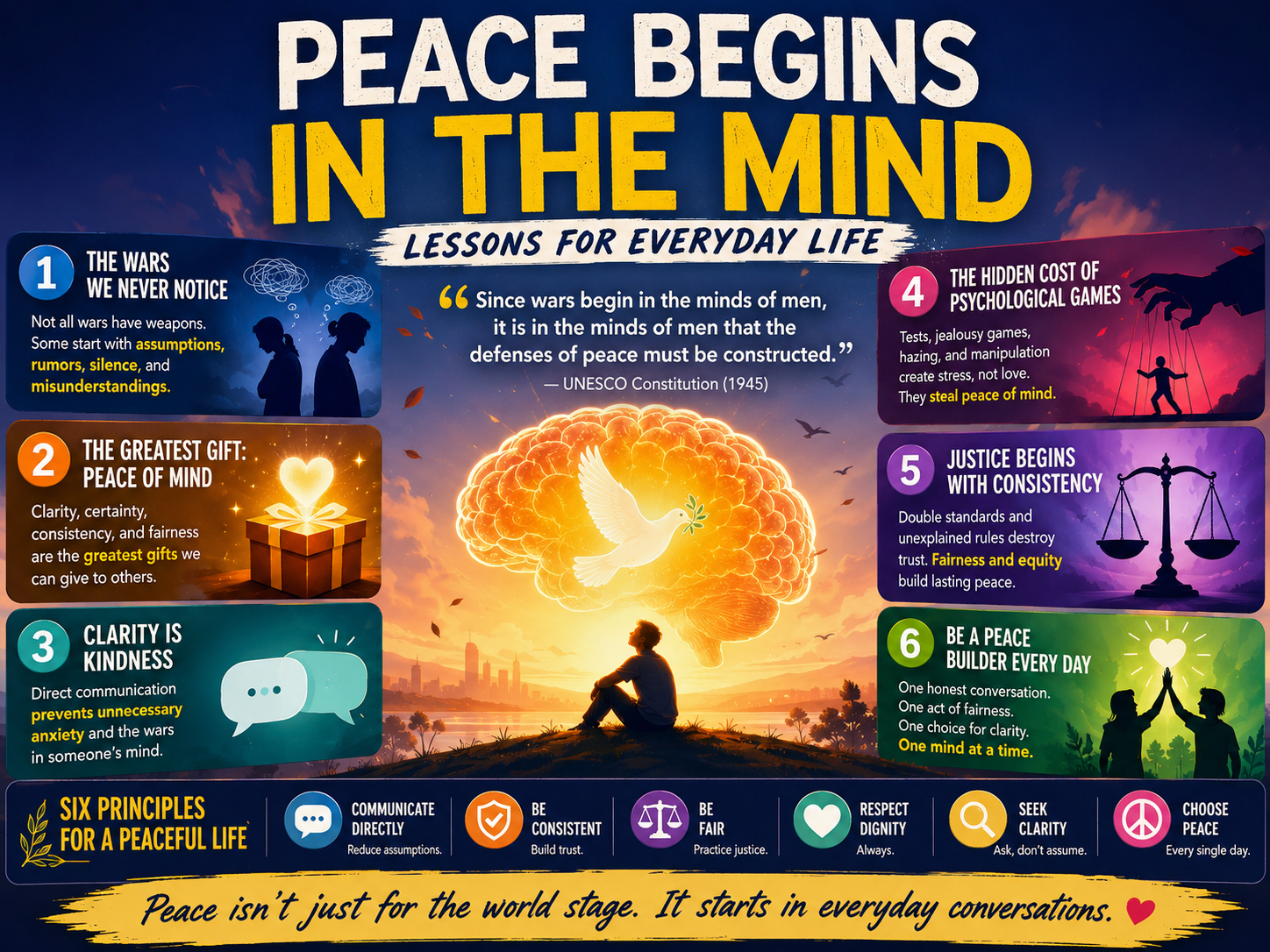
Most people think war begins with weapons. History suggests otherwise. Long before a bullet is fired, a war has already begun somewhere else — inside someone's mind. This is the philosophy that inspired UNESCO's founding after World War II. Its Constitution opens with a sentence that has outlived the war it was written for.
"Since wars begin in the minds of men, it is in the minds of men that the defenses of peace must be constructed."
At first glance, it sounds like a statement about nations. But what if it also describes our everyday lives? Not every war leaves behind rubble. Some leave behind something quieter: a restless mind, an unanswered question, a misunderstanding that could have been cleared up in a single conversation, a rumor that outruns the truth, a relationship that erodes because two people keep guessing at what the other meant.
We imagine conflict as something dramatic. Yet most of the battles we actually fight are invisible — the arguments replayed before sleep, the conversations we wish had happened, the assumptions that quietly replace honest dialogue. These invisible conflicts never make headlines. But they shape how we trust, how we love, how we work, and ultimately how we see the world.
Peace, then, is not merely the absence of violence. It is also the absence of unnecessary psychological conflict — the ability to wake up without questioning another person's intentions, to disagree without fearing manipulation, to have clarity instead of confusion. Maybe world peace doesn't begin in government buildings. Maybe it begins closer to home — in families, workplaces, friendships — in the simple choice to communicate with honesty instead of letting confusion wage silent wars inside another person's mind.
Fig. 1 — The same ambiguous moment can resolve into conflict or peace, depending entirely on whether clarity is given.
I. The Greatest Gift We Rarely Give
There is one thing almost everyone longs for, yet it is one of the rarest gifts people intentionally give each other. Not money. Not success. Not even love. Peace of mind.
When we hear the word peace, we picture diplomacy, ceasefires, the absence of war. But peace can be deeply personal — not overthinking every message, not wondering if someone is secretly testing your loyalty, not lying awake over an unresolved misunderstanding. Peace is not only a political condition. It is a psychological one.
This is why UNESCO's opening line still holds up eighty years later. Notice what it does not say. It does not say wars begin with weapons or armies. It points somewhere deeper: the human mind. Before people fight physically, something has usually already gone wrong psychologically — fear replaces understanding, suspicion replaces trust, misunderstanding replaces dialogue. If conflict grows inside the mind, peace has to be cultivated there too.
A Brief Note on the Theory
Psychologists call our discomfort with the unknown intolerance of uncertainty. Uncertainty Reduction Theory (Berger & Calabrese, 1975) describes what happens next: when information is missing, the mind doesn't sit patiently with the gap — it generates an explanation, usually the fastest one available, not necessarily the truest one. This is also why unanswered questions often feel worse than bad news: bad news, at least, can be planned for.
I saw this play out with a friend who once texted, "Can we talk later? Nothing urgent, just something on my mind." She meant exactly what she wrote. But by the time we spoke that evening, I had already mentally rehearsed three different apologies for things I hadn't even done. The gap between her message and our conversation wasn't empty — my mind had filled it, badly. Multiply that by every delayed reply, vague meeting invite, or "we need to talk" text a person receives in a week, and it becomes clear how much unnecessary conflict is manufactured by silence alone, not by any actual bad intention.
Maybe the greatest gift we can offer isn't endless reassurance or constant agreement. It's simply clarity. Clarity creates certainty. Certainty builds trust. And trust gives people something increasingly rare: peace of mind.
II. Clarity Is an Act of Kindness
If peace begins in the mind, the next question follows naturally: what destroys it? Surprisingly, it is rarely conflict itself. More often, it is uncertainty.
Imagine a message that reads only: "We need to talk." Nothing else. For the next several hours — or days — your mind starts writing stories. Did I do something wrong? Are they angry? Is this ending? Notice that nothing has actually happened yet. The only thing that changed was the absence of clarity, and your mind has already entered a battlefield.
A Brief Note on the Theory
Psychologists call this pull toward a definite answer cognitive closure — the mind's strong preference for any resolved explanation over an open question, even a wrong one, simply because ambiguity is uncomfortable to sit inside (Kruglanski, 1989). That's why assumptions spread faster than facts, and why misunderstandings so often grow larger than the issue that started them.
From this angle, clarity is more than good communication. It is an act of kindness: it stops another person's mind from fighting battles that never needed to exist. This shows up everywhere.
At work. A manager already knows the decision but says, "We'll discuss it later." Days pass. People begin speculating in the group chat. One colleague starts quietly polishing her résumé, convinced the "later" means layoffs. Another stops proposing new ideas, worried he'll be blamed if the still-unknown decision goes badly. None of this was caused by the decision itself — it was caused by the silence around it.
In dating and relationships: emotional hazing. In romance, withholding clarity is rarely an accident — it is often a power dynamic. Consider the partner who goes from warm to ice-cold with no explanation: short, distant replies, a suddenly cryptic Instagram story, and when finally asked what's wrong, a flat "I'm fine" delivered with a face that clearly means otherwise. Or the partner who casually mentions an ex, or lingers a little too long replying to someone else's comment, not because they want that person, but to watch how hard their partner scrambles to compete for their attention. They call it a "test." Psychologists call this pattern emotional hazing — borrowing the logic of initiation rituals, where suffering is treated as proof of belonging. Love should be a sanctuary, not an initiation ritual.
Among friends: relational hazing. The group chat suddenly fills with inside jokes that started somewhere you weren't invited. A weekend trip gets planned in front of you, in detail, with everyone laughing about logistics — but the invitation never quite arrives. When you finally ask if something's wrong, you get, "You're just overthinking," or "If you don't know, I'm not going to tell you." Instead of a direct conversation, people start asking around until everyone has an opinion except the two people who actually need to talk. One honest conversation could end it in five minutes.
Within families. Parents sometimes stay silent believing silence protects their kids. Children sometimes hide problems fearing they'll disappoint their parents. The intent is usually good. But silence leaves room for imagination, and imagination without facts tends toward fear rather than reassurance.
What Silence Creates
An artificial hierarchy where one person holds the "key" to clarity and the other scrambles, apologizes blindly, and walks on eggshells just to keep their seat at the table.
What Clarity Creates
A shared floor of psychological safety, where disagreement is allowed but no one has to decode hidden meanings just to feel secure.
None of these situations involve physical violence. Yet all of them disturb the mind deeply — because emotional hazing, in any of its forms, relies on weaponizing uncertainty, using ambiguity as a tool for control. Every unnecessary misunderstanding, every intentional test dressed up as devotion, is a small crack in the same foundation UNESCO was describing. Not world peace. Human peace. Peace of mind.
III. The Hidden Cost of Psychological Games
There is something curious about human behavior: we say we value honesty, trust, and healthy relationships — and yet we sometimes deliberately create uncertainty just to see how someone reacts. We call it a test. A strategy. "Playing hard to get." Sometimes we even call it love.
But from another angle, it is the intentional removal of someone else's peace of mind. The justification usually sounds harmless: "I just wanted to see if they really cared." Look closely at what that requires: another person has to become uncertain, has to question themselves, has to guess whether they did something wrong. The test only works if someone loses their footing first. That is the hidden cost.
And ironically, these tests rarely measure what people think they measure. Instead of love, they measure anxiety. Instead of commitment, they measure tolerance for confusion. Instead of honesty, they measure someone's willingness to endure psychological discomfort — which is a very different quality entirely.
This isn't limited to romance. A manager withholds context from a project "to see who takes initiative" — and watches two capable people spend the sprint guessing at priorities instead of doing the work. A friend group quietly excludes someone "to see who reaches out first" — and the person who does reach out is often just the one with the least self-respect to lose, not the one who cares most. A leader stays silent about a coming reorg "to see who's loyal" — and loyalty, tested this way, usually just measures who has the fewest other options. When people spend more energy predicting hidden expectations than doing meaningful work, trust quietly disappears underneath them.
Fear can create obedience. It rarely creates respect. Trust grows through consistency, fairness, and predictable behavior — not because life is predictable, but because people no longer have to decode hidden messages just to feel safe.
The same pattern shows up in literal hazing rituals, often justified with "we went through it, so they should too." But research on hazing consistently finds that manufactured humiliation and stress don't reliably build stronger individuals — they normalize fear. Perhaps maturity isn't measured by how cleverly we test people, but by how little unnecessary testing we create.
IV. Justice Begins with Consistency
People think justice belongs in courtrooms. In reality, we encounter it every day — in a rule that suddenly changes, a promise that quietly disappears, an expectation applied to one person but not another. Most of the time, people aren't upset because an outcome is unfavorable. They're upset because it feels inconsistent — and inconsistency quietly erodes trust.
Two employees make the same mistake. One gets understanding, the other gets written up. Neither questions whether rules should exist. They question whether the rules apply equally. Now picture the same dynamic in a family: someone is told, "You shouldn't get close to that person," and later, without explanation, the same people who set that rule are the ones pushing them toward someone else entirely. The problem isn't the new relationship. The problem is that no one explained why the original rule stopped applying. Left with silence, people are stuck asking: Was the rule ever real, or did it only apply to me? That question rarely produces peace of mind — it produces doubt that outlives the original issue by years.
A Brief Note on the Theory
Organizational psychologists call this procedural justice: research consistently shows people accept even unfavorable outcomes far more readily when they believe the process behind a decision was fair and consistently applied (Tyler, 1988). Fairness isn't just a moral preference — it's a load-bearing part of trust.
Consistency doesn't mean never changing your mind — changing your mind is part of growth. What matters is explaining why. A decision can change; a principle shouldn't quietly vanish. When people understand the reasoning, uncertainty drops. When no explanation is given, the mind fills the silence itself, and its conclusions are rarely charitable.
This is also where equality, equity, and justice diverge. Equality means treating everyone the same. Equity recognizes people have different circumstances and may need different support to reach the same starting line. Justice goes further still: it asks whether the rules and systems themselves are fair to begin with. Clarity reduces confusion. Consistency reduces suspicion. Justice reduces resentment. Together, they protect something precious: peace of mind.
V. Becoming a Peace Builder
When people hear "peacebuilding," they picture diplomats, treaties, summits, humanitarian missions. Rarely do they picture an ordinary conversation. Yet that may be exactly where peacebuilding starts — not between governments, but between people.
Across this series, one idea has run underneath every essay: if wars begin in the minds of men, then peace is not only something nations pursue — it's something each of us either strengthens or weakens every day. Every interaction leaves something behind: clarity or confusion, trust or suspicion, relief or anxiety.
Becoming a peace builder has less to do with resolving enormous conflicts and more to do with preventing small ones from growing. It looks like clarifying instead of leaving people to guess. Asking before assuming. Speaking directly instead of through a third party. Explaining a decision instead of hiding behind silence. None of it makes headlines. All of it quietly changes lives.
A Brief Note on the Theory
Organizational researcher Amy Edmondson calls this psychological safety: a shared belief that it's safe to take interpersonal risks — asking a question, admitting a mistake, disagreeing — without fear of punishment or humiliation. Teams with it consistently outperform teams without it, not because they avoid conflict, but because they spend energy on the work instead of on self-protection.
Think about the people who have given you genuine peace of mind. Chances are they weren't extraordinary because they always agreed with you or never made mistakes. They were extraordinary because you rarely had to wonder where you stood — their words matched their actions, their disagreements were respectful, their honesty was predictable. You didn't have to decode anything. You simply felt safe. That's easy to underestimate until it's gone.
None of us can eliminate conflict, and peace was never meant to mean the absence of disagreement. It means the presence of respect even within disagreement — clarity over manipulation, dialogue over assumption, consistency over convenience, understanding over ego.
Imagine asking one simple question before speaking, deciding, or acting: will this give someone more peace of mind, or less? It wouldn't solve every conflict. But it might prevent a great many of them from ever beginning.
The strongest defense of peace is not built with walls, weapons, or victories. It is built whenever we reduce unnecessary fear, confusion, injustice, and misunderstanding in another person's mind.
Epilogue
For years I thought UNESCO's opening sentence was only about preventing wars between nations. Now I wonder if it also offers a quieter lesson for everyday life. Every rumor we refuse to spread. Every misunderstanding we choose to clarify. Every unnecessary test we decide not to create. Every act of fairness we consciously uphold. Each one is a small contribution to the same idea.
Because if wars can begin in the human mind, then perhaps peace can begin there too — not someday, not somewhere else, but today, with us.
#PeaceOfMind #UNESCO #PsychologicalSafety #UncertaintyReductionTheory #ProceduralJustice #EmotionalHazing #Peacebuilding #BehavioralPsychology