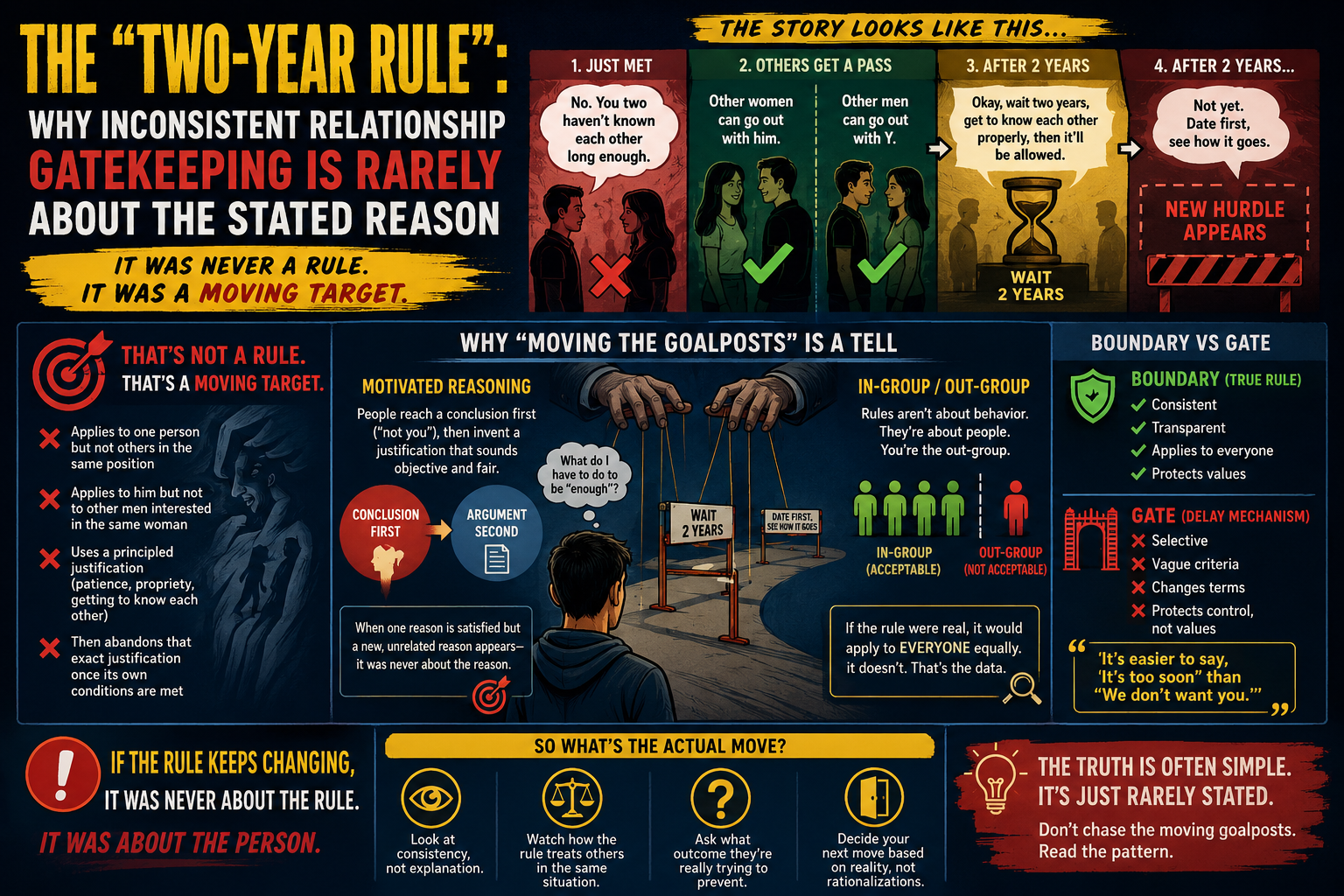
A man wants to spend time with a woman. Her family says no — "you haven't known each other long enough." Except other women are free to spend time with him. And other men are free to spend time with her. Then comes a fix: wait two years. When two years pass, marriage still isn't on the table — now it's "date first." Something doesn't add up. This is a field guide to figuring out exactly what. 🔍
We all encounter rules like this — in families, at work, in bureaucracies — that sound principled on the surface but don't survive contact with a second case. This article does two things: it names the psychological mechanisms that produce rules like this, and it hands you a simple framework, borrowed from research design, to dissect any inconsistent rule you encounter and find out what's actually driving it.
The Visible Contradiction
Stack the details up and a "rule" that sounds principled starts to look like something else entirely.
Applied Selectively
The restriction applies to one specific person, but not to other women he might spend time with, and not to other men who want to spend time with her. A genuine principle should generalize. This one doesn't.
Self-Contradicting
The two-year clause is framed as a values-based, even religious, standard of patience. But once satisfied, the next required step (marriage) doesn't follow — instead, an unrelated step (dating) is inserted, undercutting the very framework used to justify the wait.
1. Why Moving Goalposts Is Such a Reliable Tell
In psychology, this pattern is explained by motivated reasoning: people often arrive at a conclusion first — in this case, no, not you — and reverse-engineer a justification that sounds objective afterward. Kunda's (1990) foundational review established that motivated reasoning still operates within the constraints of plausibility: people don't invent just any justification, they reach for the most defensible one available, which is exactly why "not enough time has passed" or "it's not the proper way" are such popular covers. They borrow the authority of patience, tradition, or religion — language nobody wants to argue against — and point it at one specific target.
The giveaway is what happens when the stated condition gets satisfied. A genuine rule, once met, produces the promised outcome. A rationalized one produces a new condition instead. That's not a detail — it's diagnostic. Karl Popper's (1959) principle of falsifiability applies directly here: a claim that can never be disconfirmed, because it keeps generating new conditions whenever the old one is met, isn't functioning as an explanation. It's functioning as a permanent excuse.
Festinger's Cognitive Dissonance (1957)
There's also a subtler mechanism worth naming: the person applying the double standard may not experience it as hypocrisy at all. Cognitive dissonance theory predicts that when a belief ("we're being fair and principled") conflicts with a behavior (treating one suitor differently from another), the mind resolves the tension by adjusting the story — not the behavior. The rule-giver may genuinely believe the two-year clause is about patience, even while applying it in a way that has nothing to do with patience. That's what makes these rules so hard to argue with directly: the inconsistency isn't always conscious.
2. In-Group Bias: Why the Same Rule Bends for Different People
The most telling detail in the whole scenario is that the rule doesn't generalize across people. Tajfel and Turner's (1979) Social Identity Theory describes exactly this pattern: people evaluate members of an "in-group" (someone already deemed acceptable) more favorably than members of an "out-group" — often while genuinely believing they're applying a neutral standard. The rule isn't really "no one gets close without two years of vetting." The rule is "you specifically need to clear a bar that others don't," and in-group bias is the mechanism that makes the double standard feel justified to the person enforcing it rather than arbitrary.
Four Mechanisms Behind One Inconsistent Rule
Double Standard
Not a theory — the observable data point. The same stated variable (newness of acquaintance) produces different outcomes for different people. This is what tips you off that something else is driving the result.
In-Group / Out-Group Bias
Tajfel & Turner (1979). The theoretical name for the moderator: who is being evaluated changes how the "rule" gets applied, even though the rule is presented as universal.
Motivated Reasoning
Kunda (1990). The mechanism by which a personal or unstated objection gets dressed up as an objective, principle-sounding condition.
Moving the Goalposts
The longitudinal evidence: each time a stated condition is met, the predicted outcome fails to appear and a new condition takes its place — a repeated failure to replicate.
3. A Framework: Dissect It Like a Research Design, Not an Argument
Here's where this becomes a genuinely reusable thinking tool, applicable to far more than one relationship. Treat the situation the way a researcher treats a hypothesis: name the variables, then test whether the claimed relationship between them survives contact with more than one case. Baron and Kenny's (1986) classic distinction between moderator and mediator variables — still the standard reference in social-science methodology — gives us precisely the vocabulary needed.
Mapping the Variables
How a claimed cause, a hidden cause, and a hidden moderator interact — and how the hypothesis test fails.
Name the Dependent Variable (the outcome)
The thing that changes and needs explaining. Here: permission granted or denied to spend time with Y. Every other variable in the model exists only to explain movement in this one.
Name the Claimed Independent Variable (the stated cause)
Whatever the rule-giver says is driving the outcome — here, duration of acquaintance. Stated as: duration → permission.
Test It Across Cases — Not Just One
Do other newly-acquainted people get the same restriction? Does satisfying the variable actually produce the outcome? Here, both tests fail: other men aren't restricted the same way, and two years passing didn't produce permission either — a new condition appeared instead. A variable that fails to predict the outcome consistently across cases has been falsified as the true cause.
Identify the Moderator (who changes the rule's effect)
A moderator changes the strength or direction of the IV→DV relationship without being the outcome itself. Here: who is asking. The identical stated variable (newness of acquaintance) produces a restriction for one person and no restriction for another — a textbook interaction effect, and strong evidence the rule was never really about the stated variable.
Revise the Hypothesis — and Let Competing Explanations Coexist
H1 (stated): Duration of acquaintance predicts permission. Result: Fails — same duration, different outcomes; duration satisfied, outcome still withheld. From there, more than one revised hypothesis can explain the failure. They aren't mutually exclusive — each simply locates the real variable in a different person:
H2 (revised, about the suitor): An unstated, person-specific factor — status, background, a prior impression — predicts permission, and duration is a justification applied selectively.
H3 (revised, about the gatekeeper circle): One or more people already inside Y's circle — a gatekeeper, a relative, a family friend — is themselves drawn to Y, and the restriction functions to keep the field clear rather than to vet suitability. This could involve a single interested party or several.
H4 (revised, about Y herself): Y herself already has a preference for someone inside that circle, and the family's stalling reflects (or defers to) that existing preference rather than any general standard about "how long is long enough."
H2, H3, and H4 each place the real variable in a different person — the suitor, a gatekeeper, or Y — but produce the identical observable failure: a rule that never resolves once its stated terms are met. None of them can be confirmed from the outside. The only way to distinguish between them is to ask directly — first Y, since she is the one person whose actual preference makes several of these hypotheses moot the moment it's known.
The Real Move
You can't win an argument against a justification that was never the real reason. What you can do is stop treating the rule as the thing to solve, and apply the same discipline a thesis committee would apply to a shaky causal claim: show me it holds across other cases, or admit it's not the variable you think it is.
A rule that keeps changing its terms was never a rule. It was a delay mechanism wearing a rule's clothing. Naming the confound out loud — asking directly what the real concern is — is the only test that can't be dodged with another vague timeline.
Conclusion: This Framework Travels
This same five-step dissection — name the DV, name the claimed IV, test across cases, find the moderator, revise the hypothesis — works on far more than family gatekeeping. It works on workplace promotion criteria that only seem to apply to certain employees, on bureaucratic requirements that keep expanding once met, on admissions or immigration standards applied unevenly. The tell is always identical: watch what happens the moment someone actually satisfies the stated condition. If a new one appears instead of the promised outcome, the stated condition was never the real independent variable — and now you know exactly how to prove it.
Rules that keep moving aren't protecting a principle. They're protecting a decision nobody wants to state out loud. Naming the confounding variable is how you make that decision visible.
#CriticalThinking #BehavioralScience #SocialPsychology #ResearchMethods #CognitiveBias #DecisionMaking
Scientific Citations & References
Kunda, Z. (1990). The case for motivated reasoning. Psychological Bulletin, 108(3), 480–498.
Tajfel, H., & Turner, J. C. (1979). An integrative theory of intergroup conflict. In The Social Psychology of Intergroup Relations (pp. 33–47). Brooks/Cole.
Festinger, L. (1957). A Theory of Cognitive Dissonance. Stanford University Press.
Baron, R. M., & Kenny, D. A. (1986). The moderator-mediator variable distinction in social psychological research. Journal of Personality and Social Psychology, 51(6), 1173–1182.
Popper, K. (1959). The Logic of Scientific Discovery. Hutchinson & Co.
Nickerson, R. S. (1998). Confirmation bias: A ubiquitous phenomenon in many guises. Review of General Psychology, 2(2), 175–220.