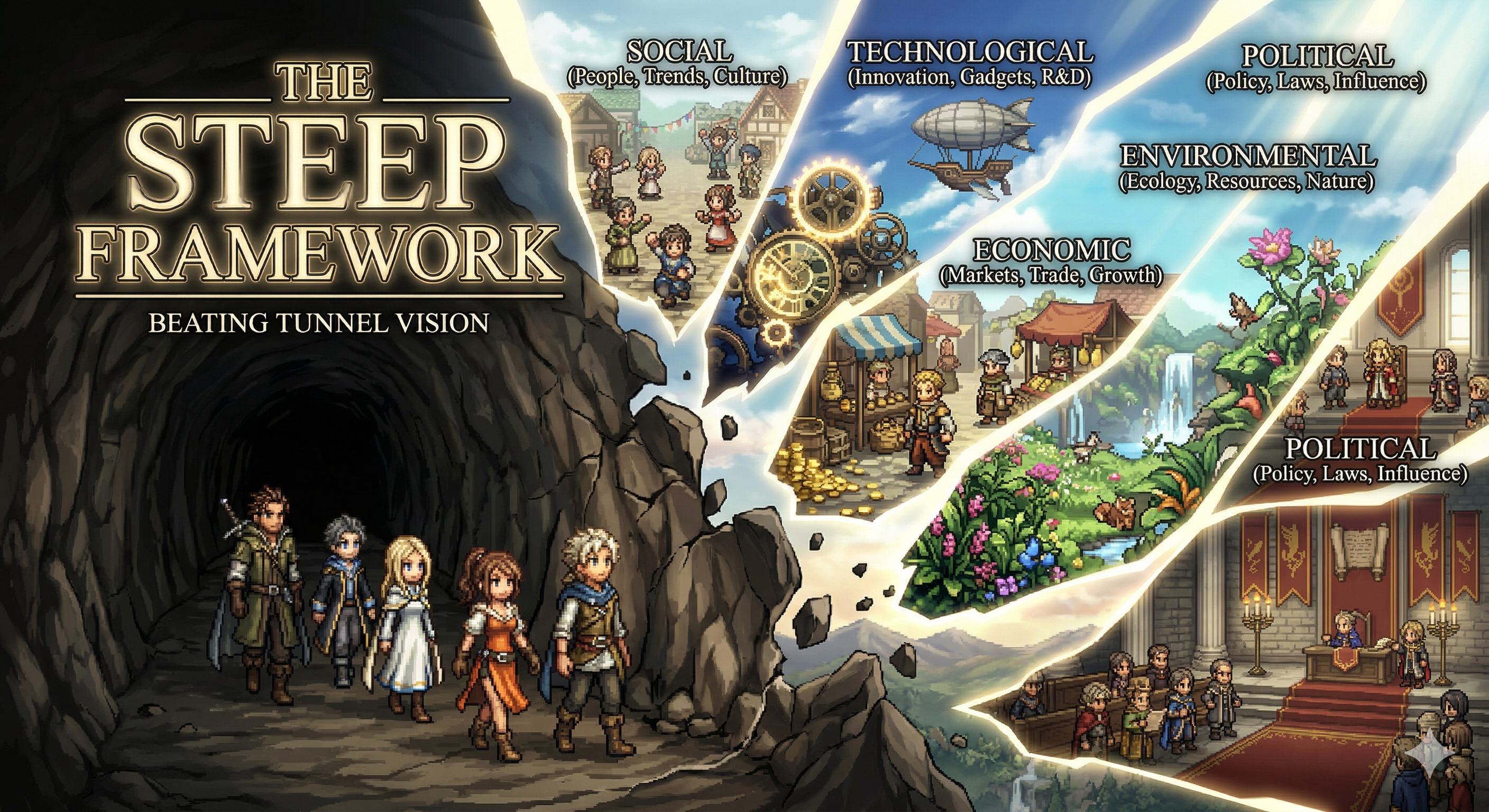
When asked to predict the future, most experts instinctively look within the boundaries of their own domain. A technology leader focuses on computing power and innovation cycles. An economist examines interest rates and market signals. A policymaker looks at regulation and governance structures.
While each perspective is valid, they are also inherently incomplete. This siloed thinking creates a dangerous condition known as tunnel vision—where critical changes occurring outside one's field of view are ignored.
In an increasingly interconnected world, the most transformative disruptions rarely emerge from a single domain. Instead, they arise at the intersection of multiple forces. Failing to see these intersections is what creates strategic blind spots.
The Limits of Linear Thinking
Linear analysis assumes that change happens within predictable boundaries. It encourages specialists to extrapolate trends within their own field, often overlooking how external forces may reshape those trends entirely.
This approach may work in stable environments, but it breaks down in complex systems where social behavior, technological innovation, economic shifts, environmental pressures, and political decisions continuously interact.
The result is a fragmented understanding of the future—one that misses the bigger picture.
Holistic Scanning with STEEP
The STEEP framework—Social, Technological, Economic, Environmental, and Political—acts as a cognitive forcing function. It compels analysts to systematically explore multiple dimensions of change, ensuring that no single perspective dominates the analysis.
Rather than asking “What is happening in my field?”, STEEP reframes the question to “What is happening across all domains that could influence this issue?”
This structured expansion of perspective helps uncover hidden connections, emerging patterns, and cross-sector dynamics that would otherwise remain invisible.
Understanding Intersectional Disruption
Consider the disruption of the taxi industry by ride-hailing platforms such as Uber. At first glance, this appears to be a purely Technological shift, driven by smartphones and GPS capabilities.
However, a deeper analysis reveals a far more complex picture. The shift was also Social, reflecting a growing willingness to trust digital platforms and share rides with strangers. It was Economic, fueled by the rise of the gig economy following the 2008 financial crisis. It was also Political, as regulators struggled to adapt to new business models.
This multi-dimensional disruption could not have been fully understood—or anticipated—through a single lens.
From Framework to Practice
Applying STEEP effectively requires more than simply categorizing trends. It demands disciplined thinking and consistent methodology.
Analysts must actively scan across all five domains, identify signals within each category, and then map how these signals interact. The goal is not just to collect information, but to synthesize it into meaningful insights.
Tools such as Horizon Scanning platforms can significantly enhance this process by organizing signals and enabling pattern recognition. However, the framework itself remains the critical foundation—it ensures that the analysis remains broad, balanced, and free from disciplinary bias.
A Systematic Defense Against Tunnel Vision
By enforcing a multi-domain perspective, STEEP acts as a safeguard against tunnel vision. It challenges assumptions, expands analytical boundaries, and encourages strategic curiosity.
More importantly, it enables organizations to anticipate second-order effects—consequences that arise not directly from a trend, but from its interaction with other forces.
This is where true strategic advantage lies: not in seeing what is obvious, but in understanding what is emerging beneath the surface.
Conclusion: Seeing the Whole Board
In a world defined by complexity, no single lens is sufficient. The future is not shaped by isolated trends, but by the convergence of multiple forces across domains.
The STEEP framework provides a structured way to see this convergence. It transforms fragmented observations into holistic understanding, enabling better decisions and more resilient strategies.
Ultimately, beating tunnel vision is not about seeing further—it is about seeing wider.