Article 89 · Organizational Learning · Expert Voice · Strategic Leadership
THE SHU PARADOX
When an organization fears the misuse of expertise so much that it pushes expertise away—and later discovers it cannot handle reality without it.
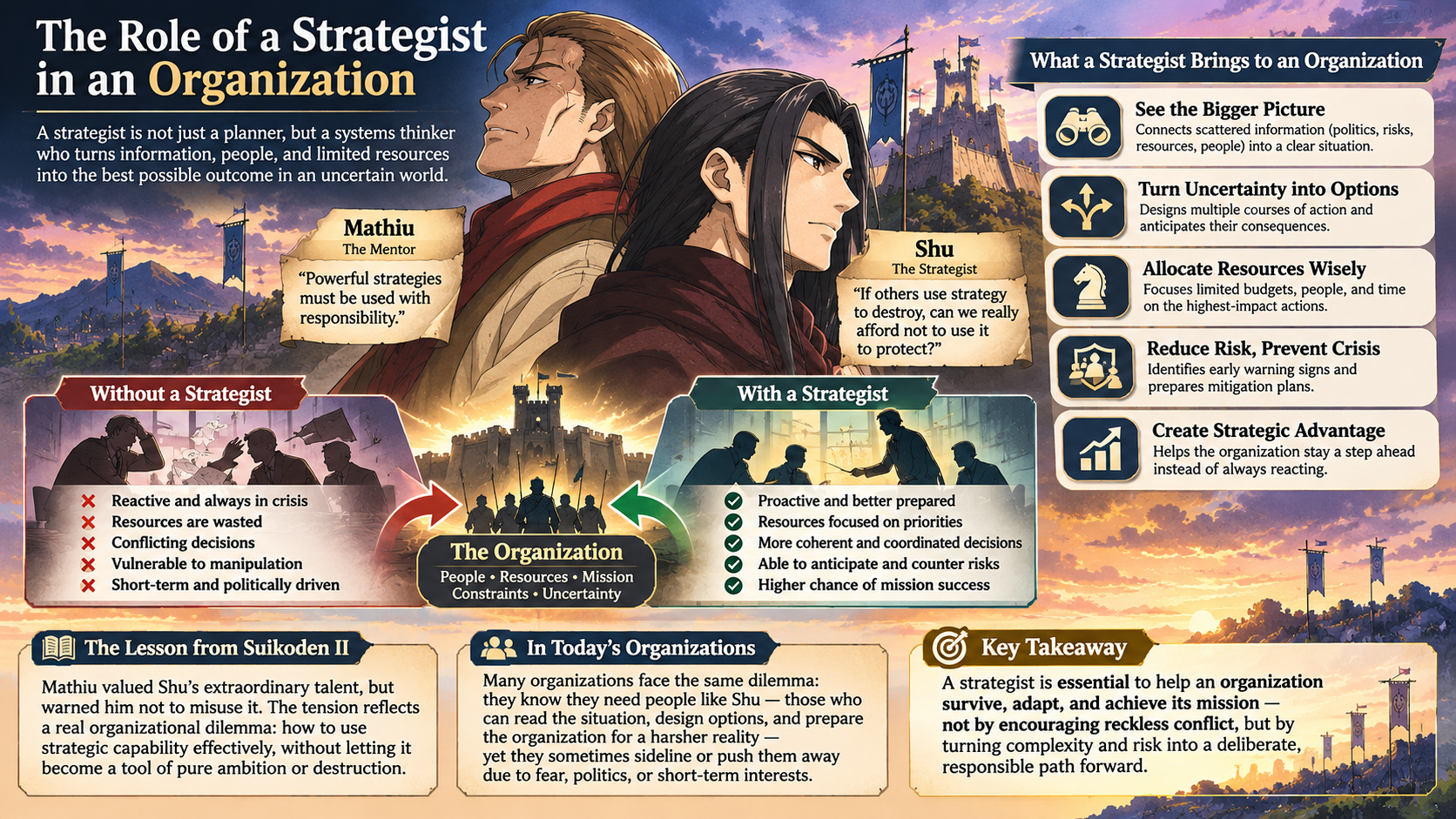
In Suikoden II, Shu is remembered as an exceptionally capable strategist who once studied under Mathiu. Their relationship offers a useful lens for a dilemma that appears in real organizations: what happens when leaders recognize that someone has valuable expertise, but distrust the way that expertise might be used?
The tension is not simply “ethics versus intelligence.” It is a harder question: how do we prevent expertise from being abused without disabling the very capability we need to solve difficult problems?
1. First, what does the original story actually establish?
Konami’s official Suikoden II character description says Shu studied under Mathiu but was expelled because he tried to use his exceptional military skills for his own career. That is the clearest official summary of the conflict. It establishes both Shu’s exceptional ability and Mathiu’s objection to its intended use.
The anime scene shown in the reference screenshots appears to dramatize Mathiu’s warning and Shu’s reaction. However, the official character summary does not reproduce that dialogue. I could not verify the exact wording of the scene against a full, accessible copy of the Japanese novelization. Therefore, this article treats the exchange as an adaptation-inspired reading—not as a verified verbatim quotation from the novel.
The Suikoden II novelization is commonly catalogued as a four-volume series by J. S. Hori; Volume 2 is listed as ISBN 4840217793. The bibliographic record helps identify the book, but it does not independently verify the precise Mathiu–Shu dialogue.

2. The disagreement: Mathiu and Shu are protecting different things
Mathiu’s position can be understood as a warning about purpose: exceptional ability must not become an instrument of private ambition. Shu’s apparent frustration in the anime can be read from another angle: if other actors are already using strategy to outmaneuver or destroy one another, why should the person capable of responding be told to hold back?
These are not necessarily mutually exclusive principles. Mathiu is concerned about the ends for which power is used; Shu’s dilemma concerns the cost of refusing to act when others continue to act.
Conceptual interpretation of the character conflict—not a diagram from the game or novel.
The danger on Mathiu’s side is moralizing restraint until it becomes paralysis. The danger on Shu’s side is treating the existence of hostile actors as permission to use any means necessary. Responsible leadership must avoid both.
3. The organizational version: leaders panic about reality, then sideline the people who understand it
Now translate the dilemma into an organization. A team faces a complex problem: the operating environment is changing, risks are accumulating, and existing plans are not working. Leaders ask for solutions—but the person who understands the system, can challenge assumptions, or has the technical ability to respond may already have been marginalized.
Sometimes this happens because the expert is difficult, blunt, politically inconvenient, or unwilling to endorse a preferred narrative. Sometimes the expert has behaved poorly or has conflicts of interest. Sometimes leaders have legitimate concerns about how the expertise might be used. Those possibilities must be assessed rather than assumed away.
The organizational failure occurs when leaders treat a concern about a person’s motives as a reason to discard the person’s knowledge altogether—without testing the evidence, setting safeguards, or creating a way for the expertise to contribute responsibly.
This is especially costly in complex environments. No single leader can personally know everything. Organizations depend on people closest to the data, the operations, the technology, the communities, and the risks to surface information that senior decision-makers may not possess.
4. What research says about silencing expertise
Employee voice and organizational silence
Organizational researcher Elizabeth W. Morrison describes employee voice as voluntarily communicating suggestions, concerns, information about problems, or work-related opinions upward. Silence withholds potentially useful information from the organization. Her review shows that whether people speak up depends on individual motivations and organizational conditions—not simply whether they have something useful to say.
Psychological safety is not comfort or agreement
Edmondson and Bransby’s 2023 review explains that psychological safety matters because organizations need candid sharing of information, questions, concerns, and diverse expertise. People may stay quiet when they fear being seen as ignorant, incompetent, or intrusive. Psychological safety does not mean lowering standards or avoiding disagreement; it means making interpersonal risk-taking possible so the team can learn.
Inviting input but ignoring it can make things worse
Research on “pseudo voice” warns that asking employees for opinions without intending to consider them can be experienced as managerial disregard. A feedback channel is not meaningful if contributions disappear without acknowledgement, explanation, or action.
Leaders need to listen and respond, not merely collect feedback
A 2024 conceptual review of safety listening synthesizes research on what organizations do after someone raises a concern. It highlights that failures to listen to people who call attention to risks are implicated in safety incidents. The relevant question is not only whether people can speak, but whether decision-makers genuinely process and respond to what they hear.
5. What should an organization do instead?
The research does not recommend giving every expert unchecked authority. It points toward conditions where relevant information can surface, be examined, and influence decisions. A practical approach is to separate three questions that organizations often collapse into one:
- Is the expertise real and relevant? Evaluate demonstrated competence, evidence, work samples, and track record.
- Is the proposed use legitimate? Examine purpose, proportionality, conflicts of interest, foreseeable harm, and who benefits or bears the risk.
- What safeguards make responsible use possible? Define scope, decision rights, review, documentation, and accountability.
A practical governance sequence synthesized from research on employee voice, psychological safety, and safety listening. It is not a single validated intervention protocol.
Build structured dissent into decisions
Before a high-stakes decision, assign someone to challenge the assumptions, invite independent technical review, and ask what evidence would change the decision. This prevents disagreement from being treated as disloyalty and helps distinguish useful dissent from obstruction.
Give experts a channel that reaches decision-makers
Use clear escalation routes, written risk notes, technical review panels, and protected ways to raise concerns. Leaders should acknowledge input and explain the disposition. A suggestion need not be accepted, but it should be considered in good faith.
Keep power bounded by purpose and oversight
Expertise should inform decisions, not grant an individual unlimited authority. Define the legitimate objective, proportionality, limits, review points, and accountability. If an expert has a conflict or has acted improperly, address that conduct directly while preserving access to relevant knowledge through appropriate safeguards.
Do not confuse challenge with disloyalty
A person who questions a plan may be trying to prevent failure. Leaders should test the substance of the challenge before judging its tone or presumed motive. Equally, experts should present evidence clearly, disclose uncertainty, and remain open to correction.
6. The real lesson: restraint must not become institutional helplessness
Mathiu’s warning matters: talent can become dangerous when it serves ego, status, or private ambition. But a modern organization can make the opposite mistake: it can become so anxious about the risks of expertise that it excludes the very people who could help it respond to reality.
Shu’s dilemma, read through the anime scene, asks a question worth carrying into organizational life: if others continue acting strategically, is it enough for us to declare our own restraint virtuous—even when people depend on us to respond?
The answer is not to abandon ethics or to imitate the worst actor. It is to preserve capability while governing its use. Do not demand that experts become silent to prove they are trustworthy. Ask them to make their reasoning transparent, accept scrutiny, and use their skills within legitimate boundaries. And require leaders to listen, assess, and explain their decisions.
Do not discard the strategist because strategy can be misused. Establish the rules that make strategy serve the mission—and hold everyone, including the strategist and the leadership, accountable to them.
Sources and further reading
- KONAMI — Suikoden II official character profile. Official description of Shu: formerly studied under Mathiu, expelled for attempting to use exceptional military skills for his own career. This is the primary official source for the character background summarized here. https://www.konami.com/games/suikoden/rem/1_2/us/en-us/about_2
- Hori, J. S. — Genso Suikoden II novelization, Volume 2. Japanese novelization bibliographic listing: ISBN 4840217793; author and volume details are catalogued here. The full text was not available for direct verification of the anime dialogue. Volume 2 bibliographic entry
- Morrison, E. W. (2014). “Employee Voice and Silence.” Annual Review of Organizational Psychology and Organizational Behavior, 1, 173–197. Review of upward voice, silence, antecedents, and organizational consequences. https://doi.org/10.1146/annurev-orgpsych-031413-091328
- Edmondson, A. C., & Bransby, D. P. (2023). “Psychological Safety Comes of Age: Observed Themes in an Established Literature.” Annual Review of Organizational Psychology and Organizational Behavior, 10, 55–78. Review of psychological safety, collaboration, candid information sharing, and diverse expertise. https://doi.org/10.1146/annurev-orgpsych-120920-055217
- Detert, J. R., & Edmondson, A. C. (2011). “Implicit Voice Theories: Taken-for-Granted Rules of Self-Censorship at Work.” Academy of Management Journal. Studies how beliefs about the risks of speaking up contribute to workplace silence. https://doi.org/10.5465/amj.2011.61967925
- de Vries, G., Jehn, K. A., & Terwel, B. W. (2012). “When Employees Stop Talking and Start Fighting: The Detrimental Effects of Pseudo Voice in Organizations.” Journal of Business Ethics, 105, 221–230. Discusses the harm when managers invite input without intending to consider it. https://doi.org/10.1007/s10551-011-0960-4
- Pandolfo, A. M., Reader, T. W., & Gillespie, A. (2024). “Safety Listening in Organizations: An Integrated Conceptual Review.” Reviews organizational responses to safety-related voice and the consequences of failing to listen. https://doi.org/10.1177/20413866241245276
- Edmondson, A. C. (2003). “Speaking Up in the Operating Room: How Team Leaders Promote Learning in Interdisciplinary Action Teams.” Journal of Management Studies, 40(6), 1419–1452. Examines how leaders influence speaking up and learning in interdisciplinary teams. https://doi.org/10.1111/1467-6486.00386
Evidence note: these studies support the importance of voice, psychological safety, and listening; they do not prove that a particular organization has sidelined a particular expert, nor that every dissenting employee is correct. The Shu–Mathiu diagram is an interpretive model. The recommendations are a practical synthesis of the cited research, not a claim that one standardized intervention has been tested as a package.
