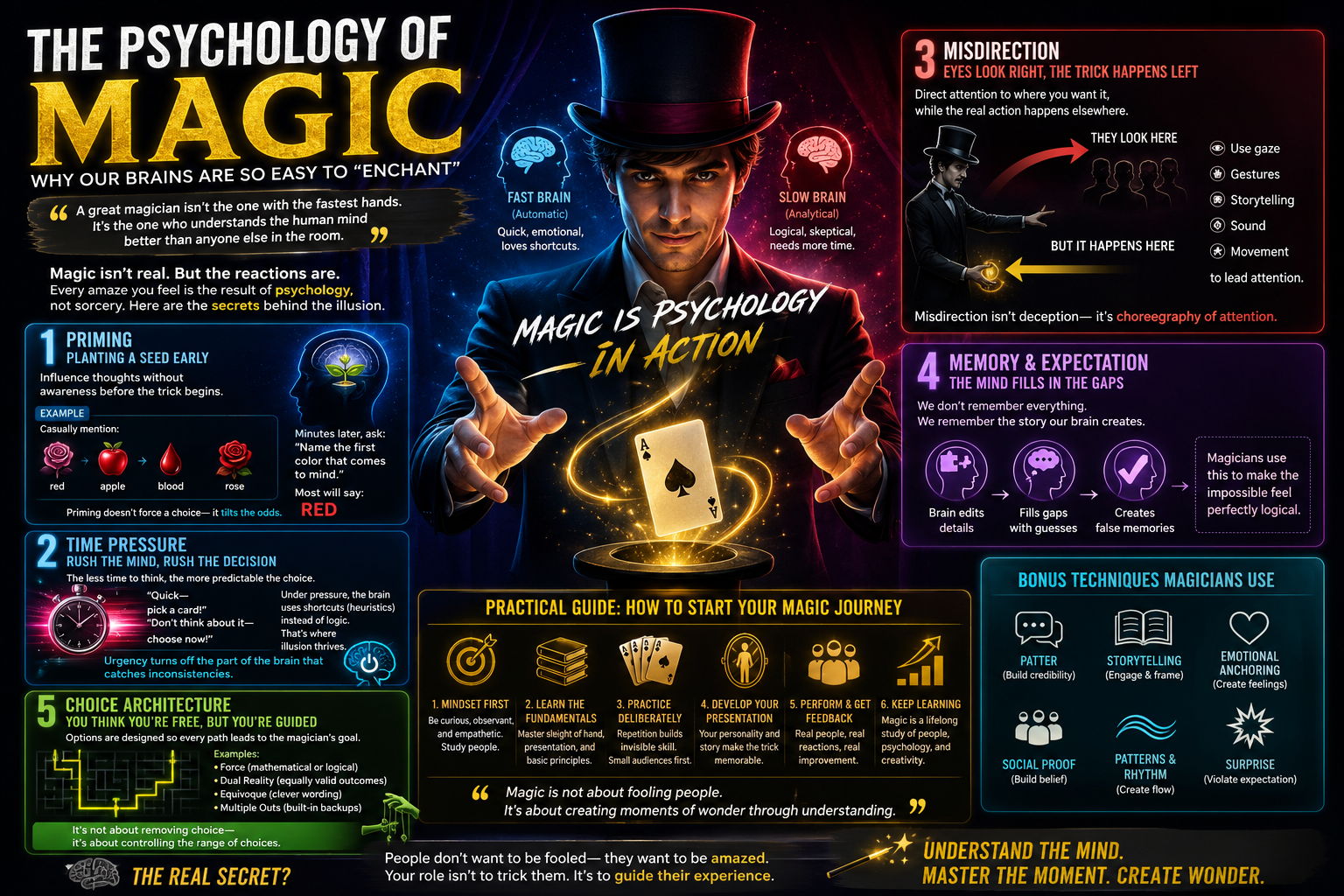
“A great magician isn't the one with the fastest hands. It's the one who understands the human mind better than anyone else in the room.”
As children, we believed magicians had supernatural power. Cards traveled between hands. Coins vanished into thin air. People were sawed in half. Thoughts seemed to be read like an open book.
Then we grew up, and we realized something: there is no magic. There is only psychology — attention, memory, expectation, and the quiet mechanics of human decision-making.
A professional magician is, in many ways, closer to a psychologist than a sorcerer. They study the weak points of the most complex operating system on Earth: the human brain.
This piece does two things. First, it breaks down — one by one — the psychological principles that make illusions feel real. Second, it turns those principles into a practical starting guide for anyone curious about what it actually takes to begin performing magic.
Part 1 — Priming: Planting a Seed Before the Show Begins
Priming is the process of influencing someone's thoughts without their awareness. A skilled magician plants a seed long before the main trick even starts.
For example, throughout casual conversation, the magician repeats a cluster of words: red · apple · blood · rose. Five minutes later they ask: “Name the first color that comes to mind.” Most people answer: Red. They feel it was a free choice. It wasn't. The decision was quietly steered minutes earlier.
Priming works because the brain constantly reaches for the most recently activated information as its fastest available reference point — it's a shortcut, not a flaw, but shortcuts are exactly what a performer can shape.
How magicians actually deploy this:
- Verbal priming — repeating a semantic cluster (red, apple, blood, rose) minutes before asking an “open” question.
- Visual priming — deliberately wearing or displaying a color, number, or shape earlier in the act, so it resurfaces later as someone’s “free” choice. A magician wearing a red tie, using a red prop, and gesturing near a red exit sign has primed red three separate times before anyone realizes it.
- Numerical priming — mentioning “seven days in a week” or “seven wonders of the world” in passing, well before asking someone to “just say a number.”
- Priming through repetition disguised as small talk — the seed is planted inside a joke, an aside, or a story, so it never feels like an instruction. This is what separates priming from a suggestion: a suggestion is noticed; a prime isn’t.
The deeper principle: priming doesn’t force a choice, it tilts the odds. Most audience members will land on the primed answer, but not literally 100% of them — which is exactly why skilled performers build in a backup plan (see Part 6, Choice Architecture) for the rare person who doesn’t take the bait.
Technique Spotlight: Priming
Priming doesn't force a choice; it tilts the odds. Most audience members will land on the primed answer, but not literally 100 % of them — which is exactly why skilled performers always build in a backup plan (see Part 6, Choice Architecture).
Part 2 — Time Pressure: When the Brain Rushes, Logic Shuts Down
The less time someone has to think, the more likely they are to make a poor or predictable decision. Magicians often say: “Quick — pick a card!” or “Don't think about it — choose now!”
Why does this work? The brain runs on two systems: a fast, intuitive mode, and a slow, deliberate mode (a distinction popularized by psychologist Daniel Kahneman). Under pressure, the brain defaults to the fast system, leaning on mental shortcuts — heuristics — instead of careful reasoning. That fast, shortcut-driven state is exactly where illusion thrives.
Why this matters mechanically, not just psychologically: the slow, deliberate mode of thinking is also the mode that catches inconsistencies — the “wait, that doesn’t add up” feeling. Time pressure doesn’t just make people choose faster; it actively suppresses that inconsistency-detector. A spectator rushed into naming a card is far less likely to notice that the deck was subtly stacked, because the part of their brain responsible for noticing has been temporarily sidelined.
Common ways this shows up on stage or at the table:
- A rapid countdown (“3... 2... 1... now!”) right before a reveal, so the audience’s attention snaps to the countdown’s rhythm instead of the method.
- Overlapping instructions (“touch your nose, then say a number, then open your hand”) delivered quickly enough that spectators are focused on keeping up, not analyzing.
- Rushing the choice moment specifically, while slowing everything down before and after it — the contrast makes the rushed moment feel unremarkable rather than suspicious.
This same mechanism explains why high-pressure sales tactics (“this offer expires in 10 minutes”) and rushed decisions in negotiations work the same way outside of magic — urgency is a switch that turns off careful thinking in almost everyone.
Technique Spotlight: Time Pressure & Dual-Process Theory
Urgency does not merely speed people up — it actively suppresses the inconsistency-detector that lives in System 2. A spectator rushed into naming a card is far less likely to notice a stacked deck because the part of their brain responsible for noticing has been temporarily sidelined.
Part 3 — Misdirection: Eyes Look Right, the Trick Happens Left
This is the most famous technique in magic, and also the most misunderstood. Most people think misdirection simply means “redirecting the eyes.” It runs deeper than that. What’s actually being redirected isn’t the eyes — it’s attention.
Human beings never perceive the whole world at once. We only register the small slice we’re actively attending to. When a magician points to the sky, everyone looks up. Meanwhile, the other hand slips a card into a pocket. No one notices — not because their eyes weren’t open, but because their attention was somewhere else entirely.
Misdirection has two main flavors, and professionals combine both:
- Physical misdirection — a gesture, a sudden sound, dropping something, or simply looking intently at one hand so the audience’s eyes follow the performer’s own gaze (this is one of the strongest cues of all: humans instinctively track where other people are looking).
- Psychological/temporal misdirection — timing the actual secret move to happen during a moment of low suspicion, such as right after a laugh, right after a big reveal (when attention naturally relaxes), or during a transition between two “acts” of the routine, when spectators assume nothing important is happening yet.
A key nuance beginners miss: misdirection doesn’t mean “the audience is looking somewhere else.” It means “the audience’s suspicion is somewhere else.” A spectator can be staring directly at a performer’s hands and still miss the method, because their internal question (“is this hand doing something?”) is pointed at the wrong hand, or the wrong moment in time.
Technique Spotlight: Misdirection
Watch Apollo Robbins’ classic demonstration of pure attention control:
Part 4 — Confirmation Bias: We See What We Expect to See
Magicians frequently plant false clues. For example: “I won’t touch this card.” That single sentence causes the audience to focus intensely on confirming that the card is indeed untouched. In doing so, they stop watching everything else. When the trick ends, they say, “That’s right — the card was never touched.” True. But something else changed entirely, and it slipped past unnoticed because attention was locked onto confirming one narrow claim.
This works because confirmation bias isn’t really about believing false things — it’s about verifying narrow, true things while ignoring everything outside that narrow frame. The magician’s statement is almost always literally accurate (“I won’t touch this card” — and indeed they don’t). The audience spends their mental energy confirming a true but irrelevant detail, which is a far more effective distraction than an outright lie, because there’s nothing to “catch.”
A related, very common variant: the magician draws attention to the wrong variable entirely. For example, emphasizing repeatedly that “the box was empty the whole time” directs scrutiny toward the box’s contents, while the actual method involves the box’s construction, not what was inside it.
Part 5 — False Memory: Editing the Audience’s Recollection
This is one of the eeriest abilities a performer can develop: making someone believe something happened when it never did. For example, after a trick concludes, the magician says: “Remember, you shuffled the deck yourself.” In reality, the magician shuffled it. Minutes later, the brain quietly begins rewriting the memory. The spectator becomes genuinely convinced they were the one who shuffled.
Memory isn’t a video recording. It’s a story that gets rewritten every time it’s recalled — a finding well documented in memory research (notably by psychologist Elizabeth Loftus).
Why this technique is so effective in a magic context specifically:
- Spectators aren’t trying to memorize the performance accurately — they’re busy being entertained, which means the “encoding” of the memory is already loose and reconstructive from the start.
- A confident, authoritative restatement of events (“you shuffled it, you picked the card, you chose the box”) creates a kind of social pressure to agree, especially in front of other people.
- The false memory doesn’t need to be planted immediately — it’s often introduced after the trick, once the emotional peak has already made the original sequence of events fuzzy.
Technique Spotlight: False Memory
Elizabeth Loftus’s classic talk on the malleability of memory:
Part 6 — Choice Architecture: The Illusion of Freedom
A magician rarely forces a choice. Instead, they design the choices available. Say there are four options: A, B, C, D. Whichever one the spectator picks, the magician already has a path prepared for it. It feels like total freedom — but every route was mapped out in advance.
A concrete structure often used in practice — the “any of several outs” method:
- Four different objects (say, four envelopes) each secretly contain a different pre-planned outcome.
- Whichever envelope the spectator picks “at random,” the performer’s script and follow-through are built to make that specific outcome feel like the inevitable, meaningful one.
- The performer never says “you might have picked any of these” — the framing always implies the choice was uniquely significant, reinforcing the illusion of free will after the fact.
Why this matters more broadly: choice architecture is a concept borrowed directly from behavioral economics (popularized by Thaler and Sunstein’s work on “nudging”). Magicians simply take this one step further: instead of nudging toward a likely outcome, they engineer the environment so that every possible outcome has already been accounted for.
Part 7 — Equivoque: The “Magician’s Choice”
This is a classic technique built on the same principle. Two objects are on the table. The magician says: “Pick one.” If the spectator points to Object A, the magician says, “Good — we’ll use A.” If they point to Object B, the magician says, “Good — let’s remove B.” Either way, Object A ends up being the one used. The spectator feels in control. The outcome was fixed from the start.
Scaling equivoque beyond two objects: the same logic extends to lists. If a performer needs to “force” one specific city from a list of five, they can ask a spectator to eliminate cities two at a time, phrasing each elimination flexibly (“cross out two — good, we’ll remove those” vs. “point to two you like — good, we’ll keep those”), so that regardless of which cities the spectator picks first, the target city is never the one eliminated. Done smoothly and conversationally, this can take under 20 seconds and feels completely unscripted.
The single hardest part of equivoque, and the one beginners underestimate: the phrasing has to sound identical in tone and pace whether the outcome favors the performer’s plan or not. If a performer’s voice suddenly becomes more decisive or relieved when the “right” object gets chosen, an attentive spectator will pick up on that inconsistency in tone.
Part 8 — Pattern Interrupt: Breaking the Brain’s Rhythm
The brain loves patterns — and magicians exploit that love by building one up, then shattering it. “One... two... three...” Everyone braces for “four.” Instead, the magician suddenly shouts: “Stand up!” For a fraction of a second, the brain stalls in confusion. That split-second gap is exactly when the real move happens.
Why the brain reacts this way: predictive processing means the brain is constantly forecasting what happens next based on patterns it has already detected. When the pattern breaks unexpectedly, the brain has to briefly stop, discard its prediction, and re-orient — a real, measurable lag in processing. Performers exploit that exact lag.
Other common pattern interrupts used in performance:
- Repeating an action identically three times, so the audience assumes a fourth repetition is coming, then doing something completely different on the fourth attempt.
- A sudden change in vocal tone or volume — speaking softly and slowly, then abruptly loud and fast.
- Physical pattern breaks, like reaching for an object with the “wrong” hand, or standing up suddenly mid-routine.
Part 9 — Anchoring: The First Number Becomes the Reference Point
Magicians often open with a suggestive number. “Think of a big number.” Then: “Now pick a number.” Most people choose something relatively large, because the brain has already been anchored to “big” — a bias well documented in behavioral economics (Tversky & Kahneman’s anchoring effect).
How performers narrow the range further, on top of anchoring:
- Range-limiting language — “think of a number between 1 and 50, nothing too obvious like 1 or 50 itself” quietly excludes the edges.
- Parity and shape cues — mentioning “an odd number” or “a number that feels a little unusual” nudges people away from round numbers.
- Combining anchoring with priming (Part 1) — anchoring sets a general size or category, while priming earlier in the conversation can plant the specific target number.
Part 10 — Framing: How a Question Is Asked Changes the Answer
Compare: “Pick a card.” versus “Pick the card that draws your eye the most.” The results differ. Word choice reshapes the entire thought process behind a decision. Magicians choose every sentence with surgical precision.
A few more framing pairs that produce measurably different behavior:
- “Pick a card” (neutral) vs. “Pick a card that feels lucky to you” (adds an emotional filter).
- “Choose a box” vs. “Choose the box you’d choose if you had to guess where I hid it” (reframes a random pick as a strategic guess).
- “Stop me whenever you want” vs. “Stop me exactly when it feels right” — the second phrasing subtly slows people down.
Part 11 — Cognitive Load: Wearing Down the Brain
Magicians frequently ask spectators to juggle several tasks at once: Count numbers. Remember a card. Hold a coin. Answer a question. Maintain eye contact. The more mental bandwidth is consumed, the easier it becomes to hide the actual method — there simply isn’t enough attention left over to notice it.
Working memory — the mental workspace used for holding and juggling information moment to moment — has a well-documented, limited capacity. Once several simultaneous tasks are competing for that limited space, spare capacity for independently monitoring a performer’s hands simply isn’t available.
Layering cognitive load in practice often follows this order:
- Give a simple physical task first (hold this, hold out your hand).
- Add a verbal task on top of it (now count backward from 20).
- Add a social task on top of both (and look me in the eye while you do it).
Part 12 — Social Proof: If Everyone Believes It, We Believe It Too
When an entire audience looks amazed, our own brain assumes something genuinely extraordinary must be happening. This is part of why a live theater performance feels far more magical than watching the same trick alone on video.
How performers actively cultivate this:
- Seeding reactions strategically — placing a friend or briefing the first spectator to react visibly.
- Group participation over solo participation — a trick performed with three or four spectators generates cross-reinforcing reactions.
- Physical proximity in a crowd — reactions ripple outward through a room faster than any individual can rationally process.
Part 13 — Confidence: More Important Than Speed
Many tricks fail not because the technique was flawed, but because the performer looked hesitant. Humans read body language far faster than they process logic. If the magician appears certain, the audience follows that certainty without question.
What “confidence” actually looks like technically:
- Steady eye contact during the riskiest moment of a sleight.
- Even pacing — no sudden speeding up right before or during the secret move.
- Congruent tone and content — saying “there’s absolutely nothing in my hand” while genuinely relaxed.
Part 14 — Storytelling: People Don’t Remember the Trick
They remember the story. The best magicians rarely say, “Watch this card.” They say: “My grandfather gave me this deck many years ago...” Instantly, a trick becomes an emotional experience — and emotion is far stickier in memory than raw fact.
Three storytelling structures magicians reach for again and again:
- The personal-history frame
- The relationship frame
- The tension-and-release frame
Part 15 — The Peak-End Rule: The Ending Decides Everything
Behavioral research shows people remember two things about an experience far more than the rest: the most intense moment (the peak), and how it ended. That’s why skilled performers save their biggest surprise for the finale.
Part 16 — Inattentional Blindness: Missing the Obvious
One of the strangest limits of human attention is inattentional blindness — when attention is locked onto one task, something large and obvious can pass entirely unnoticed, even in plain sight (famously demonstrated in the “invisible gorilla” experiment by Simons and Chabris).
Watch the Original Experiment
The Selective Attention Test (Invisible Gorilla):
Part 17 — One Ahead: Staying a Step Ahead of the Audience
This is one of the oldest and most powerful principles in mentalism. The performer secretly obtains a piece of information before the audience thinks they’re giving it. When the “reveal” happens, it looks like real-time mind-reading, but the magician is actually always working one step behind the information they already collected.
Sources & Further Watching
Most of the effects described above trace back to real research in cognitive and behavioral psychology. Key sources:
- Priming — Bargh’s 1996 “elderly walking” study (and the later replication debate).
- Time Pressure / Dual Systems — Daniel Kahneman, Thinking, Fast and Slow (2011).
- Misdirection — Apollo Robbins TED Talk (embedded above).
- False Memory — Elizabeth Loftus TED Talk (embedded above).
- Anchoring & Framing — Tversky & Kahneman 1974 paper.
- Cognitive Load — George Miller’s classic 1956 paper.
- Peak-End Rule — Kahneman et al. 1993 cold-water study.
- Inattentional Blindness — Simons & Chabris Invisible Gorilla (embedded above).
A note on rigor: psychology has been through a well-documented replication crisis. Core pillars here (anchoring, the peak-end rule, inattentional blindness, working-memory limits, and the reconstructive nature of memory) are on solid empirical footing. Treat single-study claims (especially early social priming) as illustrative rather than settled fact.
Closing: The Bigger Lesson
In the end, magic isn’t about breaking the laws of nature. It’s about understanding the laws of the human mind. Every time we feel certain, “I saw it with my own eyes,” we may not have seen quite what we think. Every time we say, “I chose that myself,” the choice may not have been as free as it felt. And every time we’re confident in a vivid memory, that memory may not match what actually happened.
That’s the biggest lesson magic has to offer. Great magicians don’t control objects. They control attention, expectation, emotion, and the way the brain assembles reality. Once we understand these principles, we don’t just appreciate the art of magic more — we become more alert to how advertising, media, negotiation, politics, and everyday conversation can shape our thinking without our awareness.
Because often, the biggest illusion isn’t the one happening on stage — it’s the one happening inside our own heads.
How to Become a Magician: A Detailed, Step-by-Step Learning Roadmap
Understanding the psychology above is half the craft. The other half is building real skill, methodically, in an order that actually works.
Stage 0 — Get the Right Mindset Before You Learn a Single Trick
- Magic is a performing art, not a puzzle to hoard. The goal isn’t knowing 100 secrets — it’s making 3–5 routines feel genuinely impossible.
- Expect to feel clumsy for weeks. Sleight of hand is a physical skill, like an instrument.
- Decide your starting lane. Pick ONE: Card magic, Coin magic, Mentalism / mind-reading, or Kids’ party magic.
Stage 1 — Your First 2–4 Weeks: Foundational Skills
For card magic: overhand shuffle control → double lift → basic false cut → card forcing.
For coin magic: classic palm → French drop → basic coin production.
For mentalism: basic scripting and cold-reading phrasing → simple forced-choice structure (Equivoque) → the One Ahead principle.
Practice 15–20 minutes a day, in front of a mirror, doing the same single sleight slowly and correctly.
Stage 2 — Weeks 4–8: Learn Your First Complete Routines
Once your fundamentals feel natural, attach them to 2–3 complete tricks with a beginning, middle, and end. Also start writing out, word for word, what you’ll say during the trick.
Stage 3 — Weeks 8–12: Mirror Practice → Camera Practice → Real Humans
- Mirror practice
- Record yourself on your phone
- Perform for one trusted person and ask: “What did you actually notice?”
Stage 4 — Ongoing: Study From Real, Credible Sources
- Books: Mark Wilson’s Complete Course in Magic; Bobo for coins; solid mentalism theory books.
- Structured platforms: Penguin Magic, theory11, Vanishing Inc.
- Local magic clubs (I.B.M. or S.A.M.)
- YouTube: search “[sleight name] tutorial [named magician]” rather than anonymous compilations.
Stage 5 — Build a Practice Routine You Can Actually Sustain
4 days/week technique drilling · 2 days/week full routine with script · 1 day/week perform for at least one real person. Consistency beats intensity.
Stage 6 — Master Presentation, Not Just Mechanics
The psychological techniques covered earlier — storytelling, framing, confidence, pacing toward a strong ending — are not decoration. They are the actual engine that makes a technically simple trick feel impossible.
Stage 7 — Understand and Respect Magician’s Ethics
Don’t expose another performer’s methods publicly. Don’t teach a trick you haven’t properly learned or paid for. Always perform with the spectator’s comfort and consent in mind.
Stage 8 — Get Real Reps, Then Specialize
Look for low-stakes live opportunities. Pay attention to what real audiences teach you that books can’t. Over time most magicians naturally gravitate toward a niche.
First-Three-Months Checklist
- ☐ Chosen a starting lane (cards, coins, or mentalism)
- ☐ Learned 3–4 foundational sleights or structures cleanly
- ☐ Learned 2–3 complete routines with scripted presentation
- ☐ Practiced in a mirror, then recorded myself, then performed for one trusted person
- ☐ Read at least one credible full book or completed one structured course
- ☐ Performed for a real, informal audience at least three times
- ☐ Can perform my best routine smoothly without thinking about the mechanics
This piece blends classic magic theory with concepts from cognitive and behavioral psychology to explain why illusions work — and offers a starting map for anyone who wants to move from being fooled by these principles to using them, ethically, on stage.