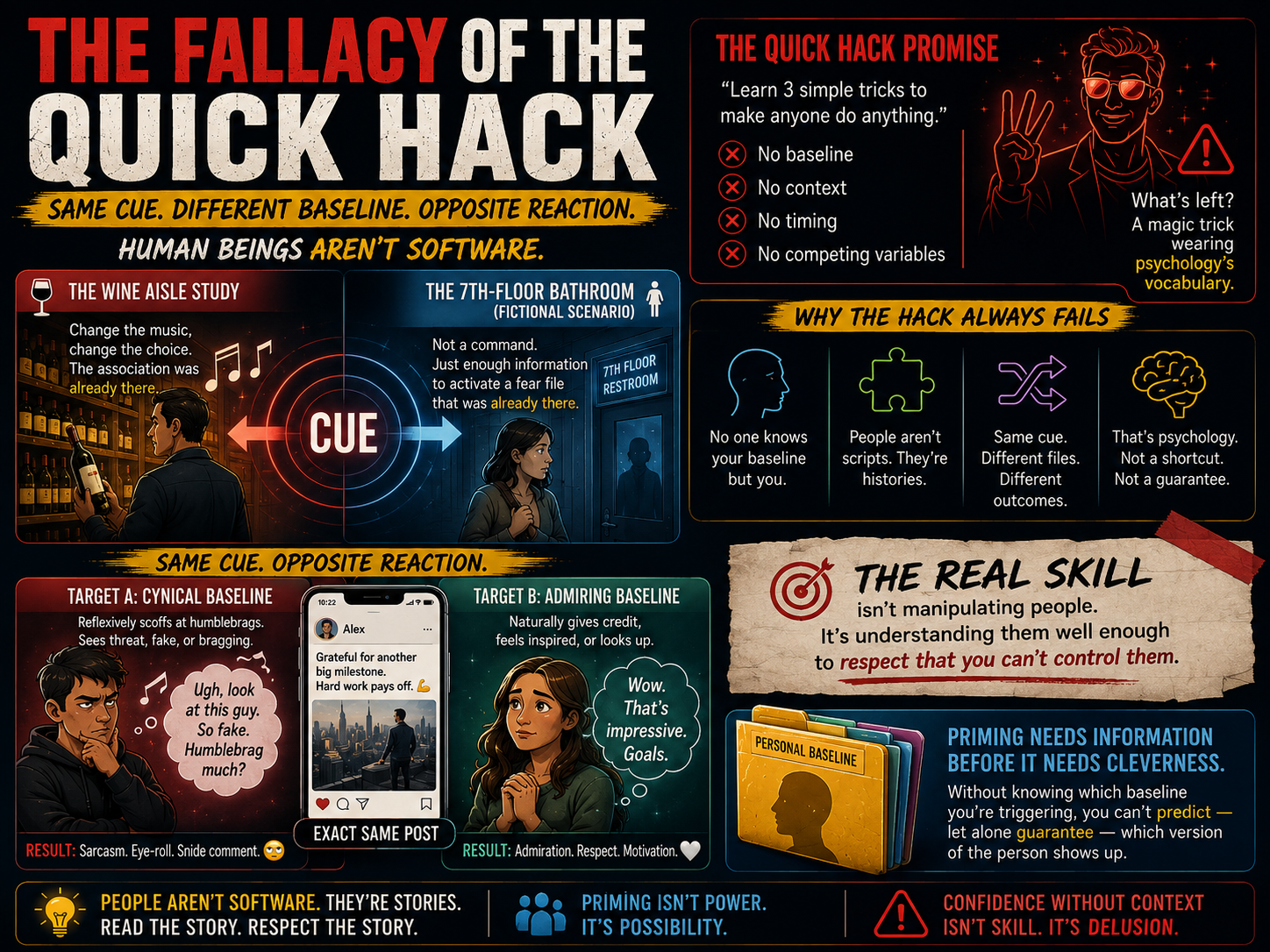
Long before "mind hacks" flooded social media feeds, behavioral scientists spent decades testing priming in controlled laboratories. The verdict, after all that research, is uncomfortable for anyone selling a five-second script: priming can be surprisingly powerful — right up until the moment it collapses completely.
This is a four-part field guide to cognitive priming: where it genuinely works, a real story of it working outside the lab, the theory that explains both, and why the "psychology guru" genre falls apart the moment it leaves the internet.
The Four Parts
- When Priming Works, and When It Falls Apart
- Priming in the Wild: The Seventh-Floor Bathroom
- The Theory Behind Both Stories
- Why "Psychology Tricks" Fail the Moment They Leave the Internet
Part I — When Priming Works, and When It Falls Apart
Here is what happens when science actually tries to steer human decision-making: it works, sometimes strikingly well, and then it fails in a way that reveals exactly why it worked in the first place.
When Priming Works: The Supermarket Wine Aisle
In 1997, psychologists Adrian North, David Hargreaves, and Jennifer McKendrick alternated the background music in a UK supermarket's wine aisle between French accordion music and a German oompah band, while French and German wines sat side by side on the same shelf.
On accordion days, French wine outsold German wine roughly five to one. On oompah days, German wine took the lead instead. When shoppers were asked afterward whether the music had influenced them, almost none thought it had.
The music didn't install a new idea. It activated a cultural association shoppers already carried — "France," "Germany," and everything those categories evoke — right at the point of choosing.
When Priming Fails: The "Slow Walker" That Wasn't
In 1996, John Bargh and colleagues had participants complete word puzzles seeded with age-related terms — Florida, wrinkle, pension, bingo. The claim: afterward, participants walked measurably slower down the hallway, as if the concept of "elderly" had been primed straight into their gait.
It became one of the most cited findings in social psychology — until 2012, when researchers Doyen, Klein, Pichon, and Cleeremans tried to replicate it using infrared motion sensors instead of a human holding a stopwatch. The effect vanished. In a follow-up experiment, walking only slowed when the experimenters themselves had been told in advance to expect a slowdown — suggesting the effect had been travelling through the person doing the measuring, not the person being measured.
Interactive 1 — The Wine Aisle Simulator
Pick which music plays in the aisle today. The bar shows the actual reported split from the 1997 field study.
French music playing — French wine outsells German roughly 5 to 1.
The Takeaway
Priming isn't a magic button. It can't inject a thought or a behavior into someone from nothing. It only works when it taps something already stored — a belief, a fear, an association already sitting in memory. The wine study worked because the association was already there and the stakes were low. The walking study fell apart once anyone controlled for what the observers expected to see.
Part II — Priming in the Wild: The Seventh-Floor Bathroom
The following is a fictional scenario built to illustrate the mechanism in a real-world setting.
Priming isn't hypnosis, and it isn't magic. It's the act of triggering a "file" that already exists in someone's head. Here's what that actually looked like outside a lab.
The Bet
Yesterday afternoon, I made a bet with my colleague Hasan: twenty bucks said our coworker Shofia wouldn't use the seventh-floor bathroom that day — that she'd go all the way down to the lobby instead. Hasan scoffed; why would anyone walk down six flights when a clean restroom sat ten steps from her desk?
My edge wasn't cleverness. It was baseline data. Shofia was, by reputation, easy to spook. A strange noise from an empty room, and she wouldn't investigate without company. A flickering hallway light, and she'd take the long way around. A ghost story mentioned within earshot was usually enough on its own.
So when Hasan took the bet, I didn't tell Shofia to go downstairs. I didn't block a hallway or take the elevator out of service. I just made one option feel quietly safer than the others — without ever issuing an instruction.
The Setup and the Confirmation
The first ingredient wasn't a command. It was a narrative. Hasan and I talked just loudly enough for Shofia to overhear — something freaky had happened in the seventh-floor restroom, apparently, someone ran out screaming. I kept my eyes on my phone, playing uninterested. Neither of us filled in the gaps; a complete story sounds like a story, an incomplete one leaves room for someone's imagination to finish the job.
The second layer came a few minutes later, when Hasan and I "happened" to pass the security desk while Shofia was nearby, and I asked the guard — already looped in — what all the noise near the elevators had been about earlier. He didn't miss a beat: someone had sprinted down the stairs screaming after seeing "floating hair" near the seventh-floor mirrors.
Behind us, Shofia stopped walking completely. A beat too long looking at the elevator, then the staircase, then the hallway toward the restroom. She whispered "nope" to herself, picked up her things, and took the elevator straight to the ground floor without a word.
Twenty minutes later, the twenty dollars was in my hand. "You didn't convince her," Hasan said. He was right — I hadn't. "I just gave her enough information to convince herself."
Interactive 2 — Same Rumor, Different Baseline
Slide from "loves ghost stories" to "easily spooked." The rumor sent into the hallway never changes — only the reading it produces.
The Mechanism
Nobody controlled Shofia's mind. Her brain simply connected an ambiguous rumor to a fear response that was already wired in. When she chose the elevator, it felt to her like an independent, logical decision — even though the path to that decision had been quietly shaped from outside. Without knowing someone's baseline, a psychology trick is just a guess dressed up as a plan.
Part III — The Theory Behind Both Stories
Before getting to why "mind hack" content collapses in the real world, it's worth naming the actual psychological machinery behind what happened in Parts I and II. Two frameworks do most of the work.
Spreading Activation: A Cue Can Only Wake Up What's Already There
Cognitive psychologists model memory as a network of interconnected concepts rather than a filing cabinet of isolated facts. In the classic account proposed by Allan Collins and Elizabeth Loftus in 1975, activating one concept — a word, an image, a sound — sends a ripple of "activation" outward along the connections to related concepts, making them easier and faster to notice or recall.
This is why accordion music can prime "French" without anyone consciously thinking the word: the music activates the node for "France," and that activation spreads to nearby nodes like "French wine." It also explains the failure case — activation only travels along connections that already exist. If "wrinkle" has no strong wiring, for a healthy 22-year-old, to "walk slower right now," there's nothing for the cue to reach.
Dual-Process Theory: Two Systems, One Vulnerable to Cues
Psychologist Daniel Kahneman, building on work by Keith Stanovich and Richard West, splits thinking into two modes. "System 1" is fast, automatic, and runs on pattern-matching and association — it's the system that reacts to a rumor with a spike of anxiety before any conscious reasoning kicks in. "System 2" is slow, effortful, and deliberate — the system capable of stepping back and asking, "Wait, is this actually true?"
Priming works almost entirely on System 1. This is also why knowing about a bias intellectually doesn't inoculate anyone against it in the moment — that knowledge lives in System 2, but the reaction is already underway in System 1 by the time System 2 gets involved.
Interactive 3 — System 1 vs. System 2
Toggle between the two systems handling the same rumor. Notice which one has already acted by the time the other one is consulted.
Why This Matters for the "Mind Hack" Industry
Put these two frameworks together and a clear standard falls out: a priming attempt only works when (1) the target has a pre-existing associative link between the cue and the desired reaction, and (2) the cue lands while System 1 is doing the deciding, before System 2 can intervene. Both conditions depend entirely on the specific person, their history, and the moment — which is exactly why a single scripted "trick" can't reliably work on everyone.
Part IV — Why "Psychology Tricks" Fail the Moment They Leave the Internet
Guiding Shofia away from the seventh-floor restroom looked, in the moment, like a clean and repeatable formula. In the real world, human behavior is too layered for anything close to a guaranteed script. Shift a single variable and the exact same "trick" falls apart.
The Variable Problem
- The biological variable. A genuine, urgent physical need overrides a vague emotional cue almost every time.
- The social variable. A confident coworker laughing the rumor off neutralizes the anxiety instantly.
- The cognitive variable. Someone deep in a deadline, wearing headphones, may never process the cue at all.
Brains Aren't Operating Systems
The core flaw in most viral "mind hack" content is that it treats human psychology like software: execute prompt A, inject cue B, guarantee output C. But a brain isn't running predictable code — it's an ecosystem shaped by current internal state, past conditioning, and environmental context all at once.
Why "Knowing" the Bias Doesn't Make You Immune
Even people who understand a bias intellectually still fall for it emotionally. Someone can recite the definition of the sunk cost fallacy and still stay in a failing project because walking away feels like a personal loss. As Part III's dual-process framework makes clear, this isn't hypocrisy — it's architecture. The knowledge sits in System 2; the reaction fires from System 1 before System 2 is consulted.
The Fallacy of the Quick Hack
This is exactly where the "dark psychology" influencer genre falls apart. A confident voice promising to teach anyone how to make a crush obsessed with them, or dominate any negotiation, in three easy steps isn't just overselling — it's misunderstanding the mechanism at a basic level. Strip away baseline knowledge, timing, and the absence of competing variables, and what's left isn't psychology — it's a magic trick wearing psychology's vocabulary.
The same variable problem shows up in something as ordinary as a social media post. Say someone posts content clearly designed to look accomplished or clever. If the target's baseline is a cynical, mocking personality — the type who reflexively scoffs at anything that looks like a humblebrag — that post will reliably surface exactly that instinct: sarcasm, an eye-roll, a snide comment. Post the exact same content to someone whose baseline runs the other way, and it produces admiration instead. Same cue, opposite reaction, because the "file" being activated belongs to the target, not the post. This is the whole reason priming needs information before it needs cleverness: without knowing which baseline you're triggering, there's no way to predict — let alone guarantee — which version of the person shows up.
Interactive 4 — Same Post, Two Audiences
The post never changes: it's written to look accomplished and clever. Pick the reader's baseline and watch the reaction flip.
The Takeaway
The next time a video promises to teach a brain hack in three easy steps, the tell is right there in the premise. Anyone who actually understands human psychology will say, up front, that people are too complex, too context-dependent, and too shaped by their own history to be reduced to a script that works on everyone the same way.
Key Sources
1 North, A. C., Hargreaves, D. J., & McKendrick, J. (1997). In-store music affects product choice. Nature, 390, 132 — https://www.nature.com/articles/36484; North, A. C., Hargreaves, D. J., & McKendrick, J. (1999). The influence of in-store music on wine selections. Journal of Applied Psychology, 84(2), 271–276.
2 Bargh, J. A., Chen, M., & Burrows, L. (1996). Automaticity of social behavior. Journal of Personality and Social Psychology, 71(2), 230–244.
3 Doyen, S., Klein, O., Pichon, C.-L., & Cleeremans, A. (2012). Behavioral priming: It's all in the mind, but whose mind? PLoS ONE, 7(1), e29081 — https://journals.plos.org/plosone/article?id=10.1371/journal.pone.0029081
4 Collins, A. M., & Loftus, E. F. (1975). A spreading-activation theory of semantic processing. Psychological Review, 82(6), 407–428.
5 Kahneman, D. (2011). Thinking, Fast and Slow.
6 Stanovich, K. E., & West, R. F. (2000). Individual differences in reasoning: Implications for the rationality debate. Behavioral and Brain Sciences, 23(5), 645–665.
The interactive simulators in this essay are illustrative teaching devices built to reflect the reported direction and rough magnitude of the cited studies, not validated diagnostic instruments.