A lesson my father taught me when I was young has stayed with me ever since: if you immediately point out the contradiction between a person's values and their behavior, don't expect them to thank you. Expect resistance. Not necessarily because they're bad people — but because most of us instinctively protect our identity before we evaluate new information.
Over the years, I've found that idea surprisingly consistent with several concepts in psychology, negotiation, and conflict resolution. This piece is my attempt to trace that childhood lesson back to the research that actually backs it up — and to be honest about where the research is solid and where it's just a useful metaphor.
Why Direct Confrontation Often Fails
Imagine saying: "You claim honesty is important, yet you just lied." Even if the statement is factually correct, the conversation often becomes less about the behavior and more about defending one's self-image. When emotions are high, people tend to interpret criticism as a threat to identity. Instead of asking, "Is this true?" the mind shifts toward, "How do I defend myself?" The discussion becomes a battle of egos rather than a search for understanding.
A Brief Note on the Theory
Legal scholar Dan Kahan's work on identity-protective cognition found that when a fact feels like it threatens a person's sense of self or group identity, people tend to reason in ways that defend the identity first — sometimes even becoming more resistant the more directly the fact is presented. This isn't a character flaw; it's a well-documented, ordinary feature of how people process threatening information.
The "Plot Twist" Approach
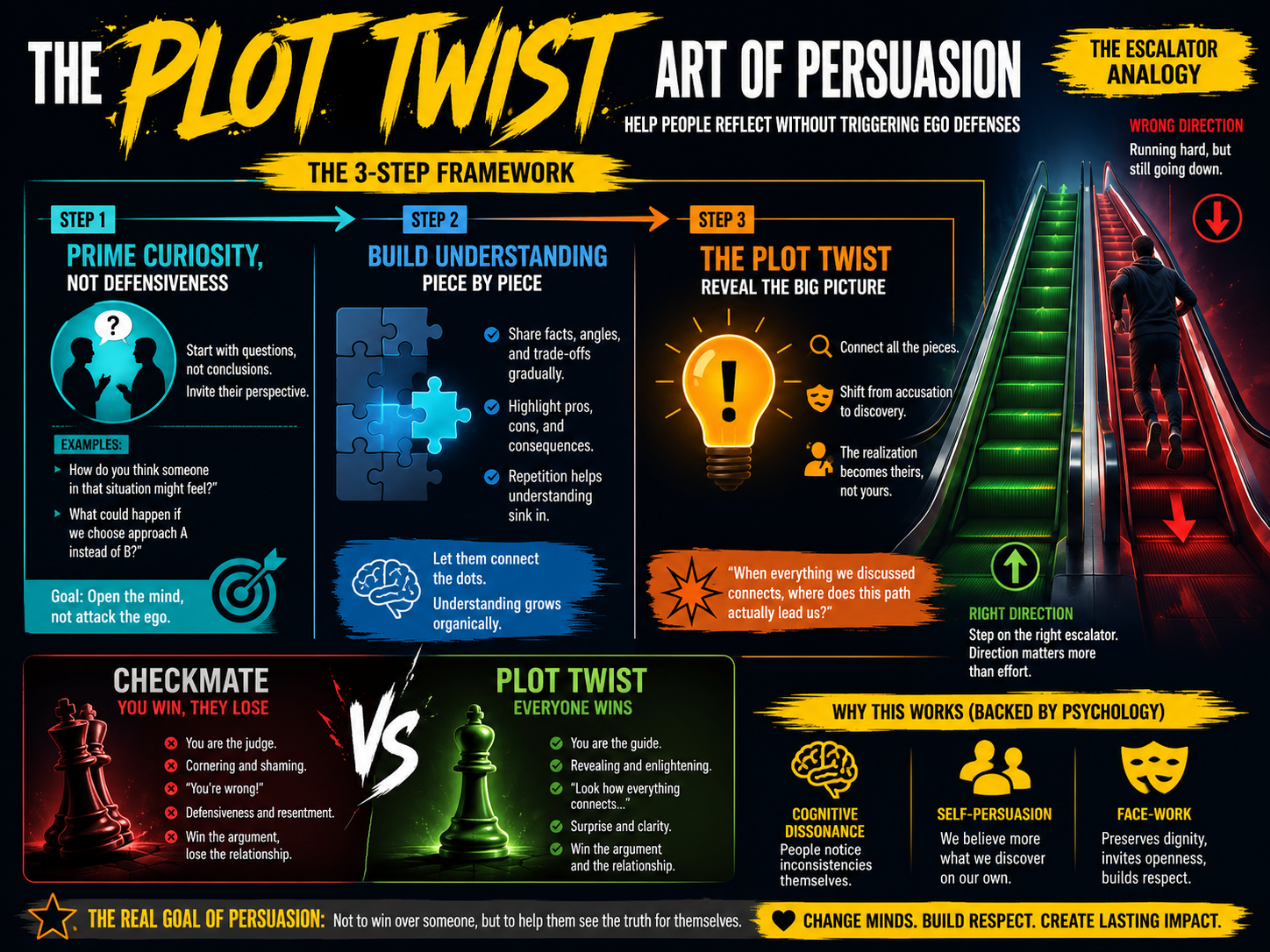
Instead of presenting the conclusion immediately, imagine building a puzzle. You don't hand someone the completed picture — you place one piece after another until the image becomes visible on its own. The goal isn't to corner someone. The goal is to help them see the bigger picture for themselves.
To make this concrete, picture a manager named Sarah, whose report, Dimas, has missed three deadlines in a row. Sarah could open with, "You said reliability matters to you, but you keep missing deadlines." Instead, she tries something else — the same three moves described below, in the same order she'd use them in the room.
Step 1 — Prime Curiosity, Not Defensiveness
Start with questions rather than conclusions. Sarah opens with: "How do you think the deadline slipping affected the rest of the team's plan this week?" Questions invite reflection; statements often invite debate. By encouraging perspective-taking first, people become more willing to examine ideas without feeling personally attacked.
A Brief Note on the Theory
This step borrows from two well-established traditions: Socratic questioning, the ancient practice of guiding someone to a conclusion through structured questions rather than assertions, and Motivational Interviewing (Miller & Rollnick, 1991), a counseling method built around drawing out a person's own reasons for change rather than supplying reasons for them. Both are grounded in decades of clinical and educational research, not folk wisdom.
Step 2 — Build Understanding Piece by Piece
Rather than delivering one overwhelming argument, introduce information gradually — the benefits, the trade-offs, possible unintended consequences, and different perspectives. Sarah and Dimas talk through what the deadline was actually protecting (a client demo), what got in the way (an unclear handoff from another team), and what similar handoffs have cost the team before. Sometimes repeating key ideas in different ways helps people connect the dots over time. The objective isn't repetition for its own sake — it's letting understanding develop naturally instead of forcing agreement.
Step 3 — The Plot Twist
This is where the conversation changes. Not with a dramatic "See? You were wrong!" — but with something closer to Sarah's actual line: "Interesting... if we connect everything we've talked through, where does this pattern actually lead next quarter?" This shifts the conversation from accusation to discovery. Instead of defeating someone in an argument, you're inviting them to recognize a pattern. The realization becomes theirs — not yours. Dimas, not Sarah, is the one who says the handoff process needs to change — which is also why he's the one who actually follows through on fixing it.
A Brief Note on the Theory
Social psychologist Elliot Aronson's research on self-persuasion found that people tend to internalize and act on conclusions they arrive at themselves more than conclusions handed to them — because a self-generated conclusion doesn't need to be defended against, it only needs to be integrated. This is a real and replicated finding, though it's worth being precise about its limits: self-persuasion changes how durable a belief feels, not whether every fact is automatically accepted.
Fig. 1 — The same contradiction can end in a defended ego or a self-discovered insight, depending on how it's delivered.
An Escalator Analogy
One analogy I like is an escalator moving downward. Imagine someone running upward with incredible determination. They're working hard. They're exhausted. They're doing everything they can. Yet they never reach the top. The problem isn't effort — the problem is direction. Sometimes people don't need to work harder. They simply need to step onto a different escalator.
Back to Dimas: telling him to "try harder" to hit deadlines would have kept him running on the same downward escalator — a broken handoff process that made lateness almost inevitable no matter how early he started his part. The plot-twist conversation didn't ask him to run faster. It helped him notice which escalator he was on. This metaphor keeps the conversation focused on the system or approach rather than attacking the person's character — which matters, because criticism aimed at character tends to trigger defensiveness, while criticism aimed at a process tends to invite problem-solving.
Checkmate vs. Plot Twist
A chess checkmate has a winner and a loser. Someone wins. Someone loses. A plot twist is different — everyone suddenly realizes that all the small clues have been pointing toward the same conclusion all along. Nobody has to lose face. Instead of thinking "I lost the argument," people are more likely to think "Ah... now I understand." That difference can completely change the emotional outcome of a difficult conversation.
Checkmate
A winner and a loser. The conclusion is delivered, defended against, and — even when technically correct — often rejected or resented rather than internalized.
Plot Twist
No opponent. The clues were always there; the other person simply connects them. Dignity stays intact, and the insight tends to stick.
Why This Can Work
Several ideas from psychology help explain why this approach can be effective — and it's worth naming them precisely rather than hand-waving at "psychology says."
Cognitive Dissonance — Leon Festinger (1957)
Festinger's foundational theory holds that people experience genuine psychological discomfort when their beliefs and actions don't align, and are motivated to resolve that discomfort — sometimes by changing the behavior, sometimes by changing the belief, sometimes by rationalizing the gap away. Gentle questions and reflection give someone room to resolve that dissonance toward the belief and behavior actually lining up, rather than toward a defensive rationalization.
Self-Persuasion — Elliot Aronson
Building on Festinger's work, Aronson's research found that conclusions people reach through their own reasoning tend to be held more firmly, and acted on more consistently, than conclusions simply presented to them. A self-generated insight doesn't need to be defended against — it only needs to be lived with.
Face-Work — Erving Goffman (1955)
In his essay "On Face-Work," sociologist Erving Goffman described how people constantly manage a public self-image — their "face" — in social interactions, and how interactions that let someone maintain that face tend to stay cooperative, while interactions that threaten it tend to turn defensive or hostile. A conversation that lets someone reach a conclusion without being publicly cornered preserves their face; a checkmate, almost by definition, does not.
Practical Applications
This approach shows up, in slightly different forms, across several fields that all deal with changing minds without triggering defenses:
Leadership & Mentoring
A manager who asks "what do you think happens if this pattern continues?" instead of "you keep doing this wrong" gets a report who owns the fix.
Education & Coaching
A teacher who lets a student find the flaw in their own proof remembers that lesson longer than one who was simply told the answer was wrong.
Conflict Resolution & Diplomacy
Mediators routinely ask each side what outcome the other side might reasonably want, long before proposing a solution — for exactly this reason.
Everyday Conversations
Even with a partner or a friend, "what do you think would happen if..." tends to open a conversation that "you always..." tends to close.
Some practical habits sum this up well: ask before telling, explore before concluding, focus on the process instead of assigning blame, and let people connect the dots whenever possible.
A Necessary Caveat
None of this is a guarantee, and it isn't manipulation dressed up in nicer language — the difference matters. Manipulation steers someone toward a conclusion that serves the persuader at the other person's expense, often while hiding the steering itself. The plot-twist approach only works, and is only honest, when the conclusion being invited is one the evidence genuinely supports and one the other person is free to reject once they see it. If Dimas had looked at the pattern and disagreed with Sarah's read of it, a good version of this conversation leaves room for that. The goal was never to guarantee a particular answer. It was to guarantee a fair hearing for the evidence.
Final Thought
One of the most valuable lessons my father ever taught me was this: "Don't try to win people over by defeating them. Help them discover the answer for themselves."
Whether or not someone ultimately agrees with you is never entirely within your control. But conversations become far more productive when the goal shifts from winning an argument to creating space for reflection.
Sometimes the most powerful persuasion isn't a checkmate. It's a well-timed plot twist — the moment when someone quietly says, "Oh... I hadn't looked at it that way before."
#Persuasion #CognitiveDissonance #SelfPersuasion #FaceWork #MotivationalInterviewing #Leadership #ConflictResolution #CommunicationSkills