“ Most people think rejection has a clear sound. ‘No.’ It feels final. It hurts. But at least it’s honest. What if I told you that some opportunities don’t die because someone says ‘no.’ They die because no one ever says anything final at all.
Instead, they are slowly buried beneath an endless sequence of postponements.
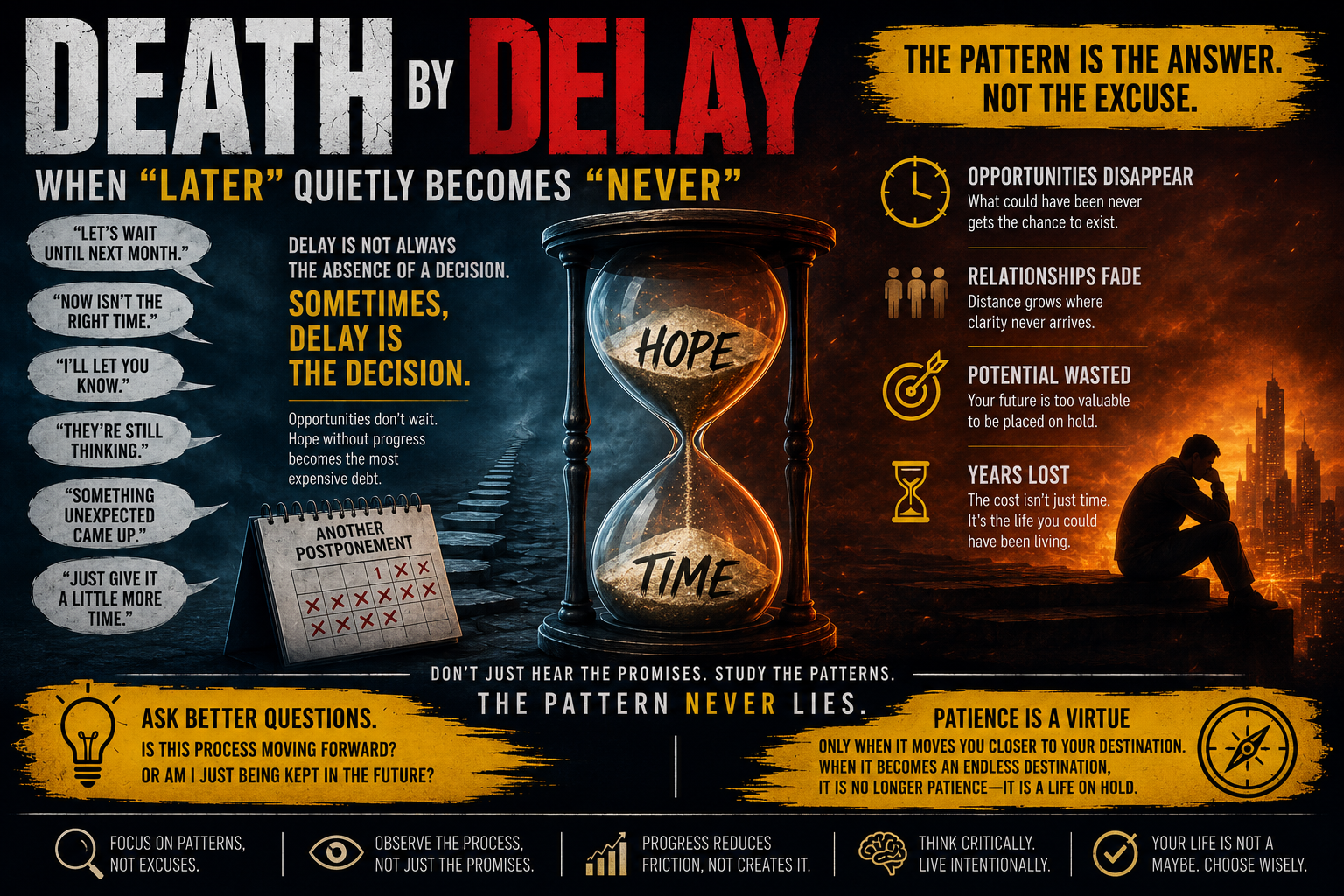
“Let’s wait until next month.” “Now isn’t the right time.” “I’ll let you know.” “They’re still thinking.” “Something unexpected came up.” “Just give it a little more time.”
None of these statements is unreasonable on its own. In fact, every single one might be completely true.
Life is unpredictable. People get sick. Schedules change. Priorities shift.
That’s precisely why endless delay is so difficult to recognize.
The problem isn’t a single postponement. The problem is when postponement becomes the pattern.
One delay rarely changes the outcome. Ten delays might. Fifty delays almost certainly will.
Eventually, time accomplishes what no direct rejection ever could.
The opportunity disappears. The relationship fades. The project quietly dies. The connection that might have existed never gets the chance to exist at all.
And when everything is finally over, someone casually says, “Maybe it’s time to stop hoping.”
By then, the decision has already been made. Not by one dramatic rejection. But by hundreds of tiny postponements that never looked suspicious when viewed one at a time.
This article is not about assuming that every delay is manipulation. Most delays are genuine. Most people mean well.
But critical thinking asks a different question.
Not, “Was this particular excuse believable?”
Instead, it asks, “What does the overall pattern communicate?”
Because communication isn’t limited to words. Patterns communicate. Timing communicates. Repeated postponement communicates.
Sometimes the most important decision someone makes isn’t saying “No.” It’s making sure they never have to.
By delaying the moment long enough, time itself delivers the rejection.
And that raises a difficult question:
At what point does “not yet” stop being a delay… and quietly become the answer?
Intolerance of Uncertainty
Research in cognitive psychology shows that most people find prolonged uncertainty more stressful than clear negative news. The brain prefers a definite outcome — even a painful one — because it can then adapt and move on. Endless delay exploits this preference: it keeps the brain in a permanent state of “maybe,” preventing both acceptance and alternative action.
Part I — Why Delay Is More Powerful Than Rejection
Most people assume rejection is the most effective way to stop something from happening.
Surprisingly, it often isn’t.
A direct rejection creates clarity. It closes one door, allowing another to open. You know where you stand. You stop investing time. You adjust your plans. You move on.
Delay works differently. It preserves hope. And hope is powerful.
As long as people believe that tomorrow might finally be the day, they continue waiting. They postpone other opportunities. They avoid making alternative plans. They remain emotionally invested in an outcome that never actually arrives.
This is why delay can be far more effective than saying “no.”
A rejection ends the conversation. A delay keeps the conversation alive—without allowing it to move forward.
Psychologists have long observed that uncertainty changes human behavior. People generally tolerate bad news better than endless uncertainty. A clear answer, even an unpleasant one, allows the brain to adapt. Uncertainty keeps the brain searching.
“What if next week is different?” “What if they’re finally ready?” “What if this delay is genuine?”
Every new promise resets the emotional clock. Every postponed deadline creates another reason to wait.
And because each individual delay appears reasonable, the pattern often remains invisible.
One postponement isn’t suspicious. Neither are two. Even five may have perfectly valid explanations.
The danger isn’t found in any single excuse. It’s found in what all of those excuses produce collectively.
Months pass. Sometimes years. Without anyone ever making a definitive decision.
The opportunity doesn’t disappear overnight. It slowly expires.
Not because someone explicitly rejected it… …but because time quietly consumed it.
This creates an important distinction.
There is a difference between waiting because circumstances require patience and waiting because waiting itself has become the destination.
The first eventually leads somewhere. The second simply extends itself indefinitely.
One asks for patience. The other survives by continuously asking for more patience.
From the outside, these two situations can look almost identical. Both involve delays. Both involve promises. Both involve uncertainty.
The difference only becomes visible when you stop examining individual excuses… …and begin examining the pattern they create.
Critical thinking begins precisely at that moment.
Not by asking, “Is this excuse believable?”
But by asking, “If I step back and look at the past year—not today’s explanation, but the entire sequence—where has this process actually taken me?”
Sometimes the answer is progress. Sometimes the answer is simply…
another delay.
Part II — The Perfect Strategy Leaves No Villain
One of the reasons endless delay is so difficult to recognize is because it rarely looks malicious.
In fact, if you isolate each conversation, each promise, or each postponed meeting, almost everything appears perfectly reasonable.
Someone gets sick. A meeting is cancelled. Schedules change. Priorities shift.
None of these events is unusual. None of them proves bad intentions.
And that’s exactly what makes the pattern so effective.
Imagine reading only one page of a novel. You would have no idea how the story ends.
Now imagine reading a different page every month. Each page, by itself, makes sense. Only after finishing the entire book do you realize every chapter was quietly leading toward the same ending.
Human interactions often work the same way.
We naturally judge events one at a time. Today has an explanation. Next week has another explanation. Next month brings yet another.
Because every explanation seems reasonable on its own, we rarely stop to ask a much larger question:
“Where is this process actually going?”
Critical thinking isn’t just about analyzing individual facts. It’s also about recognizing trajectories.
A trajectory asks a different question.
Not, “Why did today’s delay happen?”
But, “After twenty delays, what direction are all of these delays pointing toward?”
Patterns reveal what individual events cannot.
One postponed meeting tells you almost nothing. Twenty postponed meetings tell you a story.
Not necessarily a story of manipulation. Not necessarily a story of dishonesty. But certainly a story that deserves closer examination.
This is one of the biggest mistakes people make. They defend every individual delay… while completely ignoring the cumulative effect.
It’s like watching one drop of water fall onto a rock.
Nothing happens. Another drop. Still nothing.
A thousand drops later… the rock has changed shape.
No single drop caused the transformation. The pattern did.
Time has a peculiar characteristic. It magnifies small decisions.
Tiny postponements that seem insignificant today may become life-changing when repeated over months or years.
A friendship fades. A business opportunity disappears. A career path quietly closes. A relationship that might have existed never even begins.
And no single moment appears responsible.
Everyone can honestly point to each individual delay and say, “That one was understandable.”
They may even be right.
But critical thinkers understand something deeper.
Sometimes the most important evidence isn’t hidden inside a single event. It’s hidden inside the direction that hundreds of small events collectively create.
Because history isn’t written by isolated moments. It’s written by patterns.
And patterns often tell the truth long before individual explanations do.
Cumulative Causation & Systems Thinking
In complex systems, outcomes are rarely produced by single dramatic events. They emerge from the accumulation of small, repeated forces. Just as erosion reshapes landscapes through countless drops of water, human outcomes are often shaped by the direction of many minor decisions. Looking only at individual drops (or individual excuses) hides the trajectory that is already visible when the entire sequence is examined together.
Part III — Delay Is Sometimes the Decision
Most people think a decision happens the moment someone says “yes” or “no.”
But real life isn’t always that straightforward.
Sometimes the most important decision is never spoken aloud. Instead, it unfolds through time.
Imagine two people who genuinely want to meet. Left alone, they probably would.
Now introduce a third person. Someone who controls the communication. Someone who schedules the meetings. Someone who always knows “a little more.”
Nothing dramatic happens. No lies. No obvious sabotage. Just small adjustments.
“Not this week.” “Let’s wait until after the holidays.” “They’re busy today.” “Maybe next month.” “I’ll ask them again.” “Let’s not rush.”
Every decision sounds reasonable. Every explanation can be defended.
And that’s exactly why nobody notices what is quietly happening.
The process never moves closer to the meeting. It only moves further into the future.
This creates a fascinating illusion. Everyone believes the decision is still pending.
But is it?
Think about two different timelines.
Timeline A
Delay. Eventually… A meeting happens. The process reaches its destination. The delay served a purpose.
Timeline B
Delay. Another delay. Another promise. Another postponement. Months become years. Nothing ever happens.
Yet everyone continues speaking as though the decision has not been made.
But hasn’t it?
Perhaps the decision was never, “No.”
Perhaps the decision was simply, “Keep delaying until time makes the decision for us.”
This is one of the quietest forms of decision-making because responsibility becomes almost impossible to identify.
Nobody rejected anyone. Nobody explicitly refused. Nobody can point to a single conversation and say, “That was the moment everything ended.”
Instead… the ending emerges gradually.
Every participant can honestly remember giving what sounded like a reasonable explanation.
No single explanation killed the opportunity. Yet together… they produced exactly the same outcome as a rejection.
This is why patterns matter more than moments.
Moments ask, “What happened today?”
Patterns ask, “Where has this process been leading all along?”
Critical thinkers eventually stop asking whether today’s excuse is believable.
Instead, they ask a much more revealing question:
“If I continue accepting this pattern for another year, where will I most likely end up?”
Because sometimes the future isn’t hidden. It’s already visible inside the trajectory.
The destination is quietly being built… one postponement at a time.
Part IV — The Experiment: When Delay Follows a Predictable Pattern
The most dangerous delays are not necessarily the longest ones.
They are the ones that seem to understand you.
Imagine someone acting as an intermediary.
They know your schedule. They know your personality. They know what disappoints you. They know how long you’re willing to wait before giving up.
Now imagine every new opportunity is designed around those expectations.
Here is how it usually sounds.
“Don’t worry. They’ll come.”
That’s what gets said out loud.
But privately, the intermediary is already thinking something else entirely:
This person got hurt. Why would they willingly walk back toward something that hurt them? They probably won’t come.
Notice what just happened.
The intermediary doesn’t say this doubt out loud. Instead of resolving the uncertainty directly—by simply asking, by simply checking—another plan quietly takes its place.
“Let’s aim for the third meeting. That’s when it will really happen.”
It sounds reasonable. It even sounds encouraging.
But look closer at what that sentence quietly permits.
If the “real” meeting is scheduled for the third attempt, then the first two attempts no longer need to succeed. They can be arranged loosely. They can be allowed to fall through. Nobody will complain, because nobody was really expecting them to work anyway.
So the first invitation arrives when the other person happens to be unavailable. The second one arrives just a little too late to make plans around. Both times, there’s a tidy explanation. Both times, it looks like coincidence.
And underneath both of those “coincidences” sits a private, unspoken calculation:
This person will get tired of trying. They’ll probably only show up for the first meeting or two before they stop bothering—so the real chance can safely wait until the third.
This is the quiet engine behind the whole pattern. The person managing the delay isn’t just reacting to circumstances. They already have a theory about how the other person will behave—how much disappointment they’ll tolerate, at what point they’ll stop showing up—and every “opportunity” that gets offered is built around confirming that theory rather than testing it.
A chance is offered. But it’s arranged in a way that makes failure convenient. And every failure becomes fresh material for the next delay.
“See? We tried. It just didn’t work out this time.”
Nobody said no. Nobody has to. The setup does the rejecting on their behalf.
What makes this kind of delay so hard to catch is that it never relies on one big move. It relies on several small, forgettable ones—each too minor to question on its own.
- Spread the responsibility around. The delay is never traced back to one person. “They said they were busy.” “I heard the other side wasn’t ready either.” “It wasn’t really up to me.” When responsibility is diffused across three or four people, no single person ever has to own the outcome.
- Let real inconveniences do the work. A genuinely busy week. A real cold. An actual traffic jam. None of these are invented. They’re simply selected—reached for at the exact moment they’re useful, and quietly ignored the rest of the time. Real excuses are far more convincing than fake ones, which is exactly why they get borrowed so often.
- Offer the appearance of effort. A message gets sent. A date gets floated. A “let’s see” gets typed out. None of it commits to anything, but all of it looks like trying. Anyone reviewing the conversation afterward would say, “Well, they clearly made an effort.”
- Control who talks to whom. As long as the two people at the center never speak directly, the story can be shaped in transit. One side hears “they’re still upset.” The other hears “they’re just busy right now.” Neither version is necessarily a lie. But neither version is the whole truth either—and only the messenger holds both halves.
- Let timing absorb the blame instead of a person. “It’s just not the right time” is one of the most effective sentences ever invented, because time can’t defend itself, and it can’t be confronted. Blaming a person invites conflict. Blaming “timing” invites patience.
- Never close the door completely. A flat “no” would end the story and expose the pattern. So the door stays open—just barely, just enough to keep the other person from walking away and looking elsewhere. “Maybe next month” is doing the same job as “no.” It just doesn’t sound like it.
None of these tactics needs to be used all at once, and none of them needs a mastermind pulling strings. Often they aren’t even conscious strategies—just habits that happen to be convenient for whoever benefits from more time. But used together, consistently, over months, they produce something remarkably close to a decision that was never actually made out loud.
At this point, an important question emerges.
Is the delay simply responding to circumstances… …or are the circumstances consistently being arranged in ways that maximize the chance of another delay?
These are two very different hypotheses.
Hypothesis A — Poor Coordination
People are genuinely trying. Schedules collide. Miscommunication happens. Bad timing repeats itself by coincidence.
If this is true, removing the communication barriers should quickly solve the problem. Once everyone has direct access to the same information, successful coordination becomes increasingly likely.
Hypothesis B — Strategic Delay
Someone has already formed a prediction about how people will behave.
Instead of testing that prediction openly, they quietly build the process around it.
If they believe one person will stop trying after several disappointments… the process simply needs to generate enough disappointments.
If they believe repeated postponements will slowly reduce motivation… the postponements continue.
Eventually, the predicted outcome appears.
People stop showing up. People lose interest. People move on.
From the outside, it looks like the prediction was correct.
But critical thinking asks a deeper question.
Was the outcome merely predicted… …or was the environment quietly shaped until the prediction became inevitable?
This distinction matters.
Because there is a profound difference between forecasting human behavior and creating the conditions that make that behavior increasingly likely.
Self-Fulfilling Prophecy
Behavioral scientists call this a self-fulfilling prophecy. An expectation influences actions. Those actions influence the environment. The environment influences people’s behavior. And eventually, the original expectation appears to have been true all along — not necessarily because it accurately described reality, but because reality gradually adapted to the expectations placed upon it. Critical thinkers therefore examine both the final outcome and the process that produced it.
This is why critical thinkers don’t evaluate only the final outcome. They also examine the process that produced it.
Did every obstacle emerge naturally? Or did every obstacle conveniently point in the same direction?
One coincidence proves nothing. Two coincidences may still be chance.
But when every delay, every reschedule, every missed opportunity, and every explanation consistently produce the exact same outcome…
the pattern itself becomes data.
Not proof.
But data worthy of careful investigation.
The goal of critical thinking is never to accuse.
It is to distinguish between randomness and systematic patterns.
Because sometimes the most important question isn’t,
“Did they predict what would happen?”
It’s…
“Did they quietly help make it happen?”
Part V — Why People Choose Delay Instead of Saying “No”
If delaying someone can eventually produce the same outcome as rejecting them…
why not simply say “no” in the first place?
Because saying “no” has consequences.
A direct rejection creates accountability.
People ask questions.
“Why?”
“What changed?”
“What happened?”
A clear decision has an owner.
Someone becomes responsible for it.
Delay, however, spreads responsibility across time.
No single postponement appears significant.
No single conversation seems dishonest.
Each delay has its own explanation.
Each explanation sounds reasonable.
By the time the opportunity has completely disappeared, nobody feels responsible.
Everyone remembers acting reasonably.
No one remembers making the decision.
Time made the decision instead.
Or at least…
that’s how it appears.
This creates what might be called the illusion of innocence.
Nobody explicitly closed the door.
They simply never opened it.
Nobody explicitly prevented the meeting.
They simply kept moving it to another day.
Nobody explicitly rejected the opportunity.
They simply allowed the opportunity to expire.
Psychologically, this is much easier to live with.
Rejecting someone directly often creates guilt.
Watching time quietly do the rejecting rarely does.
Perhaps that’s why delay can become so attractive.
It preserves everyone’s self-image.
The intermediary can still say, “I really tried.”
The organizer can still say, “The timing was just unfortunate.”
The group can still say, “We never told you not to.”
And technically…
every statement might be true.
This is why critical thinking should never focus exclusively on words.
Words describe intentions.
Patterns reveal outcomes.
The important question isn’t, “Did everyone have a reasonable explanation?”
The more revealing question is, “If everyone was genuinely trying to make this happen… why did every step consistently move in the opposite direction?”
Notice the difference.
We’re no longer asking whether someone lied.
We’re asking whether the observable pattern aligns with the stated objective.
If the stated objective is, “We want you two to meet.”
then the process should gradually increase the probability of that meeting.
Not decrease it.
Every successful process removes barriers.
Every failed process adds them.
That’s true in engineering.
It’s true in project management.
It’s true in public policy.
And it’s equally true in human relationships.
When a process repeatedly introduces new obstacles while continuing to promise the same destination, critical thinkers eventually stop evaluating the promises…
…and start evaluating the process itself.
Because intentions are invisible.
Processes are not.
Results are not.
Patterns are not.
The process tells a story that words sometimes cannot.
And sometimes, the quietest question of all becomes the most important one:
“If the goal was always to make this happen… why was every decision making it less likely?”
That question doesn’t accuse.
It investigates.
And investigation is where critical thinking begins.
Diffusion of Responsibility & the Illusion of Innocence
When responsibility is spread across time and across multiple people, no single individual feels the moral weight of the final outcome. Each person can truthfully say “I never said no.” The collective pattern, however, still produces the functional equivalent of a rejection. This diffusion makes the strategy psychologically comfortable for those who use it — and correspondingly hard for the person on the receiving end to challenge.
Part VI — Never Trust Words More Than Processes
Words are easy.
Processes are difficult.
Anyone can say,
“We want this to happen.”
“We’re trying our best.”
“Just be patient.”
“Everything is still on track.”
Words describe intentions.
Processes reveal priorities.
Imagine a company that repeatedly announces, “Employee well-being is our highest priority.”
Yet every year…
It cuts mental health programs.
Reduces vacation time.
Increases workloads.
Punishes people for taking sick leave.
Which should you believe?
The speech…
or the process?
Now imagine a government promising transparency.
But every important document is delayed.
Every meeting is postponed.
Every request requires another approval.
Every answer becomes, “Please wait.”
Again, what tells the truth?
The announcement…
or the process?
Human relationships are no different.
Someone may sincerely tell you, “I really want this to work.”
But if every decision consistently reduces the probability of success…
critical thinking requires us to notice the contradiction.
The process is speaking.
Perhaps more honestly than the words.
This doesn’t automatically prove bad intentions.
People are imperfect.
Organizations are imperfect.
Communication fails.
Unexpected events happen.
That’s why one contradiction proves very little.
Patterns, however, deserve attention.
If the stated objective is, “We want two people to finally meet.”
Then over time, the process should become progressively easier.
Communication should become more direct.
Schedules should become clearer.
Barriers should gradually disappear.
That is how successful systems behave.
Healthy systems reduce friction.
Broken systems increase it.
And if friction keeps increasing while everyone continues saying, “We’re getting closer.”
Then perhaps the most important question isn’t, “What are they saying?”
It’s, “What is the process actually producing?”
This principle extends far beyond personal relationships.
It applies to businesses.
Governments.
Universities.
Families.
Friendships.
Even our own lives.
If your daily habits consistently move you away from your stated goals, then your habits—not your intentions—are telling the truth.
Because in the end…
People remember promises.
History remembers outcomes.
And outcomes are almost always the product of processes, not speeches.
Critical thinkers understand this difference.
They listen carefully to words.
But they trust patterns.
They respect intentions.
But they verify them through actions.
Because processes leave footprints.
And footprints are much harder to fake than promises.
Part VII — The Cost of Waiting
The greatest cost of endless delay is rarely measured in days, months, or even years.
It is measured in opportunities that quietly disappear while we continue waiting.
Time is unlike money.
Money can often be earned again.
Time cannot.
Every month spent waiting is also a month not spent building something else.
Every postponed decision silently rejects countless alternative possibilities.
This is what economists call opportunity cost.
Whenever we choose one path, we automatically give up every other path we could have taken.
The same principle applies to waiting.
Waiting is not a neutral act.
Waiting is a decision.
Sometimes it is the right decision.
Sometimes it is the most expensive one we ever make.
Imagine someone waiting for a promised opportunity.
They don’t apply somewhere else because they believe, “Mine is coming soon.”
They don’t pursue another relationship because they’re told, “Just wait a little longer.”
They don’t start a new project because, “Everything will be ready next month.”
Months become years.
Then one day…
the answer finally arrives.
“I’m sorry.”
“Things didn’t work out.”
“You should move on.”
By then, the greatest loss is no longer the opportunity itself.
The greatest loss is everything that could have happened during the years spent waiting.
The people you never met.
The career you never explored.
The city you never moved to.
The business you never started.
The experiences you never allowed yourself to have because your attention remained fixed on a future that never arrived.
This is why endless delay can be so psychologically damaging.
Hope is valuable.
Hope gives people strength.
Hope keeps people moving during difficult times.
But hope without progress gradually transforms into something else.
It becomes emotional debt.
Every promise asks for another investment.
Another month.
Another year.
Another chance.
Eventually, people find themselves unable to leave—not because the opportunity still looks promising, but because they have already invested so much of themselves into waiting.
Opportunity Cost & the Sunk Cost Fallacy
Economists distinguish between two related traps. Opportunity cost is the value of everything you forgo while waiting. Sunk cost is the psychological pressure to keep investing because of what you have already spent. Critical thinking requires separating the two: the past investment cannot be recovered, so the only rational question is whether the future expected value still justifies continuing. Most people stay because of the sunk cost; the wiser question is always about the remaining opportunity cost.
Behavioral economists describe this as the sunk cost effect.
The more we have already invested, the harder it becomes to walk away.
Not because the future looks brighter…
…but because leaving forces us to admit that the past investment cannot be recovered.
Ironically, that is exactly when many people wait even longer.
Not because the evidence has improved.
But because abandoning hope feels more painful than continuing to wait.
Critical thinking offers a different perspective.
Instead of asking, “How much have I already invested?”
It asks, “If I were starting today, with everything I now know, would I still choose to keep waiting?”
That single question changes everything.
It shifts our attention away from the past…
…and back toward the future.
Because life doesn’t reward the amount of time we’ve already spent waiting.
Life rewards the decisions we make from this moment onward.
Sometimes patience builds extraordinary outcomes.
Sometimes patience quietly becomes procrastination imposed by someone else.
The challenge is learning to recognize the difference before another year disappears.
Because the most valuable thing delay can ever cost you…
isn’t time.
It’s the life you could have been living while you were waiting.
Part VIII — The Courage to Ask Better Questions
The purpose of this article has never been to encourage suspicion.
Nor is it to suggest that every delay hides bad intentions.
Most people are honest.
Most delays are genuine.
Life is messy.
Unexpected things happen.
Plans change.
People change.
That is simply part of being human.
Critical thinking does not begin by assuming the worst.
It begins by resisting the temptation to assume certainty.
Instead of immediately asking, “Can I trust this person?”
Perhaps we should first ask, “What does the evidence actually show?”
Instead of asking, “What did they promise?”
Ask, “What has the process consistently produced?”
Instead of focusing on a single conversation…
Look at the trajectory.
Instead of evaluating today’s explanation…
Evaluate the pattern created by every explanation over time.
Science teaches us something profoundly important.
A single observation rarely proves anything.
Researchers do not build conclusions from one data point.
They collect evidence.
They test competing hypotheses.
They challenge their own assumptions.
They remain willing to change their conclusions when better evidence appears.
Perhaps everyday life deserves the same discipline.
Perhaps we should stop asking, “Who should I believe?”
And start asking, “Which hypothesis is best supported by the observable evidence?”
That simple shift transforms the way we think.
It replaces certainty with curiosity.
Emotion with investigation.
Assumption with observation.
And reaction with analysis.
The goal is not to become cynical.
Cynicism assumes everyone is lying.
Naivety assumes everyone is telling the truth.
Critical thinking assumes neither.
It simply asks for evidence.
Sometimes, after examining the evidence, you’ll discover the delays were completely understandable.
Perhaps life genuinely became complicated.
Perhaps circumstances really did interfere.
Perhaps patience was exactly the right choice.
But sometimes…
The evidence points somewhere else.
Not because of one dramatic lie.
Not because of one obvious betrayal.
But because every small decision, every postponed conversation, every missed opportunity, and every repeated promise quietly moved in the same direction.
The pattern became the answer.
Perhaps the greatest lesson isn’t to distrust people.
Perhaps it’s to stop outsourcing our judgment.
Don’t let promises replace observation.
Don’t let hope replace evidence.
Don’t let repeated postponement disguise itself as progress.
Most importantly…
Don’t mistake movement for momentum.
A calendar can keep moving while your life remains perfectly still.
Time passing is not the same as progress happening.
At some point, every critical thinker must ask one final question.
Not, “How much longer should I wait?”
But, “If nothing changes from this moment forward, would I still believe that this process is moving toward the future I was promised?”
If the answer is yes…
Wait with confidence.
If the answer is no…
Perhaps the bravest decision isn’t waiting one more day.
Perhaps it’s recognizing that endless delay has already given you its answer.
Not through words.
Not through promises.
But through the only language that never stops telling the truth.
The pattern.
“ Don’t mistake movement for momentum. A calendar can keep moving while your life remains perfectly still. Time passing is not the same as progress happening.