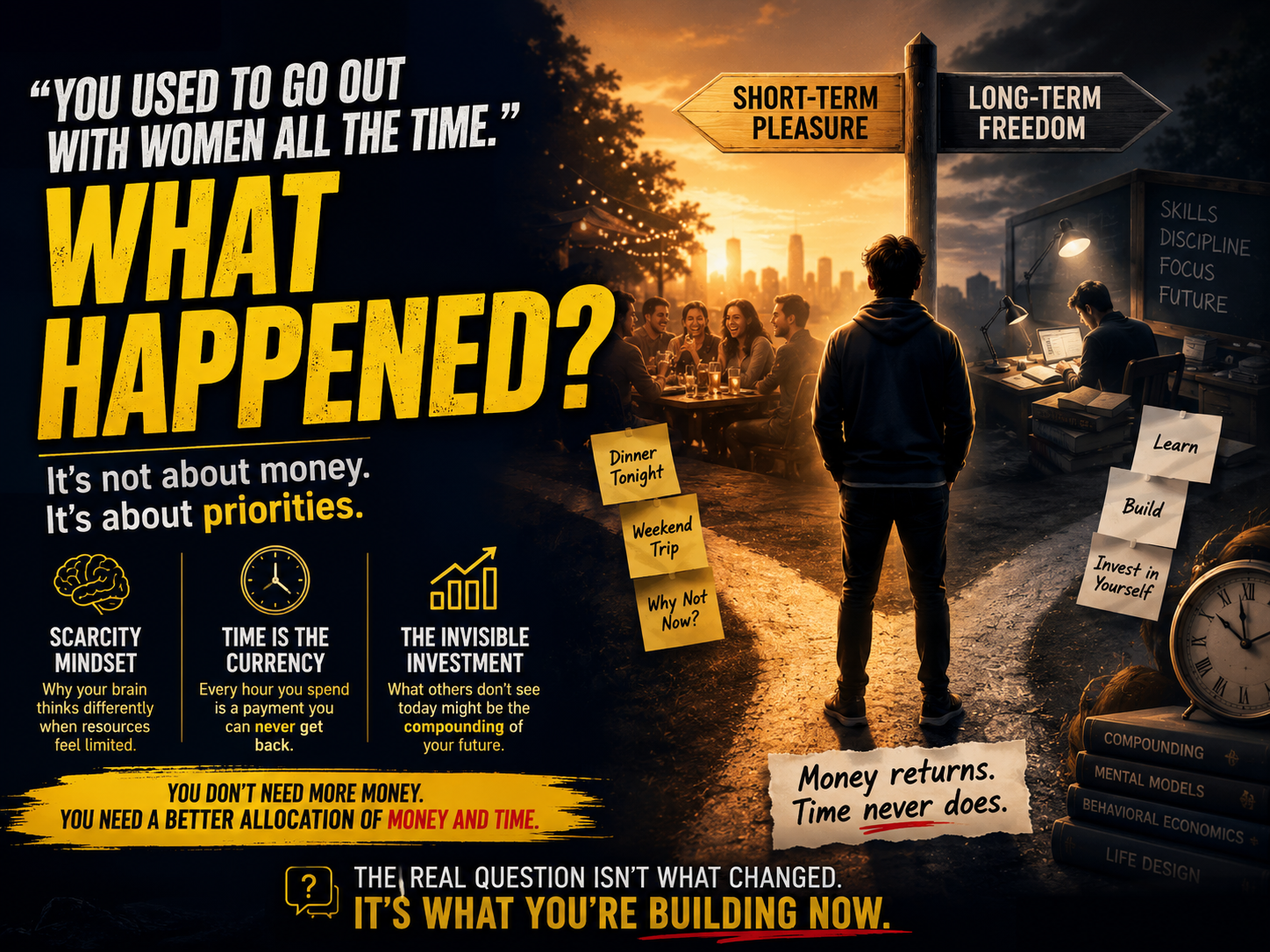
"You used to go out with women all the time. What happened?" Someone asked me this recently. I laughed. Not because the question was offensive, but because it was fascinating. It wasn't the first time someone had noticed that I don't go out nearly as much anymore. No more spontaneous coffee dates. No more random weekend trips. No more "Let's grab dinner tonight." Just silence, working, learning, and building. And somehow, that puzzled people.
What made me smile wasn't the question itself, but what wasn't being asked. No one asked, "What are you building these days?" or "What are you working toward?" Instead, the assumption was simple: you stopped going out, therefore, something must be wrong. It made me realize that we often measure people's lives by what we can see—the vacations, the dinners, the Instagram stories. But almost no one notices the invisible investment happening behind the scenes.
People assume I'm missing out. From my perspective, I'm investing. I no longer measure every decision by "Will this make me happy tonight?" but rather, "Will this make my life better five years from now?" That single shift in perspective changes everything. To understand why, we need to talk about two concepts that quietly shape our decisions: Scarcity Mindset and Time as Currency.
The Real Meaning of Scarcity
In behavioral economics, scarcity isn't just about a lack of money. It refers to the psychological condition of having limited resources—whether that's time, energy, mental bandwidth, or emotional capacity. When a resource feels limited, the brain calculates its value differently, making us highly selective rather than simply "cheap."
Part 1 — Scarcity Mindset: It's Not About Being Cheap
One of the biggest misconceptions about the term "scarcity mindset" is that people immediately associate it with being stingy. "If you stop going out, you must be cheap." Psychology tells a much more interesting story.
Scarcity doesn't necessarily make people irrational; more often, it makes them selective. And selectivity is frequently misunderstood. Years ago, when I had a stable job and a comfortable salary, saying yes was easy. Coffee after work? Sure. Weekend trip? Why not. The cost barely registered because replacing that money felt predictable. Another paycheck was already on its way.
Today, my priorities are different. I'm investing in myself. Learning new skills, building projects, and creating things that may not generate immediate results but could completely change my future. Suddenly, every expense competes with another possibility. That spontaneous dinner might equal a new online course, a development board for an experiment, a domain name, or simply one more week of financial breathing room.
The question is no longer, "Can I afford this?" The question has become, "What am I giving up if I say yes?" That is not fear. That is opportunity cost.
Part 2 — Time Is the Only Currency You Can Never Earn Back
People often say that money isn't everything. I agree. But here's the uncomfortable truth: money isn't even the scarcest resource we have. Time is.
You can lose money and earn it back. You can lose a job and find another. You can recover from financial mistakes. But every hour you spend is permanently removed from your life. There are no refunds. No exchanges. No second inventory. Every day, each of us receives the exact same deposit: twenty-four hours. The difference lies entirely in how we choose to spend them.
Spending Time
Saying "yes" automatically out of habit, FOMO (Fear Of Missing Out), or the desire to please others, without calculating the opportunity cost.
Investing Time
Saying "no" to good things so you can say "yes" to great things. Treating time as a finite asset that compounds when focused on growth.
When someone asks, "Why won't you come out with us?" they are really asking, "Why won't you spend two or three hours with us?" I don't evaluate that invitation in hours anymore; I evaluate it in opportunity. Those same three hours could become three chapters of a book, a prototype for an idea, a workout, or deep rest that allows me to perform better tomorrow.
Ironically, modern society is exceptionally good at protecting money. People read dozens of reviews before buying a phone. They negotiate salaries. Yet, those same people will casually spend four hours scrolling through social media without asking a single question about its return on investment. Imagine withdrawing $200 from your bank account every day and throwing it into the ocean. We would call that irresponsible. Yet, we do something remarkably similar with our time.
Part 3 — The Invisible Investment
The biggest problem isn't just that people misunderstand scarcity. The bigger problem is that we only notice visible spending, and we rarely notice invisible investing.
When someone buys a new car, takes an expensive vacation, or eats at a luxury restaurant, everyone notices. Visible consumption creates immediate signals. It tells the world, "Look what I have." Invisible investment tells no such story. No one applauds the night you spent reading while everyone else went out. No one congratulates you for spending six months learning a new skill. Progress is often painfully quiet.
This creates a dangerous illusion: society assumes that visible activity equals progress. If you're always out, you must be successful. But life operates more like a bamboo plant. It can spend years developing its root system underground before suddenly growing meters in just a few weeks. From the outside, it appears as an "overnight success." People celebrate the harvest, but they rarely appreciate the seasons of planting.
"Every 'no' protects a future 'yes'. No to unnecessary distractions. Yes to deeper focus. No to short-term validation. Yes to long-term growth. That's a trade I'm willing to make."
Epilogue — Consumers Ask One Question. Builders Ask Another.
Consumers tend to ask, "What are you buying?" Builders tend to ask, "What are you building?" One focuses on visible outcomes; the other searches for invisible intentions.
I've reached a stage in life where I'd rather invest in things that don't photograph well for social media: Knowledge, skills, health, discipline. These investments don't generate exciting stories or trending topics. But they compound relentlessly. Just like interest in a savings account, small investments made consistently become something much larger than they first appear.
So if you've wondered why someone suddenly spends less, goes out less, or quietly disappears for a while, perhaps don't begin with, "What's wrong with you?" Instead, try asking, "What are you working toward?"
As for me? I'm not disappearing. I'm under construction. Because I finally understand the true price of every "yes." It isn't measured in dollars. It's measured in life. And life is the only currency we never get to earn twice.
#OpportunityCost #ScarcityMindset #TimeManagement #SelfReflection #InvisibleInvestment #BehavioralEconomics #PersonalGrowth