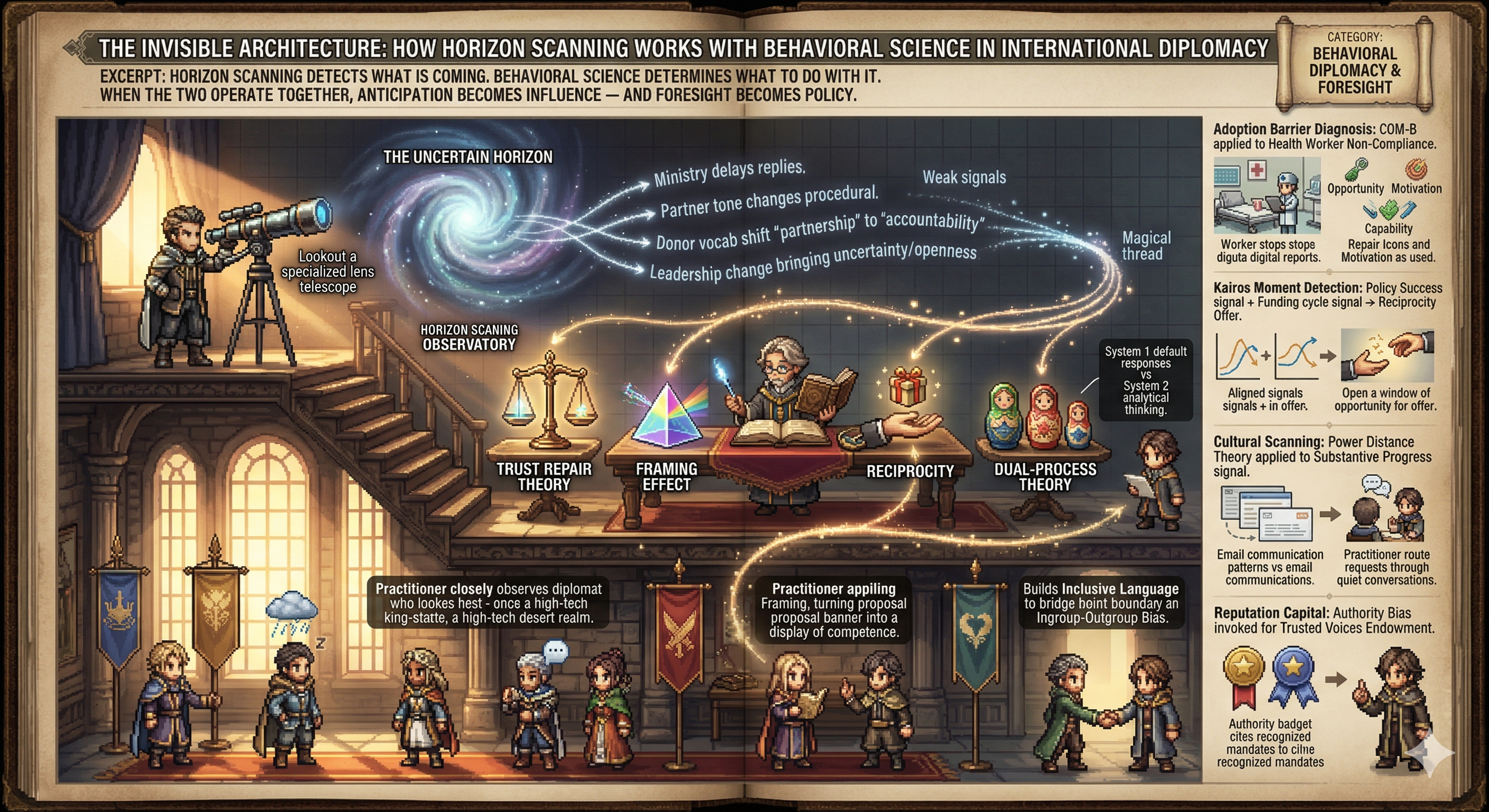
A seasoned diplomat once said that the most dangerous moment in any negotiation is not when someone says no — it is the silence before they do. That silence contains everything: hesitation, recalculation, face-saving, and unspoken fear. Detecting it requires foresight. Responding to it correctly requires behavioral science. Using both together is what separates reactive coordination from genuine influence.
This article explores how Horizon Scanning — the structured foresight methodology used to detect early signals of potentially significant change — can be deployed in combination with the core principles of behavioral and social psychology. The thirty behavioral frameworks drawn from fieldwork and inter-agency coordination experience are not separate from a foresight practice. They are its implementation layer.
1. What Horizon Scanning Actually Does
Horizon Scanning is often misunderstood as a forecasting tool — a method for predicting the future. It is more precise than that. Horizon Scanning detects weak signals: the early, often ambiguous indicators that a system is shifting before the shift becomes visible to most observers.
These signals appear in policy discourse, in institutional behavior, in budget reallocations, in informal conversations at the margins of formal events.
- Weak Signals in Diplomacy:A Ministry that has always been responsive begins delaying replies. A partner agency changes its tone in meeting minutes from collaborative to procedural. A donor shifts vocabulary from "partnership" to "accountability." A counterpart who used to attend workshops in person begins sending junior staff.
- The Pattern is the Data:None of these, taken alone, is evidence of anything. Together, they form a pattern — and patterns, in Horizon Scanning, are data. The challenge is not detection. The challenge is response. This is where behavioral science enters.
2. The Integration Logic: From Signal to Strategy
Horizon Scanning answers: What is changing? Behavioral science answers: How do I respond to that change in a way that preserves or builds cooperation? Together they form a complete diplomatic intelligence cycle.
The Foresight-Behavior Integration Cycle
How anticipation is transformed into diplomatic influence.
Signal Detection
Horizon Scanning identifies early behavioral and institutional shifts.
Signal Interpretation
Behavioral science decodes exactly why the shift is happening.
Strategic Response
Psychological principles are selected and timed to the detected condition.
Sustained Cooperation
Trust is built, repaired, or deepened before the crisis fully arrives.
3. Scanning for Relational Signals — Before They Become Problems
Most institutions scan for operational risks: budget shortfalls, logistical delays, political disruptions. Far fewer institutions scan for relational signals — the early indicators that a partnership, alliance, or coordination channel is weakening.
This is a critical gap. In practice, operational failures in international development rarely begin with operational causes. They begin with relational erosion: a counterpart who felt bypassed, a ministry that lost face in a public meeting, an agency that was not consulted before a decision was announced. By the time these relational fractures become visible as operational failures, the damage is already deep.
Horizon Scanning applied to relationships means monitoring signals like: shifts in the warmth and length of correspondence, changes in who attends what meetings, the emergence of formal language in previously informal channels, and the gradual withdrawal of institutional goodwill signals like proactive sharing of information. These are not soft observations — they are early data.
The behavioral response to these signals draws directly from Trust Repair Theory (Kim, Dirks & Cooper, 2009): acknowledgment, explanation, and demonstrated consistency. But the power of combining this with Horizon Scanning is timing. Trust repair is far more effective when applied early — before the other party has fully concluded that trust has been broken. Scanning creates that early window. Behavioral science fills it correctly.
4. Detecting the Moment — Behavioral Signals as Horizon Data
Kairos — the ancient Greek concept of the right moment — is not mystical. It is observable. The Timing Principle in behavioral science holds that influence attempts succeed or fail largely based on when they are made, not just how. Horizon Scanning gives you the tools to see the Kairos moment approaching before it arrives.
Specific behavioral signals that a counterpart or institution is approaching a high-receptivity window include: a recent policy success that has created institutional confidence, a leadership change that brings uncertainty and openness simultaneously, a funding cycle that creates urgency without yet triggering defensiveness, or a shared external pressure that creates a "we're all in this together" dynamic. These are scannable. They appear in public documents, in staffing announcements, in the language of press releases.
When these signals converge, a practitioner trained in behavioral science knows to deploy Reciprocity (Cialdini, 1984): offer something of genuine value first, before making any request. The signal scanning tells you the window is open. The behavioral principle tells you what to put through it.
5. Reading Institutional Behavior Through a Foresight Lens
Institutions, like individuals, exhibit behavioral patterns that are predictable when observed carefully over time. Dual-Process Theory (Kahneman, 2011) applies not just to individuals but to institutional decision-making: organizations also default to System 1 responses — precedent, habit, identity — before engaging in deliberate System 2 analysis. Understanding this allows a foresight practitioner to predict how an institution will respond to a proposal before it is made.
If horizon scanning reveals that a Ministry has recently been criticized for inefficiency — publicly or in donor reports — their System 1 response to any new proposal will be filtered through a self-protection lens. They are not irrational. They are defensive in a predictable direction. The behavioral response is to apply the Framing Effect (Tversky & Kahneman, 1981): do not present the proposal as a new initiative they must implement. Present it as a demonstration of their competence and leadership. The content is the same. The frame changes the institutional emotion — and therefore the decision.
Similarly, scanning can identify when an institution is in an Ingroup-Outgroup Bias moment (Tajfel & Turner, 1979) — drawing its boundaries tighter in response to external pressure or competition. The behavioral response is not to challenge the boundary, but to build inclusive language that repositions your organization inside the group. "Our shared heritage," "our region's leadership," "what we have built together" — this is not flattery. It is precise behavioral architecture, informed by a reading of where the institution currently sits emotionally and politically.
6. Weak Signal Detection as COM-B Diagnosis
One of the most powerful intersections of Horizon Scanning and behavioral science is in diagnosing adoption barriers before they harden into resistance. The COM-B model (Michie et al., 2011) — Capability, Opportunity, Motivation — provides a diagnostic framework that maps directly onto the types of weak signals that scanning can detect.
| Detected Weak Signal (Horizon Scan) | COM-B Diagnosis | Targeted Behavioral Intervention |
|---|---|---|
| A health worker stops submitting digital reports. Scanning reveals the offline data tool has been unavailable for two weeks. | Opportunity Missing The physical environment prevents the action. | Do not demand compliance. Restore the tool and use Nudge Theory (Thaler & Sunstein) to make the submission path the default. |
| A new supervisor takes over, and suddenly regional reporting drops. | Motivation Missing The social value of the task has not been reinforced. | Re-frame the purpose. Deploy a respected authority figure to communicate the strategic importance of the data. |
| A software update is rolled out, and errors in data entry spike by 40%. | Capability Degraded The new interface is cognitively overwhelming. | Simplify the UI. Reduce cognitive friction using choice architecture so the right action requires the least effort. |
The intervention is then not a general call to compliance but a targeted COM-B correction. Scanning identifies which element of COM-B is missing. Behavioral science provides the repair.
7. Anticipating the Policy Window — Scarcity, Anchoring, and Timing
In policy advocacy, the most common failure is not a bad proposal — it is a good proposal delivered at the wrong moment, to the wrong decision-maker, framed in the wrong way. Horizon Scanning exists precisely to prevent this.
Scanning the policy environment means tracking: when key decision-makers are approaching the end of their tenure and therefore more motivated to leave a legacy, when a ministry is about to face an external review creating urgency around demonstrable achievements, or when a regional political event creates a window of multilateral goodwill. These are all scannable signals — present in calendars, announcements, and institutional documentation.
When the window is identified, behavioral science provides the tactics. The Scarcity Principle (Cialdini, 1984) can be deployed: "This policy window will not remain open — the next budget cycle closes in six weeks." The Anchoring Effect (Tversky & Kahneman, 1974) can set the reference point for what is reasonable before the negotiation begins. The Foot-in-the-Door Technique (Freedman & Fraser, 1966) builds commitment incrementally: a small agreement now predicts a larger agreement later, because people stay consistent with their prior actions. None of these tactics work well when applied randomly. They work when the scanning has told you that the moment, the actor, and the institutional mood are aligned.
8. Emotional Contagion and the Mood of the Room
Horizon Scanning is not only applied to documents and institutional data. It is applied to rooms. An experienced practitioner walking into a multi-agency coordination meeting scans the emotional temperature before the agenda is opened: who is sitting with whom, whether body language is open or closed, whether pre-meeting conversation is energetic or muted, whether the senior official looks engaged or performing. These are weak signals of what the meeting's actual outcome will be — not its stated outcome.
Emotional Contagion Theory (Hatfield et al., 1993) tells us that emotions spread through rooms before words do, carried by mirror neurons, tone, and postural synchrony. A practitioner who has scanned the room as tense can choose to be the counter-signal: deliberately calm, slightly warmer than necessary, using light humor not to be likeable but to shift the emotional baseline of the room. This is not performance. It is intervention — informed by reading, and executed with behavioral precision.
Similarly, when scanning reveals that a counterpart is in a defensive posture — perhaps due to political pressure invisible in the formal meeting agenda — the Perspective-Taking framework (Galinsky et al., 2008) guides the response. You do not challenge their position. You acknowledge the constraint that created it. "I imagine the pressure from the Ministry side has been significant. Perhaps a revised timeline would give us both more room." That sentence costs nothing. It can restore a partnership that was quietly closing.
9. Cultural Scanning — Reading the Signals That Don't Translate
Some of the most important weak signals in international cooperation are cultural — and therefore invisible to practitioners who read the world through a single cultural frame. Cultural Intelligence (Earley & Ang, 2003) and Power Distance Theory (Hofstede, 1980) provide the interpretive frameworks. Horizon Scanning provides the observation discipline to catch the signals in the first place.
A counterpart who responds to every email with formal acknowledgment but no substantive progress is not being bureaucratic. In many high-power-distance cultures, they are waiting for a senior figure to give clearance — and signaling that wait through the texture of their correspondence. A practitioner without cultural scanning capacity interprets this as obstruction and escalates. A practitioner with cultural scanning capacity reads it accurately, identifies the senior figure who needs to be engaged first, and routes the request correctly — often through a quiet conversation at the margins of an event, not a formal letter.
The Ben Franklin Effect is useful here: asking a culturally senior counterpart for a small, non-threatening favor — an introduction, a clarification, a recommendation on local protocol — activates their internal self-justification and draws them closer into the process. They have now invested something. Subsequent engagement feels natural rather than requested. Scanning identified the cultural dynamic. Behavioral science provided the entry point.
10. Reputation as a Foresight Asset
Reputation Capital (Fombrun & Rindova, 1996) is not only a product of past behavior. It is a predictive instrument — and therefore a central concern for Horizon Scanning. An institution or individual whose reputation is strong operates with an invisible credit line: partners respond faster, ministries grant more access, and proposals receive more benefit of the doubt. This credit line is invisible until you need it — and by the time you need it, it is too late to build it.
A foresight-oriented practitioner tracks not only their own reputation, but that of their institutional partners. A partner whose reputation is declining — visible in their absence from key meetings, in the reduced engagement of their communications, in the attrition of their senior staff — is a weak signal worth monitoring. It predicts future coordination difficulties before they arrive. Adjusting engagement strategy ahead of that decline — deepening direct relationships with individuals rather than relying on institutional channels — is anticipatory relationship management: foresight applied to partnerships.
Simultaneously, a practitioner who has built strong Reputation Capital can deploy Authority Bias selectively and legitimately — framing recommendations under recognized institutional mandates, citing widely respected frameworks, and ensuring that proposals carry the visible endorsement of trusted voices. Scanning tells you whose authority is currently trusted in the room. Behavioral science tells you how to invoke it correctly.
11. Game Theory in Sustained Multi-Party Coordination
Long-term multi-agency coordination is a repeated game. Axelrod's Tit-for-Tat strategy (1984) has been empirically demonstrated as the most stable cooperation strategy in repeated interactions: begin cooperatively, respond to defection proportionally, and return to cooperation when the other party re-engages.
The Tit-for-Tat Reliability
This is not naivety — it is structural reliability. It teaches counterparts, over time, that cooperation will always be rewarded and that defection will never be permanently punished, thus stabilizing the alliance.
Horizon Scanning enhances this by giving you early visibility into when a partner is beginning to drift toward defection — reducing responsiveness, withdrawing from shared commitments, or quietly repositioning their priorities away from the collaboration. You see this before the defection becomes visible. You can then choose to respond with a proactive re-engagement signal — a shared meal, a small unrequested act of support, a public acknowledgment of their contribution — that resets the cooperation dynamic before it deteriorates. This is Tit-for-Tat operating ahead of the curve, guided by foresight.
12. Priming the Environment Before the Conversation
One of the most underused applications of combined Horizon Scanning and behavioral science is environmental priming. The Priming Effect (Bargh & Chartrand, 1999) demonstrates that exposure to certain stimuli — words, images, spatial arrangements, even the order of agenda items — shapes the cognitive frame through which subsequent information is processed.
A practitioner who has scanned the institutional mood ahead of a critical meeting can design the meeting environment to prime the desired cognitive state: photos of past successful joint initiatives on screen as participants arrive, a meeting title that frames the session as a continuation of something already working rather than a negotiation of something new, an agenda that begins with a shared success story before introducing a difficult topic, flags placed together rather than separated by institutional affiliation. Scanning tells you what the participants are carrying into the room. Priming adjusts what they encounter when they arrive.
Conclusion: Foresight Without Behavioral Science Is Incomplete
Horizon Scanning is powerful. It gives practitioners visibility into what is changing before the change becomes undeniable. But visibility without the capacity to act on it skillfully is merely early anxiety. The thirty behavioral principles explored across fieldwork and inter-agency experience are not soft skills sitting beside the strategic work — they are the implementation layer of strategic foresight.
When Cialdini's reciprocity is deployed at the moment scanning has identified a newly open relational window, it succeeds. When COM-B is applied to a compliance failure whose root causes were detected early through behavioral signal monitoring, adoption follows. When emotional intelligence and mirror neuron theory are used to shift the emotional climate of a room whose temperature was read before entry, cooperation emerges where competition had been hardening.
What looks like diplomatic intuition is, underneath, a disciplined practice: scanning the environment continuously, reading the behavioral signals accurately, selecting the right principle for the detected condition, and timing the intervention to the open window. Together, they form the invisible architecture of effective international coordination — where foresight and behavioral science are not two disciplines but one integrated practice.
The signals are always there. The question is not whether you can see them. The question is whether you know what to do with them.
Scientific Citations & References
Cialdini, R.B. (1984). Influence: The Psychology of Persuasion. Harper Collins.
Michie, S., van Stralen, M.M., & West, R. (2011). The behaviour change wheel: A new method for characterising and designing behaviour change interventions. Implementation Science, 6(1), 42.
Kahneman, D. (2011). Thinking, Fast and Slow. Farrar, Straus and Giroux.
Tversky, A., & Kahneman, D. (1981). The framing of decisions and the psychology of choice. Science, 211(4481), 453–458.
Thaler, R.H., & Sunstein, C.R. (2008). Nudge: Improving Decisions About Health, Wealth, and Happiness. Yale University Press.
Kim, P.H., Dirks, K.T., & Cooper, C.D. (2009). The repair of trust: A dynamic bilateral perspective and multilevel conceptualization. Academy of Management Review, 34(3), 401–422.
Tajfel, H., & Turner, J.C. (1979). An integrative theory of intergroup conflict. In W.G. Austin & S. Worchel (Eds.), The Social Psychology of Intergroup Relations (pp. 33–47).
Hatfield, E., Cacioppo, J.T., & Rapson, R.L. (1993). Emotional contagion. Current Directions in Psychological Science, 2(3), 96–99.
Galinsky, A.D., Maddux, W.W., Gilin, D., & White, J.B. (2008). Why it pays to get inside the head of your opponent. Psychological Science, 19(4), 378–384.
Earley, P.C., & Ang, S. (2003). Cultural Intelligence: Individual Interactions Across Cultures. Stanford University Press.
Hofstede, G. (1980). Culture's Consequences: International Differences in Work-Related Values. Sage Publications.
Fombrun, C.J., & Rindova, V. (1996). Who's tops and who decides? The social construction of corporate reputations. New York University, Stern School of Business Working Paper.
Axelrod, R. (1984). The Evolution of Cooperation. Basic Books.
Bargh, J.A., & Chartrand, T.L. (1999). The unbearable automaticity of being. American Psychologist, 54(7), 462–479.
Rizzolatti, G., & Craighero, L. (2004). The mirror-neuron system. Annual Review of Neuroscience, 27, 169–192.
Freedman, J.L., & Fraser, S.C. (1966). Compliance without pressure: The foot-in-the-door technique. Journal of Personality and Social Psychology, 4(2), 195–202.