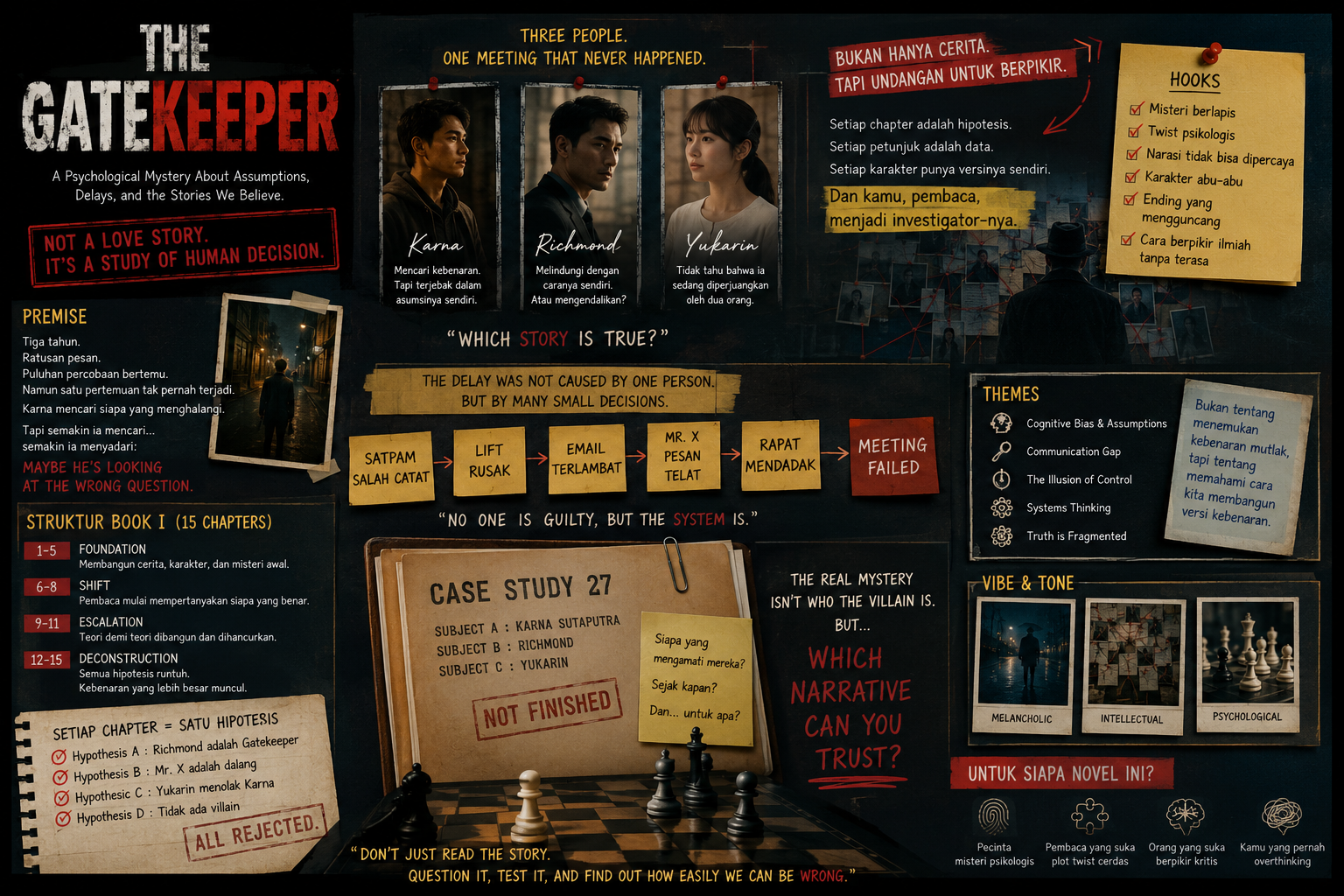
For three years Karna Sutaputra tried to meet one woman. Every single attempt failed. Not with a dramatic rejection. Not with a clear no. Only with small, reasonable, almost invisible delays. This is the story of how a thousand ordinary decisions created one perfect, permanent separation.
Chapter 1 — The Last Conversation
“You should stop hoping.”
The words were simple. No raised voice. No anger. No outright rejection. Just a short sentence spoken as if everyone had known the answer for a very long time.
Karna Sutaputra stared at the man across from him. Richmond.
Richmond did not look like someone who had just destroyed another person’s hope. He looked sincere. Almost gentle.
“I’m sorry.” “We’ve tried.” “Sometimes life simply doesn’t work the way we want.”
Karna nodded slowly. Strange. Not a single sentence from Richmond sounded false. No lie that could be proven. No threat. No ban.
Richmond had never once said, “Stay away from Yukarin.” Never. For three years it had been the opposite.
“Don’t worry.” “Soon.” “We’re working on it.” “She wants to meet you too.” “Just a little longer.”
The words had always made sense. Until Karna stopped counting how many times he had heard them. And then everything simply… ended. Without a single meeting that had ever truly happened.
Richmond stood. Straightened his jacket. Spoke softly.
“Move on. It will be easier.”
Then he left. Just like that. Leaving Karna alone.
Five minutes later Karna’s phone vibrated. Unknown Number. One message. No name. No photo. Only a sentence.
He lied.
Karna froze. One minute later. Second message.
Not about everything.
Third message.
About the timing.
Karna immediately called the number. It was already dead.
That night, for the first time, Karna did not try to remember what Richmond had said. He took a blank sheet of paper. At the top he wrote one word.
Timeline.
Dates. Times. Locations. Promises. Cancellations. Postponements. Everything.
First meeting. Cancelled. Second meeting. Delayed. Third meeting. Yukarin suddenly left town. Fourth meeting. Richmond was sick. Fifth meeting. Schedule changed. Sixth meeting. Wrong phone number. Seventh meeting…
Karna stopped writing. Something made the hair on his arms rise.
Every reason was different. But every result was the same.
He opened his laptop. Drew a diagram. Circles. Arrows. Dates. Names. The diagram grew more complicated until he finally saw it.
Not Richmond. Not Yukarin. Not himself.
One name appeared just before every single delay. Yet that name had never once been spoken in any conversation.
Chapter 2 — The Timeline
The next morning Karna did not go to work. He did not look for Richmond. He did not try to contact Yukarin. Instead he bought a whiteboard. A large one.
The shop owner asked, “For a presentation?”
Karna smiled slightly. “For finding the truth.”
His apartment turned into a police investigation room. Photos. Dates. Sticky notes. Red string. Names. Times. Locations. Everything pinned up.
In the center of the board was only one photograph. Yukarin. Yet the photograph felt almost empty. Because Karna realized he had never truly known her. Everything he knew had come from other people.
Richmond said, “She’s busy.” Friend A said, “She’s sad.” Friend B said, “She’s afraid to meet.” Friend C said, “She’s angry.” Friend D said, “She actually wants to meet.” Mr. X said, “She’s waiting.”
Karna stood staring at the board for nearly an hour. Then he crossed everything out with a black marker. One by one.
BUSY × SAD × ANGRY × WAITING × NOT READY × WANTS TO MEET ×
Then he wrote: Evidence?
None. Everything was only words.
For the first time Karna felt something cold in his stomach. He had been falling in love with a story. Not with facts.
That night he opened old messages. A strange pattern appeared. Every time Richmond said, “She will come,” a few hours later Mr. X would message: “Looks like it’s cancelled.” And it was.
But one week later Karna found something that made no sense. On the same day Yukarin had actually come.
Karna stopped reading. His hands trembled.
If Yukarin had come… then who had not?
He opened the calendar. Same date. Same time. Same building. Different rooms.
Room 302. Room 203.
Karna laughed quietly. Two numbers. Simply swapped. Yet those two numbers had changed his entire life.
Was it coincidence?
He kept searching. Second meeting: one digit wrong in the phone number. Third meeting: correct building, wrong floor. Fourth meeting: correct day, wrong week. Fifth meeting: correct time, wrong time zone.
Karna stepped back three paces and stared at the board. More and more small errors. Errors never large enough to raise suspicion. Yet always large enough to ensure two people never met.
He took a red marker and wrote in large letters:
Coincidence? Or Design?
At that exact moment his phone rang. Unknown Number. One new message.
You’re asking the wrong question.
Karna typed immediately: “Who are you?”
No reply. Five minutes. Ten minutes. Then a final message.
Don’t ask who delayed you. Ask who always knew the delay would happen… before it happened.
The number disappeared again.
Chapter 3 — The Observer
“How did you know?”
Richmond’s voice was quiet. The room went silent. Everyone stopped talking.
Karna looked at him, confused. “Know what?”
Richmond slid a folder across the table. Inside were photographs. Meeting rooms. Corridors. Courtyards. Every one stamped with date and time.
“Every time we discussed Yukarin… you always knew.”
Karna laughed softly. “Me?”
Richmond nodded. “This cannot be coincidence.”
He turned the page.
14 January, 10:03. The group decided to cancel the meeting. 10:19. Karna posted a quote on social media: “Sometimes silence is louder than words.”
18 February. The group decided to change the schedule. Twenty minutes later Karna cancelled his train ticket.
21 March. The group decided to move the location. Forty minutes later Karna texted a friend: “I think the place has changed.”
Richmond set the folder down. “How did you know?”
Karna did not answer. Because he himself had only just realized it was true. He had always known. But how?
That night Karna opened his laptop and searched every old chat. Nothing. Not a single message that told him those decisions.
He began to wonder. Had he been eavesdropping? Impossible. Was his phone tapped? Impossible. Had someone been leaking information?
That last thought made him stop typing. He opened an old folder he had almost forgotten. The name was simple: Archive.
Inside were hundreds of screenshots. Not of conversations. Of clocks. Online statuses. Last active times. Times someone deleted a story. Times someone changed a profile picture. Times someone went offline.
Karna froze.
“I… all this time… have been analyzing patterns.”
He had never known the content of the meetings. He had never heard the discussions. He had only watched small changes.
If Richmond suddenly went offline for three hours. If four other people went offline at the same time. If the group chat suddenly fell silent. If afterward everyone came online again almost together… then almost always a major decision had been made.
Karna had not been eavesdropping. He had simply been too good at reading patterns.
The next day Richmond gathered the group.
“He must have an insider.”
Friend A: “Or a hacker.” Friend B: “Maybe he installed spyware.” Friend C shook his head. “No. He always knows too fast.”
Richmond exhaled. “Find. Who. Is. Leaking. Information.”
In the corner of the room one man remained silent. He said nothing. Defended no one. Accused no one. His name was not even mentioned in the meeting.
But when everyone left, he smiled faintly, took out his phone, and sent a message to an Unknown Number.
Good observation. But you’re still looking at the wrong side of the chessboard.
He slipped the phone back into his pocket and whispered to himself:
“The faster you find Richmond… the longer you will never find me.”
Chapter 4 — The First Lie
The Unknown Number returned. Karna was no longer surprised. He opened the message at once.
Stop watching Richmond.
No greeting. No name. No explanation.
Karna smiled. “Finally… you made a mistake.”
He replied: “Why?”
The message failed to send. The number was dead again.
Karna began to laugh to himself. Not because it was funny. Because something had just clicked.
Mr. X always contacted him after something happened. Never before. That meant Mr. X was not a player. He was only a spectator. Or so Karna thought.
That night he made a new table. Every piece of information from Mr. X that later proved true. Every piece that later proved false. There was no red. Not one. Every statement was accurate. The only consistent error was the clock. Mr. X always arrived late. Four hours. Two days. Sometimes two weeks.
Mr. X had never lied. He had only always arrived after everything had already changed.
So who had made Karna take the wrong decisions? Not Mr. X. Karna himself. Because he had always treated old information as still valid.
He sat in silence. All this time he had blamed Richmond. Then blamed Mr. X. But he himself had never checked whether the information was still relevant.
For the first time Karna erased Richmond’s name from his investigation board. Then he wrote one large sentence:
Every information has an expiration date.
On the other side of the city Richmond was also building an investigation board. In the center was a photograph of Karna. Above it in large letters: How does he always know?
Richmond pinned photographs one by one. Friend A. Friend B. Friend C. Friend D. He crossed them all out. Then he stopped at one photograph. Not Mr. X. Not even a member of the group. The photograph was of himself.
Richmond murmured, “If it isn’t them… then… I myself… am the one leaking something.”
He stared into the mirror. “But… I don’t even realize I’m doing it.”
Chapter 5 — The Missing Variable
Karna stared at his investigation board. Three days. No sleep. No shower. Barely eating. The entire apartment was covered in sticky notes.
Yet one thing bothered him. All the patterns made sense. Too much sense. In research, when all the data is too neat, something is usually wrong.
He opened his old master’s thesis. Methodology chapter. One sentence highlighted in yellow: “Correlation does not imply causation.”
He smiled bitterly. “Idiot. I’m making a first-year student mistake.”
He took a marker and crossed out the entire board. Richmond × Mr. X × Yukarin × Friend A × Friend B × Friend C × Everything.
His neighbor, who happened to glance through the open door, asked, “Mas… why did you erase everything?”
Karna answered quietly, “Because… I just realized… I have no control variable.”
He sat down, took a cup of coffee, and spoke to himself. “I’ve always been comparing failed events… with other failed events. What if… I look for the events that succeeded?”
Silence. Succeeded?
He opened the calendar and searched. There were none. There had never been any.
He froze. If there had never been a successful meeting… how could he know what the normal process even looked like?
For three years he had only studied failure. He had never had a comparison.
He took a new notebook. First page. Large title: CONTROL GROUP. Empty. No data. No sample. No comparison. Which meant every conclusion he had drawn was, scientifically, not yet a conclusion.
His phone vibrated. Unknown Number.
Finally… You’re thinking like a researcher.
Karna stood up. “Who are you?!”
No reply. Five minutes later a second message arrived.
You spent three years investigating people… without first investigating your own assumptions.
Karna did not reply. Because for the first time he was afraid. Not of Richmond. Not of Mr. X. But that all this time he might have been chasing an answer to the wrong question.
Chapter 6 — The Test
Richmond closed the meeting-room door. Everyone had gone home. Only he and one older man remained. White hair. Simple suit. Professor Adler.
“So?” the professor asked. “Are you still holding on?”
Richmond nodded. “Still.”
“How long?” “Three years.”
The professor sighed. “Poor boy.”
Richmond looked out the window. “If he gives up… then he was never worthy.”
The professor smiled. “You still believe that theory?”
Richmond was silent for a moment. “I’m not testing his love. I’m testing his character.”
“What’s the difference?”
Richmond answered, “If someone gives up easily, he will give up when marriage becomes difficult. If someone angers easily, he will anger at his wife. If someone blames easily, he will blame his family. I am only… trying to make sure.”
The professor cut in. “Make sure… or control?”
Richmond did not answer.
The professor opened his notebook. “Do you know why social experiments have ethics committees? Because human beings are not laboratory rats. You may test a bridge. You may test an airplane. You may test software. But when you begin testing human beings without their consent… you are no longer seeking truth. You are playing with their lives.”
Richmond clenched his fists. “I only want to protect Yukarin.”
The professor nodded. “I believe you. But do you know what is most dangerous about a person who is certain he is protecting someone else? He begins to feel that every decision must pass through him. Eventually he is no longer a protector. He becomes…”
The professor stopped. Richmond slowly turned. The professor looked at him and spoke one word.
Gatekeeper.
That night Richmond went home. For the first time he was not thinking about Karna. He was thinking about himself. Had he been protecting Yukarin… or had he been enjoying being the one who decided who was allowed to meet whom?
When he entered his apartment he found a white envelope. No name. Inside was a single photograph. Himself. Speaking with Professor Adler. In a room that had been closed.
On the back, handwritten:
Now you know… How it feels.
Chapter 7 — The Chessboard
Karna could not sleep. Almost two in the morning. His investigation board now covered an entire wall. No longer just a timeline. A network. Names. Arrows. Relationships. Possibilities. Hypotheses.
In the center one sentence: WHO BENEFITS?
He stared at it for nearly five minutes. In every investigation, his old lecturer used to say, there is one question that is always forgotten. “Who benefits?”
If Richmond deliberately blocked the meetings, what did he gain? If Mr. X deliberately leaked, what did he gain? If Yukarin stayed silent, what did she gain? No answers.
He wrote in red: Richmond → No Benefit. Mr. X → Unknown. Yukarin → Unknown. Karna → Lost 3 Years.
He stepped back. Everyone seemed to be losing. Then who was winning?
“That is impossible,” Karna muttered. In game theory there is no game played for years without a player who gains something. Which meant there was a player who had not yet entered the board.
Elsewhere Richmond sat in front of his own whiteboard. In the center was not a photo of Yukarin. Not a photo of Karna. A photo of himself. Beneath it: WHAT AM I MISSING?
He began pinning old photographs. Festivals. Seminars. Conferences. Workshops. Then he stopped.
Every time he had met Karna, the same person appeared in the background. An old man. Never speaking. Never in group photos. Never a speaker. Yet always present.
Richmond enlarged the image. Always blurred. As if the camera had never quite managed to capture his face. He checked the metadata. Dates, times, locations—all normal. Then he saw it. The photographer names were all different. But the camera serial number was the same.
Richmond froze. “Impossible…”
How could five different photographers use the exact same camera?
At the same moment Karna was checking his own photographs. He found the same thing. The old man. Always there. Yet the stranger part: Karna had no memory of ever seeing him. Even though the man appeared in almost every photograph.
Unknown Number. New message.
Good. Now you’re looking beyond the players.
Karna typed immediately: “Who is he?”
The reply came within seconds—the first time ever.
Wrong question.
Next message:
Don’t ask who he is. Ask why neither of you noticed him for three years.
Karna stared at the photograph again. He enlarged it. Enlarged it further. The old man was not looking at Richmond. Not looking at Yukarin. He was looking directly at the camera. As if he knew that one day someone would enlarge the photograph.
Chapter 8 — The Woman Who Never Knew
That morning Yukarin opened her email. 173 unread messages. Three proposals. Four reports. Two seminar invitations. One letter from her mother. And one email she had never opened.
Subject: Meeting Request. Status: Unread. Date: Three years ago.
Yukarin did not even remember it had ever existed. She was about to open it when the phone rang.
“Yukarin.” “Yes?” “We have to leave.”
She closed the laptop. The email remained unread.
Across the city Karna was staring at the same email. The difference: His version had never been sent.
That night Yukarin met Richmond.
“How is it?” Richmond asked.
Yukarin smiled. “What?”
Richmond looked confused. “That person.”
Yukarin frowned. “Which person?”
Richmond froze. “The one who… wants to meet you.”
Yukarin laughed softly. “I have no idea who you’re talking about.”
Richmond went still. “Impossible. I’ve told you so many times—”
Yukarin interrupted. “Rich… you have never once said anyone’s name.”
The room became silent. Richmond opened old chats. “She wants to meet.” “She’s still waiting.” “She already came.” “She’s disappointed.”
He scrolled for one hour. Two hours. Three hours. Then he threw the phone onto the sofa.
For three years he had never typed the name “Karna.” Not once. He had always written “she.” Or “he.” Or “that person.”
Richmond stared into emptiness. If that was true… how could Yukarin possibly know who was being discussed?
In Karna’s apartment the Unknown Number sent a new message.
Do you know why eyewitness testimony is unreliable?
Karna read it. Did not reply.
Second message: Because people don’t remember reality. They remember the story they told themselves.
Karna slowly looked at his investigation board. Every sticky note contained an assumption. Not a fact.
“Richmond knows.” — Assumption. “Yukarin rejected me.” — Assumption. “Mr. X is leaking.” — Assumption. “The delays are deliberate.” — Assumption.
He took one sticky note and wrote: FACT. Beneath it: Empty. Nothing. Not a single one.
In another city an old man closed a book. Title: Cognitive Biases in Human Decision Making. He smiled and said quietly, “Excellent… Now they’re finally questioning their memories.”
CASE STUDY 27
Subject A: Karna Sutaputra
Subject B: Richmond
Subject C: Yukarin
They were three subjects under observation. Not because of any secret organization or unethical scientific experiment. But because someone, for years, had been meticulously documenting how assumptions, indirect communication, and small delays can alter human decisions. There was no proof that person had ever arranged the events themselves. Only extremely detailed notes.
Chapter 9 — The Fourth Player
The Unknown Number finally sent a location. Karna went. An old warehouse. Empty. Only CCTV.
He watched the recordings, expecting to see Mr. X. What appeared was himself. Three years earlier. Entering the warehouse. Leaving again.
Karna froze. “I… have been here before?”
He had no memory of it.
Next video: Richmond. Entering. Leaving. Next video: Yukarin. Entering. Leaving.
All three of them had been in the same place. On different days. And each of them had carried the same white folder.
Karna searched his memory. Nothing. Blank.
Chapter 10 — The Butterfly Effect
“How many people does it take to destroy one meeting?”
The question appeared in Karna’s head uninvited. He did not look for the answer. He looked for the number.
He took a blank book and began writing like a research report.
Experiment
Objective: Determine the minimum number of independent events required to prevent two people from meeting.
Event #1 — Security guard wrote the wrong room number. 203 instead of 302. Outcome: Meeting Failed.
Event #2 — Elevator broken. Richmond late. Outcome: Meeting Failed.
Event #3 — Administrator forgot to forward an email. Outcome: Meeting Failed.
Event #4 — Mr. X sent a message two hours late. Outcome: Meeting Failed.
Event #5 — Yukarin had a sudden meeting. Outcome: Meeting Failed.
Karna stopped. Every outcome was identical. Every cause was different. He drew five lines, all leading to one circle: MEETING FAILED.
Then he began erasing. Erase the security guard → still failed. Erase the elevator → still failed. Erase Mr. X → still failed. Erase Richmond → still failed. Erase Yukarin → still failed.
His hand slowly stopped.
“If I remove every person… why does the meeting still fail?”
He drew a long breath. “I’ve been looking for a culprit. Maybe there is no culprit. I’ve been looking for a process.”
Elsewhere, Professor Adler was playing chess when Richmond entered.
“I’ve found him. Mr. X.”
The professor moved a pawn without looking up. “Good. And then?”
“Tomorrow I catch him.”
The professor smiled. “And if you’re wrong?”
Richmond laughed. “Impossible.”
The professor pointed at the board. “Just because this piece moves before the king does not mean it controls the game. The greatest mistake of an investigator is assuming the piece that appears most often is the mastermind.”
Richmond stared at the board. All this time he had been chasing pawns.
Meanwhile Yukarin was feeding an injured bird. A student asked, “Bu, why won’t the bird eat?”
Yukarin smiled. “Because it is still afraid.”
“But we want to help it.”
Yukarin nodded. “Not every creature can distinguish good intention from threat.”
“Then what do we do?”
Yukarin looked at the bird. “We step back. Let it decide when to come closer.”
That sentence was the exact opposite of Richmond’s belief. Richmond: If I care, I must control. Yukarin: If I care, I must step back.
Chapter 11 — Hypothesis A
Karna stood in front of the whiteboard and wrote the first hypothesis in large black letters.
HYPOTHESIS A
Richmond is the Gatekeeper. He deliberately delayed every meeting for three years.
He underlined it twice. Then he began testing it the way a researcher tests a theory that once felt obvious.
Evidence 1: Richmond always said “soon.” For three years. “Soon” appeared forty-seven times. “We’re working on it” appeared thirty-one times. “She wants to meet you too” appeared nineteen times.
At first it looked like deliberate stalling. Then Karna noticed something else. Every time Richmond wrote those words, his typing speed slowed. The timestamps showed longer gaps between messages. As if he was choosing each word carefully. Not the way a liar chooses words. The way a man chooses words when he is trying not to break something.
Evidence 2: The wrong room numbers. 302 and 203. Karna had always believed Richmond arranged the swap. But the change had been made by an administrator named Lila. Lila had received a call from Richmond’s office thirty minutes earlier. The call log said only: “Confirm the room.” Richmond had confirmed the room that was already booked. He had not chosen it.
Evidence 3: Every cancellation that hurt Karna also hurt Richmond’s own schedule. Richmond had cancelled his own meetings. Missed his own flights. Arrived late to his own important presentations. If Richmond was the Gatekeeper, he was also locking himself out.
Karna wrote in red beside the hypothesis: Motive? Protect Yukarin. But protection that lasts three years without a single actual meeting begins to look like something else.
He took a new sticky note and wrote: If Richmond wanted to keep us apart forever, why did he keep promising a meeting? Why not simply say no?
Silence answered him.
Unknown Number: You are still treating him as the center.
Karna typed back. “He is the one who stood between us.”
The reply came after forty seconds. Did he stand between you… or did he stand in the only place where he could still see both of you?
Karna did not answer. He returned to the board and wrote one more line under Hypothesis A: Still possible. But the evidence is softer than it used to be.
Chapter 12 — Hypothesis B
HYPOTHESIS B
Mr. X is a double agent. He deliberately prolonged the separation by feeding Karna information that was always slightly wrong in timing.
Karna opened the special folder he had created only for Mr. X’s messages. One hundred and forty-three messages across three years. He printed them all. Laid them on the floor in chronological order. Then he marked every single one with two colors.
Green: information that later proved true. Red: information that later proved false. There was no red. Not one.
Every statement Mr. X had sent was accurate. The only consistent error was the clock. Mr. X always arrived late. Four hours. Two days. Sometimes thirteen days.
Karna wrote on a new sheet: If he is a double agent, what is the benefit of telling the truth too late?
He tried every version. None of them held. Mr. X had never moved a single piece on the board. He had only described the board after the pieces had already stopped moving.
Karna took the red marker and wrote across Hypothesis B: REJECTED.
Then, smaller, underneath: He was never a player. He was a delayed mirror.
Unknown Number: Correct.
Chapter 13 — Hypothesis C
HYPOTHESIS C
Yukarin knew. Yukarin refused. Yukarin chose not to meet him.
This one hurt the most to write. Karna forced himself to list every reason he had once believed this. The long silences. The cancelled meetings that always seemed to come from “her side.” The way Richmond spoke as if he was protecting her feelings.
He opened the email that had sat unread in Yukarin’s inbox for three years. Subject: Meeting Request. From: Karna Sutaputra. Status: Unread. Never opened. Never replied to.
Then he opened Richmond’s old chats with Yukarin. He searched for his own name. Zero results. He searched for “the person who wants to meet you.” Zero results. He searched for any sentence that clearly identified him. Zero.
Richmond had spoken about “him” and “that person” and “the one who keeps waiting” for three years. But he had never once typed the name Karna. Yukarin had never been given a name to reject.
Karna sat back. The hypothesis began to collapse under its own weight. She had never rejected him. Because she had never been asked in a language she could hear.
Karna crossed out Hypothesis C with a single thick black line. Then he wrote beside it: She did not refuse the meeting. She never knew the question existed.
Unknown Number sent only three words that night: Now you see her.
Chapter 14 — Hypothesis D
HYPOTHESIS D
There is no villain. Only a system of small, independent decisions that always produced the same result: delay.
Karna cleared half the wall. He began drawing circles.
Circle 1: Security guard writes 203 instead of 302. Intention: none.
Circle 2: Elevator breaks. Intention: none.
Circle 3: Administrator forgets to forward an email. Intention: none.
Circle 4: Richmond says “soon” instead of giving a hard date. Intention: protection, not obstruction.
Circle 5: Friend A tells Karna “she is sad” because that is what Friend A believes that week. Intention: helpfulness.
Circle 6: Mr. X reports the truth four hours late because that is when he learns it. Intention: never creation of the delay itself.
Circle 7: Karna himself treats every piece of old information as still current. Intention: hope.
Karna connected the circles with thin red lines. All of them pointed to the same center: MEETING FAILED.
He erased one circle at a time. The center remained. He erased every human name. The center still remained.
The system did not need a villain. It only needed ordinary people making ordinary decisions at slightly wrong moments.
Karna wrote the conclusion slowly. No single person kept them apart. The pattern of small, reasonable, uncoordinated choices did.
This is why the question “Who is the Gatekeeper?” was always the wrong question. The Gatekeeper was never a person. It was the way people protect, assume, delay, and hope — all at the same time.
Chapter 15 — Rejected Hypotheses
Karna cleared the entire wall. Only four large sheets remained, pinned in a row.
Hypothesis A — Richmond is the sole Gatekeeper. ❌ Rejected.
Hypothesis B — Mr. X is the mastermind / double agent. ❌ Rejected.
Hypothesis C — Yukarin refused the meeting. ❌ Rejected.
Hypothesis D — Someone is deliberately keeping them apart. ❌ Rejected.
He stepped back. The wall looked almost empty now. Three years of investigation reduced to four crossed-out sentences.
On a final blank sheet, in the center of the wall, he wrote the only sentence that had survived every test:
The only consistent variable across three years was the human need to find a single person to blame.
Then, in smaller letters at the bottom of the page:
Case Study 27 is closed. Observation continues.
Epilogue
Somewhere far from any city an old man closes another notebook. The cover is plain. The pages are filled with dates, small observations, and quiet corrections. He does not smile. He does not look satisfied. He only sets the pen down and rests both hands on the closed book for a long time, as if the weight of what he has written is finally heavier than the paper.
Outside the window the Sahara stretches under a hard blue sky. The light is clean and merciless. In the distance a woman with dark hair walks among a group of large animals being prepared for transport. Cages. Restraints. Low voices of handlers who already know the schedule will change twice before departure.
Yukarin does not look back.
She adjusts a strap on one of the animals. Her hands move with the same quiet competence they always had. There is no drama in the gesture. No sense that something important was left unfinished three thousand kilometers away. Only the dry wind, the smell of dust and fur, and the knowledge that the next war will need these creatures ready.
She pauses once, briefly, when a younger handler asks if she is certain about the route. Yukarin answers without raising her voice. “Yes.”
Then she continues walking. The shadow she casts is long and alone.
In another place, under different stars, a man named Karna Sutaputra stands on a ridge and looks at a map that no longer contains any of the names he once chased. The paper is creased from being folded and unfolded too many times. Richmond’s name is gone. Mr. X’s number is gone. Even Yukarin’s name has been carefully erased, though the faint indentation of the letters can still be felt if he runs his thumb across the surface.
He does not cry. The three years taught him that tears require a clearer kind of loss. This one is quieter. It has no single moment to point at. No slammed door. No final conversation. Only a long sequence of almosts that never quite became a meeting.
He folds the map once more and puts it away. The wind moves through the dry grass around his boots. Somewhere far below, a road continues without him.
They never met.
Not because anyone forbade it. Not because anyone planned it.
Because a thousand tiny, reasonable decisions — a wrong room number written by a tired guard, an elevator that broke on the wrong afternoon, an email left unforwarded, a protective sentence spoken too carefully, a piece of true information that arrived four hours late, a man who kept saying “soon” when he meant “I am afraid,” another man who kept reading patterns instead of asking directly — each of them almost invisible, each of them defensible, added up to one perfect, permanent separation.
There was no villain to hate. There was only the soft, relentless machinery of ordinary human caution.
And somewhere between the desert and the ridge, a fourth player continues to take notes. He writes more slowly now. The ink is darker. The margins are fuller.
He records the exact hour Yukarin checked the last animal. He records the exact minute Karna folded the map for the final time.
Then he pauses, looks at the empty space between the two entries, and writes one last line before closing the book again:
They came so close that the distance finally became permanent.
The wind moves across both landscapes at the same time. It carries nothing from one to the other.
After the Closing
The old man places the notebook on the shelf beside twenty-six others. Case Study 27 sits quietly among them, its spine unmarked, its final line still drying.
He turns off the lamp. The room falls into the soft darkness of late evening.
Then the phone on the desk vibrates once.
Unknown Number.
A single message appears on the black screen.
You closed the wrong study.
The old man does not move. For the first time in many years his hand hesitates above the device.
A second message follows.
Subject A is no longer the only one who learned to read patterns.
The screen goes dark again. The number is already dead.
Outside, the wind that once moved across two separate landscapes now carries something else — a faint sound of pages turning in a notebook that should have remained closed.
Somewhere, under the same hard sky, a woman walking among animals pauses without knowing why.
Somewhere else, a man on a ridge unfolds a map he thought he had finished with, and finds a new line drawn in handwriting that is not his own.
The fourth player stands very still in the dark room.
For the first time, he is no longer certain who has been taking the notes.