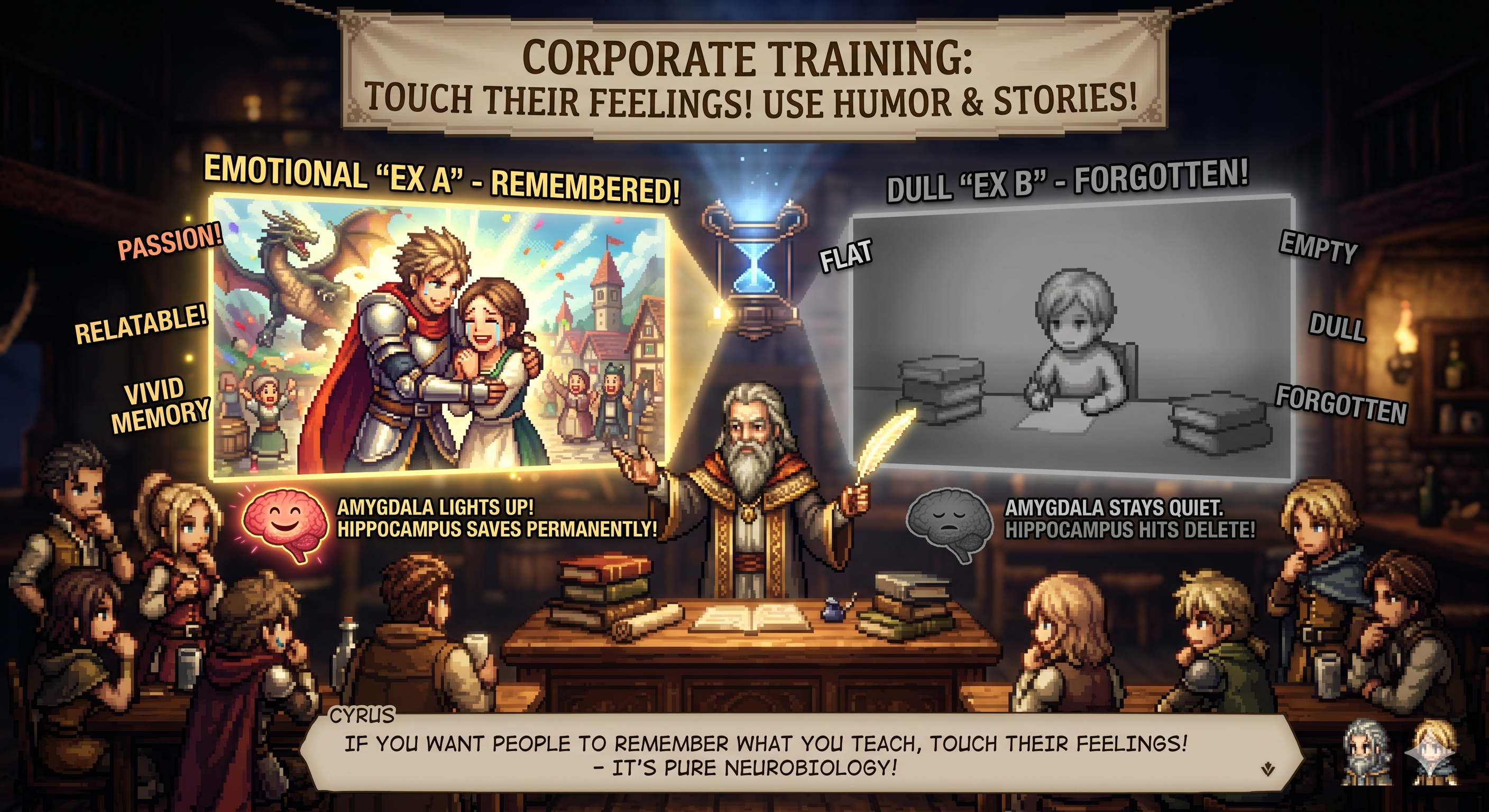
Let's talk about memory. Why do you vividly remember your emotional "Ex A", but completely forget "Ex B"? And more importantly — what does this have to do with Corporate Training, Town Halls, and Capacity Building? 🤔
We all have that one "Ex A" — the one that stayed. Not because of their immaculate logic or their well-structured life plan. Not because they had the best resume or the most coherent five-year vision. They stayed because they made you feel something. A specific look. A shared laugh at the wrong moment. A vulnerability you didn't expect. Your brain grabbed that experience by the collar and filed it under "Do Not Delete."
And then there's "Ex B". Objectively fine. Logically sound. Emotionally... flat. Gone from your mental hard drive as completely as if they were never there. You can barely recall their last name.
Now here is the question that should unsettle every corporate trainer, HR director, and senior leader reading this: Which one are you being in the room?
The Golden Rule of Capacity Building
A wise professor once shared a non-negotiable rule in HR and Organizational Development: "If you want people to remember what you teach, touch their feelings." At the time, it sounded like poetic, motivational advice. Turns out, it is hardwired neurobiology — backed by decades of empirical research. 🧠
The "Ex A" Experience
Humor. Surprise. Vulnerability. Relatable stories. Unexpected twists. The brain tags this experience as high-value data and mobilizes its full neurochemical encoding apparatus. Emotion becomes the "superglue" of long-term memory consolidation.
The "Ex B" Experience
Dull. Overly technical. Emotionally sterile. Delivered on schedule, without surprise, without stakes. The brain does what evolution optimized it to do: conserves metabolic energy and quietly discards the irrelevant. 🗑️
1. The Neuroscience: Why "Ex A" Never Leaves Your Brain
To understand why your emotional ex occupies permanent real estate in your memory while "Ex B" is gone, you need to understand the most important partnership in the human brain: the Amygdala–Hippocampus Pipeline.
The amygdala — a small, almond-shaped structure sitting at the base of each temporal lobe — functions as the brain's emotional significance detector. It runs continuously in the background, scanning every incoming experience for emotional relevance. The hippocampus, adjacent to it, is the brain's memory consolidation engine, the mechanism that converts short-term experiences into long-term declarative memories.
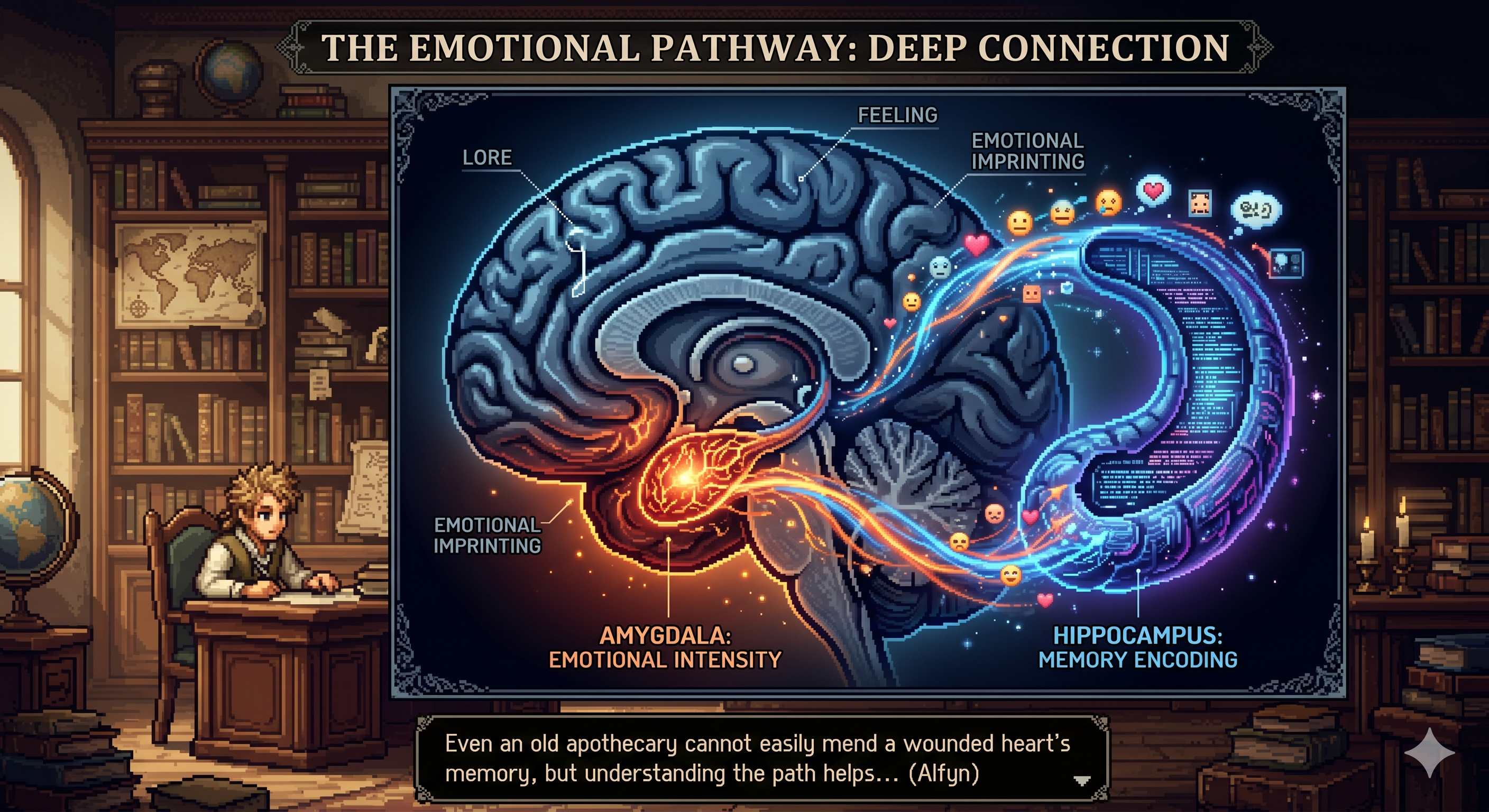
Visualizing the neural dialogue within the Amygdala–Hippocampus Pipeline.
These two structures do not operate independently. They are in constant biochemical dialogue. When the amygdala detects an emotionally significant event — joy, fear, surprise, awe, grief — it releases a cascade of stress hormones, primarily norepinephrine and cortisol, that act directly on the hippocampus. This hormonal signal translates, neurologically, to a single urgent message: "This is important. Encode it deeply. Do not discard."
Cahill & McGaugh (1998) demonstrated this mechanism with clinical precision. Participants who were administered a beta-blocker (propranolol) — which blocks the norepinephrine signal from the amygdala — showed significantly impaired memory for emotionally arousing content, while their memory for neutral content was unaffected. Remove the emotional signal, and the memory enhancement disappears entirely. The chemistry, not the content, determines what is remembered.
The Brown & Kulik (1977) Flashbulb Memory Effect
Psychologists Roger Brown and James Kulik introduced the concept of Flashbulb Memory — the phenomenon where emotionally charged events (the moment you heard about 9/11; the moment you received unexpected great or terrible news) are encoded with extraordinary vividness and durability. The brain essentially takes a high-resolution snapshot of the entire context: what you were wearing, who was next to you, what song was playing. Corporate trainers and leaders who engineer these "flashbulb moments" inside their sessions create memories that participants can recall with the same clarity ten years later. This is the neurological target of the Ex A Protocol.
Without emotional encoding, new information is subjected to what Hermann Ebbinghaus (1885) mapped as the Forgetting Curve: approximately 50% of untagged information is lost within one hour, 70% within 24 hours, and up to 90% within a week. Your meticulously prepared 47-slide deck, delivered with technical precision and zero emotional activation, has a half-life of about 60 minutes.
The Memory Retention Curve
Information retention over time: Emotionally tagged (Ex A) vs. cognitively flat (Ex B) — with spaced retrieval interventions.
Figure 1: Memory retention trajectories based on emotional encoding and retrieval practice. Data synthesized from Ebbinghaus (1885), Cahill & McGaugh (1998), and Kornell & Bjork (2008).
2. The Neurochemistry of Attention: What Dopamine Has to Do With Your Slide Deck
Before memory is even possible, there is attention. And attention, at the neurochemical level, is governed almost entirely by dopamine.
Dopamine is not, as it is popularly misunderstood, the brain's "pleasure chemical." More precisely, it is the brain's anticipation and prediction-error signal. Wolfram Schultz's (1997) landmark research on dopamine-producing neurons revealed that dopamine fires most intensely not when a reward is received, but when a reward is unexpected — when the world delivers something the brain did not predict. The moment of productive surprise is the moment of maximum neurological engagement.
This has a devastating implication for the standard corporate presentation format. When you open with an agenda slide, you have just told the brain everything it is going to experience. There is no prediction error. No surprise. No dopamine. The brain correctly models the next 90 minutes as a low-novelty environment and begins directing attentional resources elsewhere — to the unread Slack messages in the participant's pocket, to the lunch decision, to literally anything with higher dopamine yield than your slide deck.
The Ex A Protocol is, at its neurochemical core, a dopamine engineering strategy. Every act of surprise, every unexpected story pivot, every moment of humor or genuine vulnerability, every counterintuitive data point that defies the audience's model of reality — these are all prediction-error events that re-engage the dopamine system and re-direct full attentional resources back to the speaker.
The Four Neurochemical Levers of Memorable Leadership
Dopamine via Humor & Surprise
Unexpected humor generates a prediction-error dopamine spike. The punchline violates the brain's forecast, triggering the same novelty-detection circuitry as discovery. Post-humor, the audience's attentional window is fully open — this is the optimal moment to deliver your core message.
Oxytocin via Storytelling
Zak (2015) demonstrated that narrative storytelling causes the brain to release oxytocin — the neurochemical associated with empathy, trust, and social bonding. A story about a real person facing a real struggle activates the listener's mirror neuron system, producing neurological co-experience. They are not watching your story; they are living it. Information embedded in oxytocin-generating narratives shows 22x higher recall rates.
Cortisol via Productive Tension
Moderate cortisol arousal — generated by presenting a genuine problem, a real threat, or unresolved tension — sharpens focused attention and improves encoding depth. The key word is moderate: high chronic cortisol destroys hippocampal function, but a well-timed moment of strategic urgency creates the neurological conditions for deep learning. A story where the stakes are real is neurologically superior to one where the outcome is certain from the first slide.
Norepinephrine via Emotional Peaks
Cahill & McGaugh's (1998) mechanism: norepinephrine released during emotionally arousing moments acts directly on the amygdala–hippocampus circuit to enhance memory consolidation. A deliberate "emotional peak moment" engineered into the session — a surprising personal disclosure, a shocking statistic, a moment of genuine humor or tension — creates a norepinephrine-tagged memory that resists the Forgetting Curve for months.
3. Micro-Horizon Scanning: Reading the Room in Real Time
So how do you ensure you are being "Ex A" in the room — consistently, across an audience of thirty or three hundred people with varying baseline energy levels, varying prior knowledge, and varying tolerance for abstraction? You do not simply prepare a better slide deck. You deploy Micro-Horizon Scanning: a real-time environmental intelligence system applied at the individual and group level, operating continuously throughout the session.
Horizon Scanning, in its traditional foresight application, is the systematic detection of weak signals in the macro-environment — early indicators of emergent trends before they become crises. Micro-Horizon Scanning borrows this same methodology and compresses it to the scale of a room and a 90-minute window. As a speaker, facilitator, or leader, you are the foresight analyst. The room is your operating environment. Cognitive fatigue, disengagement, and emotional flatness are your "emerging risks." The weak signals are visible — if you know what to look for.
The critical operational principle: you must detect the signal and intervene before the audience crosses the threshold of disengagement. Once the Default Mode Network (the brain's daydreaming system) fully activates, you have lost the room. Retrieval is possible but costly. Prevention is structurally superior.
Signal 1 — The Postural Collapse
Shoulders drop, spines curve, heads tilt backward, arms cross. Physiologically, this posture reduces diaphragmatic breathing, decreasing oxygen delivery to the prefrontal cortex. The body is literally preparing for low-activity mode. This signal typically appears 20–35 minutes into any session that has not introduced an emotional or physical state change.
⚡ Intervention: Trigger a physical state change. Ask a question that requires them to turn to a neighbor. Ask for a show of hands on something polarizing. Have them stand. The body re-engages the mind — not the other way around.
Signal 2 — The Phantom Scroll
Participants begin checking phones under the table, glancing at laptops, or performing the telltale micro-movement of thumbs scrolling under the desk. This is the dopamine audit result: the phone has won the competition. Your content has failed the prediction-error test — it is too predictable, too safe, too confirmed. The brain has ranked external stimuli as higher-yield.
⚡ Intervention: Shatter the pattern immediately. Deliver an unexpected statistic that contradicts their professional assumptions. Tell a self-deprecating story. Ask them directly what they expected to learn today — then tell them you are not going to give them that. The prediction error will re-engage the dopamine system within seconds.
Signal 3 — The Glazed Stare
They are looking at you, but the eyes are unfocused, tracking slightly above your face. This is the signature of Default Mode Network activation — the brain's baseline state of internally-directed thought (daydreaming, self-referential processing). They are physically present but neurologically absent. This state, documented by Buckner et al. (2008), consumes significant metabolic energy and is highly resistant to passive re-engagement.
⚡ Intervention: Use the word "Imagine." The brain cannot run the Default Mode Network and a forced visual simulation simultaneously. A rich, specific imagined scenario — "Imagine you are the HR Director. It's 8 AM on a Monday, and your CEO just sent you a message saying..." — forces the prefrontal cortex back online within 2–3 seconds.
Signal 4 — The Side Conversation
Small whispering clusters emerge. Two people are talking to each other while you are speaking. This is almost universally read as a discipline problem — it is actually a cognitive surplus signal. Their brains have spare capacity that your content is not utilizing. They are too cognitively under-challenged, not too distracted. This is a distinct category from the glazed stare.
⚡ Intervention: Elevate the cognitive demand immediately. Ask an open question with no clean answer. Introduce a genuine dilemma: "Here's a real situation. What would you do?" Direct the surplus energy into the content rather than suppressing it.
Signal 5 — The Clock Check
More than three participants check the time within a five-minute window. This is a timeline signal, not merely a fatigue signal — they are calculating how much longer they must endure the current state. The fact that they are counting time is confirmation that the perceived value of the next unit of time exceeds the perceived value of what they are currently receiving from you.
⚡ Intervention: Name it. "I see some of you checking the time — let me tell you something in the next three minutes that will make the rest of this worth staying for." The explicit promise of a payoff creates anticipatory dopamine. You have bought a focused attention window — use it for your single most important point.
Signal 6 — The Micro-Expression of Disbelief
A fleeting expression — a slight eyebrow raise, a subtle lip press, a barely perceptible headshake — that crosses a participant's face when you make a claim. Paul Ekman's (1992) research on micro-expressions established that these involuntary signals are produced in 1/25th of a second and reveal genuine emotional response before the participant is consciously aware of it. If you see this, your claim has triggered cognitive dissonance or skepticism.
⚡ Intervention: Address the dissonance directly. "I can see some skepticism in the room — that's exactly the right reaction. Let me show you the data." Acknowledging the doubt disarms it, builds credibility, and converts a moment of disconnection into a moment of trust.
4. HOW TO: Architecting the "Ex A" Experience — The Practitioner's Playbook
Theory without execution is entertainment. Here is the operational framework — the specific, research-backed techniques for engineering an "Ex A" experience in any corporate learning context, from a 20-person team briefing to a 500-person annual Town Hall.
The Counterintuitive Opening (Violate the Expected Pattern)
The first 90 seconds of any session determine whether the brain classifies the experience as "Ex A" or "Ex B" territory. Most presenters open with: who they are, what the agenda is, and how long it will take. This is the neurological equivalent of announcing boredom. Instead, open with a statement that violates the audience's prediction model.
Real-World Example
In a 2019 study by Howard & Gengler (cited in Zak, 2015), presenters who opened with a counterintuitive statement — "Everything we've been told about employee motivation is wrong" — sustained 34% higher audience attention levels across the full session compared to standard-agenda openings. The prediction-error event at the start primes the brain for a high-novelty environment and keeps the dopamine system on standby for the duration.
🎯 Application: Replace your first slide with a single provocative question or a two-sentence story that ends on unresolved tension. Do not introduce yourself until the audience already wants to know who you are.
The Story Spine: Narrative as a Memory Delivery System
Paul Zak's (2015) neurobiological research established that character-driven stories with tension cause sustained oxytocin release — and that information embedded within those stories shows 22x higher recall rates than the same information presented as data points or bullet lists. Stories are not decorative additions to corporate content. They are the most neurologically efficient data-delivery mechanism available to a human speaker.
The Pixar Story Spine (Adapted for Corporate Use)
🎯 Application: Identify one real person (with permission or anonymized) whose experience perfectly embodies your key concept. Build your entire session around their story. Your data becomes the proof of what happened to them — not a standalone abstraction.
Strategic Vulnerability: The Trust-and-Recall Accelerator
Brené Brown's (2010) research on vulnerability, later extended into organizational contexts by Edmondson's (1999) work on psychological safety, demonstrates a consistent finding: leaders who disclose genuine personal failures or uncertainties generate significantly higher audience trust, engagement, and information retention than those who maintain a posture of authority and competence. This is the "Ex A" effect in its purest form. Your ex was unforgettable partly because they let you see something real.
Case Study — Google's Project Aristotle (2016)
Google's internal research on high-performing teams identified psychological safety — the belief that one can speak up, admit mistakes, and be vulnerable without punishment — as the single strongest predictor of team effectiveness, outperforming all other variables including individual competence. Teams led by managers who modeled vulnerability showed 26% higher learning behavior. The leader's willingness to say "I got this wrong" was the environmental condition that made everyone else willing to learn.
🎯 Application: In each session, deliberately include one story where you were wrong, confused, or failed — and what you learned from it. The moment of admitted imperfection is the moment the audience stops evaluating you and starts trusting you. Information delivered inside a trust window is retained at dramatically higher rates.
The Spacing Effect: Engineering Memory That Lasts Beyond Friday
Even a perfectly executed "Ex A" session is incomplete without a post-session retrieval architecture. Ebbinghaus (1885) identified, and Kornell & Bjork (2008) confirmed with modern neuroimaging, that spaced retrieval practice — deliberately recalling information at increasing intervals — is the single most effective intervention for long-term memory consolidation, outperforming re-reading, summarization, and conceptual mapping.
The 1–3–7 Retrieval Protocol
🎯 Application: Build the 1–3–7 protocol into your session design before the session begins. Emotional encoding in the room + systematic retrieval outside it = retention curves that resist the Forgetting Curve for months, not days.
The Peak-End Rule: Engineering the Memory That Defines the Whole
Kahneman, Fredrickson, Schreiber & Redelmeier (1993) established the Peak-End Rule: people do not remember the average of an experience. They remember the emotional peak and the ending. This means the architecture of your closing 10 minutes is disproportionately more important than the architecture of your middle 60 minutes. A mediocre session that ends brilliantly will be remembered more favorably than an excellent session with a weak, administrative close.
Real-World Validation: The Medical Pain Study
In Kahneman's original colonoscopy study, patients who experienced a longer procedure — but whose final moments were deliberately made less painful — retrospectively rated the entire experience as significantly less unpleasant than patients whose shorter procedure ended at maximum pain. The ending rewrote the entire memory. The same mechanism operates in corporate sessions: design your ending as the emotional peak, not the administrative close.
🎯 Application: Design your closing 10 minutes as the single most emotionally resonant moment of the session. Return to the opening story and resolve it. Deliver a personal moment of genuine conviction. Make a specific ask that connects each person's individual contribution to a larger purpose. Never end on logistics. End on meaning.
The Integration of Heart and Mind
The distinction between an "Ex A" leader and an "Ex B" leader is not talent. It is not charisma. It is not even intelligence. It is intentional design. Every element of the Ex A Protocol — the counterintuitive opening, the story spine, the strategic vulnerability, the spacing architecture, the peak-end engineering — can be learned, practiced, and systematically improved.
The brain does not remember what you taught. It remembers what it felt while you were teaching. Design the feeling first. The content will be carried inside it, permanently, to places a bullet point could never reach.
Conclusion: Don't Be "Ex B"
What's one training, speaker, or moment you still remember — and what made it stick? It was not a bullet point. It was not a well-formatted handout. It was a moment of vulnerability that mirrored your own fear. A burst of laughter that arrived when you least expected it. A story that began with someone else's struggle and ended, somehow, feeling like it was about you.
That is the Ex A Protocol. Not a presentation style. Not a performance technique. It is a neuroscientific framework for designing human experiences that bypass the brain's spam filter, activate its encoding machinery, and convert 90 minutes into permanent behavioral change.
By deploying Micro-Horizon Scanning to detect weak signals in real time — the postural collapse, the phantom scroll, the glazed stare, the clock check — you intercept disengagement before it crosses the threshold of no return. By applying the five practitioner tools — the counterintuitive opening, the story spine, the vulnerability moment, the 1–3–7 spacing protocol, and the peak-end design — you construct the neurochemical conditions in which memory is not only formed but protected.
Your audience's brain will decide in the first 90 seconds whether this is an "Ex A" or "Ex B" experience. Design those 90 seconds with the same care you once designed the entire deck. Then let the neuroscience do the rest.
#HumanResources #LearningAndDevelopment #CapacityBuilding #LeadershipDevelopment #WorkplaceLearning #Storytelling #Neuroscience #BehavioralScience
Scientific Citations & References
Cahill, L., & McGaugh, J. L. (1998). Mechanisms of emotional arousal and lasting declarative memory. Trends in Neurosciences, 21(7), 294–299.
Tyng, C. A., Amin, H. U., Saad, M. N. M., & Malik, A. S. (2017). The influences of emotion on learning and memory. Frontiers in Psychology, 8, 1454.
Ebbinghaus, H. (1885). Über das Gedächtnis: Untersuchungen zur experimentellen Psychologie. Duncker & Humblot. [English translation: Memory: A contribution to experimental psychology, 1913.]
Schultz, W. (1997). A neural substrate of prediction and reward. Science, 275(5306), 1593–1599.
Zak, P. J. (2015). Why your brain loves good storytelling. Harvard Business Review.
Kahneman, D., Fredrickson, B. L., Schreiber, C. A., & Redelmeier, D. A. (1993). When more pain is preferred to less: Adding a better end. Psychological Science, 4(6), 401–405.
Kornell, N., & Bjork, R. A. (2008). Learning concepts and categories: Is spacing the "enemy of induction"? Psychological Science, 19(6), 585–592.
Buckner, R. L., Andrews-Hanna, J. R., & Schacter, D. L. (2008). The brain's default network. Annals of the New York Academy of Sciences, 1124(1), 1–38.
Edmondson, A. (1999). Psychological safety and learning behavior in work teams. Administrative Science Quarterly, 44(2), 350–383.
Brown, B. (2010). The gifts of imperfection: Let go of who you think you're supposed to be and embrace who you are. Hazelden Publishing.
Brown, R., & Kulik, J. (1977). Flashbulb memories. Cognition, 5(1), 73–99.
Ekman, P. (1992). An argument for basic emotions. Cognition & Emotion, 6(3–4), 169–200.
The Amygdala-Hippocampus "Superglue" Effect: Research from Columbia University proving that high-frequency neuronal activity connecting the amygdala and hippocampus is the exact mechanism our brain uses to prioritize emotional memory encoding over neutral ones. Nature Human Behaviour (2023).
The "Brain Orchestra" Concept: Park, J., & Leong, Y. C. (2025). Emotional arousal physically forces different networks in our brain to harmonize and work together, making those specific memories highly "sticky" and integrated. Nature Human Behaviour. Read UChicago press release.
Memory Modulation Theory: McGaugh, J. L. (2004). The classic foundational neuroscience theory proving that emotional arousal releases stress/excitement hormones (like epinephrine and dopamine) which directly regulate and enhance memory consolidation.