“The tragedy was never the absence of divine help. It was the refusal to recognize it in a form he hadn't pre-approved.”
“God, please help me.”
It is one of the oldest prayers humanity has ever spoken. People whisper it in hospitals. They cry it during wars. They repeat it while watching their lives quietly fall apart at 2 a.m., staring at a ceiling, negotiating with a silence that doesn't seem to negotiate back.
There is an old story — told in slightly different versions across many cultures and religious communities — that asks an uncomfortable question about that prayer.
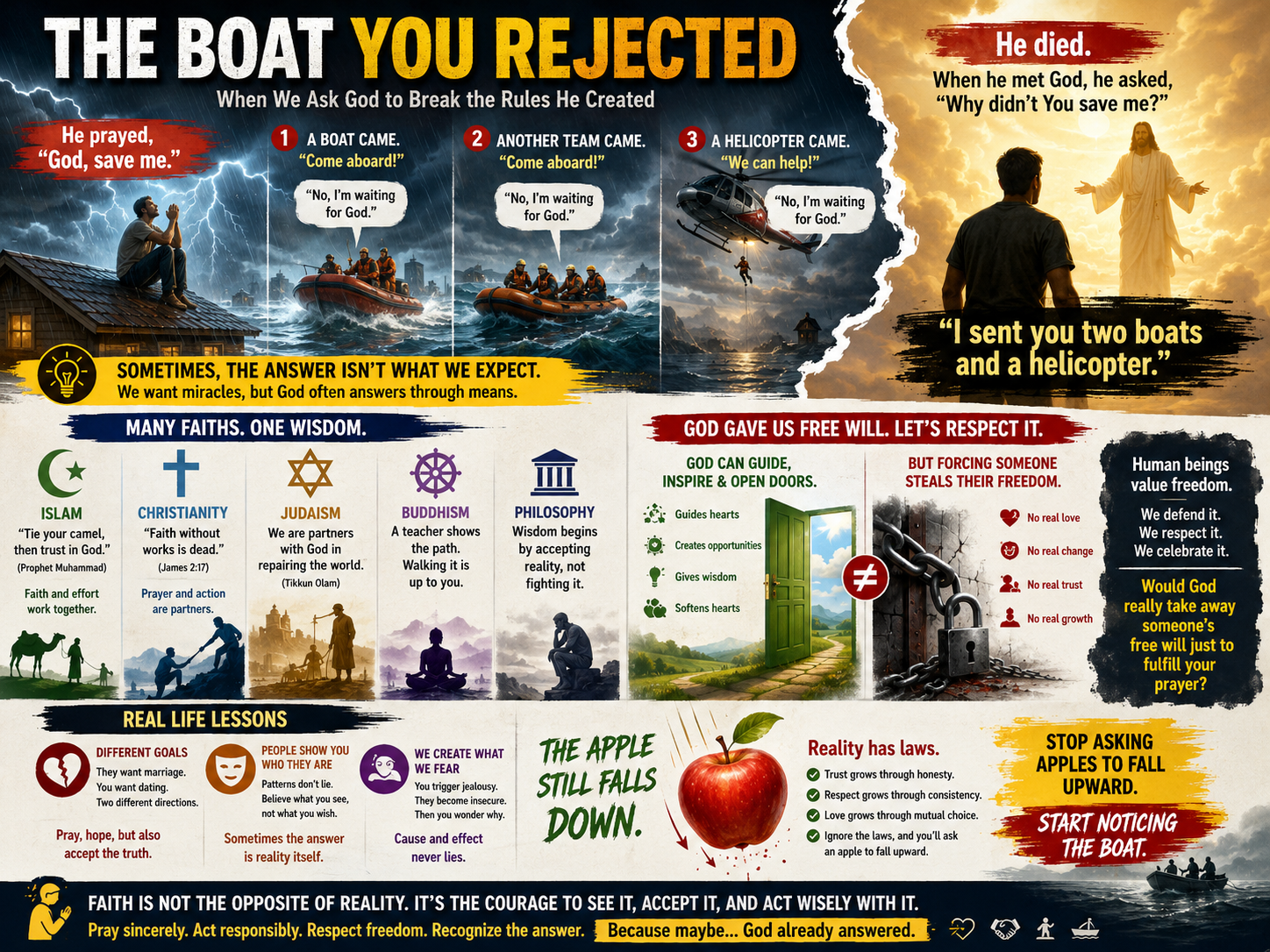
A man becomes trapped by a flood. The water keeps rising. He kneels on the roof of his house and prays: “God, save me.”
A rescue boat arrives. “Come aboard!” “No,” he replies. “I'm waiting for God.” Later, another rescue team comes. Again he refuses. Finally, a helicopter hovers above him. He waves it away. Eventually, the flood takes his life.
When he stands before God, he asks, “Why didn't You save me?” And the answer is simple: “I sent you two boats and a helicopter.”
The story is usually told as a parable about faith. It is that. But look closer and it is also a very precise case study in how the human mind talks itself out of the help sitting right in front of it — which is the thread this reflection follows, from the psychology of that refusal, through what the world's traditions actually say about effort and trust, to what it might mean to stop waiting for the “right” kind of boat.
Sometimes We Expect Miracles While Ignoring Reality
Many of us unconsciously decide, in advance, what God's answer is allowed to look like. We imagine lightning from the sky. A dramatic reversal. A miraculous coincidence engineered just for us.
But what if the answer comes disguised as an opportunity, a difficult conversation, a piece of blunt advice from someone we don't particularly like, a doctor, a teacher, a stranger — a rescue boat with peeling paint and an engine that sputters?
The problem isn't always that God is silent. Sometimes we are listening only for the frequency of the answer we already want, and everything broadcast on another frequency gets filtered out as noise. Which raises the obvious next question: why does the mind do that filtering in the first place?
Why We Do This: The Psychology Behind the Rejected Boat
This isn't just a spiritual failing — it's a well-documented pattern in human cognition. Several psychological mechanisms explain why the man on the roof waves the boats away, and they tend to arrive together rather than one at a time.
Confirmation bias sets the trap first. Once we form an expectation — “God's help will look dramatic and unmistakable” — we unconsciously filter incoming information to match it. Ordinary help doesn't register as an answer because it doesn't fit the template we already built in our minds.
Cognitive dissonance (Leon Festinger, 1957) then keeps the trap shut. Holding two conflicting ideas — “I asked for help” and “help arrived in a form I find unacceptable” — creates psychological discomfort. Rather than revise the expectation, it's often easier to reject the evidence and preserve the original belief. Declining the boat resolves the tension by keeping the fantasy of a “proper” rescue intact.
Locus of control (Julian Rotter, 1966) decides what happens next. People with a strong external locus of control tend to wait for outside forces to change their circumstances, sometimes passively, rather than recognizing the agency and opportunities already available to them. Waiting on the roof — rather than climbing into the boat — is passivity dressed up as piety.
Learned helplessness (Martin Seligman, 1967) can deepen that passivity further. When someone has experienced repeated disappointment or feels their actions don't matter, they can stop attempting to act even when a real opportunity for escape appears directly in front of them. The mind, worn down, stops testing the door even when it's unlocked.
The sunk cost fallacy, applied to belief itself, makes reversing course feel worse the longer it's delayed. The longer someone waits for a specific kind of answer, the harder it becomes to accept a different one — not because the different answer is worse, but because accepting it means admitting the wait itself may have been unnecessary.
And attribution theory (Fritz Heider) supplies the final alibi. We tend to attribute outcomes either to external forces or internal choices, and we're often inconsistent about which one we pick. Blaming God for the flood while ignoring the three offers of rescue is a convenient attribution: it locates the failure outside the self.
None of these mechanisms make someone foolish. They make someone human. But naming them is the first step toward not becoming the man on the roof — and naming them together, rather than one at a time, shows how neatly they lock into each other.
Many Faiths Teach That God — or the Universe, or the Self — Works Through Means
This idea is far more widespread across traditions than a single quote or two might suggest.
Islam. Believers are encouraged to trust God (tawakkul) while also taking deliberate action (sa'i, effort). The saying often attributed to the Prophet Muhammad — “Tie your camel, then trust in God” — captures this balance precisely: faith is not passivity, it is effort placed inside a larger trust.
Christianity. The Epistle of James states plainly that faith without works is dead. Prayer and action are described as partners, not substitutes for one another. Many Christian thinkers have also framed providence as working through ordinary means — people, circumstances, and choices — rather than only through the miraculous.
Judaism. Jewish tradition holds a long-standing principle of hishtadlut — the obligation to make a genuine human effort even while trusting in divine providence — alongside Tikkun Olam, the idea that humans are active partners in repairing and improving the world rather than passive recipients of it.
Buddhism. Liberation cannot simply be handed to someone else. A teacher may point to the path, but walking it remains the responsibility of the individual — a theme echoed in the Buddha's reported instruction to be “a lamp unto yourself.”
Hinduism. The Bhagavad Gita's teaching of karma yoga instructs the practitioner to act with full sincerity and effort, while releasing attachment to the specific outcome of that action. You row the boat; you don't get to dictate the current.
Sikhism. The tradition of Kirat Karo — honest, diligent work — is one of the three pillars of Sikh living, placed alongside worship and sharing with others. Devotion and labor are treated as inseparable.
Taoism. The concept of wu wei is often mistranslated as “doing nothing,” but it more accurately describes effortless, well-aligned action — moving with the grain of reality rather than forcing against it, which is not the same as refusing to move at all.
Confucian thought similarly emphasizes self-cultivation and right action within one's relationships and circumstances as the primary vehicle through which a good life, and a harmonious order, unfolds.
The Baha'i Faith teaches that work performed in a spirit of service is itself a form of worship — collapsing the boundary between “spiritual” effort and “practical” effort into a single act.
Even outside religion, philosophy arrives at a similar conclusion. The Stoics argued that wisdom begins with recognizing reality clearly instead of demanding that reality first rearrange itself around our preferences — a discipline they called the dichotomy of control.
Nine Traditions, One Convergence
Different traditions. Different languages, centuries, and continents apart. Remarkably similar lesson: the sacred and the practical are not opposites, and effort is not evidence of a lack of faith. That convergence is the pivot point of this whole reflection — because if effort and trust are meant to work together, the next question is what happens when we quietly ask one of them to do the other's job.
The Forgotten Gift: Free Will
Now consider something deeper. Many people pray: “God, please change this person.” Change my spouse. Change my parents. Change my boss. Change the person who rejected me.
But pause for a moment. Most religious traditions describe free will — the capacity to choose, to love, to reject, to grow, or to remain unchanged — as one of the defining gifts given to human beings.
Ironically, even secular human societies recognize this principle intensely. We condemn manipulation. We criticize coercion. We celebrate informed consent. We defend individual choice as close to sacred in its own right.
If human beings respect freedom this much, would we really expect a God who granted humanity moral agency in the first place to casually override another person's freedom simply because someone else asked?
Perhaps God can guide hearts. Perhaps He can soften them, or create openings and opportunities for transformation. But genuine repentance, forgiveness, love, and personal growth mean immeasurably more when they are freely chosen than when they are extracted by force — divine or otherwise.
Sometimes the prayer we should be asking isn't:
“God, make them become the person I want.”
But rather:
“God, help me accept the truth about who they've already chosen to be.”
Reality Is Often More Honest Than Our Expectations
Imagine someone tells you plainly, “I don't want marriage.” And your response is, “I'll pray until they want marriage.”
Prayer is beautiful. Hope is beautiful. But wisdom also asks us to respect what another person is clearly, repeatedly communicating — with their words and, more reliably, with their patterns of behavior.
Or imagine someone shows dishonesty again and again. You keep waiting for them to become trustworthy without a single piece of evidence that anything has changed. Eventually you conclude, “God hasn't answered my prayer.”
But perhaps God already answered it — through reality itself. Through the repeated pattern. Through the behavior that never actually varied, no matter how much you hoped it would on the next occasion.
Sometimes people tell us exactly who they are. Our challenge is not hearing them. It is believing them — a distinction psychologists sometimes describe as the gap between knowing and accepting.
We Sometimes Create the Very Outcome We Fear
There's a well-known psychological phenomenon called the self-fulfilling prophecy: an expectation that shapes behavior in a way that makes the expectation come true, independent of whether it was ever accurate to begin with.
Suppose your partner is naturally affectionate but also somewhat insecure. Then you read advice suggesting: “Play hard to get. Make them jealous. Disappear for a while.” So you intentionally provoke insecurity, expecting it to intensify their pursuit of you. Instead, they become suspicious. They stop trusting you. Now you're left wondering, “Why aren't they chasing me anymore?”
This isn't mysterious. It's cause and effect, filtered through a psychological mechanism we set in motion ourselves. We plant seeds of distrust while hoping to harvest intimacy. That rarely, if ever, works — and blaming an unanswered prayer for a wound we authored ourselves is its own kind of avoidance.
The Apple Still Falls Down
Isaac Newton didn't invent gravity. He simply recognized it. Whether we like it or not, apples fall downward — not because they resent the sky, but because reality operates according to consistent laws.
Human relationships have their own patterns, just as reliable in aggregate even if not perfectly predictable in any single case. Trust tends to grow through honesty. Respect tends to grow through consistency. Friendship tends to grow through reliability. Love tends to grow through mutual, repeated choice.
None of this is guaranteed — people are wonderfully complex, and exceptions exist. But ignoring these patterns while expecting the opposite result is a little like standing beneath an apple tree and praying, “God, today, let the apple fall upward.”
Could a higher power perform a miracle? Of course. But miracles are extraordinary precisely because ordinary life follows an understandable order. If everything were miraculous, nothing would be.
Perhaps God Already Answered
Maybe the boat was the answer. Maybe the difficult conversation was the answer. Maybe the rejection was the answer. Maybe the closed door protected you from a worse destination you couldn't yet see.
Maybe the person who refused to change wasn't an unanswered prayer at all. Maybe they were the answer — a clear, if painful, signal that you cannot build a shared future with someone who is walking in the opposite direction from you.
Faith Is Not the Opposite of Reality
Some people quietly believe that faith means ignoring reality — that the more spiritual a person is, the less they should pay attention to evidence, patterns, or plain facts. Nearly every major wisdom tradition suggests the opposite.
Faith, in its more mature forms, teaches people to seek wisdom. To observe. To reflect honestly. To act responsibly. To pray sincerely — and then to actually look up. To recognize opportunity when it arrives in an unglamorous shape. To respect the dignity and freedom of others, even when their choices disappoint us.
And perhaps most importantly: to accept that the divine does not exist merely to rearrange reality according to our preferences on demand.
Sometimes the greatest miracle isn't that the world changes for us. Sometimes the miracle is that we finally learn to see the world as it truly is.
Because once we do, we stop asking apples to fall upward. And we finally notice the rescue boat that has been waiting beside us all along.
The Reflection in One Sentence
Faith is not the opposite of noticing; the boat you're waiting to reject is usually already alongside you, and the only miracle left to ask for is the willingness to climb in.
“Sometimes the greatest miracle is not that the world changes for us. Sometimes the miracle is that we finally learn to see the world as it truly is.”
#FaithAndReason #FreeWill #Wisdom #Psychology #HumanBehavior #CauseAndEffect #CriticalThinking #Philosophy #Islam #Christianity #Judaism #Buddhism #Hinduism #Sikhism #Taoism #Confucianism #BahaiFaith #Tawakkul #KarmaYoga #WuWei #PersonalGrowth #Relationships #LifeLessons #Reflection #Spirituality #Choice #Reality