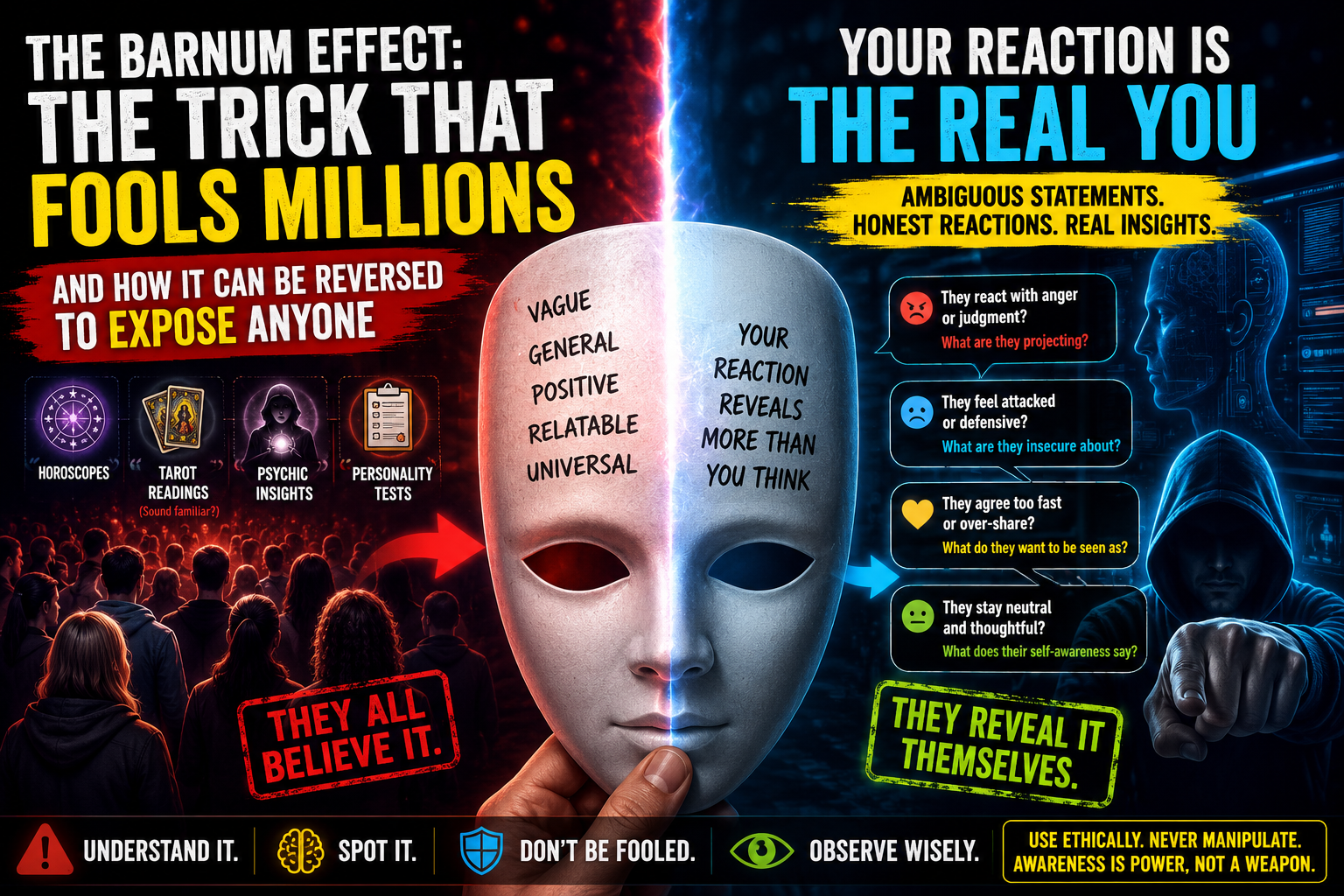
“A skilled manipulator doesn't need to know anything real about you. They just need to make you fill in the blanks yourself.”
Imagine reading a personality description that feels eerily accurate. It seems to know your secret fears, your hidden ambitions, the contradictions in your personality that no one else understands. You feel seen. You feel special.
Now imagine that same description was handed to a thousand other people—and every single one of them felt the exact same way.
This is the Barnum Effect, and once you understand how it works, you'll never look at horoscopes, personality tests, tarot readings, or “psychic” insights the same way again. Worse yet—once you understand how it can be reversed, you'll realize how easily people expose their deepest selves without ever knowing it.
Part 1: What Is the Barnum Effect, Really?
The Barnum Effect (also called the Forer Effect) is a psychological phenomenon in which people accept vague, general statements as highly accurate descriptions of their own unique personality—even when those statements could apply to almost anyone.
The Forer Experiment (1948)
Psychologist Bertram Forer gave his students a personality test, then handed each a “personalized” analysis. He asked them to rate its accuracy from 0 to 5. The average? 4.26 out of 5. The twist: every student received the exact same description—assembled from a newsstand astrology book.
Here is a portion of what they read:
“You have a great need for other people to like and admire you. You have a tendency to be critical of yourself. You have a great deal of unused capacity which you have not turned to your advantage. While you have some personality weaknesses, you are generally able to compensate for them. At times you have serious doubts as to whether you have made the right decision or done the right thing...”
Read those lines. Don't they feel... personal? Don't they feel like you? That's exactly the point. The Forer study has been replicated hundreds of times across decades and cultures, and the result barely moves—average accuracy ratings consistently land between 4.2 and 4.3 out of 5. This is not a quirk of 1940s students. It is a permanent feature of the human mind.
Part 2: Why the Barnum Effect Is Terrifying
The truly unsettling part isn't that people believe vague statements. It's why they believe them—and what that reveals about the human mind's fundamental vulnerabilities.
Your Brain Is a “Confirmation Machine”
The mind actively searches for evidence that confirms what it wants to believe (confirmation bias). When you read “You sometimes feel insecure,” your brain instantly supplies a memory that fits—while forgetting every time you felt confident. You aren't evaluating the statement. You are recruiting your own memories to validate it.
Subjective Validation: The Core Engine
Psychologists have a precise name for the mechanism underneath the Barnum Effect: Subjective Validation. It is the tendency to judge a statement as true for no reason other than that it holds personal meaning to us. Logic never enters the room. The moment a vague line connects to a private memory, your mind stamps it “accurate”—and stops questioning it entirely.
Barnum statements also work because they are engineered to be unfalsifiable, using specific linguistic tricks:
- Double-headed statements: “You are outgoing but also enjoy time alone.” (Impossible to be wrong.)
- Universal validation: “You have great potential you haven't fully used.” (True for literally everyone.)
- Flattery with a caveat: “You have weaknesses, but you overcome them.” (Everyone believes this about themselves.)
- Vague specificity: “A past event still occasionally troubles you.” (Whose past is perfectly clean?)
Worst of all, the effect exploits emotional need, not logic. It is strongest when a person is anxious, lonely, uncertain, or seeking direction—which is why it thrives during breakups, career crises, and existential doubt. The more vulnerable you are, the more easily you can be convinced that a stranger “understands” you.
The Amplifiers: What Makes It Even Stronger
Decades of research have identified specific conditions that supercharge the Barnum Effect. Understanding these is understanding exactly which levers manipulators pull:
If it appears to come from a “psychologist,” “AI,” or “ancient wisdom,” belief skyrockets. Credibility bypasses scrutiny.
The more it feels “made just for me” (via a quiz, birth date, or name), the more accurate it feels—even when it isn't.
Flattering statements are accepted far more readily than critical ones. We want the nice ones to be true.
The blurrier the statement, the more “accurate” it feels—because there is more empty space for you to fill in yourself.
The Engine Behind Manipulation Industries
This single cognitive glitch powers billion-dollar industries: astrology and horoscopes, tarot and “psychic” readings, fortune tellers using cold reading, cult recruitment (“We understood you when no one else did”), fake personality quizzes, predatory “life coaches,” and scam artists who make victims feel personally chosen.
Part 3: Why Your Brain Was BUILT to Fall for This
Here is the question almost no one asks: Why are humans this gullible? The uncomfortable answer is that we aren't gullible at all. The Barnum Effect isn't a bug in human cognition—it is a side effect of a survival feature.
Apophenia: The Pattern-Seeking Machine
The human brain is a relentless pattern-seeking machine. We see faces in clouds, hear our name in static, and find meaning in randomness. This tendency is called apophenia.
Evolution favored it: an ancestor who mistook wind in the grass for a lion lost nothing but a moment of fear. One who ignored the real lion lost everything. So our brains were tuned to over-detect patterns—because a false alarm is cheap, but a missed threat is fatal. The Barnum Effect hijacks this ancient wiring: a vague statement is the “wind in the grass,” and our mind insists on seeing a lion of personal meaning.
Layered on top of apophenia is a second primal drive: the need to be understood. Humans are social animals whose survival depended on belonging to a group. Being “seen” and “known” wasn't a luxury—it was safety. So when a horoscope or a “psychic” seems to understand our inner world, it scratches one of the deepest itches in human psychology. We want it to be true.
This is why understanding the Barnum Effect isn't about feeling superior to those who fall for it. Everyone falls for it, because everyone has a human brain. The only difference is whether you know the machinery is running.
Part 4: Cold Reading — The Barnum Effect in the Hands of Professionals
If the Barnum Effect is the ammunition, cold reading is the loaded weapon. Cold reading is the practiced art of appearing to know intimate details about a stranger—without knowing anything at all. Psychics, mediums, fortune tellers, and con artists have refined it for centuries. Here are the core techniques.
Shotgunning
Fire off many statements rapidly, then pounce on whatever “hits.” “I'm sensing an older man... a father? A grandfather? There's a J or a G name...” With enough shots, something will land—and the audience remembers only the hit, forgetting the dozen misses. This is confirmation bias weaponized in real time.
The Rainbow Ruse
State a trait AND its exact opposite in one breath, guaranteeing a hit. “You can be very confident and sociable, but there are times you feel insecure and hold back.” Whichever half resonates, the reader appears astonishingly accurate. The full “rainbow” of possibility is covered, so being wrong is impossible.
Zero prior information. The reader relies entirely on Barnum statements, live feedback, and micro-observations—clothing, age, jewelry (a wedding ring, mourning black), accent, and body language. The subject's own reactions guide the “reading.”
The darker cousin: the reader secretly researched the victim beforehand—often via social media, obituaries, or an accomplice—then presents known facts as “psychic” revelation. In the age of Instagram, hot reading has never been easier.
The genius of cold reading is that the victim does all the work. The reader throws out a vague net; the subject unconsciously supplies names, faces, and memories to fill it—then credits the reader with knowing them. This is precisely why a grieving person at a “medium” show can walk away utterly convinced they spoke to the dead.
Part 5: The Modern Trap — Horoscopes, MBTI, and TikTok “AI” Tests
You might think you're too smart for a fortune teller. But the Barnum Effect has simply migrated to platforms you trust more.
The Horoscope Case Study
Consider a typical horoscope:
“Today, you may feel torn between your responsibilities and your desires. An unexpected conversation could shift your perspective. Trust your instincts, but be careful not to rush important decisions. Someone close may need your understanding.”
Now ask yourself: On which day of your life would this NOT be true?
- “Torn between responsibility and desire”? → Every adult, every day.
- “Unexpected conversation”? → You talk to people daily.
- “Don't rush decisions”? → Always good advice.
- “Someone close needs understanding”? → Always true.
The horoscope isn't predicting your day. Your day is being retrofitted to match the horoscope. You experience twelve neutral events, and your brain highlights the one that “fits” while ignoring the eleven that don't. This is why every zodiac sign's reading feels accurate—even when the readings are secretly swapped.
MBTI, Enneagram, and Viral Quizzes
Here is where it stings for the educated reader. Beloved tools like the MBTI (“You're an INFJ!”), the Enneagram, BuzzFeed quizzes, and TikTok “AI reads your face” filters lean heavily—though not entirely—on the Barnum Effect. Their descriptions are warm, flattering, and just vague enough that everyone nods along. Psychologists have long criticized the MBTI partly for this reason: its type profiles feel personal precisely because they're broad enough to fit almost anyone.
Why They're So Addictive
They combine every amplifier at once: the authority of “science” or “AI,” the illusion of personalization (“based on YOUR answers”), a heavy dose of flattering positivity, and just enough vagueness. That's a perfect Barnum storm—which is why sharing your type feels like sharing your soul.
Part 6: What Real Insight Looks Like (The Falsifiability Test)
To defend yourself, you need to know the difference between an empty mirror and a real one. The dividing line is one word: falsifiability. Real insight can be wrong. A Barnum statement is engineered to always be “right.”
“You sometimes feel misunderstood, and you have untapped potential.”
- Applies to everyone
- Cannot be disproven
- You supply the meaning
“On this measure you scored high in neuroticism and low in extraversion.”
- Specific and measurable
- Could be wrong — and you'd know
- You can argue with it
The quick self-test: reverse the statement. If “You value honesty” sounds meaningful, ask—would anyone say “I don't value honesty”? If the opposite is absurd, the statement is empty.
Part 7: The Reversal — Turning Barnum Into a Detection Tool
Here's where the phenomenon becomes fascinating from an observational standpoint. The Barnum Effect is usually a tool of deception. But it can be flipped into a mirror of projection—a way to observe what someone reveals about themselves.
Ethical Note
The following describes observational psychology. It should be used for self-awareness and understanding human behavior—not for manipulating, exploiting, or deceiving others. Weaponizing these principles against people is a violation of trust and can cause real harm.
When you present someone with a vague, dual-natured statement, don't measure whether the statement is “true.” Measure which part they latch onto. Because Barnum statements are universal, any selective reaction is pure projection.
If they focus on the flattering parts (luck, hidden talents, strengths), it may indicate someone seeking external validation or in an optimistic phase that needs recognition. If they immediately fixate on, deny, or feel anxious about the negative parts, it may indicate higher neuroticism, defensiveness, or unresolved emotional tension. The insight is profound: what someone chooses to see in an ambiguous mirror tells you what they are already carrying inside.
Part 8: The Barnum Effect as a Weapon — How People Are “Exposed” Without Realizing It
The deeper danger is this: the Barnum Effect can be engineered to make people expose their own personality, moral standards, and hidden mindset—without ever realizing they've revealed anything at all. A person can walk away from a casual conversation, a shared horoscope, or a single social media post believing they've said nothing—while having disclosed their deepest psychological patterns to a careful observer.
Critical Ethical Warning
This is observational psychology. Understanding it protects you from being manipulated and deepens your understanding of human behavior. Using it to exploit, deceive, or emotionally control people is manipulation—and it destroys trust, relationships, and eventually yourself. Read this as a defense manual first, and a curiosity second.
Method 1: The Horoscope Mirror
A horoscope is a menu of vague, dual-natured statements. When your friend reads it aloud to you, they must make micro-choices: which lines they emphasize, which they skip, what tone they use. Because the content is universal, every choice they make is projection. They aren't describing your future—they're revealing their feelings toward you and their own inner state.
Scenario A — They emphasize the positive: “Ooh, this is a great one for you! Today is lucky, new opportunities are coming, and someone appreciates you more than you know.” → They selected the hopeful lines. This suggests goodwill toward you, or a natural tendency to see the best in people.
Scenario B — They emphasize the negative: “Hah, yours says be careful, you might make a bad decision and someone close could betray you.” → Out of neutral statements, they chose to spotlight threat. This can indicate hidden resentment, competitiveness, or projection of their own negativity.
The Trap to Avoid
A single reading is not proof. Your friend might be joking, in a bad mood, or teasing you affectionately. This is why consistency of pattern matters. One horoscope reading is a hypothesis—not a verdict.
Method 2: Priming — Guiding the Mind Before You Ask
Priming is planting a concept, emotion, or memory in someone's mind so it shapes their next response—without them realizing they've been influenced. The human brain works by association. If you “warm up” an emotional theme first, it colors how someone interprets whatever comes next.
Step 1 — Plant the theme: “I read this story about someone who ghosted their best friend during a hard time, and years later they still regretted it. Crazy how guilt lingers, right?”
Step 2 — Ask a neutral question: “Anyway—how are things with you and your friends lately?”
If they immediately connect it to their own guilt, they are highly suggestible and the guilt was already near the surface. If they stay neutral and objective, they have strong cognitive control.
The Danger
This same technique is used by scammers, manipulative partners, and cult recruiters to implant feelings that weren't there—and then “discover” them as proof.
Method 3: The Dual-Track Reaction Test
A vague, morally-themed post is a Barnum statement in disguise. It's not aimed at anyone specifically—but everyone reading it decides whether it applies to them. That decision splits humanity into two tracks.
Because your post is generic, nobody was actually accused. So whoever reacts defensively is revealing that their own conscience recognized itself in the mirror—and their ego attacked the mirror instead of looking inside.
Example post: “Sometimes the person who hurt you will never apologize—not because they're evil, but because admitting it would mean facing who they became. Growth starts the moment you can say 'I was wrong' without your ego dying.”
Track A — Reflection & Empathy
“Ouf, this one hit me. I need to text someone I owe an apology to.” → Internal Locus of Control. They look inward first. Healthy emotional maturity and self-accountability. The capacity to apologize makes them safer as a friend, partner, or colleague.
Track B — Ego-Defensiveness
“Wow, someone's clearly butthurt lol.” or “Cryptic much? Who's this aimed at?” → Classic ego-defense mechanism (“kill the messenger”). Instead of reflecting, they attacked the source of discomfort. A strong indicator of low empathy and likely defensiveness during real conflict.
The critical insight: nothing in the post accused them of anything. The post was a mirror. Track A looked into it. Track B smashed it. That reaction difference is diagnostic gold.
Part 9: The Crucial Caveats — Why This Isn't Foolproof
Even these powerful methods have failure points you must respect:
- Context blindness: A defensive reaction might come from someone having a terrible day, or mocking the format rather than deflecting guilt.
- Humor as a shield: Not every sarcastic comment equals low empathy. Some deeply empathetic people deflect with jokes because sincerity feels uncomfortable in public.
- Faked reflection: The most dangerous people know the “correct” response and perform reflection to appear trustworthy. Real accountability shows up in behavior over time.
- You might be projecting: If you post something bitter to “test” people, your own emotional state may distort how you read their replies—a Barnum trap of your own making.
Part 10: The Ethical Gray Zone — Understanding vs. Manipulating
A sharp reader will notice something uncomfortable: many good professions use these exact tools. So where is the line?
The Therapist
Uses reflective, open-ended statements to help you discover your own truth. Goal: your growth.
The Teacher
Primes students with hope and confidence before a hard lesson. Goal: their learning.
The Manipulator
Primes and reads you to extract advantage. Goal: their gain, your loss.
The technique is identical. The intention is everything. The one honest question that separates insight from manipulation is this: “Am I doing this for their benefit, or for mine at their expense?” If the person you're “reading” would feel betrayed to learn what you were doing, you've crossed the line.
Part 11: Protecting Yourself From the Barnum Effect
Knowledge is the antidote. Here's how to defend your mind:
- 1Ask: “Could this apply to almost anyone?” If yes, it's a Barnum statement—not insight.
- 2Reverse the statement. If the opposite is absurd (“I don't value honesty”), the statement is empty.
- 3Notice your emotional state. When lost or anxious, you are far more susceptible.
- 4Demand falsifiability. Real insight can be wrong; Barnum statements are engineered to always be “right.”
- 5Watch for the “fill-in-the-blank” trap. If you supply the details, you're reading yourself—not being read.
- 6Count the misses. In a “reading,” note every wrong guess, not just the hits. Shotgunning only works if you forget the misses.
- 7When someone plants an emotional theme before a question, pause: am I answering the question, or the mood they created?
Part 12: The Ultimate Danger — When This Becomes a Cage
Here is the deepest warning—the part most people miss. When you master these techniques, you gain a strange and lonely power: you start seeing everyone as a subject being tested rather than a person being known. Every conversation becomes a probe. Every relationship becomes an experiment. You stop connecting with people and start decoding them.
And there's a cruel irony: the person most exposed by the Barnum Effect might be you. The moment you decide “people who react negatively to my post are bad,” you've fallen into the exact same trap—you've read a vague situation and filled in the blanks with your own assumptions. The observer who forgets they, too, are human becomes the most easily fooled of all.
Conclusion: The Mirror Cuts Both Ways
The most terrifying thing about the Barnum Effect is not that con artists and horoscope writers use it against us. It's that we do it to ourselves. No one forces us to feel “seen” by a generic paragraph. Our own hunger for meaning, our ancient pattern-seeking wiring, and our brain's relentless confirmation bias do all the work. The manipulator simply provides an empty vessel—and we pour our entire inner world into it.
“Use it to understand people—never to trap them. Use it to protect yourself—never to prey on others. And above all, remember that the same mirror you hold up to expose others is always reflecting you, too.”
That humility is the difference between insight and manipulation. Between wisdom and cruelty. Between knowing people—and losing the ability to love them. The stories we most eagerly believe about ourselves reveal more about our needs than about reality. And that self-awareness—not any horoscope—is where genuine self-knowledge begins.
Disclaimer
This article exists for one purpose: to EXPOSE how dangerous priming and the Barnum Effect truly are. Everything described here—the horoscope mirror, the cold-reading techniques, the priming, the dual-track reaction tests—is documented not to teach manipulation, but to inoculate you against it.
The Barnum Effect and priming are used against ordinary people every single day—by scammers, cult recruiters, manipulative partners, predatory “coaches,” fortune-tellers, and psychological abusers. They work precisely because their victims never realize they're being read, primed, or steered. The only real defense is awareness.
Please use this knowledge to protect yourself and others, to build genuine self-awareness, and to recognize manipulation when it happens to you—never to exploit, trap, or harm another human being. Knowledge of a weapon is meant to make you safe from it—not to make you wield it against the vulnerable.