Cognitive Science • Inclusion • Human Resource Management
Humans are not unique because everyone thinks in the same way. We are unique because we bring different combinations of attention, experience, reasoning, imagination, knowledge, and judgement to the same problem.
Some people quickly generate alternatives. Others detect inconsistencies, connect events across a system, recognise familiar patterns, or ask whether the evidence supports the conclusion. A team needs more than one of these contributions—especially when the problem is complex, unfamiliar, or socially consequential.
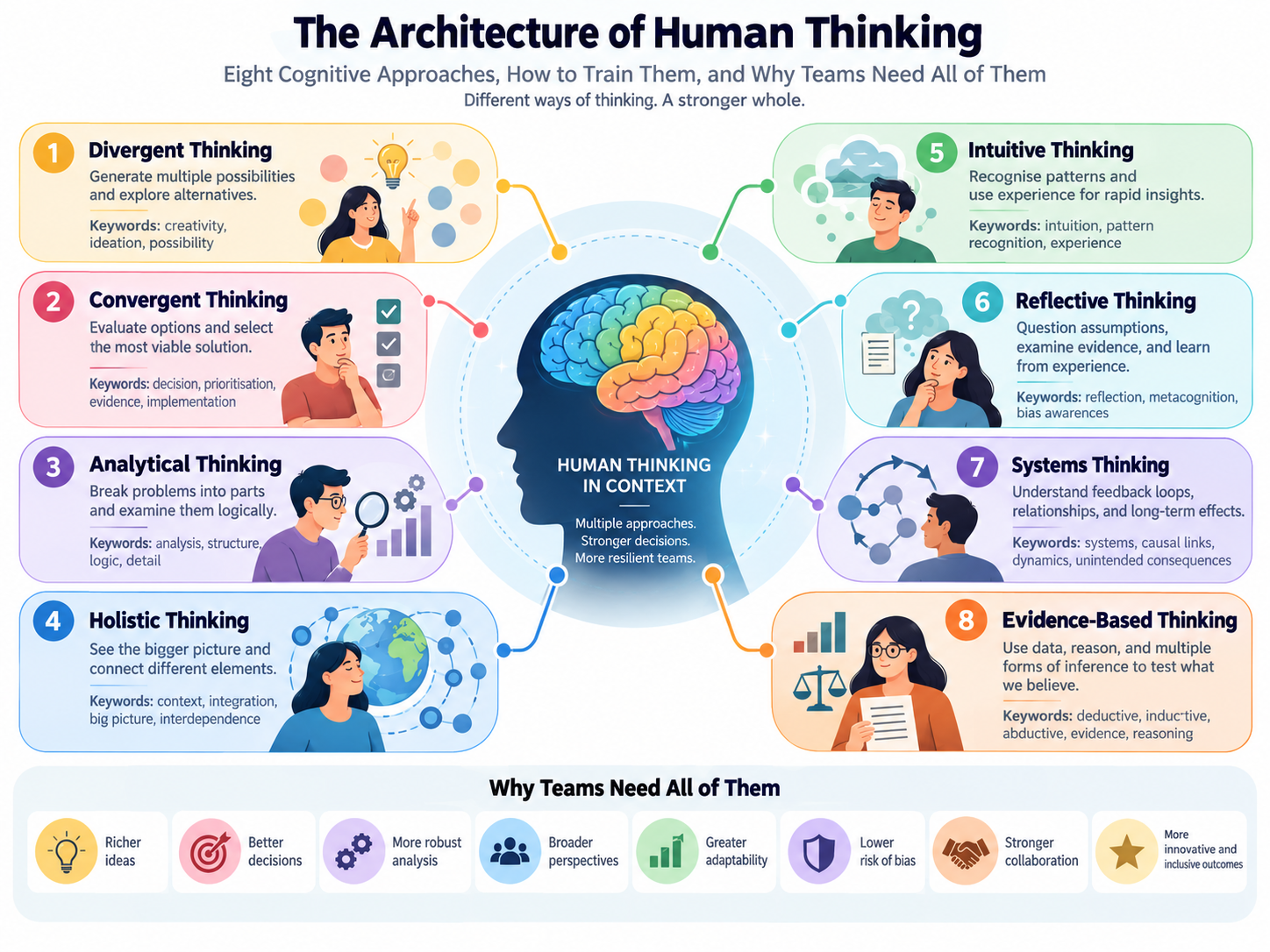
Divergent and convergent thinking are useful starting points, but they are not a complete map of human cognition. The eight approaches below are a practical learning framework, not eight fixed personality types or a validated diagnostic test. They overlap, can coexist in the same person, and can be strengthened through practice.
The aim is not to label people. It is to understand which thinking moves a task requires, practise the moves we underuse, and design teams in which different contributions can work together.
What this framework is—and what it is not
The eight approaches are best understood as lenses or moves in a thinking process, not as a complete taxonomy of the mind. They are grouped here because they help people ask different kinds of questions when solving problems. They do not all operate at the same conceptual level: divergent and convergent thinking describe ways of working with alternatives; deduction, induction, and abduction describe forms of inference; analytic and holistic thinking describe different emphases in representing a problem; and detail-focused and context-sensitive thinking describe attentional emphases.
This matters because a useful framework should help people reason more carefully, not imply more scientific certainty than it has. There is no claim that these eight lenses are exhaustive, independent, mutually exclusive, or suitable for diagnosing an individual's cognitive profile. Other capabilities—such as working memory, inhibition, domain knowledge, language, emotion regulation, and cognitive flexibility—also influence performance.
Use the framework diagnostically for the task, not diagnostically for the person. Ask “Which thinking move is missing from our process?” rather than “What type of thinker is this person?”
Explore the eight approaches
Select a node in the diagram to jump to its explanation and exercise. The map illustrates complementary approaches, not a ranking or a psychological test.
The diagram links to the numbered explanations below. It is a navigational learning aid, not a ranking, test, or permanent classification.
1. Divergent and convergent thinking: create options, then make a choice
Divergent thinking expands possible ideas and solutions. Convergent thinking evaluates alternatives against evidence and criteria to arrive at a defensible choice. They are complementary phases, not rival identities.
Practise: take a problem such as low participation in training. Spend five minutes listing plausible causes and interventions without judging them. Then shortlist options using cost, feasibility, inclusion, and expected effect. Record why you rejected alternatives.
Watch out for: endless ideation without decisions, or premature closure that dismisses alternatives before the problem is understood.
2. Analytic and holistic thinking: inspect parts and context
Analytic thinking separates a problem into parts, variables, or claims. Holistic thinking attends to relationships, circumstances, and the wider situation. Strong analysis may need both.
Practise: break an implementation failure into people, process, technology, budget, and incentives. Then map links between them and ask which relationships might explain the outcome. Check whether the apparent cause remains plausible in the wider context.
Watch out for: getting lost in details, or using complexity as a substitute for testing an explanation.
3. Intuitive and reflective thinking: notice the first answer, then test it
Intuition can produce rapid judgements from experience and recognised patterns. Reflective thinking slows down to examine evidence, assumptions, and alternative explanations. Familiar situations may reward speed; unfamiliar or high-stakes decisions deserve more checking.
Practise: record your first prediction before reviewing evidence. Later compare it with the outcome. For important decisions ask: “What evidence would change my mind?” and “What is the strongest alternative explanation?”
Watch out for: treating a gut feeling as proof, or assuming a long analysis must be correct.
4. Linear and systems thinking: follow the sequence and map feedback
Linear thinking is useful for ordered steps and straightforward causal chains. Systems thinking examines interactions, feedback, delays, incentives, and side effects. Many situations require both a process map and a system map.
Practise: map a late-reporting process. Then ask what reinforces the delay: workload, interface design, connectivity, incentives, duplicate data entry, or slow feedback. Test one leverage point and check for side effects.
Watch out for: assuming every relationship is causal, or making a model too complex to guide a decision.
5. Deductive, inductive, and abductive reasoning: apply rules, learn patterns, propose explanations
Deduction applies a rule or premise to a case. Induction infers patterns from observations. Abduction proposes a plausible explanation for an observation. Abduction creates hypotheses, not proof.
Practise: apply a rule to one case (deduction); compare several cases for a recurring pattern (induction); generate several possible reasons for an unexpected result (abduction). Find evidence that could distinguish the explanations.
Watch out for: overgeneralising from few examples, confusing correlation with cause, or treating the first plausible story as truth.
6. Abstract and concrete thinking: move between principles and practice
Abstract thinking forms concepts, models, and general principles. Concrete thinking attends to specific cases, observable details, and actions. A strategy that cannot be translated into practice remains incomplete; an action without a guiding model may solve only the immediate case.
Practise: summarise an incident as a general principle, find an example that supports it and one that may challenge it, then translate the principle into an observable action.
Watch out for: abstract jargon without a workable plan, or overfitting to one example.
7. Analogical and causal reasoning: borrow insights carefully and test mechanisms
Analogical reasoning uses similarities between cases to suggest solutions. Causal reasoning asks what mechanism connects a factor to an outcome and what else might explain it. Analogy generates hypotheses; causal testing checks whether the comparison holds.
Practise: find a similar case, state precisely what is similar and different, then identify competing causes and evidence or a small experiment that could distinguish them.
Watch out for: assuming two situations share the same cause because their surface features look alike.
8. Detail-focused and context-sensitive thinking: detect signals and interpret meaning
Some tasks reward close attention to discrepancies and exceptions. Others require context—social dynamics, timing, incentives, or changes in the environment—to understand what a detail means. This is a practical distinction, not a claim that people belong to two fixed perceptual types.
Practise: review a case twice. First list only observable details. Then list context and several interpretations. Separate observations from inference and note what extra evidence is needed.
Watch out for: missing a critical detail because the overall story feels convincing, or overinterpreting one detail outside its context.
These approaches overlap—and that is the point
The eight approaches are not mutually exclusive boxes. A person can be analytical and holistic, intuitive and reflective, creative and rigorous. Ask what thinking the situation requires and whether the team is using enough complementary approaches.
From accessing information to applying judgement
Accessing information, understanding it, remembering it, reasoning with it, making a judgement, and applying it to a new situation are related but distinct activities. A person may find a source without evaluating it, understand a sentence without knowing whether its claim is well supported, remember a fact without recognising when it applies, or make a confident decision without testing an alternative explanation.
| Activity | Core question | Evidence of progress |
|---|---|---|
| Access | Can I locate relevant information and establish where it came from? | Relevant sources are traceable; dates, authorship, and context are checked. |
| Comprehend | Can I explain the claim accurately in my own words? | The explanation preserves the original meaning and important qualifications. |
| Remember | Can I retrieve the key idea when I need it? | I can recall the idea without simply rereading the source. |
| Reason | How do the evidence, assumptions, logic, and alternative explanations fit together? | My conclusion follows from the evidence and makes its assumptions visible. |
| Judge | How strong is the conclusion, what remains uncertain, and what would change my mind? | Confidence is proportionate to evidence; relevant trade-offs are explicit. |
| Apply and transfer | Can I use the knowledge responsibly in a different situation? | I adapt the principle to context rather than copying a solution mechanically. |
Reading is valuable because it can supply concepts, evidence, vocabulary, and examples. Memorisation is valuable because accessible knowledge supports reasoning. Neither activity automatically guarantees sound judgement. The bridge is deliberate practice: explaining, comparing, connecting, testing, applying, and reviewing the consequences of a conclusion.
Applied Thinking Lab: why are field reports arriving late?
Consider a hypothetical organisation where field reports are frequently late. The observed problem is a delay; “staff are careless” is only one possible interpretation, and not a conclusion established by the observation. The purpose of the lab is to demonstrate how complementary approaches can improve the inquiry before the organisation commits to a solution.
Known: reports arrive after the expected deadline in several reporting cycles.
Not yet known: whether the main constraint is connectivity, workload, confusing forms, training, incentives, duplicate entry, supervisory feedback, or a combination.
Decision to make: identify a feasible intervention to test, while avoiding blame before the causes are understood.
Step 1 — Define the problem before explaining it
Agree on what counts as “late,” which reports and periods are included, the baseline rate, and how the data are collected. Separate direct observations (submission timestamps, missing fields, connectivity logs) from interpretations (“the team lacks motivation”). Check whether the measure itself is reliable and whether some sites are missing from the data.
Step 2 — Generate competing hypotheses
| Hypothesis | What might be observed if it is true? | Useful check |
|---|---|---|
| Connectivity or device constraints | Delays cluster in low-connectivity locations or around upload failures. | Compare timestamps, location conditions, offline records, and successful sync times. |
| Duplicated or confusing reporting steps | Repeated data entry, validation errors, and abandonment cluster around particular fields. | Observe the workflow and ask users to complete a typical report while narrating the steps. |
| Workload or poorly timed deadlines | Delays peak during high-volume periods or competing field activities. | Compare workload and deadline patterns across teams and weeks. |
| Insufficient feedback or unclear value | Staff submit late when previous submissions receive no acknowledgement or use. | Examine feedback timelines and ask submitters what happens after submission. |
| Skills or guidance gap | Errors and delays are concentrated around tasks that are poorly understood. | Use a practical work sample and observe whether clear guidance changes performance. |
These are hypotheses, not findings about a real organisation. More than one may be true, and another explanation may be missing. The table illustrates a disciplined way to connect each explanation to evidence that could distinguish it from the others.
Step 3 — Apply different lenses to the same case
Step 4 — Make the system visible, but do not mistake a diagram for proof
A simple causal map might propose that confusing forms increase correction work, correction work consumes time, and time pressure then increases rushed entries and further corrections. This would be a hypothesised reinforcing loop, not yet an established causal relationship. Interviews, process observation, time-stamped records, or a small controlled change can help test whether the proposed links are real in this context.
Step 5 — Choose a test, not an irreversible grand solution
Prioritise interventions using transparent criteria such as expected benefit, feasibility, cost, equity, reversibility, risk, and the strength of evidence. For example, one team might pilot an offline-saving feature or remove a duplicate field, depending on what the evidence indicates. Define the baseline, expected outcome, time window, and possible unintended effects before the pilot begins.
Step 6 — Review results and update the explanation
Compare actual results with the prediction. If submission timeliness improves but data quality deteriorates, the change is not an unqualified success. If the pilot has little effect, reconsider the hypothesis rather than automatically blaming implementation. Record what was learned and whether the result may generalise to other teams.
A repeatable protocol for difficult questions
The following sequence is a practical workflow for using the eight lenses. It is not a rigid algorithm: high-stakes decisions may require returning to earlier steps, consulting specialists, or pausing until better evidence is available.
Metacognition: monitor the quality of your own thinking
Metacognition is the ability to monitor and regulate aspects of one's own cognition. In practical terms, it includes noticing confusion, estimating how confident a conclusion should be, recognising when attention has narrowed, choosing a different strategy, and checking whether the result matches reality. Confidence is useful information, but it is not the same as accuracy. A person can be confident and mistaken or uncertain and correct.
One practical method is a decision journal. Before making a consequential prediction or decision, record the question, current evidence, assumptions, plausible alternatives, confidence, and the outcome you expect. Later, compare the result with the prediction. This helps distinguish a good process from a lucky outcome and makes recurring blind spots easier to notice.
- State the claim precisely. Avoid vague predictions such as “the project will go well.” Specify an observable outcome and a time frame.
- Record confidence. Use words or a probability estimate, but explain what supports it. Do not invent precision when the evidence does not justify it.
- Write a rival explanation. Ask what else could produce the same observation.
- Name the evidence that would change your mind. If no imaginable evidence could change your view, consider whether the claim has become unfalsifiable or identity-protective.
- Review the result honestly. Identify whether the miss came from weak evidence, faulty assumptions, poor execution, luck, or an outcome that could not reasonably have been predicted.
After completing an important task, answer: What did I assume? What did I overlook? Which part of my reasoning was strongest? What evidence changed my view? What would I do differently next time?
Common failure modes—and a practical countermeasure for each
| Failure mode | What it can look like | Countermeasure |
|---|---|---|
| Premature closure | Selecting the first plausible answer before alternatives have been considered. | Generate at least two credible alternatives and compare what evidence each predicts. |
| Confirmation bias | Searching mainly for information that supports an existing belief. | Ask someone to make the strongest case against the conclusion; search for disconfirming evidence. |
| Availability and vividness | Treating a memorable example as if it represents the typical case. | Check base rates, denominators, and whether the example is representative. |
| Correlation–causation error | Assuming two things are causally linked because they appear together. | Consider reverse causality, confounding factors, timing, mechanism, and alternative designs. |
| Overfitting one case | Turning an unusual experience into a universal rule about people or systems. | Compare several cases, look for exceptions, and state the boundary conditions of the claim. |
| Analysis paralysis | Collecting more information after the next useful decision would already be clear. | Set a decision threshold, a deadline, and criteria for what additional evidence would be worth its cost. |
| False certainty from a model | Confusing an elegant diagram or numerical output with reality itself. | Label assumptions, check sensitivity, validate against observations, and update the model. |
| Outcome bias | Judging a decision only by whether it worked out, rather than by what was knowable at the time. | Review both process and outcome, separating controllable choices from chance. |
These are common reasoning risks, not diagnoses or proof that an individual is irrational. Anyone can fall into them, particularly under uncertainty, pressure, fatigue, or strong incentives.
How to train thinking instead of merely collecting information
Reading supplies concepts and evidence. Memorisation makes knowledge available when needed. Both matter—but neither guarantees that we can judge evidence, connect ideas, or apply knowledge in a new situation.
- Retrieve before rereading. Close the source and explain the main idea from memory, then check what you missed.
- Ask better questions. What is the claim? What evidence supports it? What assumptions does it need? What other explanation fits?
- Use contrasting cases. Compare similar cases with different outcomes, or different cases that may share a mechanism.
- Make a model. Draw a causal map, decision tree, or concept map to make relationships visible.
- Apply the idea. Use it to solve a problem, forecast an outcome, or design a small experiment.
- Seek disconfirming evidence. Invite a colleague to challenge your argument and revise it when warranted.
- Review outcomes. Compare forecasts with reality. Keep a decision log of assumptions, confidence, evidence, and lessons.
How organisations can coordinate cognitive diversity
This connects directly to Human Resource Management, team design, organisational learning, and inclusive leadership. A team does not benefit from difference merely because different people are present. The environment must let them contribute, challenge ideas, coordinate decisions, and learn from outcomes.
Using the framework in Human Resource Management and learning design
For HRM, the framework is useful as a planning aid rather than a personality instrument. Start with the job, decision, or capability gap and define the behaviours that good performance requires. Then design learning activities that give people opportunities to practise those behaviours with feedback.
| HRM or organisational task | Thinking moves to practise | Possible evidence of application |
|---|---|---|
| Learning Needs Analysis | Separate symptoms from causes; compare evidence from performance data, work samples, observation, and staff feedback. | A needs statement tied to observed capability gaps rather than assumptions about motivation. |
| Training design | Move from abstract concepts to concrete examples, retrieval, practice, feedback, and transfer. | Learners can perform a realistic task after training, not merely report that the session was enjoyable. |
| Performance improvement | Map workflow, test alternative explanations, and identify constraints outside the individual's control. | Improvements are linked to measurable outcomes and monitored for unintended effects. |
| Team composition | Identify the work required—generation, quality assurance, synthesis, implementation, and review—and ensure the process covers it. | Roles and review steps are explicit; contribution is assessed from work and behaviour. |
| Leadership development | Invite dissent, explain decision criteria, admit uncertainty, and revise conclusions when credible evidence changes. | Team members raise risks earlier, decisions have traceable reasoning, and lessons influence later work. |
| Knowledge management | Capture not only final answers but also evidence, assumptions, failed hypotheses, and conditions where a solution works. | Colleagues can reuse the lesson without blindly copying a context-specific intervention. |
Evaluation should match the desired outcome. A knowledge quiz may measure recall, but it does not by itself establish good judgement in a live situation. A scenario exercise may examine reasoning but still not prove transfer to the workplace. Where feasible, combine knowledge checks, realistic work samples, observations, follow-up measures, and contextual feedback.
A lightweight rubric for reviewing an argument
| Dimension | Emerging | Developing | Strong |
|---|---|---|---|
| Problem framing | The question is vague or shifts during the discussion. | The scope is mostly clear, but key terms or constraints remain unresolved. | The question, scope, definitions, and decision owner are explicit. |
| Evidence | Claims rely mainly on assertion or isolated examples. | Relevant evidence is cited, but limitations or gaps are not consistently addressed. | Evidence is traceable, relevant, appropriately qualified, and compared with alternatives. |
| Reasoning | Conclusions do not clearly follow from premises or observations. | Most links are explained, but assumptions or rival explanations may be missed. | Assumptions are visible; competing explanations and causal limits are considered. |
| Uncertainty | Confidence is presented as certainty, or uncertainty is used to avoid deciding. | Some uncertainty is acknowledged but not linked to actions or thresholds. | Confidence is proportionate; unknowns, decision thresholds, and update conditions are explicit. |
| Learning | Outcomes are not reviewed or lessons are recorded only informally. | Some follow-up occurs, but the original prediction or baseline is unclear. | Results are compared with the forecast; lessons inform the next cycle. |
Use the rubric for coaching and development, not as a validated psychometric scale or a stand-alone basis for hiring, promotion, or disciplinary decisions. Adapt it to the task and involve relevant stakeholders.
What Google's Project Aristotle adds
Google's team-effectiveness work, widely known through Project Aristotle, examined how teams work together. Google re:Work highlights five dynamics associated with effective teams: psychological safety, dependability, structure and clarity, meaning, and impact. Psychological safety concerns whether team members feel safe taking interpersonal risks, such as asking questions, admitting mistakes, or expressing a different view.
This connects to cognitive diversity, but should not be overstated. Google's framework does not prove a team needs exactly eight cognitive styles, nor that diversity alone guarantees success. It points to conditions that help people contribute: they can speak up, depend on each other, understand expectations, and see why their work matters.
A team member who notices a hidden risk is useful only if they can raise it. A creative suggestion helps only if the team can evaluate it. A sound decision becomes an outcome only when responsibilities and follow-through are clear.
Explore Google's guide to team effectiveness ↗
From controlling people to designing conditions for contribution
Coordination is not the same as domination. Organisations need standards, legal and ethical boundaries, clear responsibilities, and decisions. But not every detail of how someone thinks or works needs to be dictated from above.
Good management clarifies the objective, non-negotiable constraints, resources, decision rights, and measures of success—then gives people appropriate room to use their judgement. When decisions affect how people work, involve them meaningfully where possible. Participation does not remove all role obligations; it makes autonomy and boundaries more transparent.
Inclusion is not making everyone think alike. It is building a system in which different ways of thinking can challenge assumptions, complement one another, and contribute to a shared outcome.
A 60-minute workshop for individuals or teams
The article can be turned into a practical session without requiring participants to memorise terminology. Choose a real but manageable problem, and keep the purpose on improving the inquiry rather than proving who is the smartest person in the room.
| Time | Activity | Output |
|---|---|---|
| 0–5 minutes | Frame the problem and agree on what is known, unknown, and within scope. | A shared problem statement. |
| 5–15 minutes | Generate possible explanations or solutions independently before discussing as a group. | A broad list of options, including minority views. |
| 15–25 minutes | Group options into themes, identify assumptions, and separate observations from interpretations. | A map of explanations and assumptions. |
| 25–38 minutes | Choose the strongest competing hypotheses and state what evidence each predicts. | A testable evidence plan. |
| 38–48 minutes | Compare options using agreed criteria, risks, feasibility, equity, and reversibility. | A reasoned provisional decision. |
| 48–55 minutes | Identify a small next test, its owner, the timeline, the measure, and the review date. | An action-and-learning plan. |
| 55–60 minutes | Reflect on which thinking moves were used or absent, and whose contribution was missed. | One process improvement for the next discussion. |
Facilitator reminder: do not assign participants permanent labels such as “the intuitive one” or “the systems thinker.” Rotate responsibilities, make space for independent thinking before group convergence, and ask quiet participants for input without forcing disclosure. A productive discussion is not one with no disagreement; it is one where disagreement can be examined constructively and the decision process remains transparent.
Learning to think is more than reading
Reading can introduce unfamiliar ideas, provide access to research, and challenge assumptions. Memorisation makes important facts and concepts available. Both matter. But neither guarantees that we can evaluate evidence, distinguish correlation from causation, notice blind spots, or apply knowledge to a new situation.
Learning to think means practising: asking, comparing, connecting, testing, explaining, creating, deciding, and revising. The measure is not how many pages we have read or terms we can repeat. It is whether we can use knowledge responsibly and adapt when the situation changes.
Human uniqueness is not a problem for management to eliminate. It is a reality that thoughtful organisations can learn to coordinate.
That is the opportunity: not to rank human beings by a preferred style, but to expand what individuals and teams can notice, understand, and accomplish together.
Further reading and research foundations
The sources below support specific parts of the discussion. They do not validate this exact eight-approach framework as a complete or standardised model. The framework is a practical synthesis created for reflection and application; individual constructs should be interpreted according to the methods and limits of the cited work.
- Google re:Work — Understand team effectiveness: an organisational guide describing psychological safety, dependability, structure and clarity, meaning, and impact. Treat it as an applied framework, not evidence that every team needs these eight cognitive lenses.
- Runco, M. A., & Acar, S. (2012). Divergent Thinking as an Indicator of Creative Potential. Creativity Research Journal. Reviews the role and limits of divergent-thinking measures; divergent thinking can indicate aspects of creative potential but does not guarantee creative achievement.
- Diamond, A. (2013). Executive Functions. Annual Review of Psychology. Reviews executive functions including inhibitory control, working memory, and cognitive flexibility, which support goal-directed thinking and behaviour.
- Yeung, N., & Summerfield, C. (2012). Metacognition in human decision-making: confidence and error monitoring. Philosophical Transactions of the Royal Society B. Reviews confidence judgements and error monitoring as aspects of metacognition.
- Carpenter, S. K., Pan, S. C., & Butler, A. C. (2022). The science of effective learning with spacing and retrieval practice. Nature Reviews Psychology. Reviews evidence for spaced learning and retrieval practice.
- Agarwal, P. K., Nunes, L. D., & Blunt, J. R. (2021). Retrieval Practice Consistently Benefits Student Learning: a Systematic Review of Applied Research in Schools and Classrooms. Educational Psychology Review. Reviews applied classroom research on retrieval practice.
- Pashler, H., McDaniel, M., Rohrer, D., & Bjork, R. (2008). Learning Styles. Psychological Science in the Public Interest. Reviews the evidence for the claim that instruction should be matched to diagnosed learning-style preferences; the article cautions that the required evidence for the meshing hypothesis was lacking.
- Edmondson, A. (1999). Psychological Safety and Learning Behavior in Work Teams. Administrative Science Quarterly. Reports a study of 51 work teams and examines links among psychological safety, learning behaviour, and team performance. It does not imply that all ideas should be accepted without scrutiny.
- Baugh Littlejohns, L., Hill, C., & Neudorf, C. (2021). Diverse Approaches to Creating and Using Causal Loop Diagrams in Public Health Research. Public Health Reviews. A scoping review discussing the use and limitations of causal loop diagrams for understanding complex systems.
- Carey, G., Malbon, E., Carey, N., Joyce, A., Crammond, B., & Carey, A. (2015). Systems science and systems thinking for public health: a systematic review of the field. BMJ Open. Reviews how systems methods have been applied in public health.
- Gentner, D., & Smith, L. (2013). Analogical Learning and Reasoning. In The Oxford Handbook of Cognitive Psychology. Reviews how relational similarities between cases can support inference and learning.
This article is an educational framework, not a validated cognitive assessment. The eight approaches support reflection and team design, not permanent classification. Effectiveness depends on context, leadership, task design, resources, and how the team actually works together.