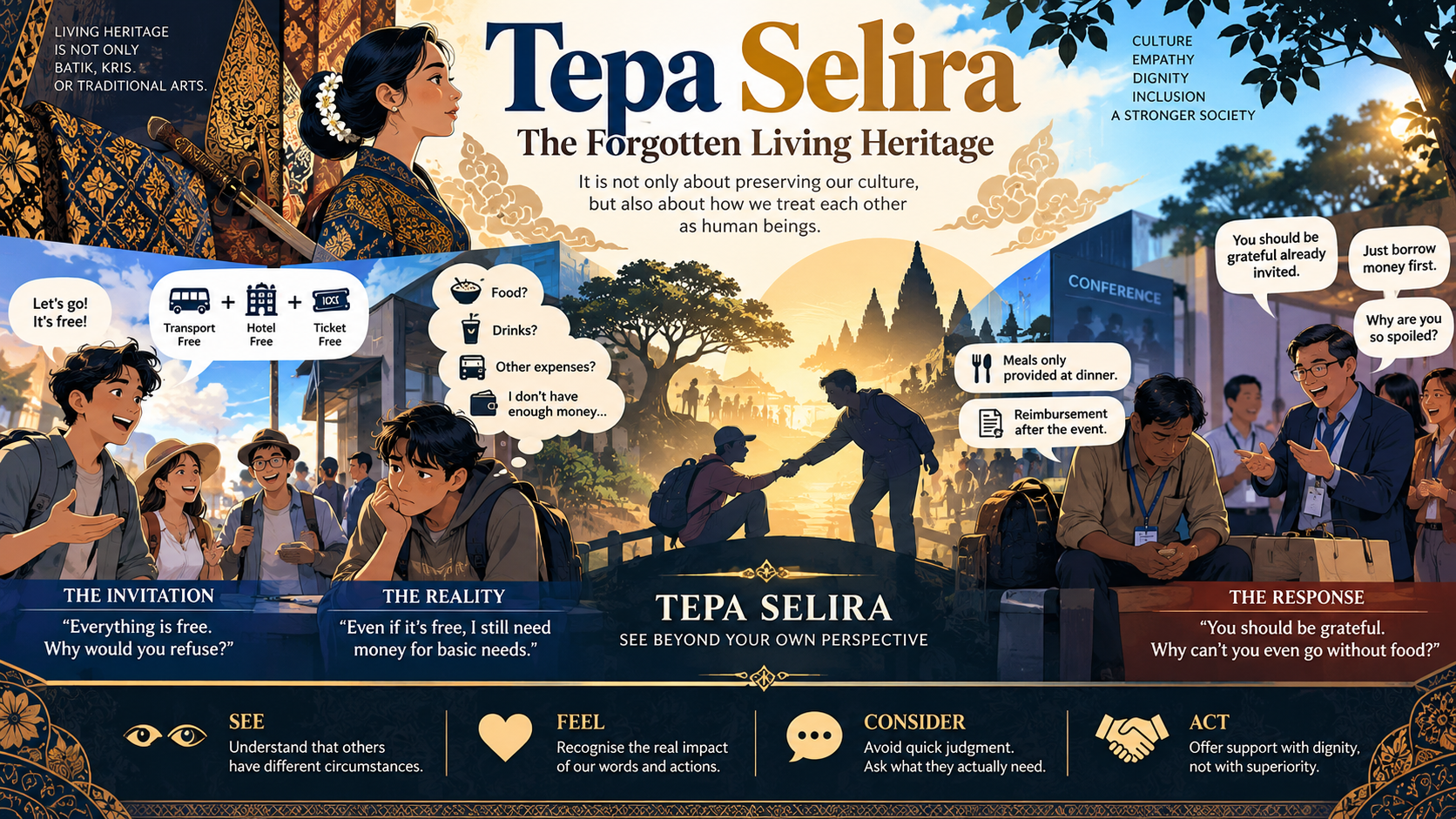
Living Heritage • Cultural Values • Human Dignity
Tepa Selira: The Forgotten Living Heritage
What if the living heritage we are forgetting is not how to make batik or craft a kris, but how to treat another human being with dignity?
When we talk about Living Heritage, what usually comes to mind? Batik. Kris. Traditional dances. Folk songs. Ceremonies. Craftsmanship passed from one generation to another.
We celebrate these practices, document them, teach them, and proudly present them as part of our cultural identity. These efforts matter. But what if some of our most important living heritage is slowly disappearing—not from our museums, but from our everyday behaviour?
What if we preserve the objects of culture while neglecting the values that give culture meaning?
Perhaps one of the most important forms of living heritage is not only what our hands can make, but how our choices make room for other people.
1. Tepa Selira: More Than Good Manners
In Javanese culture, tepa selira is commonly understood as empathy, consideration, and the willingness to imagine how our actions might affect another person. It asks us to pause before judging and to recognise that other people may be navigating realities we cannot see.
It is more than speaking politely or avoiding open conflict. It is a discipline of perspective: considering another person's circumstances before assuming that our own experience is the universal standard.
Can we understand someone's decision without immediately labelling them lazy, ungrateful, weak, or difficult? Can we recognise that what seems easy for us might be genuinely difficult for someone else? Can we offer help without making the recipient feel inferior?
And perhaps the most uncomfortable question is this: do we actually practise tepa selira, or do we merely know how to define it?
We can explain cultural values beautifully at festivals, ceremonies, and academic events. Yet when an ordinary human situation challenges our convenience, those values can suddenly become abstract. The language of empathy survives; the practice of empathy does not always follow.
2. When a “Free Trip” Is Not Really Free
Imagine inviting someone on a trip and telling them that everything is free. Transportation is arranged. Perhaps accommodation is covered, too. From the organiser's perspective, it is a generous opportunity.
But the person declines. Why? Because even when transport is free, they may still need money for food, drinks, unexpected expenses, or other basic necessities.
A relative of mine often declines invitations to go out, even when the trip is offered for free. I understand why someone might make that decision. Interestingly, I have done the same thing myself. I once declined an invitation to celebrate New Year's Eve outside the city, even though the trip was supposedly free.
The reason was simple: I did not want to risk additional expenses I might not be prepared to cover.
This made me realise something. How often do we interpret someone's refusal as a lack of enthusiasm, gratitude, or appreciation without considering the financial risks behind it?
The inviter's view
“Everything is free. Why would you refuse? You should be happy to have this opportunity.”
The invitee's reality
“What happens if I need money along the way? What if I get hungry, thirsty, or face an unexpected expense?”
Both people see the same invitation, but they experience it differently. For someone with enough financial resources, an unexpected expense might be a minor inconvenience. For someone living on a tight budget, that same expense might mean sacrificing a meal, borrowing money, or struggling to cover another essential need.
An opportunity can be free for the person offering it while remaining financially inaccessible to the person receiving it.
Not everyone who declines an opportunity is ungrateful. Sometimes, they are simply being realistic about what they can afford. A considerate invitation makes the actual costs clear and leaves room for an honest answer without shame.
3. When Gratitude Becomes an Excuse to Ignore Someone's Needs
Consider a more troubling situation. People from rural communities are invited to attend an event in a city. The organisers provide certain facilities, but reimbursements are processed later. Participants are expected to cover some expenses upfront.
For someone with enough money, this arrangement might be manageable. But what happens when a participant cannot afford to cover their basic needs while waiting for reimbursement?
I once witnessed a situation in which a participant from a rural area went without food throughout the day because dinner was the only meal provided by the organisers.
When the situation was questioned, the response was essentially this: “They should be grateful they were invited. They could have borrowed money. Why are they so spoiled that they cannot even go without food?”
Seriously?
Since when does receiving an invitation mean surrendering the right to have one's basic needs considered? Since when does gratitude require someone to go into debt just to participate in an event? And since when does being unable to afford food become evidence of a bad attitude?
Gratitude does not create purchasing power. Appreciation does not eliminate hunger. And an invitation does not automatically make someone financially capable of accepting it.
If an event depends on reimbursement, organisers should consider whether participants can realistically afford to advance those costs. Could transport be arranged directly? Could a reasonable daily allowance be provided in advance? Could meals be available throughout the programme?
Not every event can cover every expense. Budgets have limits. But when limitations exist, they should be communicated honestly. Participants should not be shamed for struggling with a financial arrangement they cannot afford.
4. “Other People Have It Worse” Is Not Empathy
Another argument often appears whenever someone expresses hardship: “Other people have it much worse. You should be grateful.”
There is a difference between encouraging perspective and using someone else's suffering to silence a person.
Yes, refugees may lack food, shelter, and safety. Yes, families may experience poverty far more severe than our own. But does their suffering mean that everyone else must remain silent about their difficulties?
If someone cannot afford to eat during an event, should we dismiss them because a refugee somewhere else might be starving? If a person cannot afford an unexpected expense, should we tell them to stop complaining because someone else has nothing at all?
Human suffering is not a competition in which only the person experiencing the worst circumstances deserves consideration.
We can care about refugees and still care about a participant who cannot afford lunch. We can acknowledge extreme poverty and still recognise the financial constraints of an ordinary family. We can encourage gratitude without using it as a weapon against people who need understanding.
Otherwise, we are not practising empathy. We are establishing a threshold below which people are allowed to ask for help—and that threshold will always move whenever someone else's suffering becomes convenient to mention.
5. When We Confuse Privilege With Personal Merit
Sometimes, people making these judgements are not deliberately cruel. They may simply have never experienced the same financial constraints. Perhaps they have savings, family support, credit cards, or friends who can lend them money.
For them, paying an unexpected expense and waiting for reimbursement is a minor inconvenience. They may genuinely believe that everyone else could do the same.
But this is where a lack of perspective becomes dangerous. We begin to assume that because something is manageable for us, it must be manageable for everyone. When someone cannot manage it, we conclude that the problem lies in their character: they must be lazy, irresponsible, unmotivated, or ungrateful.
Our ability to absorb a financial shock is not proof of our superior character. Sometimes, it simply means we have more resources.
Tepa selira requires us to recognise the limits of our own experience. Our personal circumstances are not universal standards by which everyone else should be judged.
6. Tepa Selira Is Not Mind-Reading
Empathy does not mean we can imagine exactly how another person feels. We cannot fully understand every experience simply by placing ourselves in someone else's shoes. Sometimes, the more responsible approach is to acknowledge what we do not know and ask what the person actually needs.
Instead of assuming
“If I were you, I would simply borrow money.”
Try asking
“Would you be comfortable covering the expenses upfront, or would that be difficult for you?”
Instead of dismissing
“Everything is free, so there is no reason not to come.”
Try clarifying
“Transport and accommodation are covered, but these other costs may not be. Would that arrangement work for you?”
These questions do not require us to solve every financial problem. They simply acknowledge that another person has their own circumstances, boundaries, and dignity.
Tepa selira is not excessive politeness, mind-reading, or avoiding every uncomfortable conversation. It is the willingness to consider another person's reality before imposing our own assumptions upon it.
7. From Cultural Heritage to Everyday Behaviour
Living heritage encompasses practices, knowledge, skills, values, and ways of relating to one another that communities recognise as part of their cultural heritage. We often celebrate its visible expressions: traditional textiles, craftsmanship, music, dance, and ceremonies.
These practices deserve protection. But what happens when a community continues to celebrate its cultural identity while neglecting the values it claims to cherish?
What happens when we proudly explain tepa selira, but dismiss someone who cannot afford a meal? What happens when we teach young people about respect, but humiliate people who cannot meet our expectations? What happens when we celebrate mutual assistance while expecting vulnerable people to borrow money rather than examining whether our own arrangements could be more considerate?
We may preserve the vocabulary of our culture while losing its practical meaning. We may remember the names of our traditions but forget how those traditions should influence our daily decisions.
Perhaps one of the most neglected forms of cultural preservation is the preservation of everyday humanity.
Cultural values are not sustained merely by explaining them. They survive when people practise them—especially when doing so requires patience, humility, and consideration for someone whose circumstances differ from their own.
8. A Simple Model: From Cultural Value to Human Action
The following illustration summarises the difference between merely knowing a cultural value and making it part of everyday practice.
Conceptual illustration by the author. It is a reflective model, not a validated scientific framework.
9. The Difference Between Help and Humiliation
There is a meaningful difference between helping someone and reminding them that they are dependent on us. Help can restore access and dignity. It can also become a performance of superiority when it is accompanied by shame, moral lectures, or the expectation that recipients must accept every condition without question.
A considerate organiser does not need to know every detail of a participant's finances. They can design a programme that avoids unnecessary barriers, communicate expenses clearly, and provide practical options where feasible. A considerate friend can offer an invitation without making refusal a test of loyalty or gratitude.
Likewise, a person who receives help can appreciate it while still expressing a legitimate concern. Gratitude and feedback are not mutually exclusive. In fact, feedback may help make the next opportunity more accessible to someone else.
10. What Tepa Selira Could Look Like in Practice
These principles are practical, not ceremonial. They can be applied in families, workplaces, community programmes, schools, cultural events, and public services.
Explain which expenses are covered, which are not, and when reimbursement will arrive. Do not describe an opportunity as entirely free if participants must advance costs they may not have.
Give people room to explain constraints—or decline without having to disclose private financial information.
Where feasible, arrange direct payment, advance allowances, meals, accessible transport, or alternative ways to participate.
A person's inability to pay is not, by itself, evidence of irresponsibility, ingratitude, or poor character.
Preserve privacy and dignity. Assistance should not require someone to perform gratitude or accept public embarrassment.
If several participants face the same barrier, consider whether the process itself needs to change.
None of this means that every request must be granted or every cost must be covered. Boundaries and budgets remain legitimate. The point is to make decisions with awareness of how they affect people, rather than treating our own circumstances as the default for everyone.
11. The Uncomfortable Questions We Should Ask Ourselves
Why is it sometimes easier to lecture people about gratitude than to consider the circumstances that make their lives difficult?
Why do we demand resilience from people while refusing to examine the burdens we place upon them?
Why do we expect people to sacrifice basic needs to demonstrate that they deserve an opportunity?
And why do we sometimes interpret a person's inability to participate as a moral deficiency rather than a practical limitation?
Perhaps because judging someone is easier than understanding them. Judging requires only an assumption. Understanding requires us to pause, reconsider our perspective, and acknowledge that our own experience may not tell the whole story.
It is easier to say, “They should have borrowed money,” than to consider whether they have anyone who can lend it. It is easier to say, “They should be grateful,” than to recognise that they may already be grateful and still be struggling.
It is easier to call someone spoiled than to ask why a supposedly accessible opportunity has become a source of financial anxiety.
But that is precisely when the value matters most: not when everyone is comfortable, not when helping is effortless, and not when empathy costs us nothing. It matters when another person's circumstances challenge our assumptions about what should be easy, reasonable, or affordable.
12. A Note on Cultural Pride
This is not an argument for celebrating batik, kris, traditional ceremonies, or other cultural expressions any less. They deserve protection, transmission, and respect.
It is an invitation to broaden our understanding of what cultural continuity requires. We can preserve beautiful objects and still ask whether our everyday behaviour reflects the values we associate with our heritage.
The concept of tepa selira is rooted in a particular cultural context, but the broader questions resonate across societies: Do we consider the realities of others? Do we treat people with dignity when they have less power or fewer resources? Do our values shape our decisions, or do we bring them out only when we want to display our identity?
A culture is not alive simply because its traditions survive. It is alive when its values continue to influence how people treat one another.
The central reflection
Tepa selira is not merely knowing that other people have feelings. It is remembering that other people have realities we cannot always see.
If a cultural value is to remain living heritage, it must move beyond the vocabulary we inherit and become part of the choices we make—especially when someone else's needs are inconvenient to our expectations.
Conclusion: Are We Keeping It Alive, or Merely Remembering Its Name?
Perhaps the living heritage we most urgently need to preserve is not only the art we create, the objects we protect, or the ceremonies we perform. Perhaps it is our ability to treat one another as human beings, even when we do not fully understand one another's circumstances.
The true test of a cultural value is not whether we can explain it. It is whether we remember it when someone in front of us is hungry, financially constrained, embarrassed to ask for help, or unable to accept an opportunity that everyone else assumes should be easy to enjoy.
Do not measure someone's gratitude by how much hardship they are willing to endure to accept your generosity.
If tepa selira is something we proudly recognise as part of our heritage, perhaps it is time we asked ourselves a more difficult question:
Are we keeping it alive, or are we merely remembering its name?
Further Reading
- UNESCO — What Is Intangible Cultural Heritage? Background on living heritage, community transmission, and safeguarding.
- UNESCO — 2003 Convention for the Safeguarding of the Intangible Cultural Heritage. The international framework for safeguarding intangible cultural heritage.
- Stanford Encyclopedia of Philosophy — Amartya Sen. An introduction to the capability approach and the distinction between resources and people's real opportunities to achieve valued outcomes.
Author's note: The examples in this article are used to discuss empathy, financial constraints, and institutional design. They do not imply that every declined invitation has the same cause or that every event must cover all participant expenses. The argument is that limitations should be considered and communicated without shaming people for circumstances beyond their control.
Article 81 · Horizon Scanning · Living Heritage and Human Dignity