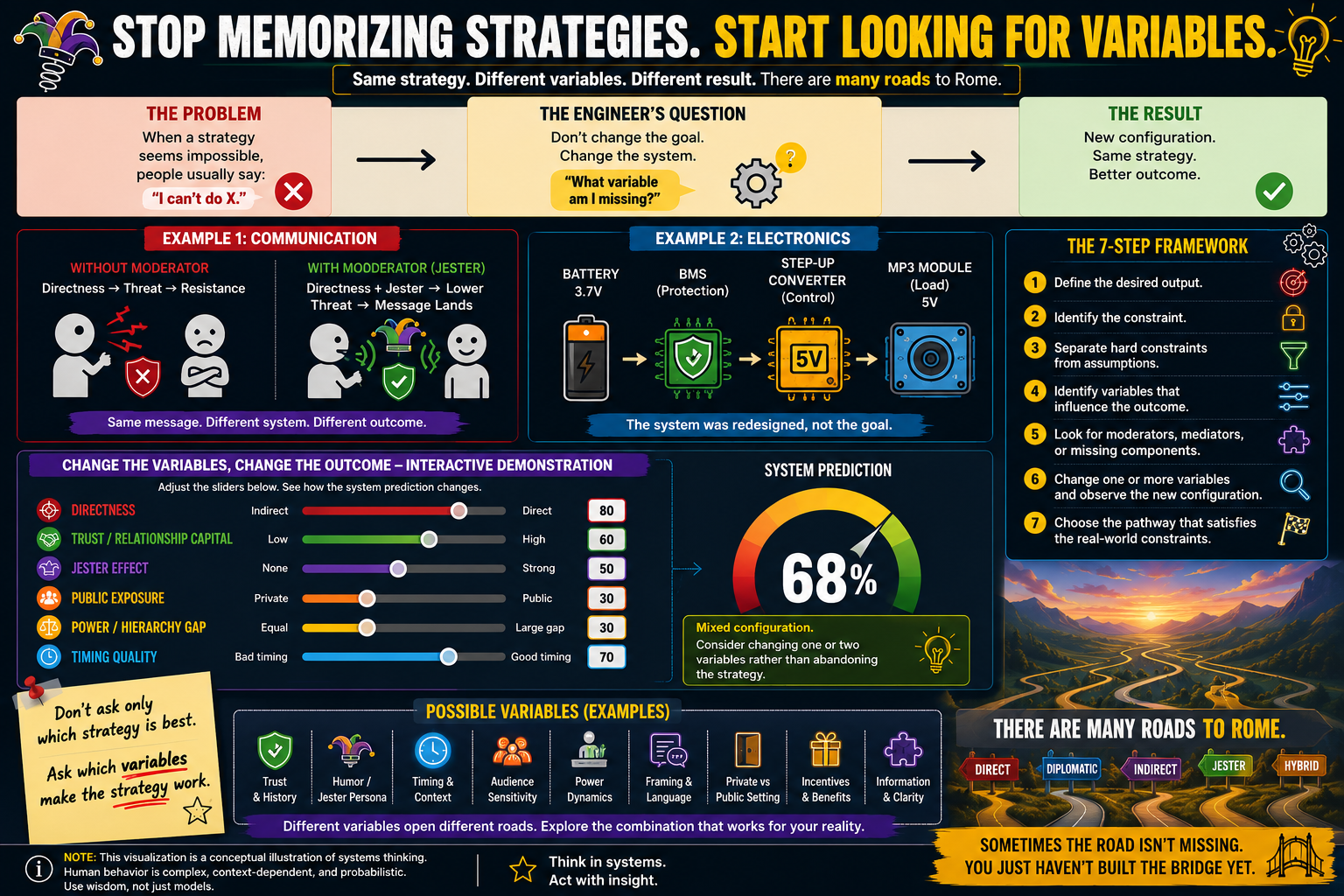
People often get stuck not because they lack intelligence, information, or even strategy. They get stuck because they treat a strategy as a fixed rule — instead of asking what variables make that strategy work.
The Core Idea
When a strategy appears impossible, don't immediately abandon the strategy. First ask:
"What variable am I missing?"
What's In This Article
- When Strategy Becomes a Cage
- The Question Behind the Question
- The Jester Variable
- Why I Sometimes Deliberately Become the Jester
- Variables Are Not Magic
- Interactive Lab — Build Your Own System
- From Psychology to Electronics
- Effective ≠ Efficient
- The Framework
Part I — When Strategy Becomes a Cage
I have noticed a recurring pattern in how people think about strategy.
Someone learns that diplomacy requires indirect communication. Then they conclude:
"If I need to be diplomatic, I cannot be direct."
Another person learns that indirect communication can preserve relationships. Then they conclude:
"Therefore, indirect communication is always better."
Someone else learns that a particular communication technique worked in one organization, one culture, or one relationship. Then they turn it into:
"X is the most effective way to communicate."
And suddenly, strategy has become a collection of commandments.
Direct = bad.
Indirect = good.
Diplomatic = indirect.
Humor = informal.
Formal = serious.
But real-world systems are rarely that simple. Strategy does not operate in a vacuum.
A strategy interacts with context, constraints, relationships, incentives, timing, resources, perception, and many other variables. And sometimes the reason a strategy fails is not that the strategy itself is wrong.
You are simply missing a variable.
Part II — The Question Behind the Question
Imagine someone tells you:
"I need to be direct, but being direct will damage the relationship."
A conventional strategist may conclude: "Then don't be direct."
But an engineer thinks differently. The engineer asks:
"What component would allow the system to produce the desired output under this constraint?"
That is a completely different question. Instead of changing the objective, you look for a missing component. Instead of saying:
"I cannot do X."
you ask:
"What would have to be true for X to work?"
That question opens an entirely different problem space.
Part III — The Jester Variable 🃏
Let's return to the communication problem. Suppose:
You might conclude that direct communication is incompatible with diplomacy. But what happens if we introduce another variable?
Jester effect.
Humor, self-deprecation, an established playful persona, relationship capital, and timing can change how the same direct statement is perceived. The message may remain direct. But the perceived social threat can change.
This is where the concept of a moderating variable becomes useful. A moderator does not necessarily remove the original effect. It changes how strongly, when, or under what conditions one variable affects another.
In this example, the Jester does not magically make direct communication diplomatic. It can change the social conditions under which directness is received.
Same message. Different system configuration. Different outcome.
Part IV — Why I Sometimes Deliberately Become the Jester
This is something I have actually used in professional environments.
Sometimes there is a situation where a message needs to be delivered directly. But saying it in the most formal and confrontational way would create unnecessary friction. On the other hand, communicating it indirectly may produce absolutely no effect.
Everyone nods. Everyone smiles. Everyone says:
"Yes, yes, we should consider that."
And then… Nothing happens. 😂
So sometimes I deliberately use a different variable: Persona.
For years, I have consistently built a somewhat playful "Jester" persona around myself. The point isn't to become the office clown. The point is that when people already understand your communication style, a little sarcasm or humor can create room for a sharper observation without making every sentence feel like a confrontation.
Instead of:
"Your approach doesn't make sense."
you might say:
"Ah yes, our revolutionary strategy: let's make the problem more complicated." 😂
People laugh. But the message is still there. And because the persona was built consistently over time, the comment is interpreted differently from the exact same sentence delivered by someone who normally communicates in a highly formal and serious manner.
The persona becomes part of the communication system. That is the variable.
Part V — But Variables Are Not Magic
This is important. A moderator is not a magic button. Adding "humor" does not automatically make direct criticism safe.
A joke can reduce tension. A joke can also humiliate someone. A trusted relationship can make directness easier. The same relationship can make a betrayal feel even more painful. Timing can transform the exact same sentence from helpful to disastrous.
Context matters. Power matters. Culture matters. History matters.
And that is exactly the point. There is rarely one universal variable. There are usually several interacting variables.
A Simple Conceptual Model
Outcome = f(Strategy, Context, Moderators, Constraints)
This is a conceptual framework, not a literal statistical equation. The point is to remind us that a strategy's outcome depends on more than the strategy itself.
Part VI — Interactive Lab: Build Your Own System
This is where I want you to stop merely reading and actually experiment with the idea. Below is the same direct statement:
Instead of a fixed set of sliders, this lab lets you add or remove variables yourself — just like designing a real system. Start with the two default variables, then add moderators like Trust, Jester, Timing, Power Gap, or Public Exposure, and watch how both the threat level and the message clarity shift. Try to find a configuration that is both effective (message lands) and efficient (low social cost).
Variable Lab — Communication System
Add variables from the palette below, drag their sliders, then remove ones you don't need. There is no single correct configuration — the goal is to feel how variables interact.
An effective configuration gets the message across. An efficient one does so with the fewest variables, the least social cost, or the least effort to set up. Compare: adding five moderators may push effectiveness to 90%, but if two moderators already reach 80%, the two-variable version is more efficient — cheaper to build and maintain.
Note: this interactive model is intentionally illustrative. The percentages are not empirical measurements and should not be interpreted as validated psychological predictions. The purpose is to demonstrate systems thinking: changing variables — and the number of variables — can change outcomes.
Part VII — Now Let's Leave Psychology and Enter Electronics
This is where the idea becomes almost embarrassingly obvious.
Imagine you have a lithium-ion battery rated around 3.7 V. But your MP3 player module expects 5 V.
You cannot simply say:
"Diplomacy says I cannot be direct, therefore the MP3 module cannot be used."
😂 The engineer asks a different question:
"What component do I need between the source and the load?"
The answer may be a step-up converter.
Notice what happened. The battery did not magically become a 5V battery. The MP3 module did not magically become a 3.7V module.
The system was redesigned. We introduced another component. That component changed the relationship between the source and the load. And suddenly, something that looked impossible became possible.
Part VIII — The Engineer's Question Is Also the Strategist's Question
This is the bridge I find most interesting. An engineer looking at the circuit does not usually stop at:
"3.7V doesn't match 5V."
They see a constraint. Then they search for a mechanism that transforms the constraint. A strategist can do exactly the same thing.
You don't necessarily have to abandon directness. You can redesign the communication architecture around it. And that principle applies far beyond communication.
Part IX — "There Are Many Roads to Rome" Is a Systems Principle
We often hear:
"All roads lead to Rome."
It is usually treated as a philosophical statement. But there is a practical systems interpretation hiding inside it.
The desired outcome does not necessarily determine a single valid pathway.
If the destination is Rome, you don't need one sacred road. You need a route that satisfies the constraints. Maybe the road is fast. Maybe it is safe. Maybe it is cheap. Maybe it avoids traffic. Maybe it requires a bridge. Maybe you take a completely different route because one road is blocked.
The same is true in organizations. The same is true in diplomacy. The same is true in relationships. The same is true in engineering. And the same is true in life.
There may be many pathways to the same outcome because the variables can be configured differently.
Part X — Don't Confuse a Constraint With a Law
This may be one of the most useful habits in strategic thinking. When someone says:
"We can't do that."
ask:
"Can't because of what?"
Then ask:
"Is that a hard constraint, or merely the current configuration?"
Those are completely different things. A physical law is one thing. A policy constraint is another. A social norm is another. A habit is another. An assumption is another. And sometimes people defend an assumption as if it were physics.
"That's just how it works."
Really? Or is that simply how the current system is configured?
Part XI — Strategy Without Variables Becomes Dogma
This is why I am skeptical when people memorize endless lists of strategies. Five communication techniques. Seven negotiation principles. Ten leadership styles. Three rules for diplomacy. Four psychological tricks.
Those lists can be useful. But they become dangerous when people stop asking:
"Under what conditions does this strategy work?"
A strategy without its conditions is incomplete knowledge. Because when the environment changes, the strategy may fail. And instead of adapting the system, people conclude:
"This strategy doesn't work."
Maybe. Or maybe… You forgot the moderator.
Part XII — Effective ≠ Efficient: The Distinction Most People Skip
The interactive lab above is designed to surface one specific lesson: a configuration that works is not automatically the best configuration.
Here's the practical takeaway:
- Effective asks: does the outcome happen at all?
- Efficient asks: at what cost — time, trust, energy, complexity, risk — did that outcome happen?
- A 10-variable system can be more effective than a 2-variable system, and still be a worse choice in practice, because it's harder to reproduce, harder to teach, and more fragile if one variable disappears.
- A 2-variable system that reaches 80% of the outcome with a fraction of the setup cost is often the better real-world strategy — even though it is technically "less effective" on paper.
Go back to the lab above. Try to reach a high Effectiveness score using only one moderator. Then try again using four. Compare the Threat score, and ask yourself honestly: was the fourth variable actually necessary, or was it dead weight?
This is the same discipline engineers apply when choosing between a single well-placed step-up converter versus a chain of five components that technically also works, but is heavier, more expensive, and more likely to fail.
Part XIII — The Real Strategic Skill
The most sophisticated question is not:
"What is the best strategy?"
It is:
"What combination of variables makes the desired outcome possible — with the least unnecessary cost?"
That question changes everything. It moves you from memorizing tactics to understanding systems. From asking for one answer to exploring a solution space. From saying "no" to identifying constraints. From defending a strategy to redesigning the architecture around the strategy.
And most importantly: it gives you more than one road to Rome — and the judgment to pick the cheapest good one.
The Framework
The Final Thought
The next time you catch yourself saying:
"I can't do X because Y."
stop. Maybe X really is impossible. But maybe it isn't. Maybe you're looking at the wrong configuration.
An engineer sees a 3.7V battery and a 5V module and doesn't necessarily declare the project impossible. They add a component.
A strategist sees direct communication and a sensitive relationship and shouldn't necessarily conclude that directness is impossible. They can add a component too:
Trust.
Timing.
Humor.
Framing.
Persona.
Private setting.
Relationship capital.
The battery doesn't need to become something it isn't. The MP3 module doesn't need to change what it requires. The system changes.
And sometimes, that's the entire difference between:
and
Don't ask only which strategy is best.
Ask which variables make the strategy work — and which of those variables you can actually afford to keep.
There are many roads to Rome.
Sometimes the road isn't missing.
You just haven't built the bridge yet.
A Note on the Model
The communication and "moderator" examples in this article are conceptual demonstrations of systems thinking. They are not intended to imply that a Jester persona, humor, trust, or any other variable will reliably produce a specific psychological outcome in every context. Real human systems remain context-dependent and probabilistic. The interactive lab is a teaching tool for reasoning about variables, not a predictive instrument.
Read the previous article
This article continues the discussion from "Living Heritage as a Peacebuilder?", where the central idea was that social systems often contain mechanisms that shape how people coexist and respond to conflict.