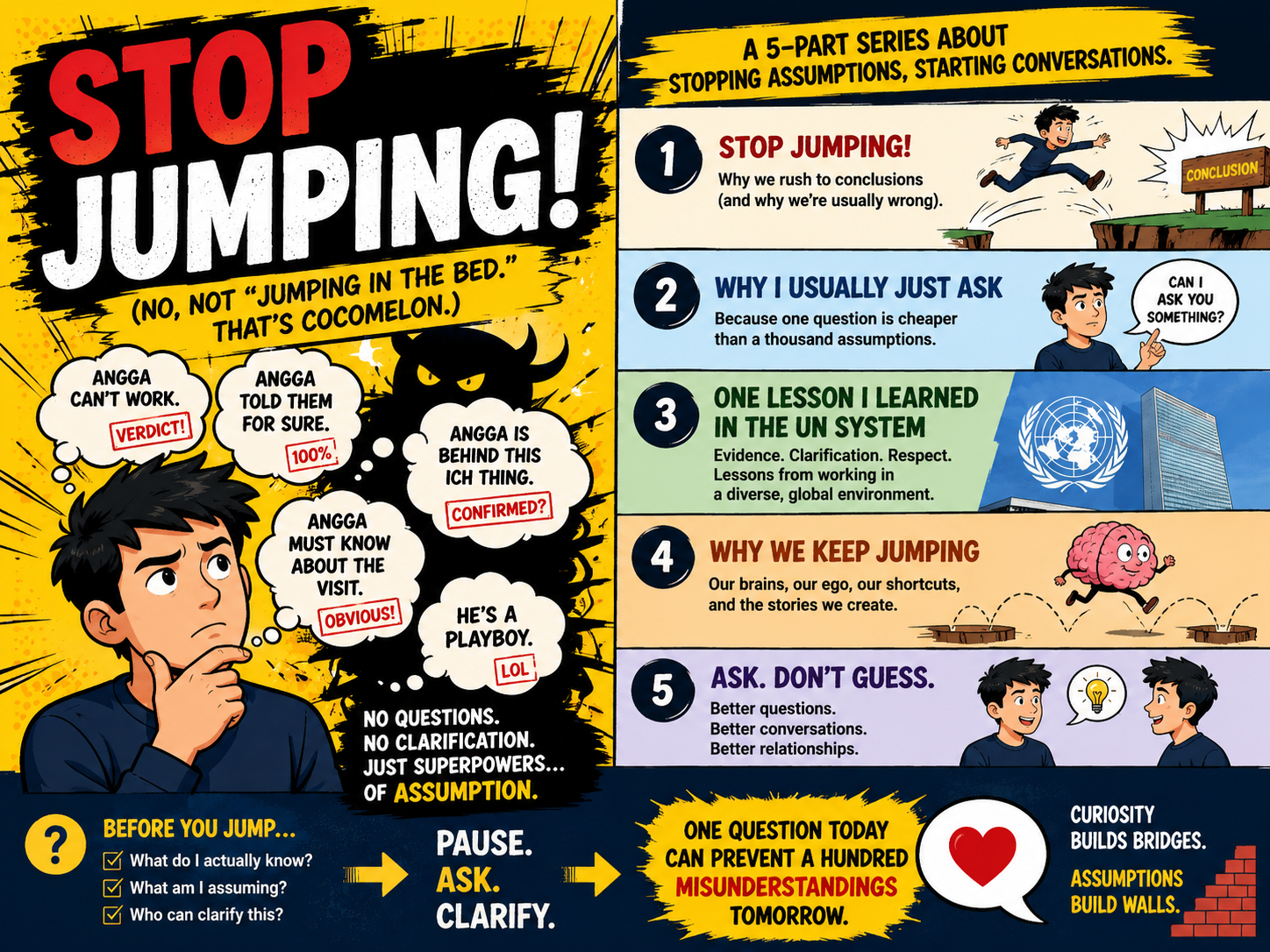
Somewhere between the moment a message goes unanswered and the moment we've already decided what it means, our brain quietly does something remarkable: it writes a complete story out of almost nothing. This isn't a character flaw. It's a well-documented reasoning bias — one that psychologists have been measuring in laboratories for decades, and one that a much older tradition of verification, tabayyun, was already warning us about long before "cognitive bias" was a phrase anyone used.
This piece is a personal, occasionally self-deprecating walk through why we jump to conclusions, why asking is so chronically underrated, what an international organization taught me about separating observation from interpretation, and why — according to the research — the smartest people in the room are usually the ones asking questions, not delivering verdicts.
What Is the "Jumping to Conclusions" Bias?
In psychology, jumping to conclusions (often abbreviated JTC) describes reaching a judgment after gathering noticeably less evidence than the situation warrants — in effect, confusing what we've actually observed with what we've merely inferred.
It's considered a normal, everyday heuristic that speeds up minor decisions, but researchers have also linked a more extreme version of the same bias to poorer everyday judgment and even to specific clinical conditions — a reminder that a habit which feels harmless in a group chat can, at scale, cost quite a lot.
Part 1 — Stop Jumping!
(No, not "Jumping on the Bed." That's Cocomelon. This is a different kind of parenting problem — for adults.)
Have you ever met someone with an extraordinary talent for jumping? Not a parkour athlete. Not an Olympic long jumper. I'm talking about a rarer, more terrifying athletic specialty: jumping to conclusions.
These people hear one sentence and somehow land on the last page of a novel that hasn't even been written yet. No questions. No clarification. No evidence. Just a running start and a leap of faith — directly into a conclusion that was never there.
"Well, obviously..." — obviously what? You just heard one word.
Someone says, "Angga can't work." Interesting theory. Let's fact-check the detective. Have you ever worked with him? "No." Have you seen his projects? "No." Did you ask literally anyone who has? "...No." And yet — verdict delivered, gavel down, case closed. No jury required, apparently, when you're this confident.
Or here's a classic: "The Ministry is planning a visit? I bet Angga told them." Fascinating theory. Truly. Because Angga himself found out five minutes ago, from someone else, while eating lunch, looking equally confused.
My personal favorite, though? Anything remotely related to Intangible Cultural Heritage happens anywhere in the archipelago, and somehow — "It must be Angga." Apparently I'm everywhere. Omnipresent. A ghost who does consulting work. If I genuinely had that level of omniscience, I would not be writing articles for free. I'd be charging for palm readings. Business would be booming.
Here's the twist: most people doing this aren't lying. They're just doing what brains do — filling empty space with a story that feels convincing, because ambiguity is uncomfortable and a wrong answer often feels better than no answer at all. So maybe, before jumping to conclusions, we should just stop jumping. At least the kind that skips the part where you ask a question first — because five seconds of clarification can save five days of a group chat spiraling into a full soap opera.
Part 2 — The World's Most Underrated Superpower: Asking
There's something I have never understood. People will happily spend three hours constructing an elaborate theory... rather than spend thirty seconds asking one question. How is that the trade people keep making?
Picture this: you're thirsty. Genuinely, desperately thirsty. The kitchen is ten steps away. But instead of standing up, you lie there staring at the ceiling like a philosopher — "I wonder if there's any water... I wonder if someone drank it... I wonder if the bottle is secretly empty and mocking me..." Go. Look. It's ten steps. 😂
Now swap "water" for literally anything else in life. "Does she still love me?" — Did you ask her? "No." "Does he hate me?" — Did you ask him? "No." "Did they misunderstand what I meant?" — Did you clarify? "No." Astaga. We are emotionally dehydrated, standing directly next to the faucet, choosing instead to write a tragic novel about drought.
Secretly, I think we enjoy playing fortune teller. The only problem is we're catastrophically bad at it — building an entire cinematic universe in our heads, casting ourselves as the wronged protagonist, then reacting to the movie as if it actually happened, without ever checking whether the trailer matched the film.
One sentence has probably ended more friendships, relationships, and team projects than any other in the language: "I assumed..." Not "I confirmed." Not "I checked." Just assumed — and then quietly promoted to Vice President of Certainty.
Working in international organizations taught me to separate four categories most people blur into one: what I know, what I think, what I heard, and what I can actually verify. If something's unclear — ask. If something sounds strange — verify. If someone seems upset — talk to them. Reports are built on evidence, not vibes.
And yet most of us abandon that entire system the second we clock out. Instead of "Are you okay?" we conclude "They're angry." Instead of "Do you still love me?" we run a full forensic investigation involving typing speed, emoji frequency, last-seen timestamps, and — somehow — the current phase of the moon, when the real answer was twenty seconds away, behind one sentence we refused to send.
Tabayyun: A Much Older Instruction to Verify
Long before psychology gave cognitive biases their clinical names, the Qur'an (Al-Hujurat, 49:6) already instructed believers to pause and investigate carefully before acting on a report from an untrustworthy source, precisely so a community doesn't end up harming people based on something that turns out to be false. This principle, known as tabayyun, is essentially a centuries-old policy against jumping to conclusions — verify first, react second.
Part 3 — One Lesson I Learned in the United Nations System
Evidence Is Louder Than Assumptions. One of the most useful habits I picked up in the UN system wasn't a fancy framework or a technical skill — it was something almost embarrassingly simple: don't confuse assumptions with facts.
Working in an international environment surrounds you with people from different cultures, languages, and religions. What sounds "obvious" to you might mean something entirely different to the person across the table. Try saying "I know what they meant" out loud and see how quickly it falls apart. Do you actually know? Or do you know what you think they meant?
One habit I genuinely respected: conversations kept circling back to evidence. Instead of "I think..." — "What information do we actually have?" Instead of "Someone told me..." — "Has this been confirmed?" It sounds like a small, boring shift. It changes everything.
Observation
"The email hasn't been answered for three days." — Measurable. Checkable. Neutral.
Interpretation
"They're ignoring me." — A story. Plausible, maybe, but unverified — and often wrong.
Another habit worth stealing: asking before concluding, not out of indecision, but because decisions get better when they're built on something sturdier than a hunch. Questions are free. Misunderstandings, on the other hand, come with interest.
One phrase I heard often, sometimes out loud and sometimes just in how people carried themselves: "We don't have enough information yet." At first that sounded uncertain to me. Now it sounds like the most mature sentence in the room. Pretending you already know is usually the real weakness — and it's the kind that's much harder to walk back later.
Part 4 — Why We Keep Jumping (Your Brain Is Not Broken, It's Just Efficient)
So why do people keep jumping to conclusions, despite three whole sections of me making fun of it? Because, according to evolutionary psychologists, our brains were shaped to. Researchers describe this through what's sometimes called error management theory: when the cost of a false alarm (assuming danger that isn't there) is much lower than the cost of a missed threat (ignoring danger that is), natural selection favors brains that jump to the alarming conclusion, even when it's usually wrong.
Picture walking through a forest and hearing something rustle in the bushes. Ancestors who insisted on a full evidence review before reacting did not, generally, get to pass on their genes. So evolution rewarded brains that guessed fast, not brains that guessed accurately — a design choice we're all still living with every time someone leaves us on read.
The Assumption Gap — Two Paths From the Same Silence
The same ambiguous moment — an unanswered message, a strange look, a rumor — can be resolved two very different ways. Only one of them is reversible if you're wrong.
Figure 1: The same ambiguous moment resolved through assumption versus verification — one path compounds, the other closes.
Here's something worth sitting with: certainty travels faster than curiosity, every time. Compare "I'm not sure" to "I know exactly what happened." The second sounds more convincing — it has main-character energy. Confidence and accuracy, though, are unrelated variables that happen to dress the same, and we keep falling for the outfit.
That might explain why "I don't know" is one of the hardest sentences an adult can say out loud. Children say it constantly, without shame. Somewhere along the way, adults swapped it for theories, because uncertainty feels exposed while a theory, even a wrong one, feels like armor. But there's something genuinely freeing about admitting it — because the moment you say "I don't know," you open the door to the one thing a finished story can never give you: learning.
Long before social media, people gossiped, assumed, and misunderstood each other just fine on their own. The difference now is speed — a misunderstanding that used to stay contained to one neighborhood can cross the planet before breakfast, all before anyone asks the single most obvious question available: "Is this actually true?"
The Most Intelligent People Ask, They Don't Announce
Researchers studying intellectual humility describe it as being genuinely aware that your own beliefs might be wrong and staying attentive to the quality of the evidence behind them — and studies consistently link it to more openness, more curiosity, and less dogmatism. In other words: the willingness to say "I might be missing something" isn't a weakness. It's one of the more reliable markers of a sharp mind.
Pause. Take one breath. Ask one question. Seek one clarification. You might discover that reality is far less dramatic, and far more interesting, than whatever your brain wrote in its first, unedited draft.
"An assumption feels complete because your brain finished the story. A question begins because wisdom realizes the story isn't finished yet."
#JumpingToConclusions #CognitiveBias #Tabayyun #IntellectualHumility #Communication #SelfReflection #BehavioralScience
Referensi Ilmiah & Sumber
Dudley, R., Taylor, P., Wickham, S., & Hutton, P. (2016). Psychological Mechanisms Underlying the Formation of Delusions: A Systematic Review and Meta-analysis of Jumping to Conclusions Across Diagnoses. Schizophrenia Bulletin. (Foundational review defining and measuring the jumping-to-conclusions reasoning bias.)
Garety, P. A., & Freeman, D. (1999). Cognitive Approaches to Delusions: A Critical Review of Theories and Evidence. British Journal of Clinical Psychology, 38(2), 113–154. (Original "beads task" research establishing how people gather — or fail to gather — evidence before deciding.)
Kahneman, D. (2011). Thinking, Fast and Slow. Farrar, Straus and Giroux. (Source of the System 1 / System 2 framework describing fast, automatic judgment versus slower, deliberate reasoning.)
Haselton, M. G., & Buss, D. M. (2000). Error Management Theory: A New Perspective on Biases in Cross-Sex Mind Reading. Journal of Personality and Social Psychology, 78(1), 81–91. (Evolutionary framework explaining why fast, risk-averse — and often wrong — judgments were favored by natural selection.)
Leary, M. R., Diebels, K. J., Davisson, E. K., Jongman-Sereno, K. P., Isherwood, J. C., Raimi, K. T., Deffler, S. A., & Hoyle, R. H. (2017). Cognitive and Interpersonal Features of Intellectual Humility. Personality and Social Psychology Bulletin, 43(6), 793–813. (Defines and measures intellectual humility as recognizing that one's own beliefs might be wrong.)
Al-Qur'an, Surah Al-Hujurat (49:6). (The verse most closely associated with the principle of tabayyun — verifying a report carefully before acting on it.)