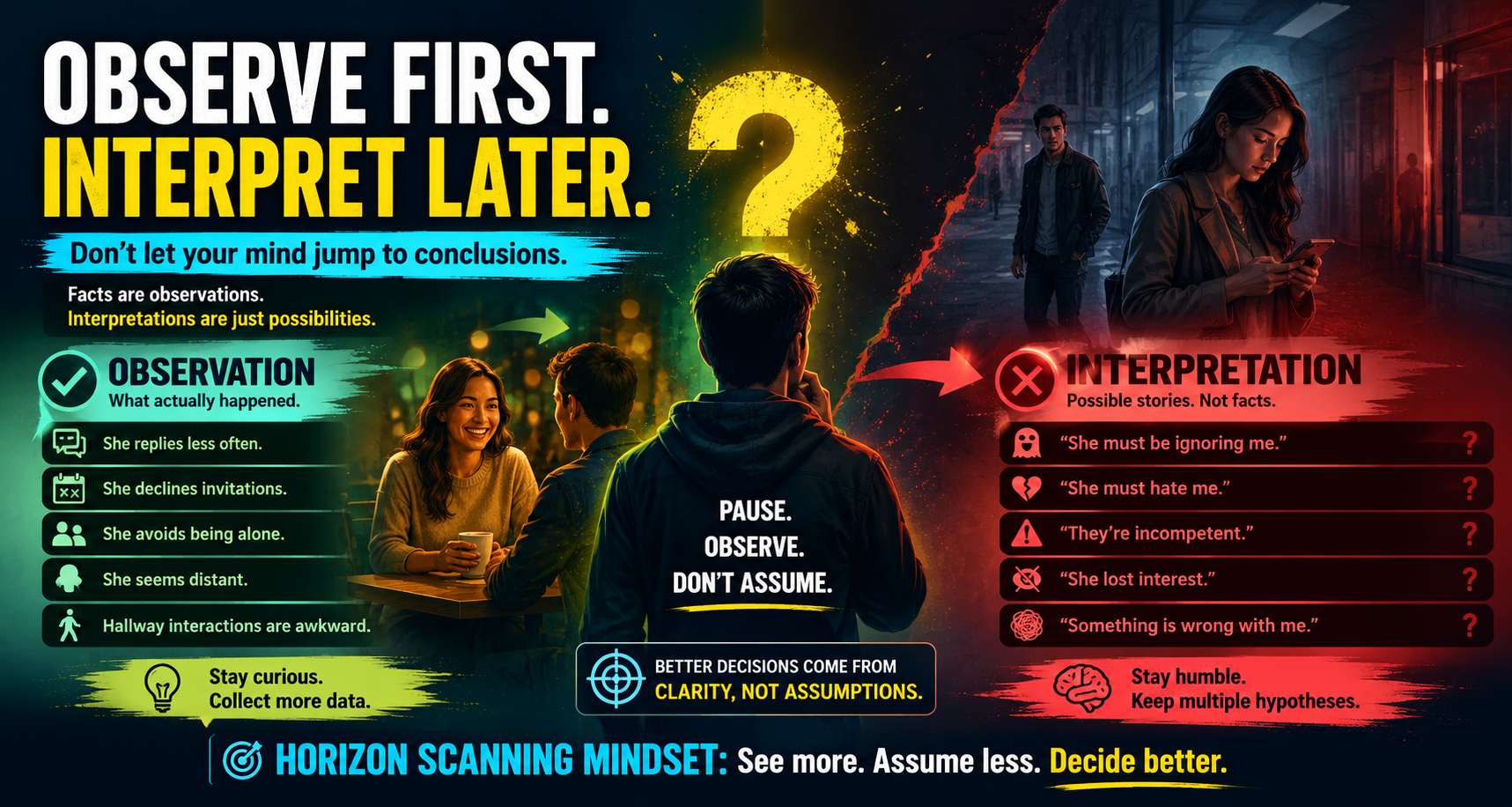
This piece unfolds in seven parts: starting with the core idea of Horizon Scanning, moving through a personal case study we'll use as a thinking laboratory, building an evidence-testing framework, and finally applying the same discipline to vendors, hiring, and stakeholder management. The subject changes along the way — the method doesn't.
Part 1 — Horizon Scanning Isn't About Predicting the Future. It's About Making Better Decisions.
When people hear the term Horizon Scanning, they often imagine governments predicting wars, economists forecasting recessions, or scientists anticipating the next technological breakthrough.
They're not wrong.
But they're also missing the bigger picture.
At its core, Horizon Scanning is not about seeing the future.
It is about reducing uncertainty before making an important decision.
Every day, we make decisions with incomplete information.
Should I trust this person?
Should I hire this candidate?
Should I choose this vendor?
Should I accept this partnership?
Should I continue investing my time in this relationship?
The problem is that most people answer these questions emotionally. They rely on first impressions, assumptions, rumors, or a single memorable event. Once an explanation feels convincing, they stop looking for alternatives.
Ironically, this is how many costly mistakes begin.
Professional analysts work differently.
Whether they are in intelligence agencies, multinational corporations, international organizations, or strategic planning teams, they are trained to resist the temptation of jumping to conclusions.
Instead, they begin with a simple mindset:
"I don't know the answer yet."
From there, they start collecting observations.
Not conclusions.
Not accusations.
Not assumptions.
Just observations.
Only after enough evidence has been gathered do they begin constructing multiple hypotheses that could explain what they have observed.
This distinction is more important than it first appears.
Imagine seeing dark clouds in the sky.
One person immediately concludes:
"It will definitely rain."
Another person says:
"Dark clouds increase the probability of rain, but they could also be moving away, dissipating, or bringing only light showers."
The second person is not indecisive.
They are thinking probabilistically.
This is the essence of Horizon Scanning.
The goal is not to become someone who can predict the future with certainty.
The goal is to become someone who makes consistently better decisions because they understand uncertainty better than most people.
Interestingly, this way of thinking is not limited to governments or Fortune 500 companies.
It can be applied almost anywhere.
Evaluating a stakeholder.
Choosing a business partner.
Assessing a supplier.
Recruiting an employee.
Negotiating with a client.
Even understanding why someone's behavior suddenly changes.
In this series, we'll explore how the principles of Horizon Scanning can be applied to one of the most overlooked domains of all:
Stakeholder Scanning.
Because before you decide how to respond to people, you must first learn how to interpret uncertainty without becoming a prisoner of your own assumptions.
The Core Mindset Shift
Most people ask: "What is the answer?" Analysts ask: "What are all the plausible explanations that could account for these observations — and which ones survive the evidence?" That single reframe is the difference between emotional reasoning and analytical reasoning.
Part 2 — Observation Before Interpretation
Most people don't have an information problem.
They have an interpretation problem.
The moment they observe something unusual, their brain immediately tries to explain it.
Someone doesn't reply to a message.
"He must be ignoring me."
A colleague suddenly becomes distant.
"She must hate me."
A vendor misses a deadline.
"They're incompetent."
The problem is not the observation.
The problem is that the interpretation arrives only milliseconds after the observation, making the two feel inseparable.
Professional analysts deliberately separate them.
They understand that an observation is a fact.
An interpretation is merely one possible explanation.
Those two should never be confused.
To make this distinction concrete, it helps to slow down one situation enough to see the gap between what actually happened and what our mind rushed to conclude. The case below is deliberately personal — not because this series is about relationships, but because relationship dynamics are the fastest way to feel, rather than just understand, how easily interpretation hijacks observation. Once the mechanics are clear here, we'll carry the exact same discipline into vendors, hiring, and stakeholders later in this series.
Case Laboratory — The Changing Behavior
At the beginning, a woman appears warm and approachable. She enjoys conversations. She agrees to meet. She seems comfortable spending time together.
Then, gradually, something changes. She becomes harder to reach. She declines invitations. She avoids situations where the two of you would be alone. Passing each other in a hallway feels awkward. She no longer seems comfortable interacting as before.
Later, you learn another piece of information. She says she already has a boyfriend. At the same time, you notice she is occasionally seen with other men. She refuses to share a taxi with you. Yet, on another occasion, she shares transportation with someone else.
Most people stop here. Their mind immediately produces a conclusion:
- "She lied."
- "She dislikes me."
- "She is inconsistent."
- Or perhaps something even more extreme.
But notice something important. None of those statements are observations. They are interpretations.
The observations are only these:
- • She initially appeared open.
- • Her behavior later became more distant.
- • She stated that she has a boyfriend.
- • She is willing to interact with some men but not with you.
- • Her willingness to be in certain situations varies depending on the person.
Everything beyond that is a hypothesis.
And hypotheses are not facts.
This distinction is the foundation of Stakeholder Scanning.
Good analysts discipline themselves to ask a different question.
Not: "What happened?"
But: "What are all the plausible explanations that could account for these observations?"
This single question changes everything.
Instead of becoming emotionally attached to the first explanation that feels satisfying, you begin exploring multiple competing possibilities.
Some will eventually be supported by evidence.
Others will collapse under closer examination.
That is exactly how Horizon Scanning works.
The purpose is not to defend your favorite theory.
The purpose is to eliminate weak theories until only the most evidence-supported explanation remains.
Because reality rarely rewards the person who reaches a conclusion first.
More often, it rewards the person who reaches the right conclusion.
Part 3 — Competing Hypotheses: Never Fall in Love with Your First Explanation
Once you have separated observations from interpretations, the next step is surprisingly difficult.
Resist the urge to explain the situation too quickly.
Instead, force yourself to generate multiple competing hypotheses.
This may feel unnatural.
Our brains are designed to conserve energy. Once we find an explanation that seems reasonable, we tend to stop searching. Psychologists refer to this tendency as premature closure — accepting an answer before sufficient evidence has been gathered.
Professional analysts do the opposite.
They intentionally ask: "What else could explain the same observations?"
Returning to our previous case, here are several plausible hypotheses.
Notice that none of them are treated as facts.
Hypothesis A — She Is Simply Not Interested
Her increasing distance, refusal to spend time alone, and avoidance of situations that could be interpreted as intimate may all indicate that she does not wish to develop a closer relationship with you. If this hypothesis is correct, her behavior is internally consistent.
Hypothesis B — She Is Protecting Personal Boundaries
Her actions may have little to do with dislike. Some people become more cautious after entering a relationship, after experiencing past trauma, or after realizing someone else's expectations differ from their own. The same behavior can arise from a desire to establish clearer boundaries rather than rejection.
Hypothesis C — Context Matters More Than It Appears
You may observe her interacting comfortably with another man and assume inconsistency. But context is often invisible. That person could be a long-time friend, a relative, a colleague working on the same assignment, someone she has known for years, or someone she perceives differently. From the outside, two situations may look identical while actually being fundamentally different.
Hypothesis D — You Are Seeing Only Part of the Picture
Every observation is limited. Perhaps you witnessed only a few moments from a much larger story. Perhaps important conversations occurred that you were never part of. Perhaps decisions were influenced by circumstances you simply do not know. Good analysts recognize that missing information is not unusual — it is expected.
Hypothesis E — Multiple Factors Are Operating Simultaneously
Reality is often more complicated than a single explanation. Perhaps she has a boyfriend. Perhaps she is also becoming more cautious. Perhaps workplace dynamics influence her behavior. Perhaps she simply feels more comfortable with certain people than others. Human behavior rarely has only one cause.
Hypothesis F — The Behavior Is a Response to a Third Party, Not to You
There is one more possibility worth naming, because it's the one people overlook most often: her behavior may have nothing to do with her opinion of you at all. Perhaps her boyfriend has expressed discomfort about her spending time with other men, and her new distance is a way of managing his insecurity, not expressing her own. Perhaps a mutual friend or colleague made a comment that changed how she felt she needed to behave in front of others. Perhaps office gossip about the two of you started circulating, and she is now managing her reputation rather than her feelings toward you specifically. If this hypothesis is correct, then nothing about her genuine view of you has changed — only the social environment she has to navigate has.
At this stage, notice what we have not done.
We have not declared anyone honest or dishonest.
We have not judged anyone's character.
We have not claimed certainty.
Instead, we have produced several explanations that are all, at least initially, plausible.
Now comes the most important question.
Which hypothesis is best supported by evidence?
That question cannot be answered by intuition alone.
It requires gathering additional observations.
Perhaps future behavior consistently supports one hypothesis while contradicting the others.
Perhaps new information eliminates several possibilities entirely.
The goal is not to defend your favorite explanation.
The goal is to let evidence eliminate weak explanations until the strongest one remains.
This is one of the biggest differences between emotional reasoning and analytical reasoning.
Emotional reasoning asks: "Which explanation feels true?"
Analytical reasoning asks: "Which explanation survives the evidence?"
The distinction may seem subtle.
In practice, it changes the quality of every important decision you make.
Theory Note — Analysis of Competing Hypotheses (ACH)
The method you are reading is a direct application of the Analysis of Competing Hypotheses (ACH), a structured analytic technique developed by Richards J. Heuer, Jr., a 45-year CIA veteran, and published in his classic book Psychology of Intelligence Analysis (1999). ACH was designed precisely to force analysts to consider multiple explanations simultaneously and to evaluate evidence against every hypothesis rather than searching only for confirmation of a preferred one.
The core insight of ACH is diagnosticity: the most valuable evidence is not the piece that supports your favorite theory, but the piece that can eliminate rival theories. This is why the matrices in the next section are built the way they are.
Analysis of Competing Hypotheses (ACH) explained — Atlas Analytics. This short video walks through the exact logic used by intelligence analysts to avoid premature closure.
Part 4 — Evidence Matrix: How Analysts Test Their Hypotheses
Creating multiple hypotheses is only the beginning.
Many people stop there.
They collect five or six possible explanations, then quietly choose the one they liked from the start.
That is not analysis.
That is confirmation bias with extra steps.
Real analysis begins when each hypothesis is challenged by evidence.
Instead of asking, "What evidence supports my theory?"
Ask a much harder question: "What evidence would contradict my theory?"
This simple shift dramatically improves the quality of your thinking.
Imagine the observations from our previous example, tested against each hypothesis. The symbols below follow a simple key: ✓ = supports the hypothesis, △ = neutral or ambiguous, ✗ = contradicts the hypothesis.
| Observation | H1: Not Interested | H2: Protecting Boundaries | H3: Context Matters | H4: Missing Info | H5: Multiple Factors |
|---|---|---|---|---|---|
| Initially warm and approachable | △ | ✓ | ✓ | ✓ | ✓ |
| Later became distant | ✓ | ✓ | △ | △ | ✓ |
| Says she has a boyfriend | △ | ✓ | ✓ | ✓ | ✓ |
| Avoids being alone with you | ✓ | ✓ | △ | △ | ✓ |
| Comfortable interacting with another man | ✗ | △ | ✓ | ✓ | ✓ |
Reading this matrix, one pattern already stands out: H1 ("Not Interested") is the only hypothesis directly contradicted by an observation — her comfort with another man doesn't sit well with a theory that she simply avoids closeness with everyone. Meanwhile, H5 ("Multiple Factors") is supported by every single row, which is unsurprising, since it's the broadest and least falsifiable hypothesis of the five. That's not a weakness of the method — it's exactly the kind of thing the matrix is supposed to reveal: a hypothesis that explains everything equally well often explains nothing precisely, and needs to be narrowed with more evidence before it's useful for a decision.
Notice something interesting.
One observation rarely proves a hypothesis.
Instead, each observation either:
- • strengthens a hypothesis,
- • weakens it,
- • or has no meaningful effect.
This is why experienced analysts avoid making major decisions based on a single incident.
Patterns matter far more than isolated events.
Now imagine that several months later, new observations appear.
Perhaps she consistently avoids one-on-one situations only with you, while remaining friendly and relaxed with many other people.
That pattern would strengthen one hypothesis while weakening several others.
On the other hand, suppose you later discover that she behaves similarly with almost every male colleague.
Suddenly, the interpretation changes again.
The evidence points in a different direction.
The observations did not change.
Only your understanding did.
This is why Horizon Scanning is a continuous process.
Analysts do not collect information once.
They continuously update their assessment as new evidence emerges.
This principle applies far beyond personal relationships.
Suppose a vendor begins missing deadlines.
A manager who jumps to conclusions immediately says, "They're unreliable."
An analyst asks:
- • Is this happening only with our project?
- • Has the vendor recently changed management?
- • Are other clients experiencing the same delays?
- • Is there evidence of financial stress?
- • Has the scope of work changed?
- • Are we contributing to the delay through late approvals?
Only after examining multiple sources of evidence does the analyst reach a conclusion.
Good decisions are rarely based on the loudest observation.
They are based on the strongest pattern.
That is why analysts do not chase certainty.
They chase better evidence.
Because evidence has one remarkable property:
It does not care which hypothesis you wanted to be true.
Brian Urlacher walks through a concrete ACH example — exactly the matrix logic applied to a real intelligence problem.
Part 5 — Decision Under Uncertainty: You Will Never Have Perfect Information
One of the biggest misconceptions about analysis is the belief that analysts wait until they know everything before making a decision.
They don't.
In fact, they know that day will never come.
Every important decision is made with incomplete information.
Governments negotiate without knowing every hidden agenda.
Companies invest without knowing every future market condition.
Doctors prescribe treatments without absolute certainty.
Military commanders act without seeing the entire battlefield.
And every one of us chooses careers, business partners, vendors, and relationships without possessing all the facts.
Waiting for perfect certainty is, itself, a decision.
Sometimes, it is the most expensive one.
This is why Horizon Scanning is not about eliminating uncertainty.
It is about reducing uncertainty to a level where a rational decision can be made.
Think of uncertainty as fog.
The goal is not to remove the fog completely.
The goal is to see far enough to avoid driving off the cliff.
Returning to our earlier example, imagine that after months of observation, one hypothesis consistently explains the evidence better than the others.
You still cannot claim certainty.
Perhaps new information will emerge tomorrow.
Perhaps your assessment will change next month.
Good analysts are comfortable with that possibility.
Instead of saying, "I know exactly what is happening."
They say, "Based on the evidence currently available, this explanation has the highest probability."
That difference may sound small.
In reality, it changes the entire decision-making process.
Suppose the evidence increasingly suggests that the relationship is unlikely to develop further.
The analytical question is no longer: "Can I prove this beyond all doubt?"
Instead, it becomes: "Given what I know today, is continuing to invest my time, energy, and emotions still the best decision?"
Notice the shift.
The objective is not to determine whether someone is good or bad.
Right or wrong.
Honest or dishonest.
The objective is much simpler.
Should I continue investing my limited resources?
This is exactly the same question organizations ask every day.
Should we renew this contract?
Should we continue funding this project?
Should we expand into this market?
Should we keep this supplier?
Every decision involves opportunity cost.
Time invested here cannot be invested elsewhere.
Money spent here cannot be spent elsewhere.
Trust given here cannot be given indefinitely without evidence that it is well placed.
This is why analysts often say that choosing is not only about selecting what to pursue.
It is also about deciding what to stop pursuing.
Perhaps the hardest lesson in Horizon Scanning is this:
Sometimes, the best decision is not made because you discovered the truth.
It is made because the probability of success is no longer high enough to justify further investment.
That is not pessimism.
It is disciplined resource allocation.
Because in the end, every important decision is an investment.
And good investors do not wait for certainty.
They act when the available evidence is strong enough — and they remain willing to change course if new evidence emerges.
That is the difference between being stubborn and being analytical.
One refuses to change despite new evidence.
The other changes because of it.
Part 6 — From Relationships to Business: The Framework Never Changes
At this point, you may be thinking: "This sounds like relationship advice."
It isn't.
The relationship example was never the destination.
It was only the easiest way to feel the difference between observation and interpretation before applying it somewhere with real financial or organizational stakes. The observe → hypothesize → test-with-evidence sequence we just walked through in detail doesn't change when the subject changes — only the evidence available does. To prove that, let's carry the same rigor, matrix included, into a business case.
Case 1 — Selecting a Vendor
Imagine a vendor who was outstanding during the proposal stage. Responses were fast. Meetings were well prepared. The pricing was competitive. The presentations were impressive. Everything suggested that they were the right choice.
Then, after the contract was signed, reality began to change. Emails took days to answer. Deadlines started slipping. Project updates became inconsistent. Different people kept replacing the original point of contact. Excuses became more frequent.
Many organizations immediately jump to a conclusion: "This vendor is terrible."
An analyst doesn't. Instead, they ask: What are the competing hypotheses?
Perhaps the company is experiencing rapid growth and has become overloaded.
Perhaps several key employees recently resigned.
Perhaps cash flow problems are affecting operations.
Perhaps your organization is no longer considered a priority client.
Perhaps the scope of work has quietly expanded beyond the original agreement.
Perhaps your own organization is contributing to delays through slow approvals or changing requirements.
Just as with the relationship case, these hypotheses can be tested against the same observations side by side:
| Observation | H1: Overloaded / Growth | H2: Staff Turnover | H3: Cash Flow Stress | H4: Low Priority Client | H5: Scope Creep | H6: Delays Caused by Us |
|---|---|---|---|---|---|---|
| Strong, fast responses during proposal stage | ✓ | ✓ | △ | ✓ | ✓ | ✓ |
| Emails now take days to answer | ✓ | ✓ | △ | ✓ | △ | △ |
| Point of contact keeps changing | △ | ✓ | △ | △ | △ | ✗ |
| Deadlines slipping only on our project | ✗ | △ | △ | ✓ | ✓ | △ |
| Scope of requests has grown since signing | △ | △ | △ | △ | ✓ | ✓ |
If deadlines are slipping only on your project while the vendor performs normally elsewhere, that single row already weakens H1 (general overload would affect every client, not just yours) and strengthens H4 and H5. That's the same mechanic as the relationship matrix in Part 4: one well-chosen observation can do more work than five vague impressions.
Each hypothesis leads to a different decision.
If the real problem is workload, adding time or adjusting expectations may solve it.
If the problem is financial instability, the risk may be much greater.
If the problem is internal communication on your side, replacing the vendor won't solve anything.
The correct decision depends entirely on identifying the correct explanation.
Case 2 — Hiring an Employee
A candidate performs exceptionally well during interviews. Excellent communication. Strong technical skills. Outstanding portfolio.
Should you hire them immediately? Not necessarily.
A Horizon Scanning approach asks additional questions. Do previous employers tell the same story? How long did they remain in each position? What patterns appear across their career? Are there consistent achievements? Or consistent conflicts? Again, the objective is not to find one perfect answer. It is to reduce uncertainty before making an expensive decision.
Case 3 — Stakeholder Management
A stakeholder who strongly supported your project suddenly stops responding. Many teams panic. Others become defensive. Some assume political motives.
An analyst asks different questions. Has leadership changed? Have organizational priorities shifted? Is funding under pressure? Has another project become more urgent? Has someone else become the new decision-maker? Only after examining the broader environment do they determine the most likely explanation. The response depends on the diagnosis. Misdiagnose the problem, and even the best solution may fail.
The Universal Principle
Notice what all these situations have in common.
Whether you are evaluating a relationship, a supplier, a business partner, an employee, a client, or a government stakeholder, the analytical process remains exactly the same.
The seven-step Horizon Scanning / Stakeholder Scanning cycle — identical whether the subject is a relationship, a vendor, or a government stakeholder.
The subject changes.
The methodology does not.
That is why Horizon Scanning is far more than a strategic planning tool.
It is a way of thinking.
A disciplined approach to navigating uncertainty without becoming trapped by assumptions.
The world is full of people who react to appearances.
Far fewer are willing to pause, ask better questions, and let evidence shape their conclusions.
Those are the people who consistently make better decisions — not because they can predict the future, but because they know how to think when the future is still unclear.
A practical walkthrough of ACH — useful for anyone applying the same logic to business stakeholders or vendor risk.
Part 7 — Your First Hypothesis Is Usually Your Biggest Risk
If there is one lesson I have learned from Horizon Scanning, intelligence analysis, and stakeholder assessment, it is this:
The first explanation that comes to your mind is often the most dangerous one.
Not because it is always wrong.
But because it is the one you are most likely to defend.
Human beings are natural storytellers. The moment we observe something unusual, our minds begin filling in the missing pieces — sometimes accurately, sometimes not — and they rarely tell us which one it is. Instead, they give us something even more convincing than accuracy: confidence.
And confidence is not evidence.
One of the most valuable habits you can develop is asking yourself a simple question whenever you become certain about something:
"What evidence would convince me that I am wrong?"
If your answer is, "Nothing."
Then you have stopped being an analyst.
You have become an advocate for your own assumptions.
This is why Stakeholder Scanning is not about becoming suspicious of everyone.
It is not about overthinking every interaction.
And it is certainly not about manipulating people.
It is about becoming a better decision-maker — someone who can distinguish facts from assumptions, who is comfortable saying "I don't know yet," and who understands that uncertainty isn't an enemy but simply the environment every important decision is made in.
Whether you are evaluating a relationship, choosing a business partner, selecting a vendor, hiring an employee, negotiating with a government agency, or planning national policy, the principle remains the same.
Observe carefully.
Question your assumptions.
Generate competing hypotheses.
Test them with evidence.
Then make the best decision you can with the information available — not because you have predicted the future, but because you have reduced uncertainty enough to move forward with confidence, and the humility to change course if tomorrow's evidence tells a different story.
Perhaps that is the real purpose of Horizon Scanning.
Not to see farther than everyone else.
But to think more carefully than everyone else before taking the next step.
Final Reflection
The people who consistently make better decisions are not those with more information. They are those who treat their first explanation as a provisional hypothesis rather than a conclusion — and who keep testing it until the evidence, not the ego, decides.
Key Sources & Further Watching
Richards J. Heuer, Jr. Psychology of Intelligence Analysis (CIA Center for the Study of Intelligence, 1999). The original source of Analysis of Competing Hypotheses (ACH). Free PDF available from CIA and various academic archives.
Analysis of Competing Hypotheses (ACH): A Structured Analytic Technique — Atlas Analytics. YouTube
Intelligence Analysis Skills: An Example of the Analysis of Competing Hypotheses — Brian Urlacher. YouTube
Analysis of Competing Hypotheses (ACH): Finding Plausible Answers — Adam Goss. YouTube
Heuer & Pherson, Structured Analytic Techniques for Intelligence Analysis. The practical handbook that expands ACH and related methods used across intelligence and strategic planning communities.