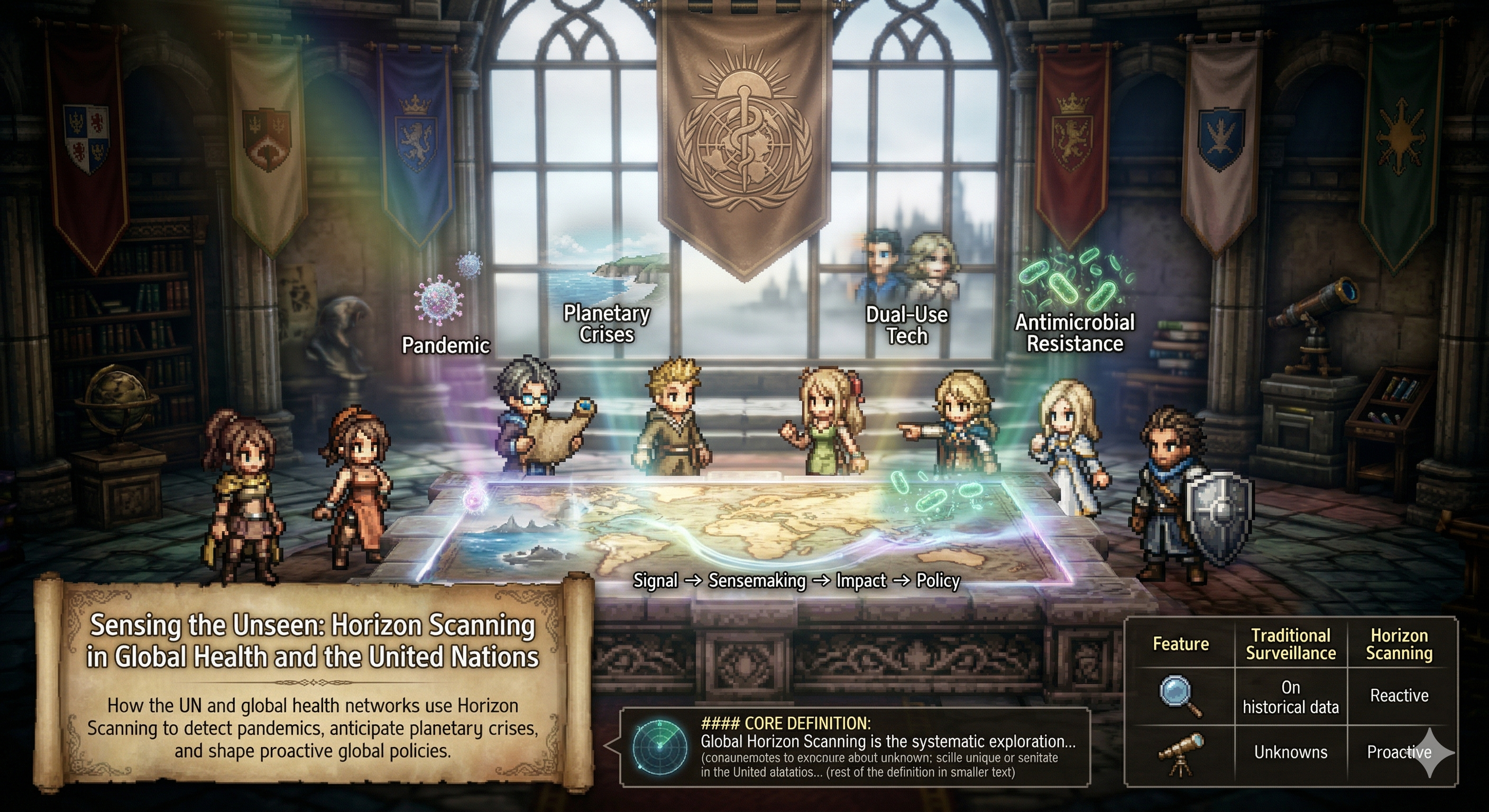
Picture the year 2019. Somewhere in the vast, chaotic ocean of global data, there were whispers. A localized cluster of unusual pneumonia. A subtle shift in supply chain orders for personal protective equipment. A spike in specific search terms on regional search engines. These were not loud alarms; they were weak signals.
Historically, humanity has possessed a tragic flaw: we are exceptional at reacting to crises, but terrible at anticipating them. We wait for the smoke to become a blazing inferno before we call the fire department. A localized viral spillover, a subtle shift in ocean temperatures, or an emerging dual-use technology can rapidly cascade into a global emergency. In an exponentially interconnected world, waiting for historical data to prove a crisis exists is a recipe for strategic failure.
This is where Horizon Scanning transitions from a niche corporate strategy tool into a critical mechanism for planetary survival.
The Analogy: Driving in the Fog
To truly understand Horizon Scanning, imagine you are driving down a treacherous, winding mountain road at midnight, engulfed in thick fog.
- Reactive Governance (Using Historical Data):This is like trying to drive forward by only looking in your rearview mirror. You only know what you've already hit.
- Traditional Risk Management:This is driving with your low-beam headlights. You can see 5 meters ahead. It’s better than nothing, but if a landslide is 10 meters ahead, you are still going to crash.
- Horizon Scanning:This is having a Satellite GPS and Radar System on your dashboard. It tells you there is a landslide 10 miles ahead, giving you plenty of time to turn the steering wheel and reroute safely before you even see the dirt.
1. "Our Common Agenda" and the UN Futures Lab
The United Nations has formally recognized that traditional, reactive governance is insufficient. In the Secretary-General's landmark report, Our Common Agenda, strategic foresight and horizon scanning were mandated as core competencies for the UN 2.0 transformation.
The UN explicitly stated the need to establish a Futures Lab and issue a recurring Global Risk Report. The goal is to integrate all UN data and intelligence, creating a global collective intelligence system that serves as the foresight brain of humanity. Instead of waiting for poverty cycles to deepen or conflicts to erupt, the UN aims to anticipate shocks and build anticipatory actions.
The Global Foresight Flowchart
How international bodies turn "noise" into "policy" using Horizon Scanning.
1. Signal Detection
Scraping open web, unstructured data, and social media for anomalies.
2. Triage & Filtering
Separating true "weak signals" from irrelevant background noise.
3. Sensemaking
Cross-referencing signals to map potential scenarios and impacts.
4. Anticipatory Action
Enacting preemptive policies, budget shifts, or regulations.
2. The UNEP Frontiers Report: Mapping Planetary Threats
Since 2016, the UN Environment Programme (UNEP) has utilized Horizon Scanning to publish the Frontiers Report. This initiative is strictly designed to identify "emerging issues of environmental concern"—local, relatively small-scale issues today that possess the potential to become regional or global catastrophes tomorrow.
By scanning scientific literature and unstructured field data, UNEP has accurately preempted several major crises. For instance, years before the global pandemic, their horizon scanning flagged Zoonotic Diseases as a critical impending threat. Recently, the 2022 report highlighted new unseen dangers, such as Phenological Shifts (climate change disrupting the life cycles of plants and animals) and Urban Noise Pollution.
UNEP Frontiers: Emerging Threat Radar
Figure 1: SVG Radar Chart mapping emerging threats based on data synthesis from the UNEP Frontiers Reports.
3. WHO and Health Technology Assessment (HTA)
Beyond environmental tracking, Horizon Scanning is the foundational step for the World Health Organization's (WHO) Health Technology Assessment (HTA) guidelines. When new pharmaceuticals or medical devices are being developed, countries cannot wait until they hit the market to figure out how to regulate or pay for them.
Through initiatives like the International Horizon Scanning Initiative (IHSI) and the BeNeLuxA coalition, European countries scan clinical trials and R&D pipelines to anticipate the economic impact of upcoming therapies (such as expensive Alzheimer's drugs). This allows governments to conduct early joint price negotiations before the drug is even approved.
WHO HTA Adoption Pipeline in Advanced Economies
Pre-market identification of emerging pharmaceuticals and disruptive medical devices.
Core evaluation of clinical trials and health economics (Cost-Benefit Analysis).
Reimbursement modeling and joint policy negotiations between member states.
Post-market tracking of technology irrelevance (The biggest global implementation gap).
Figure 2: Percentage of functional implementation stages across high-income HTA frameworks.
Conclusion: Institutionalizing Foresight
Horizon scanning is no longer a luxury for futuristic think-tanks; it is an operational necessity. The adoption of these systems by the UN and global health authorities proves that the cost of being caught off-guard far outweighs the investment required to look ahead.
We can no longer afford to learn from our mistakes after the fact. By integrating horizon scanning into policy-making, we shift from a paradigm of crisis management to one of anticipatory governance. The radar is spinning. The signals are there. The only question left is: are we paying attention?