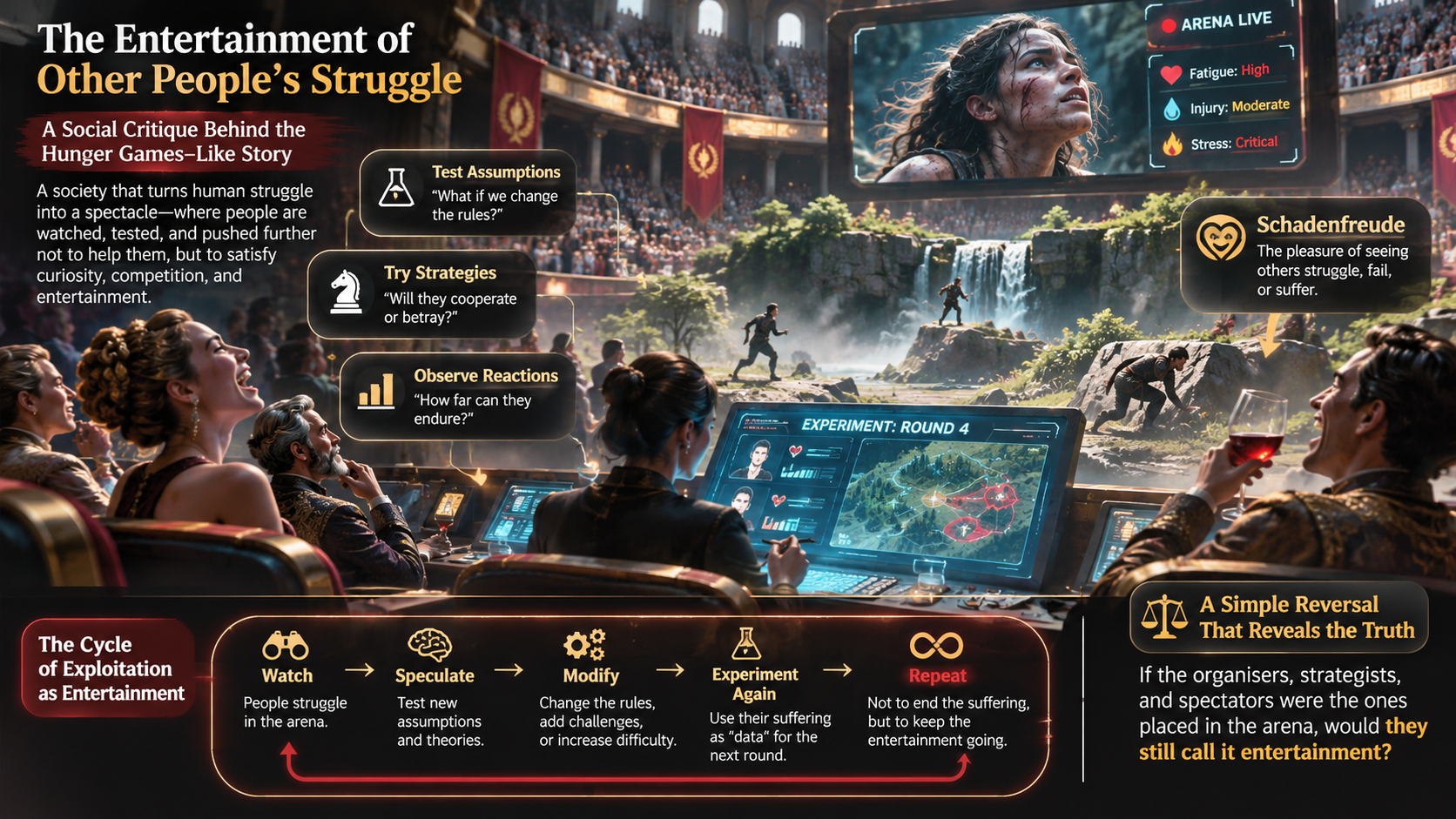
Article 92 · Social Psychology · Schadenfreude · Media Spectacle · Empathy · Social Ethics
SCHADENFREUDE: THE PSYCHOLOGY BEHIND THE HUNGER GAMES
When human suffering becomes entertainment, the audience may forget that the people inside the arena are not characters in a game. They are human beings who have to live with the consequences.
Why do people sometimes laugh when someone else fails, struggles, gets embarrassed, or finds themselves in a painful situation?
Why can a crowd become excited when another human being is pushed into a difficult situation, especially when the crowd itself is safe, comfortable, and far away from the consequences?
These questions are at the heart of a psychological concept called schadenfreude.
The word comes from German: Schaden means harm or damage, while Freude means joy. In psychology, schadenfreude refers to pleasure experienced in response to another person's misfortune.
It is an uncomfortable concept because it reveals something worth examining about human behaviour: we do not always respond to other people's suffering with sympathy. Sometimes, depending on the situation and our relationship with the person, we may experience amusement, relief, satisfaction, or even pleasure.
Films such as The Hunger Games and Gladiator offer powerful fictional settings in which to examine this behaviour. They are not psychology textbooks, and they do not prove that every audience enjoys suffering. But they can be read as social critiques of a culture that turns human struggle into public spectacle.
1. What exactly is Schadenfreude?
Schadenfreude is not simply laughing at a joke or enjoying a competition. It is the pleasure someone feels because another person has experienced a misfortune.
That misfortune might be a rival losing, a public figure being embarrassed, an arrogant person failing, or someone who is disliked experiencing a setback. The emotional response depends on how the observer interprets the event: Was it deserved? Does it benefit my group? Does it make me feel better about myself? Does it remove a person I envy from a position I wanted?
Research reviews describe several recurring routes into schadenfreude, including perceived deservingness, rivalry and social comparison, envy, and group identity. These are possible pathways, not a checklist that explains every individual reaction.
| Reaction | What it means | Example |
|---|---|---|
| Sympathy | Feeling concern or sorrow for someone else's hardship. | |
| Schadenfreude | Feeling pleasure at another person's misfortune. | |
| Gloating | Displaying satisfaction or triumph over another person's defeat. | |
| Sadism | Deriving pleasure from inflicting or witnessing suffering, often with a more active or persistent interest in the suffering itself. | Deliberately prolonging someone's distress because it is enjoyable. |
| Playful teasing | Mutual, bounded humour where participants can reasonably expect safety and stop the interaction. | A harmless magic trick that makes a friend laugh after a difficult day. |
Important distinction: Schadenfreude does not automatically mean someone is sadistic. A person may feel a moment of pleasure at a rival's setback without wanting to cause further harm. But when someone deliberately creates, escalates, or prolongs another person's suffering for entertainment, the behaviour moves beyond simply experiencing an emotion and raises a more serious ethical concern.
2. Why might someone enjoy another person's struggle?
There is no single explanation. Social psychologists have identified several mechanisms that can make another person's misfortune feel rewarding to an observer.
A. Social comparison: “At least I'm doing better.”
People often evaluate themselves in relation to others. When someone we compare ourselves with experiences a setback, the comparison can temporarily make our own position feel better.
Imagine two colleagues competing for recognition. One makes a public mistake. The other may feel relief or satisfaction, not necessarily because the mistake was funny, but because the comparison now feels less threatening.
B. Envy and threatened self-esteem
Someone else's success can sometimes make us feel inadequate, especially when we see that person as a rival or as someone who possesses something we want. If that person later fails, the observer may experience a sense of relief.

Research by van Dijk and colleagues discusses how envy and threats to self-evaluation can intensify schadenfreude. This does not mean every person who laughs at a failure is secretly envious. It means envy can be one pathway worth considering.
C. Deservingness and the desire for justice
People may feel satisfaction when someone they consider arrogant, hypocritical, unfair, or harmful experiences a consequence. In that case, the observer may interpret the misfortune as deserved punishment or a restoration of fairness.
But there is a danger here: our judgement of what someone “deserves” can be biased. A crowd may confuse accountability with humiliation, or punishment with entertainment.
D. Group identity: “Their loss is our victory.”
When people strongly identify with a group, the failure of a rival group can feel like a gain for their own side. A political opponent, rival team, competing organisation, or disliked social group may be treated less as individuals and more as representatives of an opposing side.
That shift can make empathy harder. The observer sees the group label first and the human being second.
3. The Hunger Games: when suffering becomes a designed spectacle
In The Hunger Games, the Capitol turns the forced struggle of young people into a televised event. The participants are not simply competing in a fair sporting contest. They are placed in a system of coercion where survival itself becomes the spectacle.
The audience is encouraged to follow personalities, alliances, rivalries, strategies, dramatic reversals, and moments of danger. The arena becomes a media product. Human vulnerability is packaged as a show.
This is one reason the story can be read as a critique of media spectacle and the commodification of suffering: the people watching are physically separated from the danger, while the people being watched must endure it.
The film also asks us to consider the role of power. The Capitol does not merely observe the contest; it designs the conditions, controls the spectacle, shapes the narrative, and benefits from the audience's attention.
When suffering becomes a show, the audience may start judging the performance instead of questioning why people are being made to suffer in the first place.
4. Gladiator: the crowd, the arena, and the politics of spectacle
Gladiator uses the Roman arena as a dramatic setting in which violence, public entertainment, political power, and crowd approval intersect. The film's fictional story should not be treated as a complete historical account of ancient Rome. Nevertheless, its arena is a useful cinematic image of a society where combat can be turned into a public spectacle.
The crowd watches from a position of relative safety. The fighters face physical danger. The people in the stands can cheer, boo, demand more action, or become emotionally invested in the outcome without having to enter the arena themselves.
The contrast is important: the audience has the privilege of choosing whether to watch; the person in the arena may not have the freedom to leave.
That is the power imbalance at the centre of the spectacle.
| Role | What they control | What they carry |
|---|---|---|
| The audience | Attention, approval, cheering, rejection, and the decision to keep watching. | Usually little or none of the direct physical risk. |
| The organiser / authority | Rules, conditions, incentives, framing, and the structure of the event. | May hold power while remaining distant from the immediate harm. |
| The participant | Often limited choices within the conditions imposed. | The direct physical, emotional, reputational, or social consequences. |
This is not only a question about ancient arenas or dystopian fiction. It is also a question about how modern audiences consume reality television, viral humiliation, public scandals, online pile-ons, and videos of people having a difficult moment.
5. The psychology of distance: why it is easier to watch than to endure
Distance changes how a situation feels. A viewer may see a participant as a character, a rival, a statistic, a meme, or a source of suspense. The participant experiences the situation from inside it: uncertainty, fear, pain, embarrassment, and the possibility of lasting consequences.

Media representations can invite different reactions. Some viewers feel sympathy. Some experience suspense or excitement. Some may feel schadenfreude. Others may disengage. The same scene does not produce the same emotion in everyone.
Research on media reception has specifically examined how audiences respond to portrayals of other people's misfortunes, including the difference between schadenfreude and sympathy. This helps explain why the act of watching is not psychologically neutral: the story, the viewer's attitudes, perceived deservingness, and social context can all shape the response.
Conceptual illustration, not a diagnostic model. Audience reactions vary; distance can shape perception, but it does not erase empathy in every viewer.
6. The perspective reversal: what if the organisers were tested?
Here is the thought experiment I find most revealing.
Imagine the people who design the challenges, set the rules, observe the participants, and decide what counts as an entertaining outcome. Now reverse the roles.
What if the organisers had to enter the arena? What if their safety, dignity, relationships, reputations, and futures became the variables in someone else's experiment? What if another group controlled the rules and watched to see whether they succeeded, failed, or became more distressed?
Would they still describe the experience as harmless entertainment?
Would they still call it “just a test” if they were the ones carrying the consequences?
This reversal exposes a possible double standard: people may support a system when they occupy the position of observer or decision-maker, yet reject the same system when they become its subject.
Of course, not every organiser is cruel, and not every audience member is indifferent. The point is to examine the structure of power and responsibility, rather than assume that everyone involved has the same motives.
7. Entertainment, harmless humour, and cruelty are not the same thing
Not every surprise, prank, competition, or psychological trick is harmful. Humour can help people reconnect, reduce tension, and feel less alone. A magic trick that cheers up a sad friend, or a harmless surprise that makes someone laugh, can be a kind gesture.
The ethical difference lies in consent, context, power, risk, and the ability to stop. Is the other person included in the fun, or are they the target? Can they opt out? Does the joke preserve their dignity? Does it help them feel better, or does it make their distress the entertainment?
| Harmless play | Humiliation disguised as humour |
|---|---|
| The goal is shared laughter. | The goal is to laugh at someone's distress. |
| The person can opt out without punishment. | The person is pressured to tolerate it. |
| The joke avoids exploiting vulnerability. | The joke targets grief, anxiety, insecurity, or mental health. |
| The interaction stops when someone is uncomfortable. | The reaction is pushed further because it is entertaining. |
| The person remains a participant in the fun. | The person becomes an object of the spectacle. |
If someone is already distressed, deliberately provoking them to see how much worse they become is not clever psychological play. It is a disregard for another person's wellbeing.
Make someone laugh with you, not at the cost of their dignity.
8. From the arena to everyday life: the spectator effect in ordinary relationships
The same pattern can appear outside films and public spectacles. Someone may watch a friend struggle with a relationship, a colleague face a professional setback, or a stranger become the subject of online ridicule.
Sometimes observers offer support. Sometimes they offer practical advice. Sometimes they turn the situation into gossip or entertainment. In more harmful cases, people may deliberately provoke misunderstandings, test emotional boundaries, or keep escalating a conflict to observe the reaction.
That behaviour is not automatically schadenfreude in the strict psychological sense. Schadenfreude describes the pleasure at another's misfortune; deliberately creating the misfortune adds an active element that needs separate ethical consideration.
There is a difference between observing a difficult situation and manufacturing one for amusement.
| Situation | Observer-centred response | Human-centred response |
|---|---|---|
| A person is heartbroken. | Turn their sadness into gossip or a social experiment. | Offer company, listen, or respect their need for space. |
| A colleague makes a mistake. | Enjoy the embarrassment and spread the clip. | Address the error fairly and help prevent repetition. |
| A misunderstanding occurs. | Provoke the person to see how they react. | Clarify, ask questions, and set boundaries. |
| Someone is anxious or overwhelmed. | Increase pressure because the reaction is amusing. | Reduce unnecessary pressure and avoid exploiting vulnerability. |
9. The ethical question: who benefits, and who pays?
One of the most important questions in any spectacle or experiment is how benefits and risks are distributed.
The audience may receive excitement, social connection, status, or entertainment. The organiser may receive attention, influence, money, or political advantage. The participant may receive recognition or a reward, but may also carry the most immediate risk.
This is not always unfair: some participants voluntarily enter competitions and knowingly accept reasonable risks. The concern becomes sharper when participation is coerced, the risks are hidden, the rules are unequal, or the suffering of participants is treated as a resource for other people's enjoyment.
Responsible systems need transparent rules, meaningful consent, proportionate safeguards, accountability, and a genuine way to raise concerns or withdraw where possible.
10. A final reflection: do not confuse the show with the human being
Stories such as The Hunger Games and Gladiator can entertain us while also challenging us to examine why crowds gather around spectacle, how power shapes what they see, and how easily another person's struggle can become part of a show.
But the most important question is not whether we enjoy dramatic stories. Fiction allows us to explore danger from a safe distance. The question is what happens when we carry the same spectator mentality into real life — when another person's pain becomes gossip, a joke, a test, or a source of personal satisfaction.
We can enjoy competition without wishing for someone's destruction. We can laugh without humiliating. We can challenge people without turning their vulnerability into an experiment. And we can hold someone accountable without celebrating their suffering.
Experiment with ideas, systems, and strategies. Do not casually experiment with another person's dignity, emotional wellbeing, or future. If a challenge is not safe or fair enough for you to accept yourself, think twice before imposing it on someone else.
“If you enjoy watching someone struggle from the safety of the audience, would you still call it entertainment if you were the one inside the arena?”
Perhaps the real test of our humanity is not how loudly we cheer from the stands, but whether we remember the person who is struggling in the arena.
References and further reading
- Suter, L. S. & Döveling, K. (2024). “Seeing others suffer and enjoying it? The Model of Individual and Social Appraisals of Misfortunes of others in media reception.” Frontiers in Psychology. https://doi.org/10.3389/fpsyg.2024.1437721 — A review and conceptual model of schadenfreude and sympathy in media reception.
- Boecker, L., Loschelder, D. D. & Topolinski, S. (2022). “How individuals react emotionally to others' (mis)fortunes: A social comparison framework.” Journal of Personality and Social Psychology, 123(1), 55–83. https://doi.org/10.1037/pspa0000299 — A framework describing emotional responses ranging from sympathy to envy and schadenfreude.
- Smith, R. H., Powell, C. A. J., Combs, D. J. Y. & Schurtz, D. R. (2009). “Exploring the When and Why of Schadenfreude.” Social and Personality Psychology Compass, 3, 530–546. https://doi.org/10.1111/j.1751-9004.2009.00181.x — Reviews common conditions associated with schadenfreude, including rivalry, deservingness, and envy.
- van Dijk, W. W., Ouwerkerk, J. W., Smith, R. H. & Cikara, M. (2015). “The role of self-evaluation and envy in schadenfreude.” European Review of Social Psychology, 26(1), 247–282. https://doi.org/10.1080/10463283.2015.1111600 — Reviews links between self-evaluation, envy, and pleasure at others' misfortunes.
- Wang, S., Lilienfeld, S. O. & Rochat, P. (2019). “Schadenfreude deconstructed and reconstructed: A tripartite motivational model.” New Ideas in Psychology, 52, 1–11. https://doi.org/10.1016/j.newideapsych.2018.09.002 — Discusses aggression, rivalry, justice, and dehumanisation as relevant themes.
- Liebel, S. & Liebel, V. (2010). “The Hunger Games.” Journal of American Studies of Turkey, 32, 134–136. https://jast.org.tr/index.php/main/article/view/1705 — A film review discussing spectacle, media culture, and the commodification of suffering.
- “Death from all sides”: spectacle, morality, and trauma in Suzanne Collins’ The Hunger Games trilogy (2021). Mortality. https://doi.org/10.1080/13576275.2021.1987664 — Examines the tension between representing violence as spectacle and critiquing the devaluation of human life.
Conceptual note: Schadenfreude is an emotion, not a diagnosis. It is distinct from actively causing or prolonging another person's suffering. Film interpretations in this article are critical readings of fictional works, not claims that every viewer responds in the same way or that the films provide a complete historical account.
