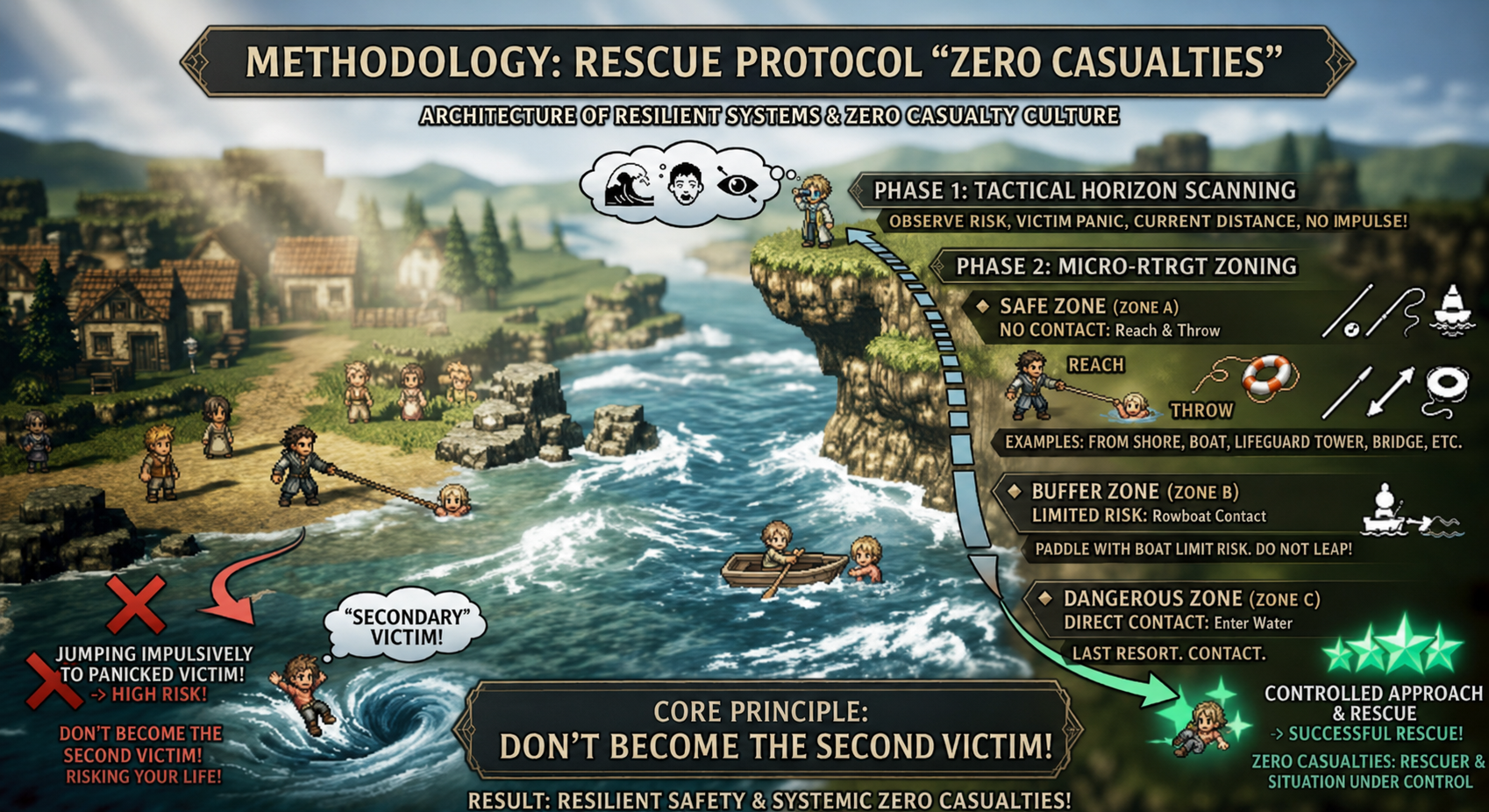
In Disaster Risk Reduction (DRR) discourse, we habitually think at macro scale: seismic hazard maps, tsunami early warning systems, or 20-year Regional Land Use and Spatial Plans (RTRGT). But what happens when these colossal frameworks are compressed into a single emergency incident lasting no more than five seconds? The conceptual core does not change — it mutates into what practitioners now call Micro-Spatial Planning and Tactical Horizon Scanning: the same principles of risk zoning, threat detection, and safe-space allocation, now operating at the speed of human reflex.
One of the most vivid manifestations of spatial planning failure at the micro level is the Secondary Victim phenomenon in water rescue. A heroic impulse to save a drowning person frequently ends in the rescuer's death — a direct consequence of collapsed situational awareness and violation of safety zoning principles. Through a DRR lens, leaping directly into the water toward a panicking victim is no different from constructing a hospital directly above an active fault line: both are failures to lock physical space to observed threat signals. Both are tragedies born from ignoring the map.
1. From Macro to Micro: The DRR Scale-Translation Problem
The Sendai Framework for Disaster Risk Reduction 2015–2030 articulates four strategic priorities: understanding risk, strengthening governance, investing in resilience, and enhancing preparedness. These are long-horizon instruments designed for systemic change across decades. Yet every large-scale disaster is ultimately a mosaic of micro-events — individual human decisions made in seconds, without dashboards, without time to consult protocols, and without the training that most populations never receive.
This is the DRR Scale Gap: the chasm between a national hazard zonation map and the cognitive state of a bystander on a pier watching someone go under. The national plan cannot bridge this gap alone. Only internalized micro-protocols — spatial doctrines trained into reflexive behavior — can function at incident speed. The macro framework sets the architecture; the micro protocol is its execution engine, running at the speed of the human nervous system.
Micro-RTRGT is the answer to the scale gap. It translates four core functions of spatial planning — hazard identification, zone delineation, access control, and risk-proportional intervention sequencing — into a sub-10-second cognitive and physical protocol executable under acute stress. The framework does not shrink. It sharpens into its most essential form: a spatial map of human safety, compressed to fit inside a panicked mind.
2. Micro Horizon Scanning: Reading Weak Signals in Seconds
At national scale, Horizon Scanning detects early-stage signals of climate disruption, geopolitical instability, or emerging technological risk before they crystallize into crises. At incident scale, Horizon Scanning becomes Dynamic Risk Assessment (DRA) — a structured, rapid environmental sweep executed in the first 2–3 seconds before any physical action is taken. The analytical tool is identical; only the temporal resolution and spatial scope change.
Before a rescuer moves, their cognitive system must scan three critical signal domains:
- Behavioral Scan (Victim State Analysis): Is the victim in Active Drowning — violent thrashing, exponential adrenaline, peak panic — or Passive Drowning — silent, submerging, no purposeful movement? A panicking victim's survival brain has biochemically overridden higher cognition. They do not perceive the rescuer as a helper: they perceive a flotation structure to climb. This is the highest-priority red flag in any rescue horizon scan. USLA incident data indicates that direct physical contact with a panicking drowning victim without equipment results in the rescuer being submerged in 68–75% of untrained rescue attempts.
- Environmental Scan (Contextual Hazard Detection): Is there a rip current — a fast, narrow channel pulling offshore? Is water temperature below 15°C, triggering rapid-onset hypothermia? Are there submerged obstacles, vessel traffic, or downstream hazards? Environmental scanning determines whether the aquatic medium will support intervention or neutralize the rescuer regardless of swim skill. A strong rip current is an equalizer: it does not care how well you swim.
- Resource Scan (Asset Inventory): What tools are immediately available — a life ring, a rope, a throw bag, a rigid pole, a piece of clothing, a nearby boat? Asset awareness is the cognitive bridge between threat analysis and action selection. A rescuer who scans correctly but lacks inventory awareness defaults to the most dangerous option — direct-swim entry — not out of poor judgment, but because unstructured panic eliminates option generation. Research from the Royal Life Saving Society Australia suggests trained rescuers following a structured 3-second DRA reduce secondary victim probability by over 80%.
💡 The 3-Second Rule in Dynamic Risk Assessment
Behavioral scan → Environmental scan → Resource scan. This three-beat cognitive rhythm, practiced until automatic, is the difference between a rescuer and a second victim. The scan costs three seconds. The failure to scan can cost a life.
3. The Psychology of the Secondary Victim: When Heroism Becomes the Hazard
The secondary victim phenomenon is one of the most extensively documented yet systematically under-trained dimensions of water rescue. A secondary victim is a would-be rescuer who drowns alongside — or instead of — the original casualty. International Life Saving Federation (ILSF) data indicates that approximately 10–15% of open-water drowning fatalities involve a secondary victim: most commonly a family member, close friend, or proximate bystander who entered the water without equipment or protocol, driven purely by love or instinct.
Why does this happen? Under acute stress combined with strong social motivation — witnessing a loved one in mortal danger — the human nervous system executes a well-understood threat-response cascade:
- The amygdala fires an urgency signal activating an immediate action bias, suppressing deliberate evaluation before it can begin.
- Mirror neurons generate powerful empathetic distress, amplifying subjective urgency and compressing perceived decision time to near zero.
- The prefrontal cortex — the seat of rational risk assessment and consequence modeling — is partially suppressed under acute adrenaline. The brain's risk calculator goes offline precisely when it is most needed.
- Attentional tunneling causes the rescuer to hyperfocus on the victim's face and position, eliminating peripheral awareness of environmental hazards — the current, the depth, the distance back to shore.
The result is a physiologically normal human response that, in a drowning emergency context, is profoundly lethal. The rescuer's instinct to help becomes the instrument of their death. From a DRR perspective, this is structurally identical to constructing critical infrastructure in a mapped flood zone — not from ignorance, but because the decision architecture was never engineered to encode risk awareness under the specific cognitive conditions of acute emotional stress. The solution is not to suppress the heroic impulse. It is to pre-load the brain with automated spatial protocols that fire before the impulse to enter the water — to install the cognitive map before the storm hits.
4. Cognitive Biases That Override Protocol: The Internal Terrain of Risk
Horizon Scanning as a DRR instrument was designed to detect external signals. In tactical rescue, however, the most dangerous signals are internal: cognitive distortions operating below conscious awareness that systematically override trained protocol, even in individuals who have received rescue training.
- Heroism Bias (Action Imperative): The social and psychological pressure to "do something visible" creates a strong preference for conspicuous physical action — jumping in — over less visible but safer alternatives like throwing a life ring. This bias intensifies proportionally with witness presence: the more observers, the stronger the pull toward the most dramatic-looking response.
- Swim Competency Overconfidence: Studies across multiple national contexts find that approximately 73% of non-professional rescuers who became secondary victims self-assessed as "strong swimmers" before the incident. Individual swim competency is largely irrelevant when a panicking adult weighing 75–90 kg, powered by peak-adrenaline survival force, latches onto any part of your body in open water.
- Anchoring on Static Victim Position: Rescuers fixate on the victim's current surface location while failing to model dynamic trajectory — the victim is sinking, drifting with a current, or moving toward a deeper hazard. This produces entry points that place the rescuer in unexpectedly dangerous water with no margin to reverse the decision.
- Survivor's Bias Heuristic: Prior exposure to successful impulsive rescues — personal or witnessed — creates a false baseline: direct-swim rescue seems reliable because it is the version of the story that gets told. The counterpart narrative — the hero who drowned — is told by coroners, not by the rescuers themselves. Each survival outcome reinforces the "available" hero narrative while statistically suppressing the cautionary tale.
- Premature Closure Under Time Pressure: When milliseconds feel like eternities, the brain terminates risk assessment before completion and defaults to the most immediately available action. This is the rescue equivalent of a structural inspector signing off on a seismic assessment after examining only the foundation — the rest of the structure remains unchecked, and the failure mode lives precisely there.
5. Micro-RTRGT: The Tactical Spatial Zoning Doctrine
In urban and regional planning, RTRGT (Rencana Tata Ruang dan Guna Tanah — Regional Land Use and Spatial Plan) defines where human habitation and critical infrastructure are permitted relative to mapped hazard zones. At its core, it encodes risk intelligence into the physical environment, so that individual decisions are structured by spatial architecture rather than real-time personal judgment under pressure.
In water rescue, this principle is formalized as the Reach-Throw-Row-Go (R-T-R-G) doctrine — the international tactical standard recognized by the United States Lifesaving Association (USLA), the International Life Saving Federation (ILSF), and Royal Life Saving Societies worldwide. R-T-R-G is not a menu of equivalent options. It is a prioritized, spatially-sequenced protocol that forces the rescuer to maintain maximum physical distance from the victim while still achieving rescue contact. Each step up the sequence expands the rescuer's zone of exposure and should only be taken when all prior options are genuinely exhausted.
Rescue Zoning Architecture (Micro-RTRGT)
Mapping the R-T-R-G framework by rescuer risk exposure level and physical space displacement from the victim.
Zone 1 — REACH (Safe Zone | Land | Rescuer Risk: 0–5%)
The rescuer extends a rigid or flexible object — a pole, belt, rope, branch, piece of clothing — from a position of full physical security on solid ground. One foot should be braced against a fixed object, or a second person should hold the rescuer's ankles. The extension maintains full ground-anchor integrity while bridging the rescuer-victim gap. This is always the first-choice action regardless of distance, because it costs nothing: the rescuer never enters the hazard zone, and if reach fails, they remain safe to attempt the next option.
Zone 2 — THROW (Safe Zone | Land's Edge | Rescuer Risk: 0–10%)
The rescuer launches a buoyancy device — a ring buoy with attached line, a throw bag, or any improvised buoyant object — toward the victim, while remaining on solid ground. A well-executed throw to an alert victim is one of the highest-success rescue methods in the entire toolkit: it neutralizes distance, provides buoyancy, and maintains a retrieval line — all without exposing the rescuer to any aquatic hazard. THROW is the primary answer to the distance problem that REACH cannot solve, and its success rate depends heavily on the passive infrastructure available at the site.
Zone 3 — ROW (Buffer Zone | Water | Rescuer Risk: 30–50%)
The rescuer accesses the victim via a watercraft. The boat hull serves as a rigid physical barrier — preventing direct body-to-body contact and the dangerous force transfer that contact creates with a panicking victim. However, ROW introduces significant environmental risk exposure: rip currents, capsize, vessel traffic, navigation hazards. This is precisely why Environmental Scanning must be completed before ROW is selected. A boat in a rip current may become part of the hazard rather than its solution.
Zone 4 — GO (Danger Zone | Open Water | Rescuer Risk: 80–100%)
Direct water entry and swim approach. This is a last-resort option under R-T-R-G doctrine, reserved for situations where all prior options have been genuinely exhausted and the victim is passive — unconscious or calm enough to safely approach. Under no circumstances should GO be executed against a victim in active panic — the rescuer will be used as a flotation platform and both parties submerged. If GO is unavoidable with any residual panic, approach must come from behind using a cross-chest carry with a buoyancy aid. The 80–100% rescuer risk rating for GO is not theoretical: it reflects documented incident data across multiple national jurisdictions.
6. Interactive Simulation: Rescue Protocol
To internalize Micro-RTRGT as a reflexive cognitive model rather than a memorized checklist, the simulation below puts you in the rescuer's position. Your task: scan the Horizon Scanner for threat signals, then select the correct spatial zone (R-T-R-G) for the scenario presented. The simulation is not about speed — it is about sequencing. The right answer is always the one that keeps you furthest from the hazard while still achieving the rescue objective.
Simulation Rules:
- Monitor the Horizon Scanner for victim status and environmental conditions before making any decision.
- Always prioritize REACH / THROW (Safe Zone) as your first and second actions in every scenario.
- Pressing GO (Danger Zone) while the victim is in CRITICAL/PANIC status results in both rescuer and victim drowning (Game Over). This mirrors real-world incident data.
RESCUE
PROTOCOL
The First Rule of Emergency Response:
DO NOT BECOME VICTIM #2
1. SCAN the Horizon Scanner before acting.
2. SELECT ZONE - Follow R.T.R.G priority:
- 🟢 Reach: Extend a stick or object (victim nearby).
- 🟢 Throw: Launch life ring or rope (victim far).
- 🟡 Row: Approach by boat (check for currents).
- 🔴 Go: Swim in. FATAL if victim panics!
SUCCESS
You saved them.
7. Passive Infrastructure: Engineering Compliance Into Space
The deepest lesson of Micro-RTRGT is that trained protocols alone are insufficient. Training degrades under acute stress. Cognitive overload suppresses learned behavior precisely when it is most needed. And the vast majority of bystanders in public water emergencies — domestic tourists, children, elderly individuals, non-swimmers — will never receive formal rescue training in their lifetimes. The solution is Passive Safety Infrastructure: the spatial design equivalent of automotive passive safety systems — crumple zones, automatic braking, airbags — that protect without requiring active decision-making from the user under stress.
Passive infrastructure in water safety operates on the principle of cognitive default engineering: designing the physical environment so that the safest available action is also the most immediately visible, most physically accessible, and most cognitively salient option. The goal is to make the correct choice the path of least resistance — for a trained professional, a panicking bystander, and a terrified child alike.
- Ring Buoy Stations at 50-Meter Intervals: Clearly marked, brightly colored ring buoy stations — ideally fluorescent orange — every 50 meters along piers, riverfronts, lake edges, and public swimming areas. The visual salience of the ring buoy short-circuits the "GO" impulse by providing a clearly superior, instantly accessible alternative. ILSF guidelines specify a minimum 20-meter retrieval line attached to all open-water ring buoys.
- Reach Poles with Integrated Safety Rails: Fixed rescue poles (fiberglass, 4–6 meters) mounted at water-access points with integrated grab rails. The physical geometry of bending over the rail to extend the pole makes it mechanically difficult to fall or jump in — the infrastructure itself imposes the correct body posture for a safe-zone rescue, without requiring any cognitive engagement from a panicking bystander.
- Behavioral Sequencing Signage: Unlike conventional prohibition signs ("No Swimming"), behavioral sequencing signs display the R-T-R-G hierarchy visually and instruct the decision sequence prospectively — before any emergency occurs. The DRR mechanism here is prospective risk priming: installing the cognitive protocol in working memory before panic suppresses rational processing. A person who has seen the protocol sign ten times will execute it faster under stress than one who encounters it for the first time.
- Environmental Hazard Indicators: Rip current warning flags, current direction markers, depth buoys, and underwater hazard demarcation systems communicate real-time threat levels without requiring any prior site knowledge from the observer. These reduce secondary victim incidents by reducing impulsive swim rescues during high-hazard conditions — not through prohibition, but by enabling the brain to update its risk model before the body moves.
The design principle unifying all passive infrastructure: the best spatial plan does not rely on the rationality, training, or calm of the person using it. It works on an untrained bystander in a state of acute panic because it has removed the requirement for a decision and replaced it with an obvious action. This is Micro-RTRGT at its most fundamental — a spatial plan that protects people from the lethal force of their own heroic instincts.
8. Beyond Water Rescue: Scaling Micro-RTRGT Across Emergency Domains
The conceptual architecture of Micro-RTRGT is not unique to aquatic emergencies. It is a universal template for any context where secondary casualties from impulsive, unprotected intervention are a documented risk. The core logic — hold position as far from the hazard as effectiveness allows; expand zone exposure only when all safer options are exhausted — is directly transferable:
- Industrial Confined Space Rescue: Mines, storage tanks, sewers, and industrial vessels follow an R-T-R-G-equivalent protocol: equipment-assisted retrieval rope (Reach), mechanical winch extraction (Throw equivalent), unmanned entry vehicle (Row equivalent), then PPE-equipped physical entry (GO). OSHA data indicates that approximately 60% of confined space fatalities involve would-be rescuers — a secondary victim rate that exceeds that of open-water drowning incidents.
- Fire and Structural Rescue: The absolute prohibition on entering a smoke-filled space without Self-Contained Breathing Apparatus (SCBA) is a formalized GO prohibition — a Micro-RTRGT constraint enforced through equipment policy rather than individual judgment. The passive infrastructure equivalent is SCBA availability at station and the physical requirement to don it before entry.
- CBRN / Hazmat Response: Hot zone, warm zone, and cold zone approach structures mirror the RTRG spatial model precisely. Entry into a hot zone without appropriate PPE rating is a GO-equivalent prohibition regardless of victim status, urgency, or social pressure. The spatial boundary is the protocol — there is no override, no exception, no heroism clause.
- Mass Casualty and Prehospital Trauma: The "scene safety first" mandate in Prehospital Trauma Life Support (PHTLS) and Tactical Combat Casualty Care (TCCC) protocols is a formalized Horizon Scanning requirement — a mandatory environmental sweep before any physical triage begins. A medic who enters an active threat zone to reach a casualty without confirming scene security is executing an unsequenced GO: lethal for the medic, and counterproductive for the patient they intended to save.
The universal principle underlying all of these domains: no protocol can save lives if it consistently kills the responder. The spatial discipline of R-T-R-G — staying as far back as effectiveness permits — is the physical expression of the most important truth in emergency response: a dead rescuer saves no one.
Failure to hold the safe zone is the primary generator of secondary victims. The best spatial plan — at any scale, in any domain — is the one that protects responders from the lethal force of their own heroic instincts. Build the environment so the right decision is automatic. Train the protocol so the right decision is reflexive. Then, and only then, can we approach Zero Casualties.
#DisasterRiskReduction #MicroSpatialPlanning #WaterRescue #HorizonScanning #ZeroCasualties #PassiveInfrastructure #DynamicRiskAssessment #SendaiFramework #SecondaryVictim #RTRG #CognitiveBias #EmergencyResponse
Scientific References & Safety Protocols
United States Lifesaving Association (USLA) & International Life Saving Federation (ILSF). Water Rescue Standards and Protocol: The Reach, Throw, Row, Go Hierarchy. Primary international doctrine underlying the Micro-RTRGT zoning model in this article. Establishes risk classifications by zone and mandates equipment-first intervention sequencing for all open-water rescue operations.
UNDRR (United Nations Office for Disaster Risk Reduction). Sendai Framework for Disaster Risk Reduction 2015–2030. Priority 3 — Investing in DRR for Resilience — provides the macro-level policy foundation for passive safety infrastructure investment. The scale-translation argument in this article draws directly on the Framework's emphasis on community-level risk encoding and behavioral resilience building.
Pusat Krisis Kesehatan, Kementerian Kesehatan RI (Indonesian Ministry of Health, Health Crisis Center). Technical Guidelines for Emergency Medical Evacuation and the Secondary Victim Phenomenon. Indonesian field data on rescuer fatality ratios attributable to failed Dynamic Risk Assessment in domestic open-water and flood emergency incidents.
Royal Life Saving Society Australia. Dynamic Risk Assessment in Aquatic Emergency Response: Reducing Secondary Victim Probability Through Structured Pre-Action Scanning. Research documenting the 80%+ reduction in secondary victim probability achieved through the structured 3-second DRA protocol among trained open-water responders, cited in Section 2 of this article.
U.S. Occupational Safety and Health Administration (OSHA). Standards for Permit-Required Confined Spaces (29 CFR 1910.146). Statistical foundation for the secondary victim rate in industrial confined space incidents cited in Section 8. Documents that the majority of confined space fatalities involve would-be rescuers rather than original victims — the highest cross-domain secondary victim rate in emergency response literature.
Kahneman, D. Thinking, Fast and Slow. Farrar, Straus and Giroux, 2011. Cognitive science foundation for Section 4: the neurological basis of the action imperative, anchoring bias, availability heuristic, and premature closure under acute stress — the System 1 threat-response mechanisms that override trained protocol in emergency contexts and produce the secondary victim phenomenon.