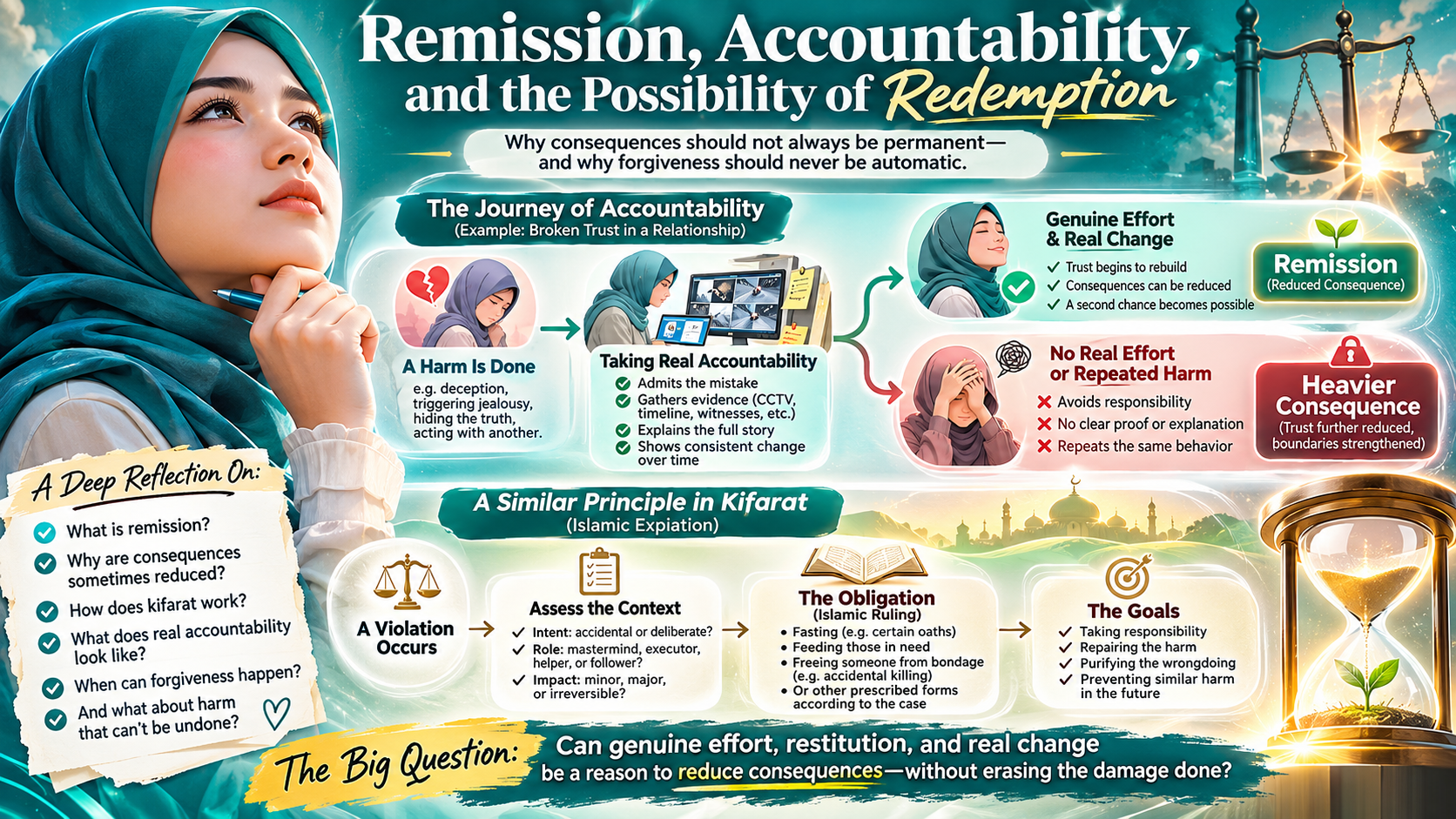
1. What Is Remission—and Why Reduce a Sentence?
In criminal justice, remission generally refers to a reduction in the time someone must serve in prison, when legal requirements are met. Why should a sentence ever be reduced? If a person committed an offense, why should the consequence become shorter?
Because punishment is not necessarily meant only to make someone suffer. It can also serve rehabilitation, encourage accountability, and recognize genuine change. A system that allows a person to demonstrate progress is acknowledging that people are not necessarily frozen in the worst thing they have ever done.
Remission is not a declaration that the offense was harmless, nor is it a prize for saying the right words. It is a mechanism that—within the rules and the facts of a case—can recognize conduct, rehabilitation, and eligibility.
Consequences should encourage accountability—not merely suffering.
That raises a question I find interesting: if consequences exist because someone did something wrong, can genuine effort to take responsibility become a reason to reduce those consequences?
2. Remission Is Not Erasing What Happened
Reducing a sentence does not mean the crime never happened. Forgiving someone does not mean the damage was imaginary. Rehabilitation does not mean the victim was never harmed. These are three different things, and confusing them can make accountability feel either cruel or meaningless.
Someone can recognize that another person has improved while still acknowledging the pain they caused. Someone can believe in redemption without denying the past. Someone can support giving a person another opportunity without demanding that the victim forgive them.
Forgiveness and accountability can coexist. In fact, genuine accountability may be what makes forgiveness possible: it gives the harmed person something more substantial than a promise to rely on.
3. A Personal Example: Trust, Jealousy, and Accountability
Imagine I am interested in someone romantically. I want to build a relationship, but she does things that hurt me—perhaps deliberately makes me jealous, shares a room with another man, or behaves in ways that make me question whether she is being honest with me. Maybe she says it was a test. Maybe she wanted to see whether I cared. Maybe there are other explanations. Whatever the explanation, trust has been affected.
I do not have to immediately say, “Fine, I forgive you. Everything is back to normal.” But neither do I have to declare that one mistake permanently defines a person, leaving no possibility of change.
If someone wants to repair trust, I would expect accountability: an honest explanation, acknowledgment of their actions, willingness to clarify what happened, and consistent behavior that demonstrates change. Not simply a demand for forgiveness. Not “If you love me, you should trust me.” And not an apology followed by the same behavior.
My boundary is not a sentence imposed by a court. It is a personal decision about whether I am willing to continue a relationship and what I need in order to feel safe doing so. I can decide to forgive without reconciling, or to leave even if the other person later makes an effort.
The goal is not to punish someone forever. The goal is to find out whether trust can genuinely be rebuilt—and to remember that reconciliation must be voluntary on both sides.
4. Accountability Can Take Time
Suppose someone disappears from my life for three years and then returns. I do not have to believe everything they say immediately, nor restore the relationship in one conversation. Meaningful accountability can take time. Sometimes explanations need to be given gradually; sometimes credible evidence is available only later; and sustained change is more convincing than a dramatic apology that lasts one day.
Accountability might involve acknowledging what happened without denial, explaining a timeline honestly where relevant, clarifying misunderstandings with credible evidence, taking responsibility for one's own decisions, demonstrating behavioral change over time, repairing what can reasonably be repaired, and respecting the other person's boundaries.
Evidence can help—but accountability should not become coercive surveillance. CCTV, location histories, private accounts, or personal data should never be demanded or accessed improperly. Verification must be proportionate, lawful, respectful, and relevant. Consistent behavior over time may be the strongest evidence of change.
Three years of silence does not mean I must demand an exhaustive record of every minute. A fair assessment can use reasonable, relevant, credible information. Sampling or a focused review can sometimes help assess a pattern, but it cannot create certainty about every unseen event. The purpose is understanding—not turning intimacy into an investigation.
5. A Flow of Trust Repair: Effort Can Change the Outcome
This is the principle I have in mind: the initial harm matters, but the person's response to it matters too. Genuine effort should have a meaningful consequence—sometimes a reduction in emotional distance, more willingness to communicate, or the possibility of reconciliation. Lack of effort or repeated harmful behavior may mean trust remains unrepaired and boundaries stay in place.
For example, imagine a person returns after a long absence. One path is that they avoid the conversation, dismiss the hurt, become increasingly close to someone else while still expecting trust, or repeat the same behavior without accountability. Another path is that they make a sincere effort: they communicate, clarify what they can, accept responsibility, and show change consistently. Those paths should not produce identical assessments.
The flow is a personal relationship analogy—not a legal process or permission to control, surveil, or punish another person. The person harmed remains free to forgive, decline reconciliation, or leave.
If someone makes sustained, sincere effort, I may decide that the consequences no longer need to remain as severe. If they become increasingly indifferent, repeat the same behavior, or show no effort to repair the damage, I may decide that trust cannot be restored. An apology should not become a reset button for repeated harm.
At the same time, effort does not guarantee forgiveness. It may make remission possible, but it does not create an entitlement to another person's affection, access, or reconciliation. The person harmed remains free to say no.
6. Different Wrongdoing Can Require Different Forms of Accountability
This is what made me think about kifarat—expiation in Islamic jurisprudence. I am not saying that remission in criminal law and kifarat are interchangeable. Their rules and purposes are different. But the broader question is fascinating: why do different violations have different forms of expiation or obligation?
In Islamic teaching, expiation is not a universal payment system in which every wrongdoing has a price and the offender may choose whichever option is convenient. Specific obligations depend on the specific offense and the relevant religious rulings. In some matters, prescribed forms may include fasting, feeding people in need, or freeing a person from bondage, where applicable under the rules. The rights of other people may also remain separate from expiation.
The principle that interests me is that wrongdoing is not always identical. Intent matters. Circumstances matter. The nature of the harm matters. A person's ability to repair it matters. The rights of those affected matter. One act may have a prescribed expiation, another may involve compensation or other obligations, and another may be more complex or irreversible. A qualified religious teacher can explain the rule for a specific case.
This is a simplified educational flow. It does not present the listed forms as interchangeable choices. The actual ruling depends on the specific case and qualified religious guidance.
This diagram is a conceptual flow of reasoning—not a menu of interchangeable choices and not a fatwa. It illustrates why identifying the actual act and applicable ruling comes before assuming which form of expiation is appropriate.
7. Accidental, Deliberate, and Irreversible Harm
Consider the difference between accidentally causing harm and deliberately causing harm. Consider the difference between a person who had no intention of hurting someone and a person who planned it. Consider the difference between a participant and someone who designed, commanded, or organized the entire operation.
Then consider the damage itself. Some harm is reversible. Some is partially repairable. Some is irreversible.
- Reversible: property can be repaired or returned; a mistake in a record can be corrected.
- Partially reversible: a false accusation may be corrected, but reputation, time, trust, or opportunities may not fully recover.
- Irreversible: a life is lost. No apology can restore that life or recreate the future that person would have lived.
This is why accountability should consider not only what was done, but what the action made impossible. The repair plan should not pretend that every loss can be returned to its original condition.
8. Defamation: When a Lie Can Damage More Than One Life
Imagine someone spreads a false accusation. The victim loses their job. Their reputation is damaged. Their family suffers financially. Their children lose stability, education, and opportunities. The consequences accumulate, and perhaps the victim eventually dies.
The harm may extend beyond the immediate victim. A family can lose stability and future opportunities across generations. If the victim would have had children or grandchildren, the future that might have existed is now impossible to know or recover. The loss is not only a salary or a reputation—it may include years of choices, relationships, experiences, and potential.
We must be careful not to assume every later tragedy was automatically caused by the original accusation. Causation is complex and should be established. But the larger point is that some wrongdoing creates consequences that cannot be measured by the immediate loss alone.
In such a case, a simple apology may feel inadequate. What happened to the victim's livelihood? Their family? Their opportunities? What can actually be restored—and what cannot? Restitution, correction, or support may help, but they cannot rewrite history.
9. Collective Wrongdoing: The Mastermind, the Executor, and the Follower
Imagine a group causes serious damage. Should every member receive exactly the same consequences? Not necessarily.
There may be a mastermind who planned the operation, someone who gave orders, a direct perpetrator, a person who knowingly facilitated it, a marginal participant, someone who was manipulated or threatened, and someone who tried to stop the damage.
They are not necessarily equally responsible. Participation alone does not establish identical guilt. Intent, knowledge, contribution, coercion, and circumstances all matter. A person who organized the harm may bear a different level of responsibility from someone whose role was limited or who acted under coercion. This does not make participants automatically innocent; it means their actual roles must be evaluated.
Responsibility should be individualized. The question is not only “Were you part of this group?” but also “What did you know? What did you intend? What did you do? What did you enable? Were you free to refuse? Did you attempt to prevent or stop the harm?”
10. When Harm Cannot Be Undone, Can Someone Still Create Good?
Imagine someone caused irreversible harm. They took a life, destroyed a family, or caused damage that can never be fully restored.
They cannot reverse history. They cannot recreate the life that was lost. They cannot simply pay money and declare everything settled. No act of charity can make the original victim's life return.
But are they incapable of doing anything meaningful for the rest of their lives?
They may still save lives, protect vulnerable people, prevent similar tragedies, contribute to society, or help other families survive. They may become someone who consistently creates good instead of harm.
That does not erase the original wrongdoing, settle every legal obligation, or guarantee forgiveness. But it means the future is not necessarily required to remain a continuation of the past. A person who once caused destruction can still choose to become someone who prevents destruction.
11. Saving a Life Is Not a Transaction—But It Matters
Imagine someone is drowning and another person saves them. Imagine someone helps rescue victims of trafficking, helps a firefighter save someone from a burning building, or intervenes when a person is at risk of suicide—then supports them in finding help and rebuilding hope.
Sometimes saving one life changes the future of an entire family. That person may eventually have children, those children may have their own children, and generations may be affected by the fact that someone survived. We cannot know or count every ripple effect, but the possibility of a continued life carries profound value.
I would not call this a literal exchange of lives. Saving someone does not cancel the life that was taken. It is not a mathematical transaction. It is the creation of new good in a world where some damage cannot be undone.
12. The Person Who Prevents a Suicide
Imagine someone is about to take their own life. Another person intervenes, stays with them, listens, helps contact appropriate support, and helps them get through an immediate crisis. Perhaps the person survives, receives ongoing help, recovers, and eventually builds a family or a life they once could not imagine.
The person who intervened may never know the full extent of what they helped preserve. The impact of a compassionate action may continue far beyond that moment. This is why I think protecting a future that is still possible can be meaningful—even though it cannot be treated as an exchange for a future that was lost elsewhere.
13. Good Deeds Are Not a “Life-for-Life” Exchange
I am not saying, “I caused someone's death, so I will save another person and now my debt is paid.” That would reduce human life to an accounting system.
Nor am I saying that someone can bypass legal punishment by performing charity, or that the victim's family should be forced to forgive because the offender later did good deeds. The rights of the victim remain important. Legal consequences remain important. Moral responsibility remains important.
But a person's ability to change also remains important. Doing good after doing harm is not a receipt that cancels the past. It is evidence that the person may be choosing a different future.
14. Accountability Has Several Dimensions
Perhaps accountability should be understood through several dimensions rather than a single punishment. Each asks a different question and helps avoid the simplistic idea that everyone who caused harm must be assessed identically.
| Dimension | Question to ask |
|---|---|
| Acknowledgment | Did the person admit what happened instead of denying or shifting blame? |
| Intent | Was it accidental, reckless, deliberate, planned, or coerced? |
| Contribution | Were they the mastermind, direct perpetrator, facilitator, limited participant, or someone trying to intervene? |
| Consequences | What harm occurred—financial, emotional, social, physical, or irreversible? |
| Repair | What can be restored, compensated, corrected, or rebuilt? |
| Rehabilitation | Has the person demonstrated sustained change, even when nobody is watching? |
| Positive contribution | Are they now helping, protecting, rescuing, or preventing harm? |
| Remission | Is there a fair and legitimate reason to reduce some consequences or offer another opportunity? |
15. Remission Must Not Become a Tool of Control
Accountability should not become an excuse to control another person indefinitely. In a relationship, I cannot create an unlimited punishment system, demand permanent access to someone's private life, or insist on endless suffering.
I can decide that trust has been damaged. I can decide that I need reasonable evidence of honesty before rebuilding trust. I can decide that I am not ready to forgive. I can decide that the relationship is over. I can also decide, after seeing genuine effort, that I no longer want to impose the same emotional consequences.
Remission should be an act of judgment and willingness—not coercion. The person who caused harm is responsible for making amends. The person who was harmed is not obligated to become a permanent judge, investigator, or probation officer. If trust requires constant surveillance to survive, it may be healthier to accept that the relationship cannot be restored.
16. Effort Is Different From Manipulation
How do we distinguish genuine change from performative apologies? Perhaps by observing whether effort continues after the immediate threat of consequences has passed.
Manipulation may focus on urgency: “Forgive me right now,” “You are cruel if you don't move on,” “Look how much I cried,” or “I already apologized, so stop bringing it up.” Genuine accountability is more likely to tolerate boundaries, acknowledge the other person's experience, and accept that trust may take time—or may never return.
Effort should not be judged solely by dramatic gestures. Consistency, honesty, patience, and respect can be much more meaningful than grand declarations.
17. What If the Person Keeps Repeating the Same Behavior?
Someone apologizes. They promise to change. They ask for forgiveness. Then they repeat the same behavior—again and again.
At some point, the pattern itself becomes evidence. An apology without behavioral change can become a strategy for escaping consequences rather than accepting responsibility. There is a difference between someone who falls short while genuinely trying to change and someone who uses apologies as a reset button.
If someone repeatedly hurts others, manipulates them, deceives them, or continues the behavior they were supposedly trying to correct, there may be little reason to keep reducing the consequences. The purpose is not to make the process impossible; it is to ensure that remission is not being exploited.
18. Why Remission Challenges Two Extremes
Extreme Two: “Everyone makes mistakes, so just forgive them and move on.”
The first leaves no meaningful room for rehabilitation. The second ignores the damage caused to other people. A more thoughtful approach acknowledges wrongdoing, takes responsibility, accepts consequences, repairs what can be repaired, and looks for sustained change. If the effort is genuine and the circumstances allow, some consequences may be reduced.
Not every case will end in remission. Not every relationship will be reconciled. Not every harm can be repaired. But the possibility of change should not be dismissed in advance.
19. The Principle: Accountability Is the Path, Not the Opposite of Redemption
Accountability and redemption are sometimes framed as opposing ideas—as if taking responsibility means a person is condemned forever, while redemption means pretending the past did not happen. I think they can be connected.
Accountability makes the harm visible. It asks the person to face what happened rather than escape it. Repair directs effort toward what remains possible. Rehabilitation asks whether the person is changing. Remission, where appropriate, recognizes that change without falsifying the past.
Redemption is not a shortcut around responsibility. It is a future built after responsibility has been faced.
20. My Conclusion: The Point Is Not to Suffer Forever
I think the purpose of accountability should be more than punishment. It should be about recognizing the harm, understanding the consequences, taking responsibility, and making a genuine effort to repair what can be repaired.
Some damage can be restored. Some damage can only be compensated. Some damage cannot be undone. And in cases where the harm is irreversible, the person responsible may still have the ability to repent, contribute, protect, rescue, and create meaningful good in the lives of others.
That good does not erase the victim. It does not automatically cancel the debt. It does not guarantee remission. But it may demonstrate that the person is no longer living according to the same destructive pattern.
Consequences should matter. Victims should matter. Intent and participation matter. Repair matters. And genuine change should matter, too.
If we create a system where wrongdoing has consequences but change has no value, we leave no meaningful incentive for redemption. If we create a system where forgiveness is automatic but accountability is optional, we risk making harm repeat itself.
Perhaps the point is to make accountability meaningful enough that change becomes possible—and change genuine enough that remission can eventually be considered.
Accountability is not the denial of redemption. It may be the path toward it.
Follow Horizon Scanning
Get new insights and foresight articles delivered to your inbox.

You can unsubscribe at any time.