In recent years I have come to realize that finding a life partner is far more complex than simply finding someone who likes you back.
In Indonesia, especially within Javanese culture, we have the classic triad of Bibit, Bebet, Bobot — roughly translated as lineage, social standing, and personal substance. I used to dismiss it as old-fashioned parental advice. The older I get, the more I see that the concept actually shares deep DNA with modern psychology, household economics, and formal decision science.
In the end, every person — consciously or not — is performing an evaluation. Not judging who is more “valuable” as a human being, but assessing whether two people have a realistic chance of building a healthy, lasting life together.
The Experience That Changed My Perspective
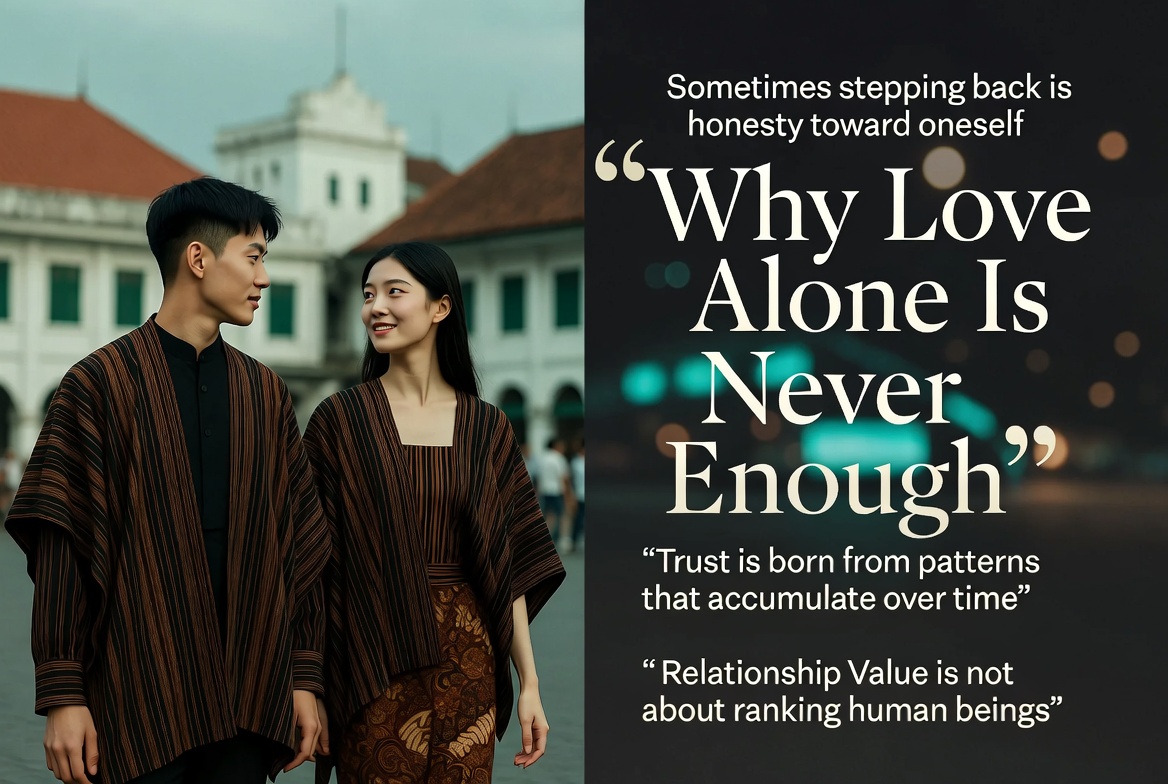
I once liked a woman. We walked together through Kota Tua Jakarta wearing traditional Javanese lurik. The moment remains vivid because it felt simple yet warm.
As time passed, however, I began to notice something that made me pause. She seemed to form easy closeness with other men. That did not necessarily mean she intended anything improper or was unfaithful. It could simply have been her naturally outgoing nature.
The real issue was mine. I am someone who becomes jealous easily. I know my own weakness. I understood that if I forced the relationship to continue under those conditions, I would likely live in constant anxiety — not only torturing myself, but also burdening her with perpetual suspicion.
At that point I learned something important. Sometimes stepping back is not the same as giving up. Sometimes it is simply honesty toward oneself.
Conversely, if one day she were able to provide a consistent sense of safety, demonstrate reliability through actions, and build trust through repeated experience, the story could of course be different. Trust is not created by words. Trust is born from patterns that accumulate over time. A feeling of security is built little by little until jealousy no longer dominates the relationship.
Knowing Yourself Matters as Much as Knowing Your Partner
Many people spend enormous energy searching for an ideal partner. Far fewer stop to ask: “What kind of relationship would actually allow me to live in peace?”
I have already found one clear answer for myself. I am not suited to long-distance relationships (LDR). Not because LDR is doomed to fail — many couples succeed at it. But I know myself. I need physical presence. I am more at ease when communication can happen face to face rather than only through a screen.
Rather than forcing something that contradicts my character, I prefer to look for someone whose life trajectory is already compatible with that need. Some may hear that as overly restrictive. For me it is simply recognizing my own boundaries.
When Love Meets Reality
Once two people both want to marry, the next questions are no longer “Do we love each other?” They become “How are we going to live together?”
This is where many couples confront concrete decisions. Who moves cities? Who compromises? Who continues a career? Who steps back from work?
Consider a simple economic scenario. A husband earns Rp 8 million per month. A wife earns Rp 35 million per month. From a household-economics perspective, the more rational decision may be for the husband to follow the wife’s job opportunity if the move raises overall family welfare.
This is not about who is superior. It is about optimizing decisions for the household as a unit. In family economics, a couple is often viewed as a team trying to maximize joint well-being rather than two individuals competing to protect personal prestige.
Culture Also Shapes How We See Roles
I was raised with the belief that a man should be the primary breadwinner. That value is still deeply rooted in me. At the same time I recognize that social reality is not uniform across regions.
In parts of the Sundanese cultural area, for example, there are households in which the wife is the main income earner while the husband takes a larger share of domestic responsibilities or more flexible work. Such patterns do not represent all Sundanese families, yet they illustrate that role division can be shaped by economic opportunity, labor markets, and mutual agreement between partners.
There is no single correct pattern. What matters more is whether both partners genuinely agree and feel treated fairly. A household is not a contest to defend ego. A household is a process of building cooperation.
From Bibit–Bebet–Bobot to Relationship Value
The longer I reflected, the more I felt that the classic Javanese framework could be translated into more contemporary language. I call it Relationship Value (RV).
Relationship Value does not mean one person has higher worth as a human being. Every person retains equal dignity. What differs is how well two particular people fit together for the purpose of building a shared life.
I imagine Relationship Value as a set of dimensions that typically include:
- Character and integrity
- Honesty
- Communication ability
- Emotional stability
- Shared life values
- Commitment
- Religion or belief system
- Health
- Education
- Career
- Financial condition
- Readiness for marriage
- Flexibility to follow a partner
- Family support
- Lifestyle compatibility
- Chemistry
Not everyone assigns the same weight to every dimension. Some place religion first. Others prioritize communication. Some regard financial stability as non-negotiable. Still others feel that a basic sense of safety outweighs almost everything else.
A Relationship Is Not a Competition
This is where I began to see that relationships should not be framed as a contest to find the partner with the “highest score.” What matters more is finding two people who can meet each other’s emotional and practical needs.
Someone who is extremely wealthy is not automatically the right match for everyone. Someone of modest means is not automatically less attractive as a partner. What ultimately determines success is not merely what each person possesses, but whether two lives can grow together.
A Method I Wanted to Develop
From personal experience, reading, and reflection, I began to imagine a more systematic approach. I call it the Relationship Value Assessment (RVA).
Instead of asking only “Do I love this person?”, the method invites someone to evaluate multiple aspects of a potential relationship consciously. Each dimension is given a weight according to the individual’s own priorities. For someone uncomfortable with long-distance arrangements, geographic proximity may carry high weight. For another person, career flexibility may matter more. Some prioritize religious alignment; others place greater emphasis on communication or emotional stability.
In this way we are not labeling anyone “worthy” or “unworthy.” We are simply asking: “Are we actually compatible enough to build a life together?”
I even imagined this approach could be embodied in a practical tool — a Relationship Value Calculator — a reflective instrument that helps couples see strengths, differences, and areas that need discussion before moving further.
Note
The interactive tool below is the concrete realization of that idea. It uses the Weighted Sum Model — a method commonly employed in Multi-Criteria Decision Making — so that the final result follows your stated priorities rather than a generic love percentage.
How to use the Relationship Value Calculator
- Complete your personal profile and deal-breakers (Step 1).
- Set the importance weights according to what matters most to you — they should total 100% (Step 2).
- Rate the partner honestly across every dimension (Step 3).
- Review the overall score, radar chart, green/yellow/red flags, Relationship Risk Index, and recommendation (Step 4).
Relationship Value Calculator
Beyond Love. Measure Compatibility, Not Human Worth.
About You
Tell us about yourself. This helps personalize the analysis.
1 Basic Information
Relationship Goal
Personality
Attachment Style
Primary Love Language
Your Deal Breakers
Select issues that would make a relationship non-negotiable for you.
Your Priorities
Assign importance weights. They should total 100%. This makes the result uniquely yours.
Evaluate Partner
Rate your potential partner honestly across key dimensions.
Character
Communication
Faith & Values
Emotional Stability
Family
Career & Finance
Physical Attraction & Health
Lifestyle & Practical Matters
Compatibility Analysis
Based on your priorities and evaluation
Compatibility Breakdown
Priority Alignment Radar
The shape shows how closely the partner matches your weighted priorities. Larger area = better overall fit.
✅ Green Flags
⚠️ Yellow Flags
❌ Red Flags
Relationship Risk Index (RRI)
Potential challenge areas based on your inputs and preferences.
Insight Summary
The final outcome may not always be a clear “continue” or “stop.” At the very least, however, the decision is made more consciously, more honestly, and more realistically.
Because in the end, love does matter. Yet in the long journey called marriage, love that is supported by trust, communication, mutual agreement, and self-understanding has a far greater chance of lasting than love that relies only on the intensity of the moment.
Relationship Value is not about ranking human beings. It is about helping two people see more clearly whether they are ready to build a life together — with all the strengths, differences, and risks that come with it.
#RelationshipValue #BibitBebetBobot #DecisionSupport #Compatibility #RelationshipRiskIndex #RelationshipPsychology #BeyondLove #RVA #WeightedSumModel
Conceptual Note
This tool draws inspiration from Multi-Criteria Decision Making (MCDM), particularly the Weighted Sum Model, which is routinely used in organizational decision-making and planning. Here the same formal structure is applied to human relationships as a personal reflective instrument — never as a judgment of anyone’s intrinsic worth.
The results depend entirely on the honesty of the ratings and the weights supplied by the user. The calculator does not replace professional counseling, religious guidance, or open dialogue between partners.