Article 91 · Social Psychology · Cognitive Bias · Social Comparison · Intellectual Humility
PSEUDO-INTELLIGENCE: WHEN DIFFERENCE IS MISTAKEN FOR INFERIORITY
Why people interpret the same world differently, why some respond to difference with contempt, and how distinct strengths can become complementary rather than competitive.
Have you ever been called shallow, stupid, or intellectually inferior simply because you understood something differently?
I have encountered this attitude more than once. The underlying assumption often sounds like this:
“If I can understand it and you cannot, then you must be stupid.”
But that conclusion is far too simplistic. Understanding is influenced by prior knowledge, experience, education, context, attention, motivation, and the way a problem is framed. Two people can look at the same information and interpret it differently without either person being unintelligent.
That does not mean every opinion is equally accurate, or that every disagreement is caused by bias. Evidence still matters. Skills still matter. Some explanations are better supported than others. The point is that a difference in interpretation is not, by itself, proof of intellectual inferiority.
Let us examine the psychology behind this.
1. We do not all look at the world through the same lens
People build mental models from different life experiences, education, professional exposure, culture, values, and prior knowledge. These inputs influence what we notice, what we consider relevant, and what we expect to happen.
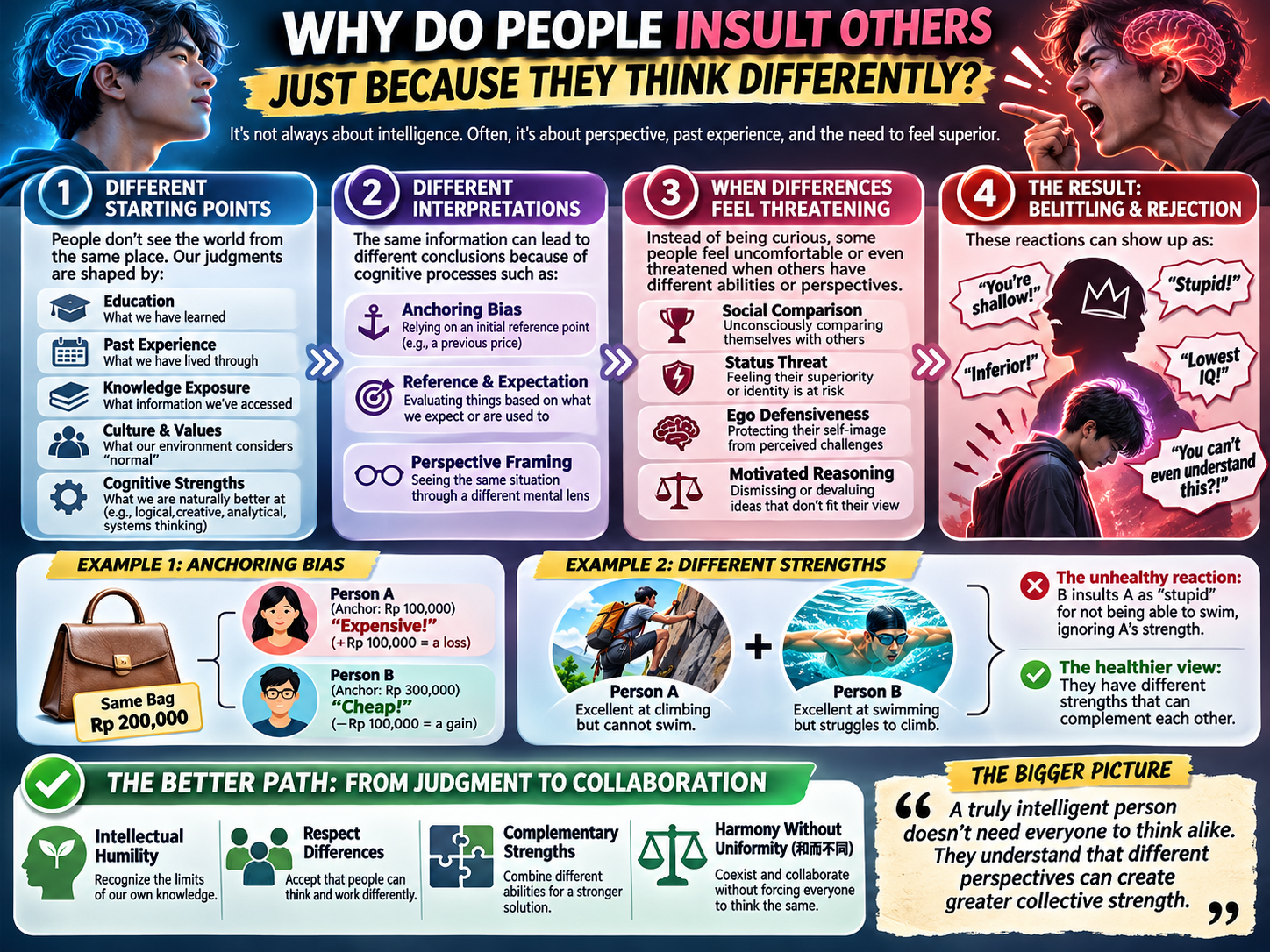
Imagine two people looking at the same handbag priced at Rp 200,000.
- Person A is accustomed to seeing similar bags priced around Rp 100,000. The current price may feel expensive.
- Person B is accustomed to seeing similar bags priced around Rp 300,000. The same price may feel like a bargain.
The object and its price have not changed. Their reference points have.

This is a useful everyday illustration of anchoring and reference-dependent judgment. Tversky and Kahneman's classic 1974 paper described how people use an initial anchor when making numerical judgments, sometimes failing to adjust sufficiently away from it. Prospect Theory later developed the idea that people evaluate outcomes as gains or losses relative to a reference point.

The same general lesson applies beyond prices. A task that feels easy to someone with years of practice may feel difficult to a beginner. A policy that looks obvious to an economist may look incomplete to a public-health specialist who is considering different consequences. Their interpretations may differ because they are drawing on different information and priorities.
2. Different strengths do not mean one person is good at everything
We should distinguish general cognitive ability from specific expertise and practical competence.
General cognitive ability concerns broad patterns of performance across cognitive tasks. Domain-specific expertise develops through learning and practice in a particular field. Practical competence concerns applying knowledge and skills to real situations. These concepts overlap, but they are not interchangeable.
Someone may be an excellent programmer but a beginner in psychology. Someone may be a skilled negotiator but have limited technical knowledge. Another person may be excellent at diagnosing a system-level problem but less experienced at carrying out a particular manual task.
Consider this simple example:
- Person A is skilled at climbing and navigating difficult terrain but cannot swim confidently.
- Person B is an excellent swimmer but struggles with climbing.
- Person C is good at coordinating people and allocating resources.
- Person D is skilled at assessing hazards and planning contingencies.
Which one is the most capable? The answer depends on the task. A mountain rescue, a water rescue, and an emergency coordination operation require different combinations of capabilities.
It is therefore unreasonable to judge a person's entire competence from one skill they do not possess.
Not being good at everything does not make someone good at nothing.
3. Why can differences feel uncomfortable?
Difference is not always experienced as neutral information. Sometimes it becomes socially or psychologically uncomfortable, especially when people compare themselves with others.
Social Comparison Theory, first proposed by Leon Festinger, describes how people evaluate their opinions and abilities partly by comparing themselves with other people. Comparisons can motivate learning, but they can also produce insecurity, defensiveness, or attempts to protect self-image.
Imagine that someone has built their identity around being the most knowledgeable person in a group. Another person introduces an unfamiliar method and explains it successfully. The new information could be useful. But the first person may experience it as a challenge to their standing.
Several mechanisms may be relevant:
Social comparison
People may assess their own abilities and standing in relation to others. An upward comparison can inspire improvement, but it can also feel threatening when self-worth is strongly tied to being superior.
Social identity and group boundaries
People often derive part of their identity from groups they belong to. When group identity becomes central, differences between “us” and “them” can influence how people interpret and evaluate others. In-group favoritism and out-group derogation are related but distinct phenomena; one does not automatically imply the other.
Ego defensiveness and motivated reasoning
When information threatens an important belief or self-image, people may scrutinize uncomfortable evidence more harshly, dismiss its source, or defend their existing position. This is a possible response, not a universal reaction and not proof of anyone's hidden motive.
Uncertainty and cognitive effort
A different perspective may require someone to reconsider familiar assumptions, learn new terminology, or tolerate ambiguity. Some people respond with curiosity. Others may avoid the effort by using labels such as “stupid,” “shallow,” or “irrational.”
4. When disagreement turns into humiliation
There is a meaningful difference between criticizing an idea and degrading the person who expresses it.
- Evidence-based disagreement: “I don't think that conclusion follows from the evidence. Here is the part I question.”
- Clarification: “What do you mean by that term? Can you explain the assumptions behind your argument?”
- Personal degradation: “You're stupid. Your thinking is shallow. You are inferior.”
The first two approaches examine claims. The third attacks a person's worth without demonstrating that the claim is wrong.
Insults can also change the direction of a conversation. Instead of discussing evidence, both sides become occupied with defending dignity, status, or identity. The original question gets lost.
Calling someone unintelligent is not a substitute for explaining why their reasoning is inaccurate. If a claim is wrong, identify the error. If evidence is missing, show what is missing. If definitions are unclear, define them. That is how intellectual disagreement becomes productive.
5. Pseudo-intelligence: performing superiority instead of demonstrating understanding
I use the phrase “pseudo-intelligence” here as a critical editorial label, not as a clinical diagnosis or a formally established psychological construct.
It describes a pattern in which someone performs intellectual superiority through ridicule, dismissive labels, or status displays, while avoiding the harder work of understanding, questioning, explaining, or evaluating evidence.
It can look like this:
- Assuming that a person who does not know one subject must be unintelligent in general.
- Treating unfamiliar terminology as proof that an idea is meaningless, without asking what it means.
- Confusing confidence, vocabulary, credentials, or social status with the quality of an argument.
- Responding to a counterexample by attacking the speaker instead of addressing the counterexample.
- Demanding that others accept one's own perspective while refusing to examine its limitations.
None of these behaviours proves that the person has low intelligence. They show that the interaction is not demonstrating good intellectual practice.
Real intellectual work requires more than reaching a conclusion. It requires being able to explain how one reached it, what evidence supports it, what could change one's mind, and where one's knowledge ends.
6. Intellectual humility: knowing that your own perspective has limits
One of the most useful concepts for this discussion is intellectual humility.
In a major review published in Nature Reviews Psychology, researchers describe a common core of intellectual humility: the metacognitive ability to recognize the limitations of one's beliefs and knowledge.
Intellectual humility does not mean pretending to know nothing, abandoning standards, or accepting every claim as equally valid. It means recognizing that confidence is not the same as certainty and that one's current understanding may be incomplete.
A person practising intellectual humility might ask:
- What information might I be missing?
- Am I judging this person by one weakness while ignoring other relevant strengths?
- Have I understood their definition, context, and reasoning?
- What evidence would make me revise my position?
- Am I evaluating the argument, or reacting to the person presenting it?
These questions do not guarantee agreement. They make disagreement more intellectually honest.
7. Cognitive diversity can help — but it is not magic
It is tempting to say that diversity always makes a team stronger. Research suggests a more complicated picture.
A meta-analysis by Triana and colleagues examined 94 papers, 280 effect sizes, and 24,425 teams. It found that deep-level differences in personality, values, and culture could be associated with fewer positive team processes and more conflict. The relationship with performance operated through those team processes and conflict. In other words, diversity does not automatically produce better outcomes.
Different knowledge and perspectives can expand the information available to a team. But people need ways to share that information, coordinate their work, resolve disagreements, and connect their contributions to a common objective.
Consider a team working on a coastal restoration project:
- A field ecologist understands habitat conditions and species interactions.
- A GIS specialist maps locations, boundaries, and spatial patterns.
- A community facilitator understands local knowledge and participation.
- A data analyst tracks indicators and identifies trends.
- A project coordinator connects tasks, people, deadlines, and resources.
These people do not need identical expertise. They need to understand what each contribution can and cannot do, communicate clearly, and coordinate around the project's goals.
That is the difference between merely having diversity and making diversity useful.
8. Why do some people accept differences only when they remain superior?
This is a provocative question, and it deserves a careful answer.
Some social environments reward rank, status, and visible dominance. In those settings, a difference may be welcomed when it confirms an existing hierarchy but resisted when it challenges that hierarchy.
For example, a person may comfortably accept that another colleague has less experience. But when that colleague demonstrates a skill the first person lacks, the reaction may become defensive. The difference has moved from harmless variation to a perceived status comparison.
Social comparison research helps explain why status-relevant comparisons can have emotional and interpersonal consequences. Social identity research helps explain why group boundaries can influence evaluations. Neither theory says that every person who criticizes someone else is motivated by envy or fear.
We should focus on observable conduct: Does the person address evidence? Do they apply the same standards to themselves and others? Can they acknowledge another person's contribution? Do they allow disagreement without humiliation?
Those questions are more useful than pretending we can read someone's mind.
9. Harmony does not require uniformity
There is a well-known phrase in the Confucian tradition: 和而不同 (hé ér bù tóng), commonly translated as “harmony without uniformity.” The idea offers a useful philosophical lens: people can maintain constructive relationships without holding identical opinions or becoming interchangeable.
Harmony does not mean avoiding every disagreement. It means handling disagreement without turning difference into a reason to dehumanize or humiliate someone.
We can disagree about methods while sharing a goal. We can recognize another person's strengths without denying our own. We can correct an inaccurate claim without declaring the person worthless.
Respect does not require us to agree with everything. It requires us to treat people fairly while examining what they say.
10. A practical way to respond when someone calls you stupid
Instead of returning the insult, bring the conversation back to the substance:
- Ask for a definition: “What exactly do you mean by shallow in this context?”
- Ask for the reasoning: “Which part of my argument do you believe is incorrect?”
- Request evidence: “What information supports your conclusion?”
- Offer a counterexample: “Would this example change how you interpret the claim?”
- Separate the person from the claim: “You can disagree with my argument without insulting my intelligence.”
- Set a boundary: If the other person continues to humiliate rather than discuss, it is reasonable to end the exchange.
This approach does not guarantee that the other person will become open-minded. It simply keeps your own standards clear.
My final thoughts
I do not believe intelligence should be measured by how effectively someone can humiliate another person.
We should be able to recognize that people have different experiences, different knowledge, different strengths, and different limitations. Those differences do not make every opinion correct, but they do make simplistic judgments about a person's entire intelligence unreliable.
We should challenge weak arguments. We should correct misinformation. We should hold people accountable for their actions. But we should not confuse criticism with contempt or expertise in one field with universal superiority.
Different abilities do not have to compete for the same space. When people recognize their limitations, respect evidence, and coordinate their strengths, differences can become resources rather than threats.
“If your intelligence makes you incapable of recognizing intelligence in others, perhaps you should reconsider what you think intelligence actually means.”
Are you genuinely trying to understand how other people think, or do you simply want everyone to think the way you do?
References and further reading
- Tversky, A. & Kahneman, D. (1974). “Judgment under Uncertainty: Heuristics and Biases.” Science, 185(4157), 1124–1131. https://doi.org/10.1126/science.185.4157.1124
- Kahneman, D. & Tversky, A. (1979). “Prospect Theory: An Analysis of Decision under Risk.” Econometrica, 47(2), 263–291. https://doi.org/10.2307/1914185
- Porter, T. et al. (2022). “Predictors and consequences of intellectual humility.” Nature Reviews Psychology. https://doi.org/10.1038/s44159-022-00081-9
- Porter, T. et al. (2022). “Clarifying the Content of Intellectual Humility: A Systematic Review and Integrative Framework.” Journal of Personality Assessment, 104(5), 573–585. https://doi.org/10.1080/00223891.2021.1975725
- Festinger, L. (1954). “A Theory of Social Comparison Processes.” Human Relations, 7(2), 117–140. https://doi.org/10.1177/001872675400700202
- Rivera, L. M., Vu, H. A. & Backstrom, V. L. (2024). “Self-esteem, ingroup favoritism, and outgroup evaluations: A meta-analysis.” Group Processes & Intergroup Relations. https://doi.org/10.1177/13684302231210496
- Triana, M. C. et al. (2021). “The Relationship Between Team Deep-Level Diversity and Team Performance: A Meta-Analysis of the Main Effect, Moderators, and Mediating Mechanisms.” Journal of Management Studies, 58(8), 2137–2179. https://doi.org/10.1111/joms.12670
- Mussweiler, T., Gabriel, S. & Bodenhausen, G. V. (2000). “Shifting social identities as a strategy for deflecting threatening social comparisons.” Journal of Personality and Social Psychology, 79(3), 398–409. https://doi.org/10.1037/0022-3514.79.3.398
Conceptual note: “Pseudo-intelligence” is used as an editorial phrase in this article, not as a scientific diagnosis. The psychological mechanisms discussed are possible explanations, not proof of an individual's motives. Research on diversity shows conditional and sometimes mixed outcomes; collaboration, task demands, leadership, and team processes matter.
Visual explanation: from different perspectives to either threat or collaboration
The diagram is a conceptual map, not a diagnostic tool. The same difference can lead to curiosity or defensiveness depending on the person, context, incentives, and interaction.
