Social Change • Persuasion • Consent • Ethics
Sometimes change matters so much that we feel compelled to push people beyond their comfort zones. But having a good reason to seek change does not automatically give us the right to control another person.
In public health, an unreliable reporting process can have serious consequences. If one district runs short of vaccines while another has stock available, fragmented information can make planning and distribution harder. A digital system such as a vaccine logistics application can help—but technology alone does not create change. People also need to understand the system, trust its purpose, and change their working habits.
This raises a difficult question: when we believe a change is necessary, should we compel people to follow it, persuade them, negotiate with them, or offer something that makes the new behaviour worthwhile?
My starting point is simple: if we need someone to change, begin with honest persuasion. Explain the reason, invite questions, negotiate where possible, and try the approach before assuming it will fail.
1. A Good Reason Is Not a Blank Cheque
Consider two situations. In the first, health workers are asked to use a reporting system because accurate stock information supports planning and may help prevent avoidable shortages. The purpose can be explained, the process can be improved, and the results can be checked.
In the second, someone insists that two adults must follow a particular relationship arrangement—for example, that they must date but are not allowed to meet—simply because the person imposing the rule thinks it will make the relationship more exciting. The preference is treated as a command, and questions are seen as disobedience.
Both situations involve an attempt to influence behaviour, but their ethical foundations are very different. One may pursue a legitimate collective objective through an authorised process. The other may simply turn a personal preference into control over someone else's private life.
Even a legitimate public goal does not justify every method. Equally, a rule that someone dislikes is not automatically oppression. The purpose, authority, process, proportionality, and real-world impact all matter.
2. The Difference Between Persuasion and Coercive Control
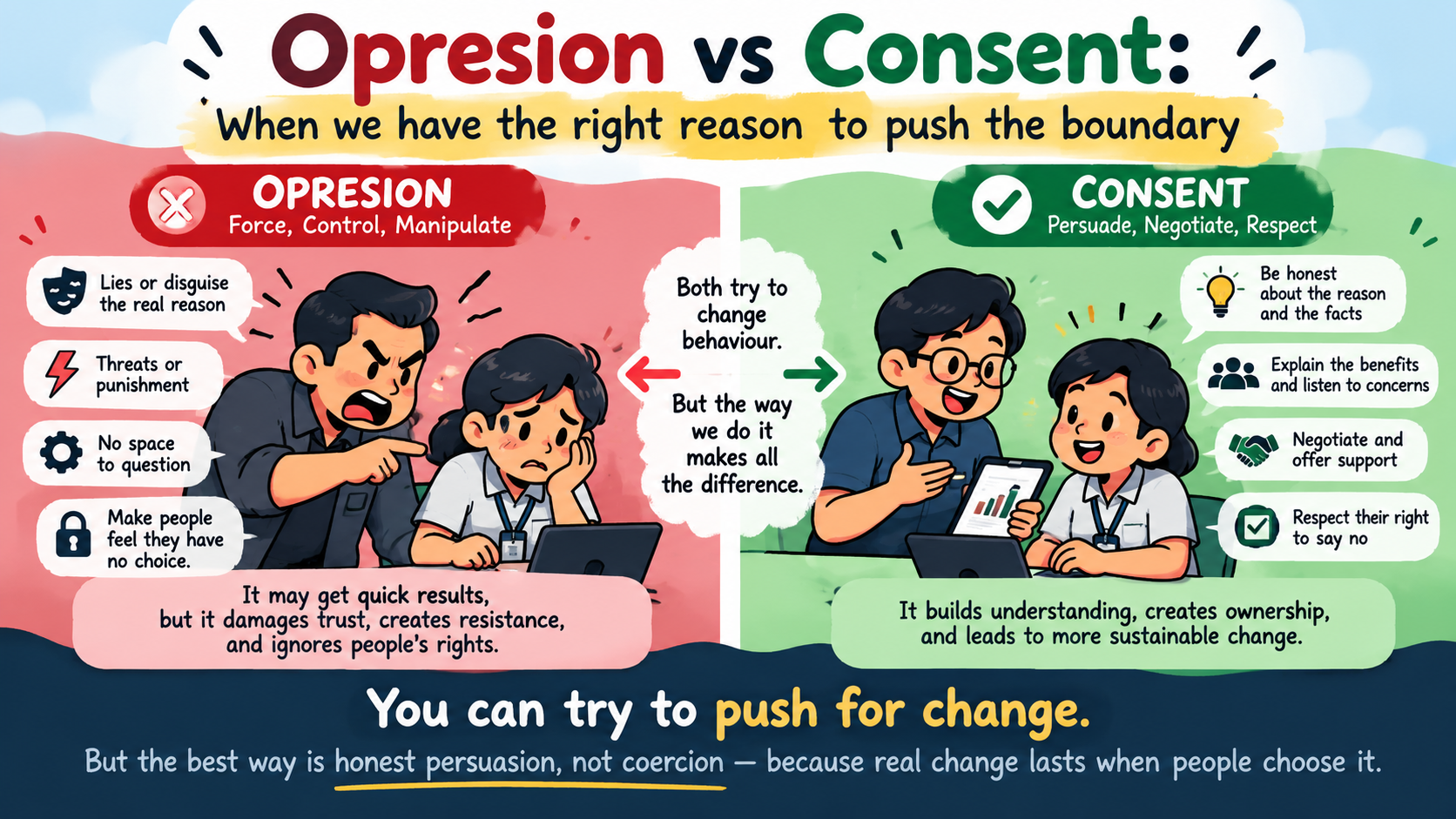
Persuasion presents reasons and evidence so that another person can evaluate them. Negotiation allows people to discuss constraints, exchange proposals, and search for a workable agreement. An offer gives someone a choice, provided the terms are transparent and the offer does not disguise an improper threat.
Coercive control is different: it seeks compliance through threats, intimidation, deception, or pressure that seriously undermines a person's ability to choose. Manipulation may also steer a decision by hiding material facts or exploiting a person's vulnerabilities. The categories can overlap, but they are not interchangeable.
Visual principle: the quality of an influence attempt is not measured only by whether it gets a “yes.” It also depends on the honesty of the process and whether the person retains meaningful agency.
3. Why Honest Persuasion Is the Best Place to Start
When change is important, it can be tempting to exaggerate the risks, hide uncertainty, or pressure people until they agree. That may create the appearance of success in the short term, but it can damage trust and make it harder to learn what is actually preventing change.
Honest persuasion starts differently. It explains the problem in plain language, shares the best available evidence, acknowledges uncertainty, listens to objections, and gives people a meaningful opportunity to respond. It does not promise that everyone will agree. Its strength is that it treats the other person as someone capable of thinking and deciding.
Describe the problem and who may be affected. Do not rely on “because I said so” as the whole argument.
Distinguish what is known from what is uncertain. Do not invent urgency, benefits, or consequences to secure agreement.
Ask what makes the change difficult. Adjust the implementation when reasonable rather than treating every objection as bad faith.
Where appropriate, propose a pilot, a trial period, training, practical support, or a clear review point.
Observe what happens. If it works, understand why. If it does not, learn from the evidence and revise the approach instead of escalating pressure automatically.
4. “Let's Try First” Is a Serious Method, Not Indecision
One of the strongest ideas in this approach is to avoid deciding the outcome before the attempt has even been made. We may believe that a new process will work, but the affected people may experience barriers we have not anticipated. A trial can reveal whether the explanation was clear, whether the tools are practical, and whether the proposed change achieves its intended purpose.
In a digital transformation project, for example, low use of an application does not automatically mean that health workers are stubborn or unwilling to change. Connectivity, workload, device access, system design, training, incentives, and trust may all affect adoption. Honest engagement can reveal these barriers and help distinguish a genuine refusal from a system that is difficult to use.
The same principle applies in personal relationships. Explain a preference, hear the other person's view, and discover whether a voluntary agreement is possible. If the other person does not agree, that disagreement is information—not proof that they must be forced to comply.
Try the respectful method, observe what happens, and learn. Do not treat the outcome you want as proof that your preferred method is justified.
5. Consent Is More Than Hearing the Word “Yes”
Consent means more than a person saying yes in a conversation. For consent to be meaningful, the person needs enough relevant information, an adequate understanding of the choice, and a real ability to decline without an improper threat or penalty. The exact requirements depend on the context, but deception and intimidation can undermine freedom to choose.
Persuasion and consent are therefore related, but they are not identical. Persuasion is a way of presenting reasons. Consent is a person's voluntary agreement. Excellent persuasion may result in agreement; it may also result in a thoughtful refusal. Both are possible outcomes of a process that respects agency.
That distinction matters when a person is especially skilled at convincing others. Sales ability, confidence, charisma, or emotional intelligence does not by itself establish whether the influence is ethical. We need to ask whether the claims were truthful, whether relevant information was concealed, whether pressure crossed a line, and whether the other person could realistically say no.
6. What About Rules That Really Are Necessary?
Honest persuasion should usually be the first approach when behaviour change is needed, but this does not mean every collective requirement must depend on individual consent. Public services, workplaces, and institutions sometimes need legitimate rules—for example, reporting standards that support essential health logistics.
In those cases, the authority for the rule should be clear, the requirement should be relevant to the objective, and the method of enforcement should be necessary, proportionate, transparent, and accountable. People should know what is required, why it is required, how to comply, and how to raise legitimate concerns.
The key distinction is between a justified, limited requirement and arbitrary domination. A rule is not legitimate merely because someone labels it “for the greater good.” Nor does the existence of a legal power mean every possible use of that power is fair or wise.
7. Humility: We May Be Right About the Goal and Wrong About the Method
People sometimes become so certain that their goal is correct that they stop examining their own methods. They assume they know what is best for everyone, then treat disagreement as evidence that others are ignorant, disobedient, or morally wrong.
But confidence is not the same as infallibility. We can have good intentions and still misunderstand a situation. We can be right about a problem and wrong about the solution. We can also make a mistake, recognise it, and choose either to repair the harm honestly or to preserve our authority through more pressure and excuses.
When we discover that an earlier decision was wrong, the ethical response is to acknowledge the error, explain what has changed, listen to the people affected, and revise the decision where appropriate. Replacing one imposed story with another does not amount to genuine correction.
For people who approach life through faith, humility can also mean recognising the limits of human judgement instead of treating personal preferences as unquestionable truths. Belief in a good purpose should encourage responsibility and reflection, not become an excuse to dominate other people.
8. A Simple Decision Framework
Identify the actual harm or need. Do not confuse a personal preference with a public necessity.
If the answer is unclear, do not assume that conviction gives you the right to decide for someone else.
Explain, share evidence, invite questions, listen, negotiate, and offer practical support.
Where safe and appropriate, agree on a trial, a review date, and what success or failure will look like.
Use only legitimate, necessary measures. Preserve channels for questions, review, and correction.
Do not disguise manipulation as care, or treat a refusal as permission to increase pressure without limit.
Conclusion: Influence Without Pretending to Own Another Person
Social change often requires more than technology or a good policy. It requires people to understand a problem, reconsider familiar habits, and decide whether—and how—to change. Honest persuasion, negotiation, transparent offers, and practical support give that process a stronger ethical foundation.
Sometimes a legitimate rule is necessary. But we should not jump to compulsion just because we are convinced that we are right. We should first explain the reason, try a respectful approach, observe the result, and learn. Where authority to require a change exists, its use must still be limited and accountable.
Start with honesty. Persuade before you pressure. Try before you assume. And remember: wanting someone to change does not mean you own the right to control their life.
Further Reading
- Stanford Encyclopedia of Philosophy: a scholarly starting point for exploring philosophical questions about freedom, autonomy, and coercion.
- World Health Organization — Health Systems Governance: background on governance and decision-making in health systems.
- UNESCO — Universal Declaration on Bioethics and Human Rights: principles concerning human dignity, autonomy, consent, and responsibility in bioethics.
This article offers a conceptual framework, not legal advice. Whether a particular requirement is lawful or justified depends on its context, applicable rules, and the rights of the people affected.