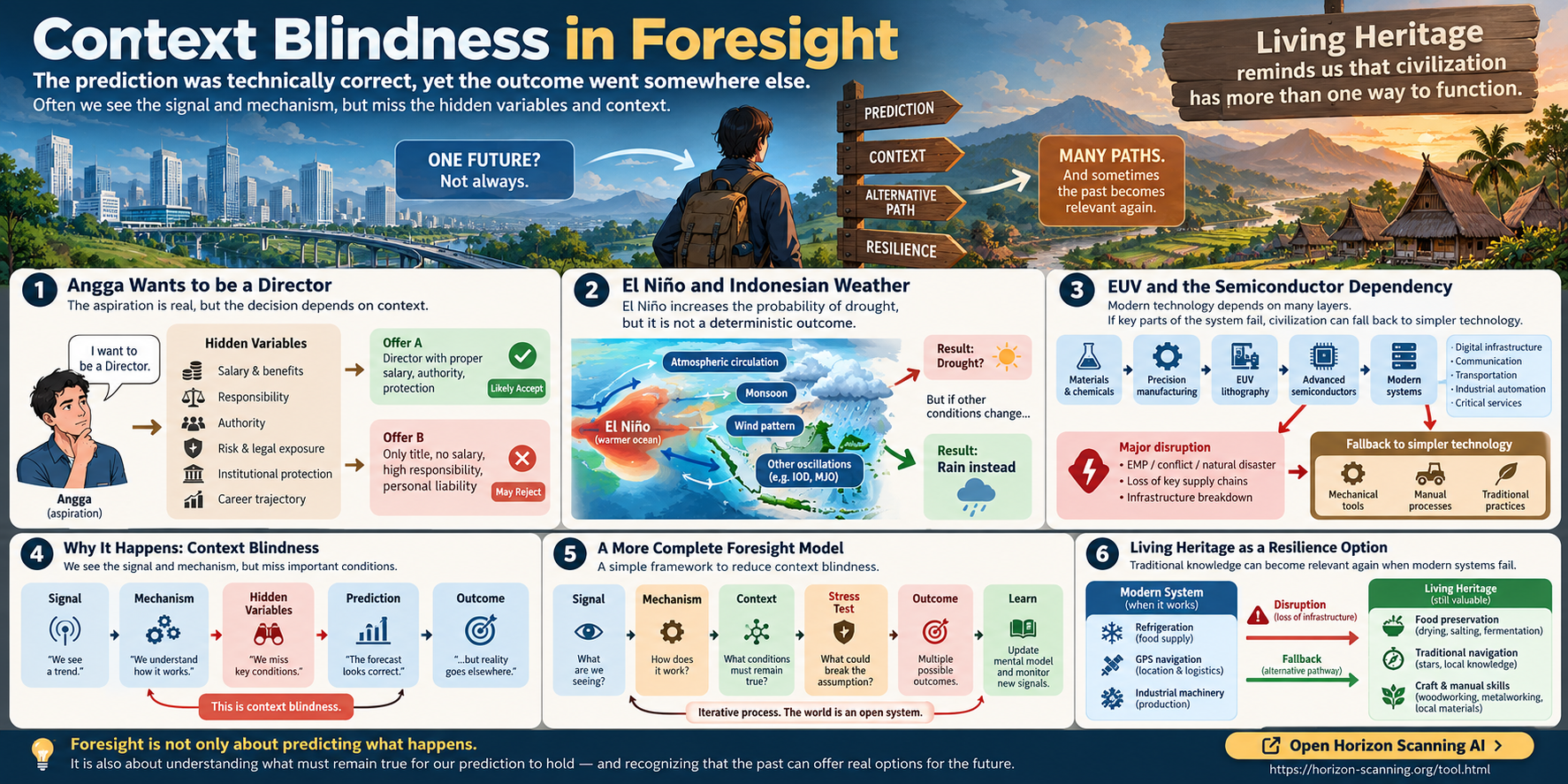
One of the most dangerous mistakes in foresight is not being completely wrong. It is being almost right — because the model correctly sees the signal, but misses a contextual variable that changes how the signal becomes an outcome.
I use Context Blindness here as a working label for that failure mode: a situation where analysis captures the visible relationship between variables but does not sufficiently represent the surrounding conditions that make the relationship hold.
A correct signal does not guarantee a correct outcome when the context is part of the causal system.
1. The easiest example: “Angga wants to become a Director.”
Imagine a foresight exercise about my career.
The researcher has good information:
- I have a clear aspiration to become a Director.
- The aspiration is stable.
- I have repeatedly expressed it.
- Leadership responsibility is part of the desired trajectory.
The data is correct.
Then someone builds this inference:
The mistake is subtle.
The forecast did not misunderstand my aspiration.
It misunderstood the relationship between aspiration and choice.
Wanting a position does not mean accepting every version of that position under every condition.
A better formulation is:
Acceptance = f(position, compensation, responsibility, authority, risk, institutional protection, resources, timing, alternatives)
So:
Salary + authority + resources + institutional protection + clear mandate.
Potentially consistent with the aspiration.
Title + high responsibility + weak resources + personal exposure + unclear authority.
The same title can generate a completely different decision.
Same signal. Different context. Different outcome.
2. Context blindness is not the same as “bad data”
This distinction matters a lot.
There are at least three different ways a forecast can fail:
The underlying observation is inaccurate, incomplete or outdated.
The data is reasonable, but the causal interpretation is weak.
The inference is plausible, but relevant conditions or interacting variables were omitted.
The third category is particularly dangerous because it can survive a lot of conventional quality checks.
The spreadsheet may be clean.
The regression may be sound.
The trend may be genuine.
The interview data may be real.
The methodology may be documented.
And yet the world can still surprise you.
Sometimes the model is not wrong about what it sees. It is incomplete about what surrounds what it sees.
3. Climate gives us a beautiful example: El Niño ≠ deterministic weather
A common simplification is:
El Niño → Indonesia becomes dry → drought.
There is a real basis for the association. NOAA describes El Niño as being typically associated with suppressed rainfall and drier-than-normal conditions over Indonesia. But NOAA also explicitly notes that teleconnections are likely, not certain. ENSO operates through coupled ocean-atmosphere dynamics and large-scale atmospheric teleconnections, while actual weather remains the result of interacting processes at multiple scales.
So when somebody says:
“El Niño was predicted. Why did it rain?”
the better answer is not automatically “the forecast failed.”
The more rigorous question is:
Which level of the causal chain was being forecast — the climate tendency, the seasonal anomaly, or the local weather event?
That distinction is critical.
A seasonal tendency can be correctly forecast while a particular afternoon storm still happens.
The signal was not necessarily false.
The mistake may have been expecting a population-level tendency to dictate every individual observation.
4. The same idea becomes extreme in technology: a critical dependency can disappear
Now consider a technological thought experiment.
Suppose a severe disruption damages or interrupts the infrastructure required for advanced semiconductor manufacturing for a prolonged period.
The question is not simply:
“Do humans still know what a computer is?”
Of course they do.
The deeper question is:
“Can the industrial system still reproduce the components required to build the computer?”
Advanced lithography illustrates why this matters. ASML describes EUV as part of a complex ecosystem involving lithography systems, sources, manufacturing, supply-chain capabilities, customer support and precision technology. ASML itself describes securing unique supply-chain capabilities as important to business continuity.
And that is where living heritage suddenly becomes relevant to technological foresight.
5. Why “living heritage” belongs in this conversation
UNESCO's 2003 Convention defines intangible cultural heritage as practices, representations, expressions, knowledge and skills recognized by communities and transmitted across generations, while also being constantly recreated in response to environment, history and interaction with nature. UNESCO's living-heritage guidance also emphasises that communities themselves are central to creating, maintaining and transmitting it.
That wording matters:
Living heritage is not simply a frozen archive of obsolete things.
It is knowledge that remains meaningful because people continue to practise, transmit and recreate it.
That creates a fascinating foresight question:
What capabilities exist today that modern systems have hidden from us because we rarely need them?
Drying, salting, smoking, fermentation and other preservation practices can become more relevant under refrigeration or logistics disruption.
Local knowledge of materials, tools and maintenance may matter when industrial replacement chains become slower or unavailable.
Place-based knowledge can provide redundancy when digital positioning or communications are unreliable.
Knowledge of seasons, water, crops and local environments may provide adaptation options under changing conditions.
These are not necessarily better than modern systems.
They are different pathways.
And from a resilience perspective, alternative pathways can matter.
This is an inference from the nature of living heritage and systems resilience — not a claim that UNESCO classifies heritage elements as technological “backup systems”.
6. The surprising lesson: the future may sometimes need the past
That sentence is the bridge between living heritage and foresight.
We tend to imagine technological progress as a one-way staircase:
old → newer → newer → newer → future
But resilient systems look more like a network:
preferred pathway ↔ alternative pathway ↔ fallback pathway ↔ local pathway
The purpose of foresight is therefore not only to ask what replaces the old.
It should also ask:
What old capability might become useful again under a different future?
7. Context blindness can also happen with people
This is where the issue becomes uncomfortable.
Smart people can be especially good at building elegant explanations.
They see patterns quickly.
They connect evidence.
They create a coherent story.
And coherence feels like truth.
But a coherent explanation can still be incomplete.
For example:
“She keeps communicating with an ex.”
“She cannot move on.”
The person may share work, family, property, community or another unavoidable social context with the ex.
The inference could be true.
But the same observable behaviour can arise from different mechanisms.
This is why behavioural foresight needs more than pattern recognition.
The same behaviour does not always imply the same underlying state.
Context changes meaning.
8. Double standards can create context blindness too
There is another version that appears in everyday life:
Someone observes a behaviour in another person and immediately interprets it negatively.
Later, the same person behaves similarly themselves — but now they provide a different explanation.
This is not only hypocrisy.
From a modelling perspective, it can be a failure to apply the same contextual variables to both cases.
Case A:
“They did X, therefore they must mean Y.”
Case B:
“I did X, but my situation was different.”
Exactly.
The situation was different.
That is precisely why context belongs in the model.
9. The hidden-variable checklist I would add to foresight
Whenever a forecast looks suspiciously clean, I would stop before declaring victory.
What reward, cost or risk changes behaviour?
What resources, laws or infrastructure limit the pathway?
What other trend or shock is moving simultaneously?
Who has authority, veto power, protection or accountability?
Does the relationship change by season, lifecycle or sequence?
Can the same outcome be produced by a different mechanism?
10. A more realistic causal model
Instead of:
Signal → Outcome
try:
Signal → Mechanism → Conditions → Interactions → Actor response → Outcome
And then add:
What breaks the pathway?
11. This is why a forecast can be “correct” and still be useful to critique
Suppose a forecast predicts:
“Group X will probably behave in way Y.”
Then the real world produces something slightly different.
We should not immediately say:
> “The forecast was useless.”Nor should we say:
> “The forecast was correct, reality was wrong.”The better question is:
Which assumption connected the forecast to the actual outcome, and which condition changed?
This is a much more productive learning loop.
It turns forecast error into a discovery of hidden variables.
And sometimes the most valuable outcome of a failed forecast is not a better number.
It is a better model of the system.
12. Red teams, premortems and structured dissent already point in this direction
This idea is not asking foresight practitioners to invent criticism from scratch.
Recent OECD guidance for public administration recommends pre-mortems, calibrated forecasts, reference-class forecasting and Red Teams. The OECD describes Red Teams as adversarial collaborators that challenge assumptions, evidence and decision quality. It also describes a “Key Assumptions Check” and “Analysis of Competing Hypotheses” as examples of structured dissent.
There is an important insight here:
The purpose of dissent is not to prove the critic right. It is to expose assumptions that otherwise remain invisible.
That is exactly what a context-blind forecast needs.
13. The “annoying person” may therefore be a useful sensor
Almost every organization has one.
The person who says:
“Wait. What about…?”
Again.
And again.
Sometimes that person is simply difficult.
But sometimes they are detecting variables that the dominant model is not measuring.
The answer should not be:
> “They are always right.”That would simply create another blind spot.
The answer is:
Convert the objection into a test.
“What assumption are you challenging?”
“What evidence would prove you wrong?”
“What evidence would prove the existing model wrong?”
“What variable are we not measuring?”
“Can we run the scenario?”
“Does the edge case scale?”
Now disagreement becomes an analytical instrument.
14. Living heritage gives us the same lesson from a different direction
UNESCO's framework places communities at the centre of identifying, maintaining, transmitting and managing living heritage. The Convention calls for the widest possible participation of communities, groups and individuals who create, maintain and transmit intangible cultural heritage.
That principle has an interesting parallel for policy and foresight:
If people live inside the system, they possess information about the system that an external model may not contain.
This does not mean every local belief is automatically evidence.
It does not mean every community practice is automatically efficient.
It does not mean experts become irrelevant.
It means that experience inside a system is a potentially important source of variables.
The person who maintains the boat knows the leak.
The farmer knows which “standard” schedule does not work after the first unusual rain.
The craftsperson knows which material substitution changes the whole behaviour of an object.
The frontline worker knows where the workflow breaks.
The community knows which policy assumption does not match lived reality.
That is not an argument against data.
It is an argument for more complete data about context.
15. The foresight loop I would use
16. A practical rule: forecast the conditions, not only the outcome
This is probably the biggest lesson I take from the whole problem.
When I hear:
“X will cause Y.”
I increasingly want to ask:
- Under what conditions?
- For whom?
- At what scale?
- At what time horizon?
- Through which mechanism?
- What other variables interact with it?
- What would make the relationship fail?
- What alternative pathway could produce the same outcome?
That is especially important for foresight because the future is not merely a continuation of a dataset.
It is a changing system of actors, incentives, technologies, institutions, environments and feedback loops.
17. The deeper connection with Living Heritage
And this brings us back to the title.
Why start a conversation about context blindness in foresight with living heritage?
Because living heritage reminds us of something modern systems frequently forget:
Knowledge does not only exist inside databases.
It also exists inside:
- people who practise something;
- communities that transmit something;
- places where knowledge is embodied;
- routines developed through repeated adaptation;
- skills that become visible only when the normal system stops working.
UNESCO's own description of living heritage emphasises that it is dynamic and continually recreated as communities respond to their environment and history. That makes it conceptually interesting for foresight: the heritage is not only a record of what people once did; it is a record of capabilities that can continue to adapt.
That does not mean every heritage practice should be turned into a “resilience technology”. That would instrumentalise culture and ignore its meaning to communities.
The more careful argument is:
Living heritage can contain adaptive knowledge and alternative practices that foresight may overlook when it models only the dominant technological or institutional pathway.
18. The conclusion I keep coming back to
Good foresight is not merely:
“I predicted the trend.”
It is also:
“I understand the conditions under which this trend becomes consequential.”
And great foresight goes one step further:
“I know what could invalidate my own model.”
Because the future rarely announces:
> “Your data was wrong.”It often says something much more subtle:
> “Your data was right. You just forgot something else was moving.”Maybe that “something else” is an incentive.
Maybe it is an institution.
Maybe it is weather.
Maybe it is infrastructure.
Maybe it is another actor.
Maybe it is a hidden dependency.
Maybe it is a cultural practice that your model treated as background noise.
Or maybe it is the one person in the room who keeps saying:
“Wait… what if?”
That person is not automatically right.
But the question may be exactly what your foresight system was missing.
Don't only ask what will happen. Ask what has to remain true for your prediction to happen — and what knowledge survives when those conditions disappear.
References & further reading
UNESCO — 2003 Convention for the Safeguarding of the Intangible Cultural Heritage.
https://ich.unesco.org/en/convention
Defines intangible cultural heritage as community-recognized knowledge, practices, expressions and skills that are transmitted and continually recreated; Article 15 calls for the widest possible participation of communities, groups and individuals in safeguarding and management.
UNESCO — About Living Heritage and Education.
https://ich.unesco.org/en/about-01159
Emphasises that living heritage is community-based and that communities are central to its creation, maintenance and transmission.
UNESCO — Living Heritage and Indigenous Peoples.
https://ich.unesco.org/en/indigenous-peoples
Discusses knowledge, practices and skills as living heritage and notes the importance of transmission and community vitality.
OECD — Applying Behavioural Science in the Italian Public Administration (2026).
OECD report
Discusses pre-mortems, calibrated forecasts, reference-class forecasting and Red Teams; the report describes structured dissent and Key Assumptions Checks for challenging policy reasoning.
NOAA — Understanding El Niño & ENSO.
https://www.noaa.gov/understanding-el-nino
Describes typical El Niño rainfall patterns and explicitly notes that teleconnections are likely, not certain.
NOAA Climate Prediction Center — El Niño / La Niña FAQ.
https://www.cpc.ncep.noaa.gov/products/analysis_monitoring/ensostuff/ensofaq.shtml
Explains coupled ocean-atmosphere processes and the typical suppression of rainfall over Indonesia during El Niño.
ASML — EUV lithography and supply-chain capability.
ASML EUV programme ·
ASML strategy & supply chain
Used here to illustrate the broader point that advanced lithography depends on a complex technological and supply-chain ecosystem. The disruption scenario in this article is a thought experiment, not a prediction of an EMP event.
Horizon Scanning AI Tool.
https://horizon-scanning.org/tool.html
Terminology note: “Context Blindness” is used in this article as a working analytical label developed by the author, not as a claim that it is a standardized academic term.