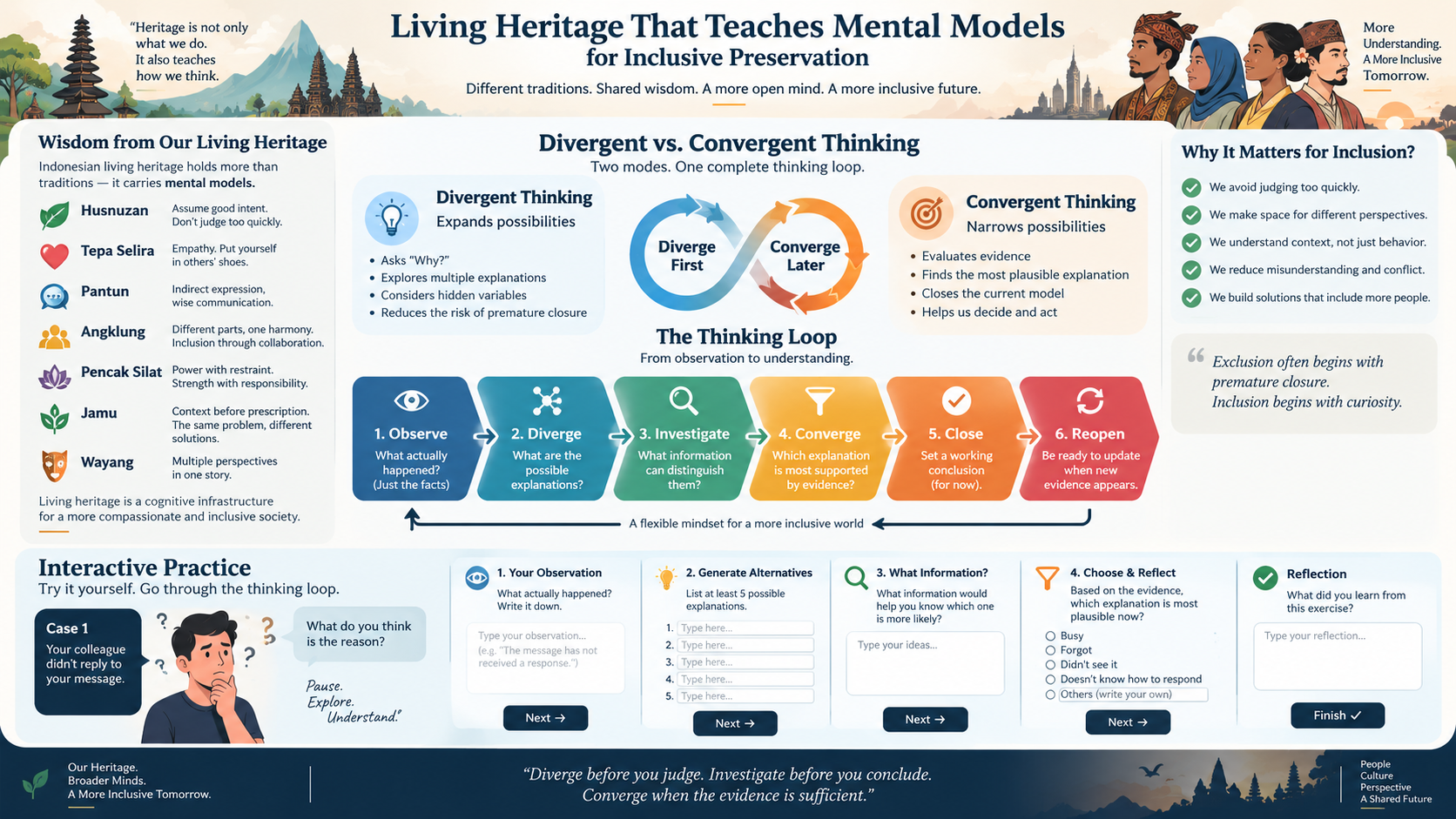
What if living heritage preserves not only what communities do, but also how communities learn to think?
When we talk about Intangible Cultural Heritage (ICH), we often talk about dances, songs, crafts, food, rituals, languages and ceremonies. But living heritage can also carry relational habits, ethical concepts and ways of making sense of other people.
This article explores that possibility through husnuzan, tepa selira, and a practical mental model for divergent and convergent reasoning. The central idea is simple:
Divergence expands the hypothesis space. Investigation reduces uncertainty. Convergence closes the model when the evidence becomes sufficient.
1. Living Heritage That Teaches Mental Models
UNESCO describes intangible cultural heritage as practices, representations, expressions, knowledge and skills that communities recognize as part of their heritage and continue to recreate across generations. That means living heritage is not simply a collection of objects from the past. It is also a continuing social process.
So I started asking a different question:
What mental models are hidden inside living heritage?
One example is the combination of husnuzan and tepa selira.
Husnuzan is commonly understood in Islamic ethics as maintaining a good or positive assumption rather than immediately jumping to suspicion. Tepa selira is commonly associated with considering another person's position, feelings and circumstances before judging or acting.
I am not claiming that these concepts are formally defined by UNESCO as cognitive frameworks. Rather, I am exploring them as cultural resources that can encourage a particular discipline of thinking:
Before judging the person, investigate the situation.
2. The Same Observation, Two Different Reasoning Paths
Consider a simple observation:
A fast convergent interpretation might be:
“She has not moved on.”
It is fast. It may even occasionally be correct. But the observation and the conclusion are not the same thing.
A divergent thinker starts somewhere else:
“Why?”
Now the hypothesis space opens.
- Maybe unresolved feelings.
- Maybe family connections remain.
- Maybe work or practical obligations.
- Maybe there is social or professional dependency.
- Maybe they are genuinely friends.
- Maybe there is a hidden variable.
Then we ask the person.
Suppose the answer is:
“I have already moved on. Our families are still connected. Sometimes the former partner is simply the person who connects us to another person we need for practical reasons.”
Now the model changes.
The original observation was accurate:
They still communicate.
But the first causal explanation was not sufficiently tested:
Communication ≠ automatically emotional attachment.
This is one of the most important distinctions in reasoning:
A data point can be real while the story we attach to it is wrong, incomplete, or premature.
3. Divergent Thinking Is Not the Absence of Convergent Thinking
I do not see divergent and convergent thinking as two mutually exclusive personality types.
Someone can be strongly divergent by default and still have a powerful convergent mode.
The difference is often which mode activates first.
My own default is closer to:
When something does not make sense, the first question is often:
Why?
Then:
What else could explain this?
Then:
What variable am I missing?
Only after enough evidence appears does the convergent move become:
“Okay. Now I understand. Close.”
So convergence is not absent. It is deliberately delayed until the explanation space has been explored enough.
4. What Happens When Knowledge = 0?
This is where the problem becomes interesting.
If your knowledge of a subject is close to zero, divergence can become very expensive.
A convergent thinker may find one plausible explanation and stop.
A divergent thinker may produce:
“Maybe this. Maybe that. Maybe another thing. Maybe a hidden variable. Maybe a second-order effect. Maybe something I haven't even considered.”
Now divergence can become endless.
So the solution is not:
“Always diverge as much as possible.”
The solution is:
Build enough knowledge to create a useful hypothesis space, then investigate, then converge.
That gives us a more complete learning loop:
Knowledge gives divergence something to work with. Investigation gives convergence something to work with.
5. The Danger of Premature Closure
Premature closure happens when the explanation space is closed before enough information has been gathered.
Examples are everywhere:
“He did not reply, so he does not respect me.”
“She declined the invitation, so she does not like me.”
“He is late, so he is irresponsible.”
“She is quiet, so she must be angry.”
These sentences may contain a real observation followed by an unsupported causal leap.
Divergent reasoning inserts a small but powerful gap:
“What else could be happening?”
That question does not mean every alternative explanation is equally likely. It simply prevents us from treating the first explanation as a fact before testing it.
6. Husnuzan as an Epistemic Pause
Husnuzan can be understood as a discipline of maintaining a positive assumption rather than immediately selecting a suspicious or hostile interpretation.
For this article, I find an especially useful reading:
Do not automatically choose the worst explanation when the evidence is incomplete.
This is not the same as believing everyone is good.
It is not the same as ignoring evidence.
It is not the same as refusing to recognize harmful behaviour.
It is simply an epistemic pause:
That sentence is powerful because it separates event from causal interpretation.
7. Tepa Selira: Add the Other Person's Context
Tepa selira is often associated with empathy, restraint and considering another person's position before judging or acting.
From a reasoning perspective, that creates an important question:
What information might they have that I do not have?
Every person operates with a different:
Add information, relationships, incentives, fears, responsibilities, culture and timing—and suddenly the same behaviour can have a very different meaning.
Tepa selira therefore supports perspective expansion. It does not require us to agree with another person's interpretation. It reminds us that our own perspective is only one point in the system.
8. Living Heritage as Cognitive Infrastructure
This lens can be extended to other Indonesian living-heritage practices. The following are interpretive readings, not claims that UNESCO formally defines these elements as divergent-thinking methods.
Pantun
Can illustrate indirect, relational communication: the message and the relationship are considered together.
Angklung
Can illustrate distributed intelligence: one person holds only part of the musical system, while coordination produces the whole.
Pencak Silat
Can illustrate power with restraint: capability and necessity are not the same thing.
Jamu
Can illustrate context sensitivity: a similar problem label does not automatically imply the same response for every person.
Wayang
Can illustrate perspective expansion: social situations can be explored through different characters and viewpoints.
9. Inclusion Begins Where Premature Judgment Stops
Exclusion can begin with a very small cognitive shortcut.
We see a behaviour.
We assign a label.
We stop investigating.
These may sometimes become reasonable conclusions after evidence. The problem is when they become conclusions before investigation.
What if there is:
- a missing resource?
- a different cultural expectation?
- an inaccessible instruction?
- a hidden responsibility?
- a constraint invisible to the observer?
- a different interpretation of the task?
This is why divergent thinking can matter to inclusive practice. It creates room for the person to be more complicated than the first label we placed on them.
Again, this is not relativism. Some explanations will be unsupported. Some behaviours will genuinely be harmful. Convergence is still necessary.
The point is:
Diverge before you decide what the person is.
10. A Practical Reasoning Loop
The final step matters. Convergence should not become dogma.
A good working model is:
“This is what I currently think, given the evidence available.”
Not:
“This is the only explanation that can ever be true.”
11. How to Train: Divergent First, Convergent Later
Exercise 1 — Separate observation from interpretation.
Write one sentence describing only what happened. Then write the interpretation your brain immediately generated. Keep them physically separate.
“The message has not received a reply.”
“They don't respect me.”
Exercise 2 — The 5 What-Else Rule.
Whenever your brain gives you a conclusion, generate at least five plausible alternatives. You are not trying to prove them. You are expanding the space before choosing.
Exercise 3 — Find the discriminating variable.
Ask:
“What information would help me distinguish these hypotheses?”
This is the step that turns divergence from endless brainstorming into investigation.
Exercise 4 — Converge explicitly.
Write:
Writing the sentence forces you to recognize when the transition from exploration to conclusion has occurred.
Exercise 5 — Reopen the model.
Write one piece of evidence that would make you reconsider your current explanation.
This trains flexibility without forcing permanent uncertainty.
12. Interactive Practice Case
“My colleague did not respond to my message.”
Observe
Write only the facts.
Diverge
List 5 possible explanations.
Investigate
What question or evidence would separate them?
Converge
Choose the best-supported explanation.
Reopen
What new evidence would change your mind?
The exercise is deliberately ordinary. The skill should eventually become useful in ordinary life, not only in workshops or strategic planning rooms.
13. The Divergent Thinker's Trap
There is a danger on the other side too.
If you are highly divergent, you can become attached to the search itself.
Every answer generates another question.
Every variable creates another variable.
Every explanation opens another explanation.
That can become analysis paralysis.
So the divergent thinker needs a deliberate convergence trigger:
Convergence Trigger
“Do I have enough information to explain the observation and act appropriately?”
Not perfect information.
Sufficient information.
That distinction prevents the search from continuing forever.
14. From Mental Model to Inclusive Practice
Perhaps the deeper connection to heritage is this:
Living heritage can preserve not only content but social intelligence.
Ways of listening.
Ways of disagreeing.
Ways of helping.
Ways of interpreting another person.
Ways of regulating ourselves before acting.
Ways of repairing relationships.
Those capacities are not frozen in the past. They can be reinterpreted and applied to modern settings.
A WhatsApp group can become a new space for guyub.
A classroom can become a laboratory for tepa selira.
A team meeting can practice musyawarah.
A community project can operationalize gotong royong.
A difficult conversation can begin with the discipline of husnuzan:
“I should not assume the worst explanation before I understand the situation.”
And divergent thinking adds another layer:
“What else could be happening?”
Then convergence completes the loop:
“Now that I know more, what is the explanation best supported by evidence?”
15. The Final Mental Checklist
Before concluding
- What did I actually observe?
- What am I assuming?
- What else could explain this?
- What variable might I be missing?
- What information would distinguish the hypotheses?
Before closing
- What evidence supports this explanation?
- Have I confused a pattern with a cause?
- Am I closing because I understand, or because I am tired of searching?
- What evidence would change my mind?
- Is this conclusion sufficient for the decision I need to make?
For me, that is where living heritage becomes especially interesting.
The object may change.
The technology may change.
The setting may change.
But a community can continue transmitting ways of thinking:
consider another perspective.
do not judge too quickly.
investigate the hidden variable.
listen before closing the model.
converge when the evidence is sufficient.
reopen when reality provides new information.
That is more than a reasoning technique.
It can also be a way of preserving space for other people to be more complicated than our first assumption about them.
And perhaps that is one of the quietest connections between living heritage, inclusion, empathy and critical thinking.
Concept Note
This article treats Husnuzan and Tepa Selira as cultural/ethical concepts and interprets them as possible cognitive practices. It does not claim that UNESCO formally defines them as divergent-thinking techniques, nor that the selected Indonesian ICH elements are officially mental-model frameworks. These are interpretive connections intended to stimulate reflection while remaining open to community context and plurality.