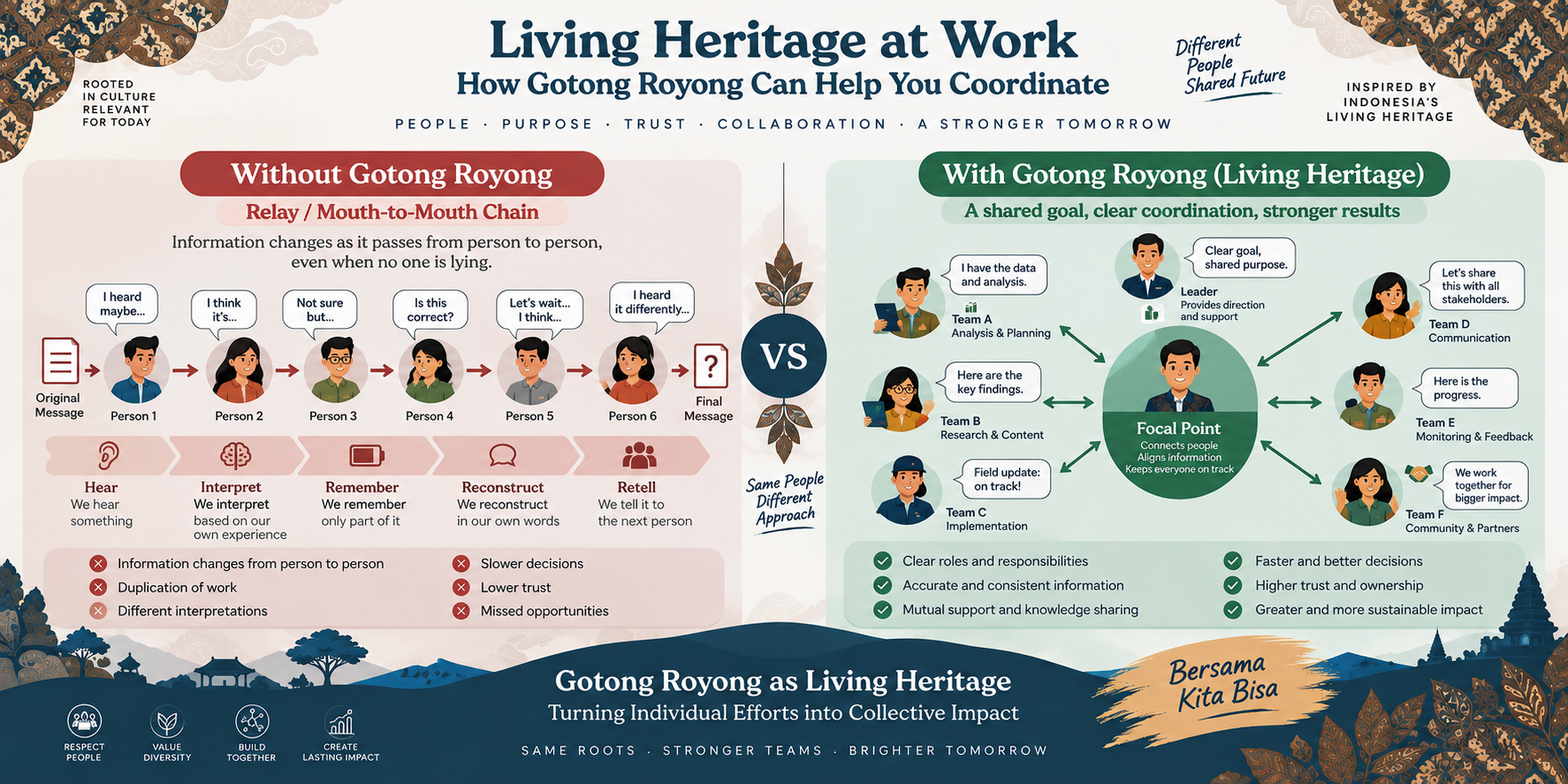
Living heritage is living knowledge. It is not simply an old object, costume, song, building, or ceremony. UNESCO describes intangible cultural heritage, also called “living heritage,” as inherited practices, knowledge, skills, expressions, rituals, social practices and other forms of knowledge that communities continue to transmit, adapt and recreate. Its meaning lives in the people who practice it.
The central idea
Gotong royong can be read as a living coordination practice: people contribute what they can, align around a shared need, help one another, and keep the collective task moving.
Part I — What Is Living Heritage?
When people hear the word heritage, they often imagine something preserved: a historical building, an archaeological site, an old manuscript, a traditional textile, or an artifact in a museum.
Living heritage is different.
It is heritage that is still practised, learned, transmitted, adapted and given meaning in everyday life. UNESCO explicitly describes intangible cultural heritage as traditional, contemporary and living at the same time. It can be found in oral traditions, performing arts, social practices, rituals, knowledge about nature, and traditional craftsmanship. It is also community-based: the communities, groups or individuals who create, maintain and transmit a practice are central to recognizing it as their heritage.
That distinction matters because a practice does not have to remain frozen in its historical form to remain culturally meaningful.
Knowledge and practices have histories and are transmitted between people and generations.
People actually use, perform or apply the knowledge instead of merely displaying it.
Living heritage can change as communities respond to new environments and circumstances.
The value is connected to what the practice means to the people who carry it.
This is why living heritage can be relevant to a workplace. The point is not to turn the office into a museum. The point is to ask:
What useful social knowledge is embedded in the way communities already know how to live and solve problems together?
Part II — What Is Gotong Royong?
Gotong royong is commonly translated as mutual cooperation, but the phrase is richer than simply “teamwork.” It refers to forms of people helping one another and working collectively around shared needs and responsibilities.
Research on gotong royong describes it as a form of social cooperation that has been embedded in Indonesian community life and can involve sharing, participation, collective responsibility and mutual assistance. One study in the Heritage of Nusantara journal describes gotong royong as an intrinsic form of daily social cooperation in many Indonesian villages and discusses its continuing relevance for community participation and cultural heritage.
Other research describes gotong royong as a cultural practice associated with togetherness, social solidarity and cooperation in solving collective problems, while also noting that its forms and sustainability can change as social and economic conditions change.
So, for this learning page, gotong royong is not treated as one rigid formula that every Indonesian community follows in exactly the same way. Instead, it is used as a living cultural lens for understanding collective action.
The cultural elements that matter
People understand what the group is trying to accomplish.
People contribute labour, knowledge, tools, time, relationships or other resources.
The relationship is not purely transactional; people support one another because the collective task matters.
Contribution can create a social expectation that support flows in more than one direction over time.
The work depends on people actually taking part, not only agreeing with the idea.
People can see that their actions affect others and the shared outcome.
These elements are particularly useful when translated carefully into modern work. The goal is not to copy village practices literally into an office. It is to identify the coordination logic inside the practice and ask where that logic can still be useful.
Part III — Why “Mouth-to-Mouth” Information Can Break Down
Imagine a simple instruction:
“Please send the revised report to the partner by Thursday afternoon and copy the programme focal point.”
Person A hears it.
Person A then tells Person B:
“The report needs to go to the partner on Thursday.”
Person B later tells Person C:
“We need to send the report Thursday.”
Person C tells Person D:
“The report is due Thursday.”
Notice what happened.
No one necessarily lied.
But pieces of information disappeared:
This is why second-hand information can be misleading even when every person is acting in good faith.
The hidden steps
Hear → interpret → remember → reconstruct → retell.
At every step, information can be compressed. A listener may omit something they think is secondary. A person may remember the meaning rather than the exact wording. Another person may add context from their own assumptions. The next person receives a reconstruction, not necessarily the original message.
This is closely related to the classic psychological idea of serial reproduction, associated with Frederic C. Bartlett's work on reconstructive memory. Later research comparing repeated and serial reproduction has found greater forgetting and distortion as material passes from person to person in a serial chain.
The critical lesson:
Misleading information does not require a liar. It can emerge from ordinary human communication when context, memory, interpretation and verification are weak.
Part IV — Why This Becomes a Workplace Problem
Now replace the children's “telephone game” with a real organization.
A project manager tells one team. That team tells a consultant. The consultant tells a local partner. The partner tells a field team. The field team makes a practical decision based on what they understood.
Suddenly:
People believe they are following the same instruction, but they are solving different versions of the problem.
Two teams unknowingly produce the same output because neither knows what the other has already done.
One team does not know that another team is waiting for its input.
People spend time checking what was actually agreed.
People begin asking who said what instead of focusing on the problem.
A task gets completed once, then has to be completed again because the initial understanding was incomplete.
The irony is that everyone can be working hard.
Many organizations do not have a lack-of-effort problem. They have a coordination problem.
Part V — Where Gotong Royong Changes the Model
A purely linear information chain looks like this:
Every person depends on the previous person's interpretation.
A more coordinated model looks different:
The difference is not simply “more communication.” It is more structured coordination.
Gotong royong as a workplace coordination logic
In a workplace, the cultural logic can be translated into a few practical questions:
Can everyone describe the intended outcome in roughly the same way?
Are roles complementary rather than duplicated?
Can people return to a trusted source instead of relying on memory?
Is there a feedback loop before assumptions become decisions?
Is there a person who can see across workstreams?
Does the update reach everyone who depends on it?
Part VI — And This Is Where the Focal Point Matters
In complex work, collaboration does not mean everyone talks to everyone about everything.
That can create a different problem: communication overload.
One useful role is the focal point.
A focal point can act as a coordination node: not necessarily the boss, not necessarily the person who does all the work, but the person who helps connect information, people, decisions, timelines and dependencies.
A good focal point reduces the need for every person to maintain every piece of information independently. It can also reduce the risk of parallel teams making contradictory assumptions.
But there is an important caution: a focal point is not a bottleneck.
If every decision must wait for one person, coordination becomes centralized dependence. The goal is not to create one human database. The goal is to create a trusted coordination mechanism that keeps people aligned while allowing work to continue.
Part VII — Gotong Royong Does Not Mean “Everyone Does Everything”
This distinction is crucial.
People sometimes misunderstand cooperation as unlimited availability: “We are a team, so everyone should help with everything.”
That can produce exhaustion, duplicated labour and unclear accountability.
Gotong royong is more useful when interpreted as collective contribution toward a shared need, not as the elimination of roles.
Coordination ≠ everybody doing the same thing.
It means different people contributing different things toward an outcome they understand together.
A designer can contribute design. A finance officer can contribute budget control. A researcher can contribute evidence. A field officer can contribute local knowledge. A communications officer can translate results into public-facing messages.
The collective strength comes from complementarity.
Part VIII — The Difference Between Cooperation and Coordination
Two teams can be very cooperative and still be badly coordinated.
For example, imagine six people working enthusiastically on a project:
“Everyone is helpful. Everyone is busy. Everyone is producing something.”
But no one has checked whether all six people are producing the same thing.
That is cooperation without coordination.
Now imagine the same six people with:
Shared goal → clear roles → common information source → feedback → adaptation.
That is much closer to a functional coordination system.
Part IX — Second-Hand Information: “But I Was Only Passing It On”
One of the most common workplace sentences is:
“I was only passing on what I heard.”
That may be completely honest.
But honesty of transmission does not guarantee accuracy of information.
A second-hand statement can contain:
Some details were left out because they seemed unimportant.
The reason behind the instruction was removed.
The listener filled a gap using their own assumptions.
An old instruction continued circulating after circumstances changed.
A suggestion gradually becomes remembered as a decision.
“I think this is what they meant” becomes “They said this.”
This is why strong teams create mechanisms for verification.
Instead of:
“Someone told me that the deadline is Friday.”
the stronger practice is:
“Let me check the agreed timeline before we act on that.”
That small shift protects both the person who heard the information and the people downstream who depend on it.
Part X — A Workplace Translation of Gotong Royong
| Living Heritage Logic | Workplace Translation |
|---|---|
| Shared need | Shared project objective |
| Mutual assistance | Support across workstreams |
| Different contributions | Complementary roles and expertise |
| Community knowledge | Shared institutional and field knowledge |
| Reciprocity | Help is not one-way forever |
| Social accountability | Visible ownership and follow-through |
| Collective problem solving | Joint troubleshooting and adaptation |
Part XI — What a Focal Point Actually Does
If gotong royong is the cultural logic, the focal point can become one of the practical mechanisms that keeps that logic functioning inside a complex organization.
Make sure different teams understand the same objective.
Turn technical information into something another team can use.
Know who needs to speak to whom.
Check whether an assumption is actually documented or agreed.
Identify missing information before it becomes rework.
Make sure decisions travel back to the people who depend on them.
The focal point therefore does not have to be the person with the most authority. The role is about maintaining coherence across relationships and information.
Part XII — Why This Is Still Living Heritage
There is an important conceptual boundary here.
Calling something “living heritage” does not mean every modern adaptation of an old value is automatically a heritage element. UNESCO emphasizes that living heritage is community-based and that the communities, groups and individuals who create, maintain and transmit a practice are central to its recognition and continuity.
So this page is not claiming that a corporate teamwork workshop is itself a traditional Indonesian heritage practice.
The more careful proposition is:
The bridge
A living cultural practice can provide a lens through which modern problems are understood and discussed.
Gotong royong can therefore be used educationally to ask what modern teams can learn from a culturally rooted model of collective action: shared purpose, mutual support, complementary contributions, social responsibility and the importance of keeping relationships functional.
Part XIII — Gotong Royong Is Not a Replacement for Good Management
There is also a danger in romanticizing cultural values.
“Let us just have more gotong royong” does not solve unclear job descriptions, insufficient budgets, broken systems, poor leadership, missing data, unrealistic deadlines or unsafe working conditions.
Cultural values can support coordination, but they cannot magically repair structural problems.
Culture can strengthen a system. It cannot substitute for a functioning system.
A healthy workplace therefore needs both:
Good systems — roles, processes, records, tools, accountability, decision rights and resources.
Good social practice — trust, reciprocity, respect, willingness to help, knowledge sharing and the ability to repair misunderstandings.
Part XIV — The Practical Experiment
Take any current project and ask five questions:
1. Do we actually share the same goal?
If two people describe the project differently, coordination is already at risk.
2. Are contributions clearly divided?
If nobody knows who owns an output, “teamwork” can quickly become duplication.
3. Is there a source of truth?
Do people check the same document, decision log, dataset or agreed record?
4. Is information verified?
Can someone ask, “Where did this information come from?” without creating conflict?
5. Does feedback return to the system?
When reality changes the plan, does the updated information reach everyone affected?
Part XV — From Cultural Practice to Modern Capability
This is perhaps the most interesting bridge between living heritage and professional practice.
The value of living heritage is not only that it gives us something beautiful to preserve. It can also reveal knowledge that communities have developed through lived experience.
In the case of gotong royong, the knowledge is social and practical: how to mobilize people, how to distribute effort, how to maintain relationships, how to respond to shared needs, and how individual contributions become meaningful when connected to a collective purpose.
Those questions remain relevant in an office, a school, a community programme, a humanitarian response, a research project or an international development programme.
The bigger idea
Living heritage can be a source of coordination knowledge.
Not because the past has all the answers, but because communities carry practical ways of solving human problems.
Part XVI — The Focal Point: Where Coordination Becomes Visible
When a project involves multiple teams, partners and information streams, someone often needs to hold the connective tissue.
That person does not need to control everything.
They need to help the system remember what it is doing.
Who needs to know? What has changed? What has been agreed? Who is waiting? What still needs verification?
That is why the focal point matters.
In a well-functioning coordination system, the focal point is not merely a messenger. The role can become a place where fragmented information is aligned, clarified, connected and returned to the people who need it.
That is remarkably compatible with the broader logic of gotong royong: different people contribute different things, but the work only becomes collective when the contributions are connected.
Part XVII — A Simple Mental Model
Part XVIII — One Final Distinction
Gotong royong should not be confused with simply being “nice” at work.
It is not:
“Everyone is friendly.”
It is closer to:
“Everyone understands the collective task, contributes appropriately, shares relevant information, and helps the system move.”
That makes it especially interesting as a living heritage concept for work.
The cultural practice gives us a language for collective responsibility. Modern management gives us tools for making that responsibility operational.
The final thought
Gotong royong is not about everyone doing everything.
It is about making different contributions work together.
That is why the conversation about living heritage does not have to stop at preservation.
It can also ask:
What knowledge does a community already carry that can help us solve today's problems?
For gotong royong, one possible answer is coordination.
Different people. Different capabilities. One shared purpose.
And somewhere in the middle, a focal point helps make sure the pieces do not drift apart.