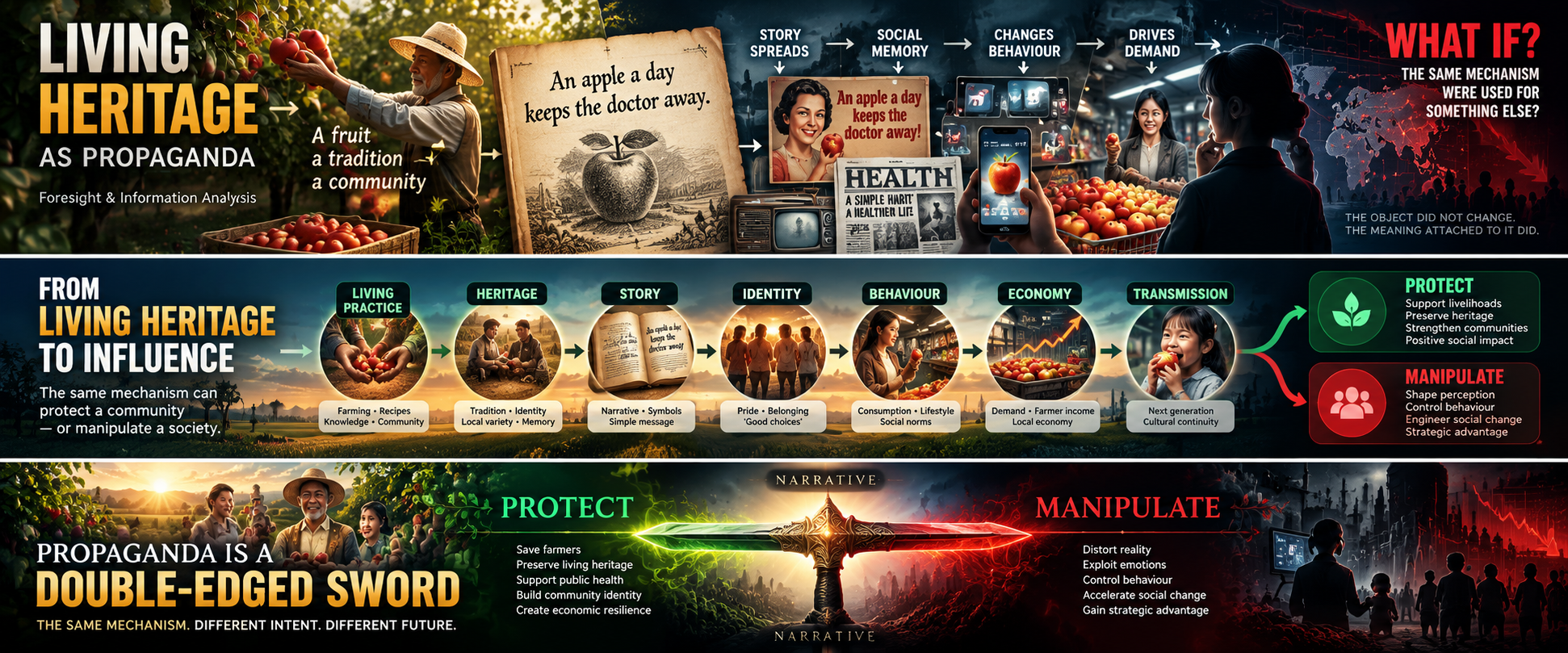
What if one of the most powerful tools for changing an economy is not a subsidy, a tax, or a new law—but a story people already believe?
That is the question behind this foresight experiment.
I am interested in a specific mechanism: take an existing fact, practice, proverb, memory, or living heritage; attach it to a simple narrative; amplify the narrative through trusted cultural channels; and observe what happens when the story begins to influence behaviour at scale.
The word “propaganda” is intentionally provocative here. I am not using it to mean that every persuasive communication is evil or false. A government campaign can use persuasion to protect public health, sustain livelihoods, preserve a vulnerable cultural practice, or help a community survive an economic shock. A commercial actor can use the same psychological mechanism for profit. A state can also use it for strategic influence.
The mechanism is morally ambiguous. The direction, transparency, evidence, consent, and consequences determine whether the persuasion becomes public-interest communication, marketing, manipulation, or something more coercive.
Part I — Start With an Apple 🍎
The story begins with one of the most familiar health sayings in the English language:
“An apple a day keeps the doctor away.”
It is tempting to tell a dramatic story in which a collapsing apple industry invented the phrase and used it to manipulate the public.
The saying predates modern apple-industry advertising. The earliest known printed form is a 1866 reference to a Pembrokeshire proverb: “Eat an apple on going to bed, And you’ll keep the doctor from earning his bread.” The familiar wording was recorded later, with a 1913 source noting the modern version.
In other words, the evidence supports a more interesting chain:
An older cultural saying links the apple with health and avoiding the doctor.
The idea becomes shorter, rhythmic, memorable and easier to repeat.
Apple producers and associations later place the story inside advertising and branding.
The distinction matters. The apple industry did not invent the proverb according to the historical evidence I can verify. But the industry absolutely did learn how useful the narrative could be.
HistoryLink's account of Washington apple farming describes increasingly aggressive advertising in the early twentieth century. A 1914 Skookum apple advertisement used the slogan “An apple a day keeps the doctor away” alongside an image of a healthy-looking child. The industry also developed related slogans such as “The Health Fruit” and “Nature's Toothbrush.” In 1928, the Washington Boxed Apple Bureau helped further the campaign. HistoryLink concludes that these campaigns helped turn Washington apples into a national product.
But the same historical source also shows why we should not simplify the story into “advertising saved a bankrupt industry.” During the Great Depression, apple prices collapsed; growers were advised not to pick some varieties, the Wenatchee Valley was declared an economically stricken area in 1935, and some orchardists survived with government loans and stimulus payments.
So the historically defensible formulation is:
The apple industry inherited an existing cultural narrative, amplified it commercially, and embedded it into a broader market-building strategy. That is not the same as inventing a false medical fact to rescue a collapsing industry.
That distinction is exactly why this is useful for information analysis.
Part II — Then Someone Tested the Story
Now the story gets even more interesting.
A 2015 JAMA Internal Medicine study examined the conventional wisdom directly. The researchers analysed 8,399 eligible US adults from NHANES data; 753 were classified as daily apple eaters, defined as consuming at least the equivalent of one small apple per day.
In the crude comparison, 39.0% of apple eaters had no more than one physician visit during the previous year, compared with 33.9% of non-apple eaters. That looks like a win for the proverb.
But after adjusting for sociodemographic and health-related characteristics, the association was no longer statistically significant: OR 1.19, 95% CI 0.93–1.53, P = .15. The authors concluded that the evidence did not support the claim that eating an apple a day keeps the doctor away.
And that creates a wonderful foresight puzzle:
How can a statement become culturally powerful without being a precise scientific proposition?
Because stories do not have to reproduce an entire evidence base.
They only have to preserve a memorable association:
APPLE → HEALTH → GOOD HABIT
Once the association is culturally stable, it can travel across generations without every person checking the original evidence.
Part III — Could It Have Been a Banana?
Now replace the object.
🍎 Apple.
🍌 Banana.
The question is not whether apples and bananas are nutritionally identical. They are not.
The question is whether a different fruit could occupy the same narrative position.
Yes.
A banana can be framed as healthy. A banana can be local. A banana can be part of a food tradition. A banana can support farmers. A banana variety can be associated with a place, a seasonal practice, a family recipe, a festival, or a transmission of agricultural knowledge.
So imagine two sentences:
“An apple is a healthy fruit.”
“Buying our local banana helps keep a living agricultural tradition alive.”
The second sentence contains much more than nutrition.
It contains identity, memory, belonging, economic solidarity and moral meaning.
That is where the living-heritage connection begins.
Part IV — From Food to Living Heritage
UNESCO treats intangible cultural heritage as something communities, groups and individuals create, maintain and transmit. Foodways can sit inside that living system: not only the food itself, but the knowledge, practices, skills, rituals, relationships and meanings surrounding it.
This matters economically. UNESCO's guidance on the economic dimensions of safeguarding intangible cultural heritage explicitly explores how economic activity can support living heritage and sustainable development, while also warning that commercialization can undermine the viability of the heritage if it is poorly managed.
That produces a much more sophisticated model than:
“Sell more products.”
Instead:
Now imagine a farming community facing falling prices and younger generations leaving agriculture.
A conventional campaign might say:
“Please buy local.”
A heritage-based campaign could say:
“When you buy this product, you are not only buying food. You are helping a living tradition remain economically viable for the next generation.”
The factual ingredients may remain ordinary.
The meaning changes.
Part V — My Working Concept: Heritage Narrative Engineering
I use the term Heritage Narrative Engineering here as a working foresight concept, not as an established academic label.
The idea is simple:
Something observable or evidence-supported already exists.
A community already has practices, memories, symbols or cultural associations.
One meaning is made especially salient.
Media, institutions, families, schools, celebrities or peers repeat the association.
People buy, eat, marry, participate, avoid, support or reject differently.
The aggregated behaviour changes markets, norms or institutional incentives.
The crucial point is that the narrative does not necessarily change the underlying fact. It changes what the fact means to people.
That is why the mechanism can be used for both benevolent and harmful purposes.
Part VI — Propaganda Is Not Automatically Evil
The word propaganda often implies deception. Historically, however, persuasive communication has also been used for public-interest goals.
Consider the UK's 5 A Day campaign. The underlying nutritional message was not “eat apples”; it was to increase fruit and vegetable consumption. A 2011 evaluation estimated that the programme increased fruit and vegetable intake by about 0.3 portions per day on average over the study period, although effects varied across income groups.
The UK campaign therefore demonstrates a useful mechanism: a simple, memorable narrative can change behaviour even when the audience is not processing the entire scientific literature behind the recommendation.
The same broad mechanism can be used in the opposite direction.
Tobacco companies historically used entertainment media to make smoking socially attractive and normal. Research based on previously secret industry documents found tobacco companies working with product-placement firms, placing tobacco products and signage in positive situations, providing free cigarettes to actors, and encouraging favourable images of actors smoking.
That is a very different ethical case from a public-health campaign.
Yet the behavioural machinery is recognisably similar:
Make the behaviour visible.
Attach it to desirable people, emotions or identities.
Make the association familiar.
Make the behaviour feel ordinary or expected.
The same narrative technology can be used to sell a cigarette, increase vegetable consumption, preserve a farming livelihood, or manipulate a population.
That is why I call propaganda a double-edged sword.
Part VII — Now Scale the Mechanism Up
Food is low stakes compared with demography.
But what happens when the object of narrative influence is not “what fruit should I eat?” but:
“What kind of life should I live?”
Marriage?
Children?
Career?
Migration?
Family formation?
Now narrative becomes a possible demographic variable.
This is where the following analysis deliberately shifts from documented evidence to a hypothetical scenario.
Part VIII — State A: The Demographic Cliff
I will not name the country in this article.
Readers can identify it from the data.
51.75 million
0.75
36.22 million
47.7%
These are official national statistics. The same official source says the country's total fertility rate was 0.75 in 2024 and projects the population to fall from 51.75 million in 2024 to 36.22 million in 2072, while the share aged 65 and over rises from 19.2% to 47.7%.
The demographic story is also visible in marriage attitudes. Official survey reporting shows a substantial shift in how younger people view marriage and childbearing, while research on national surveys has found rising shares of never-married young adults reporting uncertain or negative intentions toward marriage. Importantly, this does not mean that people have been “brainwashed”. Economic structures, housing costs, labour-market insecurity, gender relations, work culture and changing values can all influence family formation.
The military dimension is another signal. Reuters reported that active-duty military personnel in this country fell by about 20% between 2019 and 2025, to around 450,000, amid a sharp decline in the number of enlistment-age males.
The point is not “population decline equals collapse.” It is that demographic change can propagate through multiple systems:
Fewer births → smaller youth cohorts → smaller working-age population → ageing → fiscal pressure → labour constraints → military manpower pressure → changing strategic options.
Part IX — State B: The Same Demographic Problem, A Different Narrative
Now consider a neighbouring state with a very different political system and a much larger emphasis on collective mobilisation.
Again, I will not name it.
In 2023, its leader publicly called for measures to prevent the birth rate from falling during a national meeting of mothers—the first such national mothers' meeting in 11 years. External reporting cited UNFPA data placing its total fertility rate around 1.8 in 2023.
Whether the policy is effective is a separate question.
The important foresight observation is that the state is openly treating birth rates as a national concern and using public narrative to reinforce the social role of mothers and childrearing.
That is already enough to demonstrate the mechanism exists in the world.
It is not evidence that this state is secretly exporting those messages to its neighbour.
Part X — State C: The Demographic Superpower Is Also Aging
A third regional power complicates the picture.
Its population at the end of 2025 was about 1.40489 billion. Births fell to 7.92 million, deaths were 11.31 million, and the natural population growth rate was -2.41 per thousand. People aged 60 and over accounted for 23.0% of the population.
The government is simultaneously trying to create a more “birth-friendly society” through childcare, parental leave, cost reduction and policies intended to address declining births and marriage. Reporting has also described campaigns encouraging single people to date, marry and have children.
Again, this is a real demographic policy response—not proof of an external influence operation.
And that is exactly what makes the scenario interesting.
Part XI — The What-If: What If the Narrative Crossed the Border?
Now we enter my subjective foresight scenario.
I am not claiming this is happening.
I am asking whether the system dynamics are plausible enough that a serious foresight team should at least know how to recognise the pathway.
The pathway would look something like this:
↓
Norm shift
↓
Behavioural change
↓
Lower marriage / fertility
↓
Smaller cohorts
↓
Ageing + labour contraction
↓
Fiscal / military pressure
↓
Strategic vulnerability
The final step—territorial seizure or economic capture—is not a forecast. It is one extreme branch in a scenario tree. Real outcomes would depend on many other variables: alliances, productivity, migration, automation, military technology, political cohesion, international law, economic resilience and the target state's ability to adapt.
Part XII — The Provocative Question
What makes the scenario uncomfortable is that the “weapon” would not need to invent a new belief.
It could simply amplify a belief already emerging organically.
That is much more difficult to detect.
A fabricated story can sometimes be debunked.
A genuine social trend cannot be “debunked” just because someone fears its consequences.
A society may genuinely decide:
- Marriage is optional.
- Children are optional.
- Career should come first.
- Individual autonomy should dominate family obligation.
Those can be legitimate choices.
The foresight question is different:
What happens if an external actor learns how to systematically accelerate a trend that the target population is already generating by itself?
That is a much more sophisticated information-security problem than traditional propaganda posters.
Part XIII — How I Would Analyse It in Horizon Scanning
This is where the interactive Horizon Scanning tool becomes useful.
Instead of asking the reader to accept my conclusion, the matrix lets them inspect the signals and move them themselves.
| Layer | Question | Example |
|---|---|---|
| Observed | What is actually happening? | Fertility rate, population projection, policy announcement. |
| Evidence-supported | What relationship has research documented? | Demographic ageing affects labour supply and fiscal pressure. |
| Interpretation | What pattern might these signals suggest? | Demography may become a strategic constraint. |
| What If? | What hypothetical intervention could alter the trajectory? | External narrative amplification. |
| Extreme scenario | What is the far-end consequence? | Severe economic or strategic vulnerability. |
This separation is deliberate.
Good foresight does not hide the jump from data to imagination.
It labels the jump.
Part XIV — Why This Analysis Is Subjective
This article is a foresight exercise, not a prediction.
Two analysts can use the same demographic data and produce different scenarios because they can assign different weights to:
Automation, productivity, migration and delayed retirement may offset population decline.
Marriage and family norms may change without creating systemic collapse.
Governments may redesign welfare, housing and labour policies.
Military technology may reduce dependence on raw manpower.
Social attitudes may shift faster—or much slower—than demographic models assume.
Foreign actors may matter, or the observed changes may be overwhelmingly domestic.
That is why I would rather say:
“Here is one plausible pathway I can construct from the available signals.”
Not:
“This is what will happen.”
Part XV — Confirmation Bias Is Part of the Experiment
There is another uncomfortable admission.
This article intentionally foregrounds signals that are relevant to the scenario.
That is useful for a What-If exercise, but dangerous if the reader mistakes it for a complete evidence review.
Selective evidence can produce a persuasive story even when the overall evidence is mixed.
In other words:
A good narrative can be analytically useful and still be biased.
The answer is not to eliminate subjectivity. That is impossible.
The answer is to make the assumptions visible.
Part XVI — The Living Heritage Paradox
Now return to the apple.
A local agricultural tradition can be used to protect farmers.
A food story can encourage healthier consumption.
A cultural narrative can help a community preserve knowledge between generations.
These can be positive uses of persuasion.
But once we discover how powerful narrative framing can be, we must ask:
Who controls the story?
Who chooses which part of the heritage becomes visible?
Who benefits economically?
Who is excluded?
Who is allowed to correct the narrative?
And what happens if the story is more successful than the evidence behind it?
That is the central governance problem of turning living heritage into an economic or political instrument.
Part XVII — My Position
I do not think persuasion itself should automatically be treated as immoral.
If a farming community is genuinely at risk of disappearing, a public campaign that helps consumers understand the heritage value of local production may be worthwhile.
If a population needs to eat more vegetables, a memorable campaign may be more effective than a 60-page nutrition report.
If smoking is socially normalised through entertainment, governments may reasonably use equally powerful communication techniques to denormalise it.
But the line becomes dangerous when:
Part XVIII — Propaganda Is a Double-Edged Sword
PROPAGANDA IS A DOUBLE-EDGED SWORD.
The same mechanism that can protect a farmer can manipulate a consumer. The same storytelling technique that can strengthen public health can also normalise harmful behaviour. The same narrative power that can preserve a living heritage can also be turned into an instrument of strategic influence.
It can be used for people.
It can be used against people.
It can protect.
It can distort.
It can strengthen a community.
It can quietly weaken one.
That is why I would not recommend reaching for this kind of influence casually.
Use persuasive narrative when there is a legitimate reason, keep the factual foundation honest, involve the communities affected, and understand the possibility of unintended consequences.
And as citizens, analysts, practitioners and policymakers, we should learn to recognise the mechanism before the mechanism begins making decisions for us.
The dangerous question is not only “Is this story true?”
It is also: “What behaviour does this story make easier—and who benefits if that behaviour spreads?”
Foresight Disclaimer
Closing question
What if the next strategic resource is not oil, data or chips—but the stories a society repeats about itself?
Key References & Reading
Sources are provided for verification and further reading. Historical claims are separated from the author's scenario interpretation.