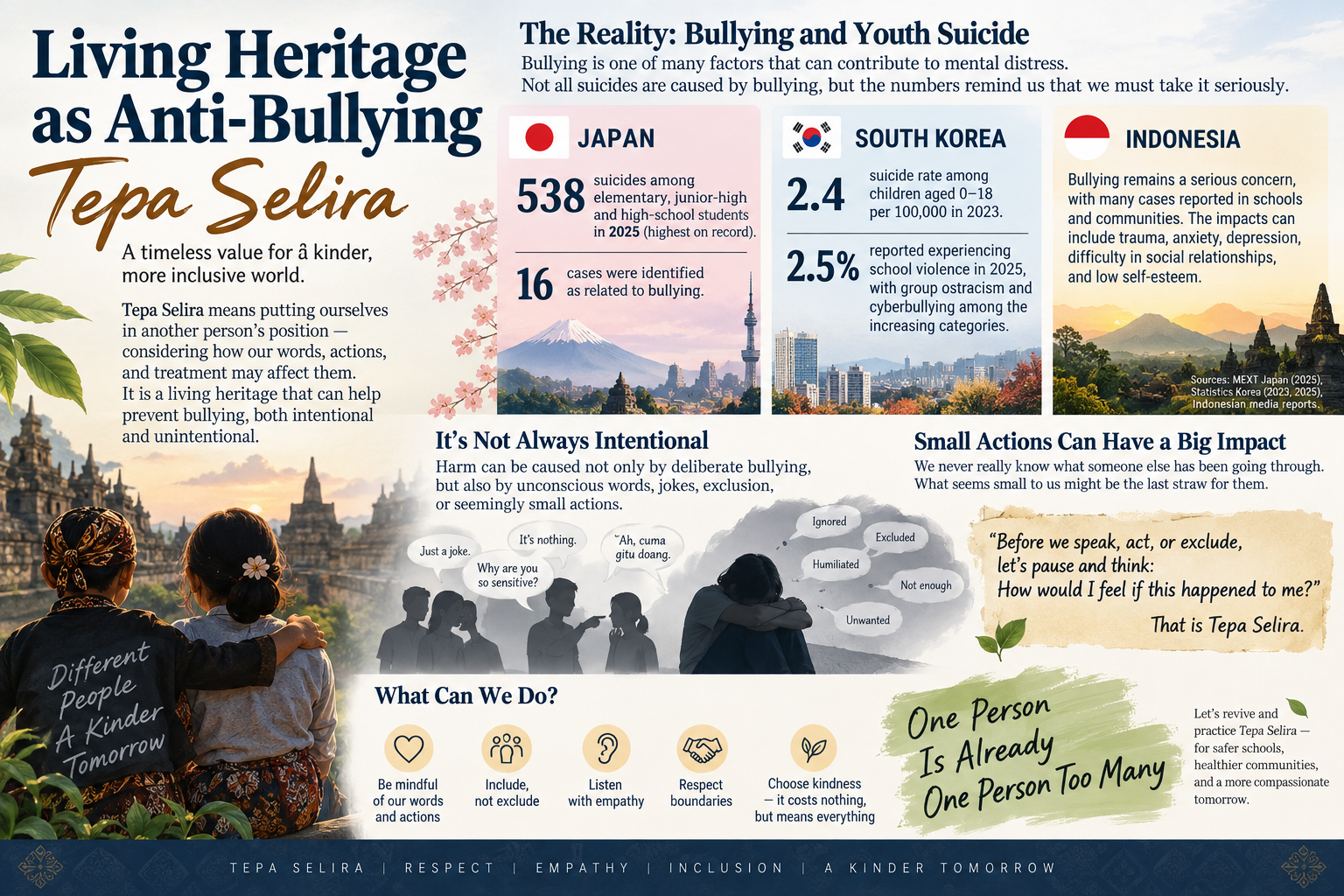
One of the things I find fascinating about living heritage is that sometimes, our ancestors already had social principles that modern society is still struggling to practice. One of them is Tepa Selira — a Javanese value usually translated as "measuring against oneself," or the discipline of imagining how something would feel if it were done to you before you do it to someone else.
The central idea
Tepa Selira is usually discussed as a tool against deliberate cruelty. But some of the deepest pain in bullying and social exclusion is never deliberate at all. It comes from small, unintentional moments that accumulate — a joke, an eye-roll, an exclusion nobody meant as exclusion — until the person carrying them breaks, and everyone around them asks, confused, "but who bullied them?"
Part I — What Is Tepa Selira?
Tepa Selira (also spelled tepa slira) comes from Javanese and is often glossed as empathy, self-restraint, or "measuring one's own feelings against another's." A simple version of the principle:
If I do not want to be hurt, I should not hurt others.
Recent academic work treats Tepa Selira as more than a proverb. A 2026 systematic literature review by researchers at Universitas Negeri Surabaya examined Tepa Selira specifically for its empathy content and found that the philosophy contains three interlocking dimensions of empathy — cognitive (understanding another's perspective), affective (feeling with them), and behavioural (acting on that understanding) — and that these dimensions are reflected in values of harmony, mutual cooperation, patience, mindfulness and justice. citeturn1search0turn1search5
That same review notes something directly relevant here: the integration of Tepa Selira into practice is described as strengthening empathetic competence and helping prevent negative behaviour such as bullying. citeturn1search5
This is where living heritage becomes more than nostalgia. UNESCO describes intangible cultural heritage, or "living heritage," as inherited knowledge, practices and social values that communities continue to transmit, adapt and use — not frozen artefacts, but tools still doing work in the present. citeturn0search2turn0search1
Part II — Bullying Doesn't Always Begin With Something Dramatic
Sometimes it begins with:
"It's just a joke."
"It's just a small thing."
"It's just teasing."
"Why are you so sensitive?"
"Ah, cuma begitu doang."
And here is the part that makes this harder to talk about than ordinary bullying: not every wound is inflicted on purpose. Sometimes there is no villain in the story. No one who set out to hurt anyone. Just a comment made without thinking, a joke that landed wrong, an exclusion that was never meant as exclusion — and the person carrying it never said a word about how much it stayed with them.
The same words pass through different histories. The listener assembles the meaning; the speaker only sends a fraction of it. That is what makes Tepa Selira so relevant here: it is not only about restraining cruelty. It is about the discipline of imagining impact — even when we never intended harm at all.
Part III — The Problem With Looking at One Incident
We see one incident. The person on the receiving end may be experiencing a pattern.
One exclusion. One humiliation. One rejection. One joke. One comment. One more day of being treated as if they don't quite belong.
And eventually, the person reacts — or, more quietly, breaks. Then everyone asks:
Why is that person so angry? Who bullied them?
But sometimes that is the wrong question, because sometimes no one did — not deliberately. What happened was an accumulation of small, unintentional moments that no single person meant as an attack. Maybe we should ask a different question:
What has this person been carrying that we did not see — regardless of whether anyone meant to hurt them?
Part IV — What the Data Tells Us
This is not a trivial issue, and the region's own numbers make that concrete, even where they cannot tell us exactly how much of the pain was intentional.
In Japan, the government's confirmed 2025 figures show 538 elementary, junior-high and high-school students died by suicide — the highest number recorded since comparable statistics began in 1980, and the second consecutive record year. Officially recorded causes and motives (which are multiply counted per case) show "school-related problems" as the single largest category, at 251 cases — a broad grouping that spans academic pressure, career anxiety, and peer relationships, not bullying specifically. citeturn2search3turn2search1
In South Korea, a nationwide school-violence survey found the reported student victimisation rate climbed to 2.5% in 2025, continuing a steady year-on-year rise since 2020 (1.1% → 1.7% → 1.9% → 2.1% → 2.5%), with experts pointing to digital isolation and post-pandemic aggression among the contributing pressures. citeturn2search6
These numbers do not mean every case involves bullying, and they do not mean every hurt was intentional. But they should remind us of something very simple:
We do not always know how much pain a person is carrying — even the people who accidentally contributed to it.
And Indonesia is not an exception. The conversation around bullying here increasingly recognises that consequences can extend beyond the immediate incident, and that not every act that contributes to someone's pain was meant as an attack — which is exactly why prevention, empathy and early attention matter more than blame alone.
Part V — The Psychology of Accumulated Small Hurts
Psychology has a name for exactly this pattern, drawn from research that started outside the bullying literature but describes the same mechanism. A microaggression is defined as a brief, everyday, often unintentional interaction or behaviour that communicates bias or hostility toward someone — and researchers explicitly note that these occur unconsciously, not necessarily with intent to harm. citeturn3search3turn3search5
What matters for Tepa Selira is not the label "microaggression" itself but the finding underneath it: research summarised by the University of British Columbia's health psychology lab shows that repeated small negative experiences are associated with depression and poorer self-rated mental health up to twenty years later, along with impaired sleep, elevated inflammation and faster cellular ageing — and that while any single day's effect may look small, these effects accumulate over time to raise the risk of future depression. citeturn3search0
A separate, more recent strand of research studies this in real time. A 2026 award-winning study of everyday ostracism — the everyday experience of feeling ignored or excluded — followed hundreds of participants through smartphone-based experience sampling and documented close to 2,000 real-life ostracism moments. It found that even brief moments of being ignored can threaten a person's fundamental sense of belonging, self-esteem, control and meaning, and that when the threat feels severe enough, people are more likely to withdraw or react in ways that look, from the outside, like sudden anger. citeturn3search2turn3search6
Both microaggression and everyday-ostracism research describe harm that occurs without anyone meaning to cause it.
A single small slight looks harmless. Repeated over months or years, the same slights are linked to depression and poorer health.
Because outsiders only see the final incident, the eventual response can look like an overreaction to "nothing."
No single observer typically sees the full accumulated sequence — only the person carrying it does.
This is, in other words, a scientific description of what Tepa Selira was already asking people to imagine centuries earlier: that the person in front of you may be carrying more than the one moment you are seeing.
Part VI — "I Was Only Passing On What I Heard" Is Not the Same as "I Did No Harm"
One of the most common defences people offer, once something has clearly hurt someone, is a version of:
"I didn't mean it that way."
That may be completely honest. But honesty of intent does not guarantee the absence of impact. A comment, a joke or an exclusion can carry:
The speaker leaves out nuance because it seemed unimportant to them.
The listener has no way to know this was "just a joke" rather than a genuine judgement.
The listener's own history fills in meaning the speaker never put there.
A joke told once is a joke. Told about the same person by different people over months, it becomes a pattern only the target can see.
This is why strong communities, schools and workplaces build in a habit of checking impact rather than only defending intent. Instead of:
"I was only joking, so it's not my problem how you took it."
the Tepa Selira version is closer to:
"Before I said it, did I imagine what it would feel like if it were said to me?"
Part VII — Rational Thinking (Nalar): Asking a Different Question
Don't only ask: Why did this happen? Who bullied them?
Ask: What happened between people that made trust hard to rebuild — even where no one set out to break it?
Don't just look at the final reaction. Look at the sequence. This is where nalar — rational thinking — matters. It is tempting to sort every situation into "bully" and "victim," because that framing is simple and satisfying to judge. But accumulated, unintentional hurt does not fit that frame cleanly, and refusing to see it because it is complicated is itself part of how it keeps happening.
Part VIII — Tepa Selira Does Not Mean No Boundaries
It is worth being precise about what Tepa Selira is not asking of anyone.
It does not mean you have to like everyone.
It does not mean you cannot have boundaries.
It does not mean you must accept every friendship.
It does not mean you cannot say "no."
It means:
Before I hurt someone — even by accident — I try to imagine what it would feel like if I were in their position.
And perhaps this is the part we have forgotten.
When something happens: "Ah, it's just a small thing."
When someone reacts: "Ah, why are you so sensitive?"
When someone finally breaks: "Why didn't they tell us?"
And when tragedy happens: "Only one person died." Or worse: "But no one bullied them, so it's not our fault."
No. One person is already one person too many. And intent does not change that.
Part IX — Where Tepa Selira Becomes a Practical Framework
If gotong royong is a cultural logic for coordinating collective work, Tepa Selira can be read as a cultural logic for coordinating collective care — a check that runs quietly before words and actions, not only after complaints arrive.
1. Pause. Before a joke, a comment or a quiet exclusion, there is a half-second where it can still be reconsidered.
2. Imagine. Not "would I find this funny," but "would I find this funny if I had already heard six versions of it this month, from six different people, and never said anything?"
3. Check impact, not only intent. "Are you okay?" costs one sentence. Assuming silence means agreement costs much more.
4. Repair when impact and intent diverge. "I didn't mean it that way, but I can see how it landed that way — I'm sorry" is a complete sentence that does not require anyone to have been a villain.
Part X — This Is Still Living Heritage, Not Just a Slogan
There is an important boundary to hold here. Calling something "living heritage" does not mean every modern adaptation of an old value is automatically heritage. UNESCO is explicit that living heritage is community-based — the communities, groups and individuals who create, maintain and transmit a practice are central to recognising it as their own. citeturn0search1turn0search6
So this is not a claim that a school assembly reciting "Tepa Selira" is itself a traditional heritage practice. The more careful claim is the bridge underneath it:
The bridge
A living cultural value can give modern institutions language for a problem that psychology is only now measuring precisely.
Tepa Selira does not replace anti-bullying policy, teacher training, or mental health support. Cultural values can strengthen a system; they cannot substitute for one. What Tepa Selira offers is a shared, locally rooted vocabulary for a habit that is otherwise easy to skip: imagining impact before intent has even formed into words.
Part XI — Instead of Asking Only "Who Is to Blame?"
Perhaps we should also ask:
Where did we lose our Tepa Selira?
Because preventing this kind of pain is not only about punishment after someone gets hurt on purpose. It is about learning to care enough to notice — even when no one meant any harm at all.
Tepa Selira.
Living heritage.
Empathy.
Inclusion.
And a simple reminder:
The person in front of you is a human being too — and you may only be seeing one page of a much longer story.