"If you know the enemy and know yourself, you need not fear the result of a hundred battles." Most people who read that line think about the enemy. My father made sure I paid attention to the other half of it. This is a three-part walk through what he actually meant — and what happens when the battlefield is inside your own head.
Part I — What Sun Tzu, My Father, and Metacognition Taught Me
"If you know the enemy and know yourself, you need not fear the result of a hundred battles." — Sun Tzu, The Art of War
Growing up, my father pushed me to understand myself — sometimes more forcefully than I would have liked. But the principle was simple: if you understand what is happening inside you, you are safer from your own bad decisions.
Years later, I realized what he was teaching me had a modern psychological counterpart: self-awareness and metacognition. Metacognition, simply put, is the ability to think about our own thinking. It is the difference between "I am angry" and "I know that I am angry, and I know what anger tends to make me do." That small difference can change everything.
My Father Had a Simple Rule
When you are emotionally unstable, understand your condition before deciding what to do next. If you know you are heartbroken, why deliberately go somewhere that you know will make it worse? Wait. Recover. Prepare yourself. Then, when you are ready, go there and face it.
Avoiding something temporarily is not always cowardice. Sometimes it is simply knowing that you are not yet in the right condition for that battle. Sun Tzu would probably recognize the logic — you do not enter unfavorable terrain merely to prove that you are brave. And that idea of terrain isn't just a metaphor I'm borrowing for effect. It becomes the spine of everything in Part II, so hold onto it.
The Same Principle Applies to Anger
My father also taught me something practical: when you are angry, watch your words. Not because anger is shameful — anger is human. But when we are angry, we can say things that create a second problem on top of the first one. Someone hurts us. We become angry. Then we say something cruel. Suddenly, instead of discussing what they did, we are defending what we said. We have turned ourselves from the injured party into part of the problem.
Self-awareness creates a small checkpoint before that happens: "I am angry right now." Metacognition adds: "When I am angry, my judgment changes. Therefore, I should be careful about what I say next." The emotion is still there. But now there is an observer standing beside it.
A Small Confession
Self-awareness doesn't automatically make someone brave, or even honest. Sometimes I catch myself sulking, and rather than pretend everything's fine, I'll just say it: "Yes, I'm sulking." But knowing what I feel doesn't mean I always name the cause — if the person who hurt me is standing right in front of me and asks what's wrong, I might say "I'm just upset because of someone." Technically true. Conveniently vague. That gap between knowing and revealing gets its own part later.
Self-Awareness Is Not Emotional Perfection
This is perhaps the most important lesson my father gave me. Knowing yourself does not mean becoming emotionless. You can know yourself and still become angry. You can understand psychology and still feel jealous. You can understand metacognition and still sulk. The advantage is not immunity from emotion. The advantage is awareness of the state you are in — and that awareness gives you choices.
Look closely at those choices and they're actually doing three different jobs: recognizing a state, managing what to do with it, and communicating it to someone else so they aren't left guessing. Those turn out to be three separate skills, and this trilogy follows them in order.
Before analyzing everyone around us, we should learn to recognize the person operating our own mind. What makes me irrational? What happens to my judgment when I am angry? When should I confront something, and when should I temporarily retreat? And perhaps the most difficult question: can I recognize that I am behaving emotionally while I am still emotional? Because the first battlefield is not always outside us. Sometimes it is the few seconds between feeling something and deciding what to do about it. My father taught me to understand that battlefield long before I knew the word metacognition — and knowing what I feel doesn't yet tell me what to do with it. That's where Part II picks up.
Part II — When You Know You're Angry, You Have an Advantage
Recognizing an emotion and deciding what to do about it are not the same skill. My father's rule was never "don't get angry" — that would be unrealistic. It was "if you're angry, watch your mouth." The first is about knowledge. The second is about management.
Consider two sentences: "I am angry" and "I notice that I am angry." In the first, anger occupies almost the entire frame. In the second, an observer has appeared. I am still angry, my heart may still be racing, but now part of my mind is watching another part of my mind. That tiny distance matters, because once I can observe my emotional state, I can begin asking questions about it: What is this emotion making me want to do? Will I agree with that decision tomorrow? The emotion has not disappeared. But it no longer has exclusive control of the microphone.
Never Give Your Emotion Free Ammunition
This is where the terrain metaphor from Part I earns its keep. Sun Tzu wrote about understanding conditions before entering battle. Emotional conflict has terrain too. Anger is bad terrain for communication. Heartbreak is bad terrain for certain decisions. Jealousy is bad terrain for interpretation. Fear is bad terrain for estimating risk. Ego is particularly bad terrain for admitting that we might be wrong.
The emotion is data. What we do with that data is another decision entirely — which is exactly the difference between knowing (Part I) and managing (here).
The Hot Version of Me Is Not the Cold Version of Me
There is a useful idea in behavioral science known as the hot–cold empathy gap. When we are in a relatively calm or "cold" state, we often underestimate how differently we may think once we enter a "hot" emotional state — anger, fear, desire, distress. Psychologist George Loewenstein, who coined the term, argued that these visceral states systematically distort our decisions in ways our calmer selves fail to predict or even remember afterward.1 At 10:00 PM: "I'm sending this message. I don't care anymore." The next morning: "Why did I send that?" Same brain. Same person. Different state.
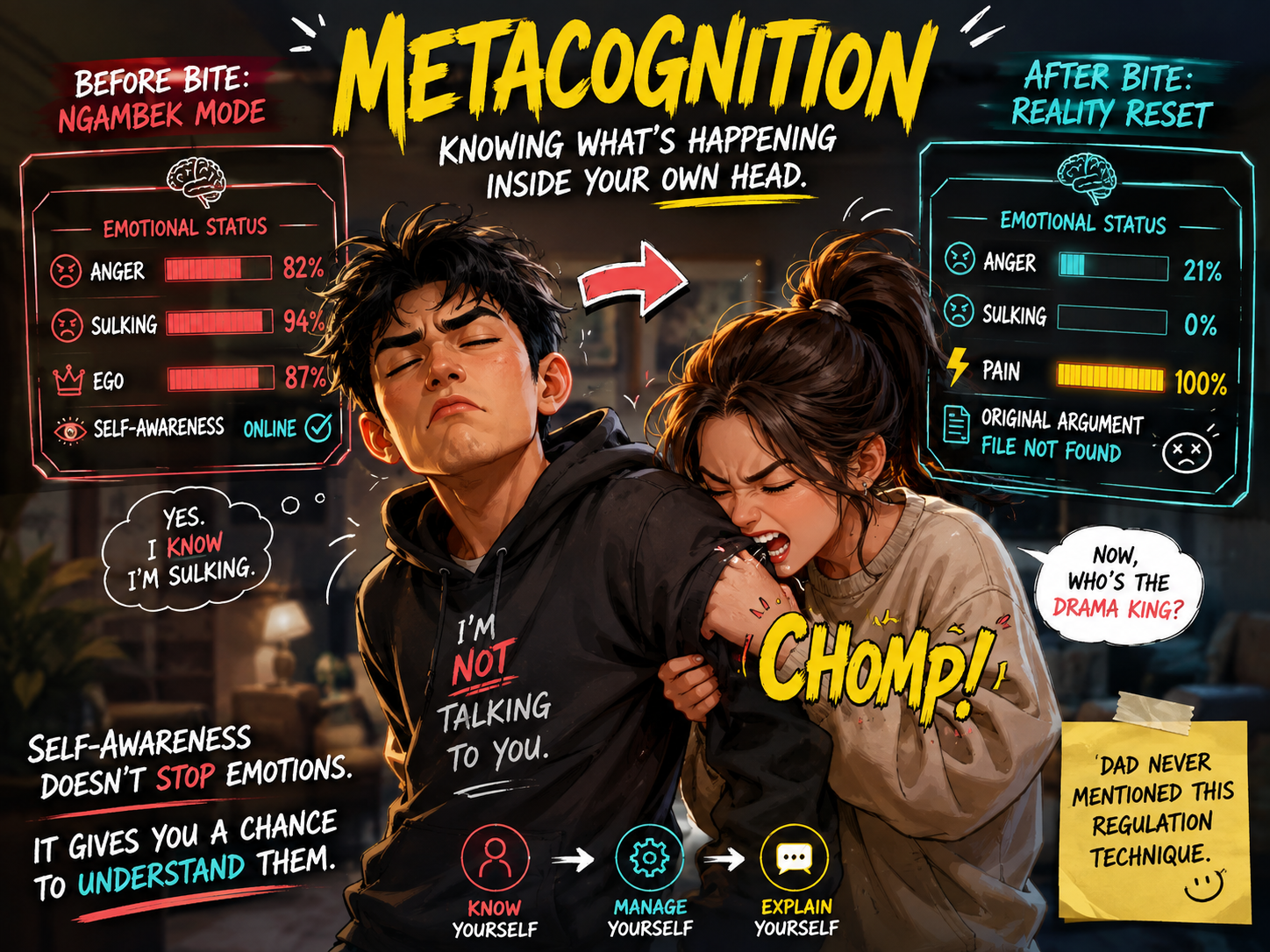
I've watched this gap collapse in real time, and the fastest version I've ever experienced happened with my ex. We used to sulk together — the honest kind, where I'd actually tell her "I'm sulking because of what happened," so there was no mystery to solve. One time she chased me down, grabbed me, pinched me ridiculously hard, and bit me. Five seconds earlier, my internal monologue was something like: "I am deeply offended, and I intend to remain offended for a while." Five seconds later, it was: "OUCH. THAT HURTS." The sulking simply evaporated.
I am not recommending physical provocation, especially unwanted, as an emotional-regulation technique. But it's a strangely clean illustration of how fast the "cold" version of ourselves can be overridden the moment a new "hot" state shows up.
Self-Awareness Does Not Mean Self-Obedience
Knowing yourself does not mean obeying yourself. I can acknowledge "I desperately want to send this message" and then decide "I'm not sending it tonight." This is where metacognition becomes more than introspection. It becomes strategy. You observe your own mind almost as if you were observing another person. You learn its habits, its weaknesses, what happens when it's tired, rejected, or wounded. Eventually, you begin recognizing patterns before they become actions.
Sometimes Retreat Is Intelligent
Imagine I know I am emotionally fragile because something has happened, and there is a place, person, conversation, or situation that I know will make it significantly worse. Why deliberately expose myself to it? People sometimes romanticize confrontation — "face your fears," "don't run away," "be strong." But timing matters. There is a difference between avoidance and preparation. If I say "I will never face this," that may become avoidance. But if I say "I know my current condition, I am not ready today, I will stabilize myself first and return when I can handle it," that can be strategy. You do not have to fight every battle at the exact moment it appears. Sometimes the intelligent decision is simply: not today. The important part is knowing whether you are retreating to recover, or retreating forever.
Know Your Emotional Terrain
Knowing yourself is not merely knowing your personality. It is knowing your conditions. When am I most likely to make bad decisions? What makes me impulsive, defensive, or prone to misreading other people? What kind of situation makes my ego stronger than my judgment — and what should I do once I recognize it? Intelligence is not merely the ability to think well. Sometimes intelligence is recognizing: "Right now, I am not thinking as well as I normally do." That sentence requires humility. But it also gives us an advantage — the angry person who does not know they are being controlled by anger has very little room to maneuver, while the angry person who can say "I know exactly what is happening to me right now" still has choices.
But managing yourself internally only solves half the problem. You can pick the right terrain, wait out the wrong hour, and still say nothing to the person standing next to you — and let them fill the silence with their own guesses. That's where Part III picks up.
Part III — Don't Make People Read Your Mind
You can understand yourself perfectly and still be completely misunderstood by everyone around you, because other people cannot see what is happening inside your head. Self-awareness has to become something else: self-communication.
Imagine I suddenly become quiet. I stop talking. Inside my head, the explanation might be perfectly clear: "I'm hurt by what happened earlier." But the other person doesn't receive that information — they only observe that I've gone quiet. One behavior can produce ten interpretations, and sometimes we get angry because the other person chose the wrong one. But there's an uncomfortable question worth asking: did we actually give them enough information to choose the right one?
Announcing the Sulk
This is why I've made a habit of naming it out loud when I notice I'm sulking, instead of letting someone reverse-engineer my mood from silence. As I mentioned back in Part I, I don't want a temporary emotional state to get misread as something permanent. If I care about you but I'm hurt by you, my silence could easily be interpreted as "I don't care about you" — when the truth may be exactly the opposite: "I care enough that what happened actually hurt me." Those are radically different messages, and only one of them is true.
And as I also mentioned, I don't always go all the way — sometimes I'll name the emotion without naming the cause, especially if the cause is the person standing in front of me. That gap between admitting what I feel and admitting why is where this part actually lives.
Naming an Emotion Is Not the Same as Justifying It
There's a psychological concept that describes what's actually happening when I say "I'm sulking" or "I'm angry" out loud: affect labeling — putting a feeling into words. In an influential fMRI study, Matthew Lieberman and colleagues found that simply labeling a negative emotion appeared to dampen activity in the brain's threat-response circuitry, suggesting that naming a feeling changes our relationship to it almost mechanically, before we've done anything else about it.2
But affect labeling is easy to get wrong in a specific way, and it's worth being precise here. Saying "I'm angry" is not the same statement as "I'm angry, therefore I'm right." Saying "I'm hurt" is not the same as "I'm hurt, therefore you are guilty." The label describes a state. It does not certify an interpretation.
Silence Is Information Too — Just Very Ambiguous Information
We sometimes think: if they really know me, they should understand. I don't think that's always fair. Even people who love us cannot reliably distinguish between "I need space," "I am angry," "I am disappointed," "I am tired," and "I don't want you anymore." From the outside, several of those states look remarkably similar: silence, distance, short replies, leaving the room. So when we refuse to communicate, we are still communicating. We are simply transmitting a very low-quality signal — and then we get frustrated when the receiver decodes it incorrectly.
Self-Awareness Is Not Just Looking Inward
When people talk about self-awareness, it can sound very individualistic: know your triggers, understand your emotions, observe your thoughts, recognize your patterns. All of that matters. But relationships add another responsibility — make yourself reasonably understandable. We cannot demand that other people understand feelings we deliberately refuse to communicate. They will guess, sometimes correctly, sometimes spectacularly incorrectly. One person thinks "I'm hurt." The other thinks "He hates me." So they become defensive. Then the first person sees the defensiveness and thinks "She doesn't care that I'm hurt." Now both people are responding not to each other's actual internal states, but to their interpretations of each other's behavior — a misunderstanding has started manufacturing its own evidence.
Know Yourself. Manage Yourself. Explain Yourself.
Looking back, the lesson my father gave me turned out to have three stages, and this trilogy has followed them in order.
| Stage | The question it answers | What it is not |
|---|---|---|
| Know yourself | What am I feeling? What triggered it? What happens to me in this state? | Emotional perfection or immunity from feeling |
| Manage yourself | Should I speak now, or wait? Am I about to do something I'll apologize for tomorrow? | Suppressing the emotion entirely |
| Explain yourself | Have I given the people around me enough to not have to guess? | Sharing every thought or feeling with everyone |
Not every thought needs to be shared. Not every emotion needs an audience. We are allowed privacy. But when our behavior begins affecting someone we care about, a simple sentence can prevent an enormous misunderstanding: "I'm upset. I know I'm behaving differently. This is why."
That is not emotional perfection. It is not complete control. Sometimes I will still be angry. Sometimes I will still sulk. Sometimes my ego will still win for a while. But at least I can try to recognize what is happening, choose my terrain instead of stumbling into it, and — when possible — communicate it.
Know yourself well enough that your emotions do not constantly surprise you. Manage yourself well enough that they do not unnecessarily damage you. And communicate yourself clearly enough that the people around you do not have to invent an explanation for who you are.
Sometimes the most important misunderstanding to prevent is not between two enemies. It is between two people who actually care about each other.
Key Sources
Loewenstein, G. (1996). Out of Control: Visceral Influences on Behavior. Organizational Behavior and Human Decision Processes, 65(3), 272–292 — the origin of the hot-cold empathy gap.
Lieberman, M. D., et al. (2007). Putting Feelings Into Words: Affect Labeling Disrupts Amygdala Activity in Response to Affective Stimuli. Psychological Science, 18(5), 421–428.
Flavell, J. H. (1979). Metacognition and Cognitive Monitoring: A New Area of Cognitive-Developmental Inquiry. American Psychologist, 34(10), 906–911 — a foundational definition of metacognition.
Sun Tzu (trans. Griffith, S. B., 1963). The Art of War. Oxford University Press — the source of the opening quotation and the terrain metaphor.
Background soundtrack: "Eyes" — thum/eyes.mp3